


 Updated on 18 June 2026


The Architecture Gap No One Talks About in Product Planning
Every successful product starts the same way: a focused idea, a lean codebase, and a team optimizing for speed. The architecture decisions made at that stage monolithic design, synchronous flows, shared databases are entirely rational. They are built for the product you have, not the product you're becoming.
The problem surfaces 18 to 36 months later, when the product roadmap demands things the original system was never designed to support scaling multi-tenant SaaS platforms, real-time personalization, AI features, global availability, or compliance with new regulations. Engineering velocity drops. Releases create anxiety. Cloud costs rise without a clear reason. New engineers take months to become productive.
According to McKinsey's 2022 research on technical debt, large enterprises typically allocate 10–20% of their technology budgets annually to managing legacy system complexity budget that could otherwise fund product innovation and competitive features. CAST Research's AppHealth data reinforces this: the average technical debt ratio across enterprise applications sits at approximately 5%, meaning that for every $1 million invested in application development, roughly $50,000 in remediation cost is being deferred and accumulating interest. In product engineering assessments Aspire has conducted, teams in HCM and healthcare verticals often carry debt ratios well above this average concentrated in integration layers and data access patterns that were never refactored after initial release.
This is the software architecture gap. A healthcare platform originally built for appointment scheduling struggles when adding telemedicine, patient analytics, and AI-driven diagnostics, because the engineering foundation was never designed for real-time data processing or event-driven workflows. An HCM platform that served a single enterprise client hits scalability walls the moment it attempts multi-tenant rollout or AI-based attrition prediction not because the product vision is wrong, but because the underlying application architecture wasn't designed for it.
Quick Reality Check
Before going deeper, consider whether any of these sound familiar in your organization:
Features that used to ship in a week now take a month or more
Every production release creates team-wide anxiety and manual verification steps
Cloud costs keep rising without a clear return on infrastructure spend
New engineers need 2–3 months to become independently productive
AI initiatives stall because the data layer isn't structured or accessible
Teams spend more time maintaining existing systems than building new capabilities
If two or more of these apply, your product has likely outgrown its original system architecture. This is a well-understood engineering problem with structured solutions but it requires deliberate action, not simply more developers.
Why Architecture Falls Behind Product Decisions
Architecture doesn't fail suddenly it drifts. Early-stage systems make deliberate tradeoffs for speed: a monolithic architecture, single-region deployment, tightly coupled business logic, and shared databases. These choices are appropriate at launch. They become liabilities when the product scales.
Hidden cost of Technical debt accumulates silently across these decisions. Duplicated logic, hard-coded business rules, brittle interfaces, and missing test coverage are individually manageable. Together, over time, they create a system where changing one thing reliably breaks another. McKinsey estimates that in large enterprises, engineers spend 20–40% of their time addressing legacy complexity rather than delivering new product capabilities a ratio that climbs in organizations where architecture review is not a regular practice.
Software scalability problems follow a similar pattern. A system that handles 10,000 users efficiently may degrade non-linearly at 100,000 not because of a single flaw, but because of compounding assumptions baked into the original design: that certain queries would always be small, that certain workflows would always be synchronous, that certain services would always be co-located. Growth exposes those assumptions one by one.
The Business Cost of Mismatched Architecture
This is not an abstract engineering concern. When software architecture can't support product decisions, the consequences appear on the balance sheet and in the sales pipeline.
Engineering teams shift from building to firefighting. Release cadence slows, which means slower customer feedback loops and longer time-to-market for competitive features. Outages increase particularly during peak load affecting retention and trust. Cloud bills grow as inefficiencies compound. Hiring more engineers doesn't solve the structural problem; without addressing the underlying technical architecture, it often adds coordination complexity and makes onboarding harder.
A healthcare product team adding telemedicine platform architecture and queue prediction to an appointment scheduling system will find that real-time data requirements expose every latency assumption in the original design. An HCM platform scaling from one to fifty enterprise clients will encounter shared database schemas, hard-coded tenant logic, and synchronous integrations that become critical bottlenecks the moment multi-tenancy is introduced at scale. The product vision is sound in both cases but the platform architecture can't support it yet.

Key Signs Your Architecture Needs Attention
Software modernization starts with an honest assessment. These are the most reliable indicators that application architecture has fallen behind product direction:
Rising lead time and cycle time new features take disproportionately long relative to their actual complexity
High coupling across modules, where changing one area triggers cascading changes in unrelated areas
Frequent workaround fixes that accumulate without root-cause resolution
Non-linear performance degradation as user load increases beyond original design assumptions
Test fragility small changes break many tests across unrelated modules
Inconsistent deployment practices and security implementations across teams
Inability to meet new compliance, data residency, or regulatory requirements without major rework
Any three of these together signal the need for a structured architecture review not a full rewrite, but a deliberate assessment of where the engineering foundation is generating the most friction relative to the product roadmap. For teams in healthcare software development or HCM platform development, where regulatory and integration requirements compound over time, this assessment is particularly time-sensitive.
Where Product Engineering Fits In
Product engineering services sit at the intersection of product strategy, architecture, software product development, cloud and DevOps engineering, and AI readiness. This is different from traditional software development, which focuses primarily on feature delivery within an existing system.
When system architecture and product direction fall out of sync, what's needed is not just more developers it's an integrated capability that spans the full product lifecycle:
Product Strategy & Consulting: aligning engineering investment with business outcomes and roadmap priorities so architectural changes deliver measurable product value.
Product Design and Prototyping: validating new architectural patterns and interaction models before full engineering investment.
Software Product Development: executing modular, maintainable code across service boundaries with a long-term ownership model.
Cloud and DevOps Engineering: enabling faster, safer releases through infrastructure automation, CI/CD pipelines, and observability tooling
This integrated approach is what distinguishes product development services from staff augmentation or project-based consulting. The goal is not just to deliver features it is to build and maintain an engineering foundation that supports product growth over a multi-year horizon without requiring a costly full rebuild every 18 months.
Practical Patterns to Realign Architecture with Product Direction
Software modernization is not a single event it is a sequence of targeted decisions that progressively reduce friction while maintaining delivery momentum. The following patterns address the most common architectural mismatches without requiring a complete system rewrite.
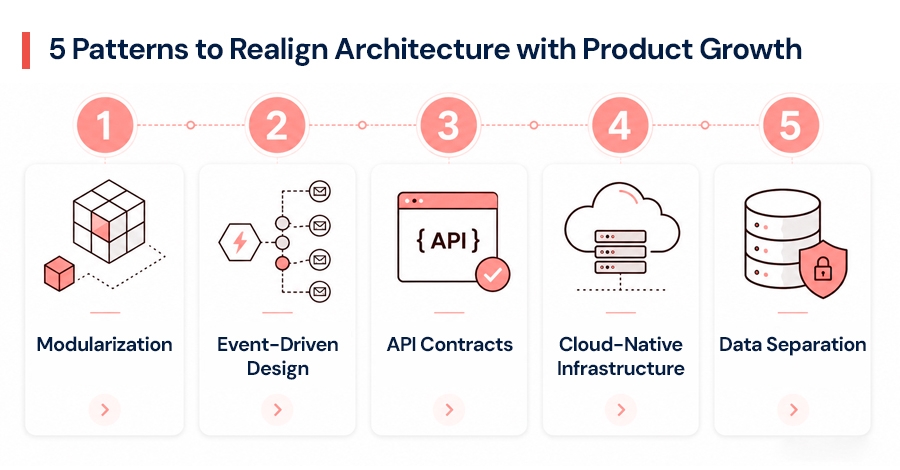
Modularization and bounded contexts are the most impactful starting point. Rather than decomposing everything into microservices immediately, extract vertical slices that align with product capabilities: billing, authentication, recommendations, or notifications. This allows teams to own areas end-to-end, reducing coordination overhead and aligning code ownership with product areas.
Event-driven and asynchronous patterns replace synchronous, blocking flows for cross-system or long-running workflows. A healthcare platform processing lab results, appointment confirmations, and patient notifications benefits immediately from async processing improving resilience and allowing individual services to scale independently, which is critical for software scalability at production load.
API contracts and versioning stabilize integration points between teams and services. Without explicit contracts, every service change becomes a coordination risk across teams. With them, teams can move independently without breaking downstream consumers a prerequisite for any modular architecture at scale.
Cloud and DevOps Engineering practices Infrastructure as Code, automated testing, and CI/CD pipelines directly improve release velocity and system reliability across environments. Combined with containerization and orchestration through Kubernetes, these practices form the operational backbone of any cloud-native architecture migration.
Data architecture separation addresses one of the most common bottlenecks: a shared operational database used as an integration layer between teams. Separating OLTP and OLAP workloads and creating per-service schemas reduces contention and enables performance tuning at the appropriate layer a foundational requirement before introducing AI or analytics capabilities at scale.
Why AI Projects Often Fail on Legacy Architectures
One of the most urgent reasons organizations are now prioritizing software modernization strategy is AI adoption. Across HCM and healthcare verticals, AI initiatives candidate matching, attrition analytics, patient flow prediction, clinical decision support are failing not because the models are inadequate, but because the underlying technical architecture cannot support them.
Consider a concrete example: an HCM platform attempting to add AI-driven attrition prediction finds that employee data is fragmented across three databases, stored in inconsistent schemas, and accessible only through batch exports rather than real-time event streams. The AI model exists and performs well in sandbox testing but cannot be deployed in production because the data infrastructure isn't ready. This is an engineering foundation problem, not a data science problem. The same pattern repeats in healthcare, where AI diagnostic tools stall because patient data sits in disconnected EHR systems with no unified access layer.
Legacy systems create four consistent blockers for AI readiness:
Fragmented data stored across inconsistent schemas with no unified access layer
No real-time pipelines: AI models require event streams, not scheduled batch exports
Poor observability: without structured logging and tracing, model behavior in production is invisible
Inconsistent APIs: AI features require stable, versioned integration points that most legacy systems don't provide
Before implementing AI copilots, recommendation engines, or predictive analytics, organizations typically require foundational product engineering work: data layer redesign, pipeline infrastructure, observability tooling, and a modular architecture that allows AI components to integrate cleanly. Product Strategy & Consulting plays a critical role here ensuring that AI investment decisions are sequenced correctly against architectural readiness, rather than attempted on a foundation that will block them.
Table 1: Architecture Pattern Selection Guide
| Pattern | When to Apply | Primary Benefit | Key Risk |
|---|---|---|---|
| Modular Monolith | Early-stage teams, low decomposition budget | Simpler deployment, clear boundaries | May postpone true decoupling |
| Strangler Fig Migration | Evolving an active monolith incrementally | Low risk, gradual value delivery | Longer total migration timeline |
| Event-Driven Architecture | Cross-service workflows, async processing needs | Resilience, independent scaling | Higher operational complexity |
| CQRS + Read Models | Read-heavy products with complex query patterns | Performance and query flexibility | Eventual consistency tradeoffs |
| Cloud-Native + Kubernetes | Teams needing autoscaling and environment parity | Predictable scaling, deployment consistency | Learning curve and operational overhead |
Table 2: Modernization Decision Matrix
| Condition | Incremental Evolution | Full Modernization |
|---|---|---|
| 1–2 isolated architectural pain points | ✅ Preferred approach | ❌ Premature |
| Lead time more than 3× historical baseline | ✅ With structured prioritization | ✅ Consider |
| AI or compliance requirements unmet | ✅ Targeted rework | ✅ Likely needed |
| Product roadmap blocked at multiple points | ❌ Insufficient response | ✅ Required |
| Engineering attrition driven by maintenance toil | ✅ Reduce toil first | ✅ Evaluate full cost |
| Cloud costs growing without measurable ROI | ✅ Optimize selectively | ✅ Assess full architecture |
Balancing Technical Debt Without Halting Delivery
Technical debt is not inherently a problem managed, deliberate debt can accelerate product validation in early stages. The risk is untracked, accidental debt that compounds over time and eventually consumes the engineering roadmap. CAST Research's AppHealth report puts the average enterprise technical debt ratio at approximately 5% of total application investment meaning a $10 million engineering portfolio is carrying roughly $500,000 in deferred remediation cost at any given time. In product engineering assessments Aspire has conducted, HCM and healthcare teams frequently exceed this average, with debt concentrated in integration layers and data access patterns built during early growth phases and never revisited.
A practical triage model works as follows: track all debt items in the backlog with estimated impact and remediation cost. Prioritize using a risk matrix probability of failure multiplied by business impact. Reserve 10–20% of each sprint for debt reduction, or create dedicated refactor cycles for high-impact areas. Measure progress using trackable proxies: code complexity scores, test coverage trends, MTTR improvements, and lead time for changes.
The organizational practice that makes this sustainable is embedding architecture-led development into product planning. Architects should participate in roadmap sessions not just sprint planning so that technical investment decisions are made with full visibility into product direction. This prevents the gradual drift that turns manageable debt into a systemic constraint on product growth.
KEY TAKEAWAYS
Software architecture is a business asset, not just an engineering concern when it falls behind, product velocity, cloud costs, and customer experience all degrade simultaneously
The three most common triggers for modernization are AI adoption requirements, software scalability failures under load, and product pivots the original system wasn't designed to support
Technical debt should be tracked, triaged, and reduced incrementally CAST Research estimates enterprises defer roughly $50,000 in remediation for every $1 million in application investment
Cloud and DevOps Engineering practices CI/CD, Infrastructure as Code, observability are the delivery infrastructure that makes fast, safe releases sustainably possible at scale
Product engineering services that combine Product Strategy & Consulting, Software Product Development, and Cloud and DevOps Engineering provide a more durable modernization path than point-in-time consulting engagements
Conclusion
Software architecture is not a one-time decision it is a continuously managed asset that must evolve alongside product strategy. When technical architecture falls behind, the consequences are visible in release velocity, cloud costs, customer experience metrics, and engineering team attrition. The path forward is not a panic-driven rewrite. It is a structured assessment, a prioritized roadmap, and an incremental software modernization strategy that reduces risk while restoring delivery momentum.
Whether you are scaling an HCM platform to serve hundreds of enterprise clients, modernizing a healthcare solution to support real-time patient workflows and AI-driven diagnostics, or preparing a SaaS product for cloud-native architecture and AI adoption, the approach is the same: assess honestly, prioritize by business impact, and apply the right engineering patterns in the right sequence.
Aspire Softserv's product engineering services spanning Product Strategy & Consulting, Product Design and Prototyping, Software Product Development, and Cloud and DevOps Engineerin are built to help product-focused organizations close the gap between where their architecture is today and where their product needs to be over the next two to three years. The goal is not just a modernized codebase it is an engineering foundation that scales with your product, supports AI readiness, and keeps your team building rather than firefighting.

Frequently Asked Questions
What happens when software architecture does not scale?
When software architecture fails to scale, systems exhibit non-linear performance degradation under load, increased outage frequency, higher cloud costs, and a slowing release cadence. Engineering teams shift from building to firefighting, and the product roadmap stalls because every new feature requires stabilizing existing infrastructure first. For healthcare software platforms, this surfaces as real-time processing failures; for HCM platforms, it typically appears as multi-tenancy and integration bottlenecks.
How do you know when architecture needs modernization?
The clearest signals are rising lead time for changes, frequent workarounds across multiple modules, inability to meet roadmap requirements without high-risk rework, and operational costs growing faster than product value. A structured architecture review against current and projected product requirements will surface these gaps systematically and prioritize them by business impact rather than engineering preference alone.
What is technical debt in software development?
Technical debt is the future cost incurred by choosing a faster or suboptimal implementation today. It accumulates as code complexity, duplication, missing tests, and undocumented decisions and compounds over time, consuming engineering capacity that would otherwise go toward product innovation. McKinsey's research indicates that large enterprises allocate 10–20% of technology budgets annually to managing this accumulated complexity.
How does technical debt affect product growth?
Unmanaged technical debt slows development velocity, increases the risk of production defects, raises maintenance costs, and diverts engineering effort away from feature delivery and toward system stability. Over time it creates a ceiling on how quickly the product can evolve and makes AI adoption, cloud-native architecture migration, and compliance readiness disproportionately expensive and risky.
When should a company modernize its software architecture?
Modernization is warranted when multiple conditions align: product roadmap requirements cannot be met within the current system architecture, compliance obligations can't be satisfied without structural changes, AI or cloud-native architecture capabilities are blocked by legacy design, and the cost of continued maintenance demonstrably exceeds the cost of planned, phased change. If only one or two conditions exist, incremental refactoring is typically the lower-risk and lower-cost path.
What are the signs of poor software architecture?
High coupling across services, long lead times for simple changes, fragile tests, repeated outages, inconsistent deployment practices, and engineering teams regularly stepping on each other's code are all indicators of application architecture problems that compound without deliberate intervention. Spiraling cloud costs without corresponding product value growth are often the first signal visible at the executive level making this both a technical and a financial conversation.
Build software that scales without friction.