

 Updated on 7 May 2026

Who Should Read This
If you're a CTO, Founder, or Product Head building a payment platform, lending system, or trading application this guide is for you. It helps you decide the right architecture based on your product stage, cost constraints, and scaling needs. Whether you're evaluating product engineering services for the first time or re-examining decisions made in your early build phase, architecture is one of the highest-leverage choices your team will make and one of the most expensive to undo.
While this guide focuses on FinTech systems, similar architectural decisions appear in HCM and healthcare platforms handling high-scale workflows but the constraints and compliance requirements differ significantly.
Getting This Wrong Is a Business Risk Not Just a Technical One
If you're building a FinTech product, choosing the wrong architecture early can stall your product within 12–18 months right when you should be scaling, not rewriting. Most teams realize this too late.
Real-time is often overused early and becomes the most expensive mistake in FinTech architecture. Architecture mistakes don't fail immediately they compound until change becomes expensive. Tightly coupled systems slow down release cycles. Over-engineered real-time pipelines inflate infrastructure costs before you have the transaction volume to justify them. Event-driven systems built without ordering and consistency rules create compliance gaps that surface at the worst possible moment.
The debate between real-time vs event-driven architecture is not about which one is theoretically superior. It's about which one fits your product right now and which keeps scaling without costly rewrites.
Real-Time vs Event-Driven: What They Actually Mean in Practice
Before comparing, it's worth being precise about definitions because these terms get used interchangeably and incorrectly far too often.
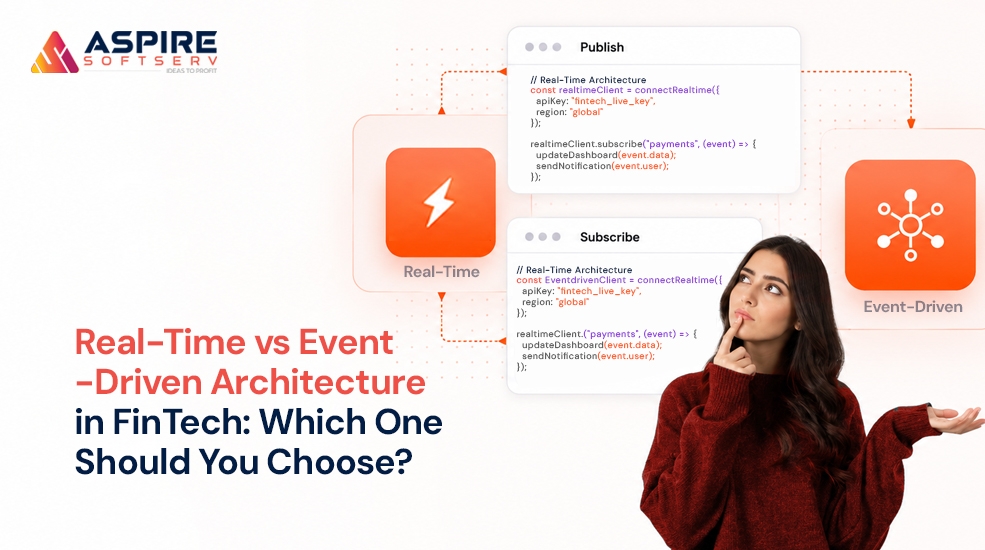
Real-Time Architecture: A system that processes and responds to data continuously with sub-second latency, typically under 100ms. Every input triggers an immediate computation and output.
Event-Driven Architecture: A system where services communicate through asynchronous events, enabling decoupling and independent scaling. Components react to things that happened not to direct calls.
Real-Time vs Event-Driven: Real-time systems optimize for latency. Event-driven systems optimize for scalability.
In practice, real-time data processing in FinTech uses tools like Apache Flink, Kafka Streams, and Amazon Kinesis for continuous streaming pipelines. Event-driven architecture in FinTech uses brokers like Kafka, RabbitMQ, or AWS EventBridge to decouple producers and consumers through asynchronous event flows the foundation of any serious event-driven microservices architecture.
Core Comparison
If you only remember one difference: Real-time = instant decisions. Event-driven = scalable workflows.
| Aspect | Real-Time Architecture | Event-Driven Architecture |
|---|---|---|
| Processing Model | Continuous streaming | Discrete events via pub-sub |
| Latency | Under 100ms (strict) | Variable ms to seconds |
| Data Flow | Push-based, stateful | Pull-based, stateless |
| Scalability | Horizontal via partitioning | Microservices fan-out |
| FinTech Use Cases | Live trading, fraud detection | Payments, audits, onboarding |
| Key Tools | Flink, Kafka Streams, Kinesis | Kafka, NATS, AWS SNS/SQS |
When to Use Real-Time Processing
Use real-time when delay directly impacts revenue or compliance. If a 200ms lag means a fraudulent transaction clears, or an arbitrage window closes, you need a streaming pipeline not an event queue.
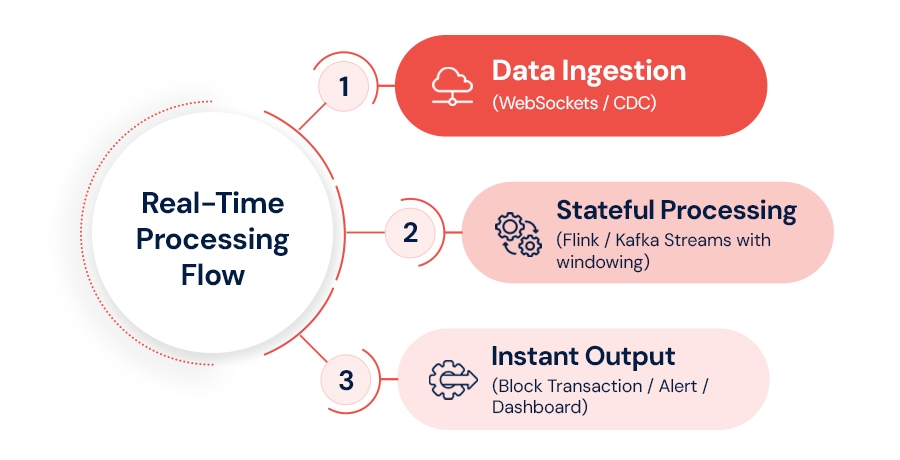
Choose real-time if you need:
Fraud detection that scores and blocks a transaction before it clears
High-frequency trading where arbitrage windows close in milliseconds
Live balance notifications and instant customer alerts
Real-time risk scoring on active portfolios
Avoid real-time when:
Your use case tolerates a few seconds of delay most workflows do
Your team lacks stream-processing experience the operational overhead is significant
Cost control is a priority early on always-on streaming infrastructure is expensive
You're orchestrating workflows, not processing continuous data streams
The biggest real-time system challenges in FinTech involve maintaining exactly-once semantics to prevent duplicate trades, managing backpressure during traffic spikes, and handling stateful computations without data loss. These are solvable but they require mature engineering practices and dedicated infrastructure investment that most early-stage teams consistently underestimate.
When to Use Event-Driven Architecture
Use event-driven when you need resilience, independent scalability, and the ability to add new consumers without touching existing services. A single event "payment_confirmed" can simultaneously trigger a fraud check, a ledger update, a notification, and a compliance audit log, with no service needing to know the others exist.
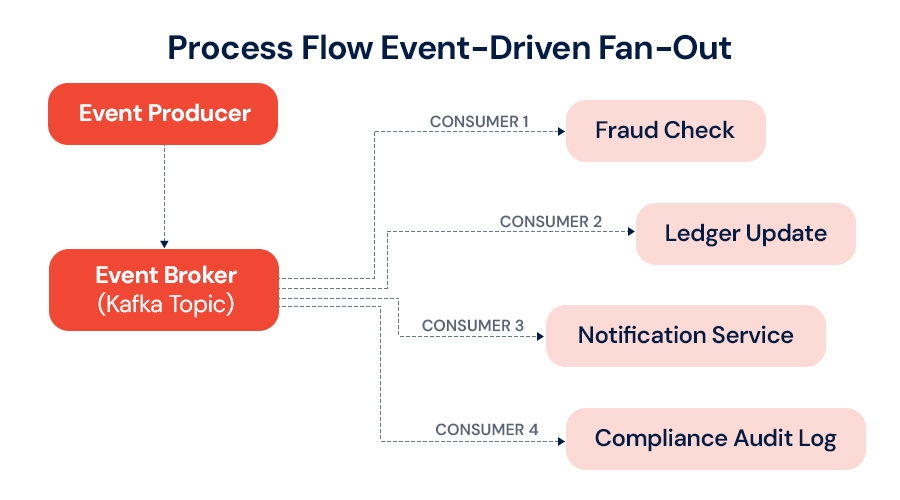
Event-driven architecture use cases in FinTech:
Payment orchestration trigger compliance checks asynchronously on fund movements
KYC and onboarding chain document verification steps without blocking the user
Portfolio rebalancing react to market data events independently per service
Multi-tenant SaaS onboarding scale per customer without shared bottlenecks
Event-driven architecture advantages:
Resilience through retry queues and dead-letter handling
Horizontal scalability without rewriting service contracts
Natural audit trail event logs become your compliance source of truth
Avoid event-driven when:
Your team is small and debugging maturity is low distributed tracing is non-negotiable, not optional
Your use case requires strict transactional consistency with zero tolerance for eventual consistency
You need sub-100ms decisions async processing will not meet that SLA
Real-Time vs Batch vs Event-Driven: Where Each Fits
Most FinTech companies operate across all three modes. Understanding real-time vs batch processing trade-offs helps you allocate infrastructure spend correctly instead of over-engineering everything from day one.
| Metric | Real-Time | Batch | Event-Driven |
|---|---|---|---|
| Latency | Milliseconds | Hours / Days | Seconds |
| FinTech Example | Live fraud scoring | Monthly reconciliations | Transaction orchestration |
| Cost | High (always-on) | Low (scheduled) | Optimized (pay-per-event) |
| Best For | Strict SLA decisions | Reporting, aggregation | Scalable async workflows |
Fintech data processing architecture at scale almost always blends all three. Real-time at the decision edge, event-driven for workflow orchestration, batch for reporting and reconciliation. The best architecture for fintech platforms is rarely a single pattern it's a deliberate layering based on what each decision actually requires.
How Leading FinTech Companies Actually Use Both
Most successful FinTech platforms don't choose between real-time and event-driven they assign each to the right layer based on what that layer's decisions actually cost if delayed.
Stripe's payment flows are built on event-driven architecture events like charge.succeeded trigger webhooks that fan out to internal and external consumers without tight coupling. Robinhood processes trade execution with real-time streaming via Kinesis, then emits events downstream for notification and settlement services.
A well-designed neobank's fintech system architecture typically looks like this:
Flink handles fraud detection in under 50ms real-time layer
Kafka handles ledger updates and compliance events at 10,000+ TPS event-driven layer
Nightly Spark jobs run reconciliation and reporting batch layer
This is what scalable fintech architecture actually looks like in production not a binary choice, but a deliberate layering where each pattern earns its place based on latency requirements and cost trade-offs.
How This Decision Impacts Your Business
These aren't just engineering decisions they directly impact cost, scalability, and how fast your team can ship. Architecture decisions show up in your quarterly numbers faster than most teams expect.
Wrong architecture → 2–3x higher infrastructure costs as you patch scalability gaps with compute instead of design
Tightly coupled systems → slower releases every change cascades through dependent services
Poor event design → failed integrations with payment rails, banking APIs, and compliance systems
Over-engineering real-time → unnecessary complexity for workflows that tolerate seconds of delay
Under-investing in event-driven → brittle monoliths that can't scale individual services independently
The goal of good event streaming architecture combined with real-time analytics architecture isn't to use the most impressive stack. It's to match your infrastructure spend to actual business requirements and keep your engineering team shipping instead of firefighting.

Quick Self-Diagnosis: Most Teams Miss This
Run through this before finalizing your architecture direction. If most answers reveal a problem, your current or planned architecture is already a business risk not just a technical concern.
Are your services tightly coupled does one failure cascade across the system?
Are your release cycles slowing as the codebase and team grow?
Can you scale individual services independently without full redeployments?
Are your infrastructure costs growing faster than your transaction volume?
Do you have genuine sub-100ms SLA requirements, or are you over-engineering?
Does your team have the observability tooling to debug distributed event chains?
Decision Framework: Which One Does Your Product Actually Need?
This is typically where Product Strategy and Consulting decisions define long-term system behavior not just initial implementation choices. Getting this right at the design stage prevents months of rework at the execution stage.
Use real-time when:
You need instant fraud detection or trade execution where latency directly impacts revenue
Your SLA is under 100ms and any delay causes compliance failure or customer loss
You're processing continuous data streams market feeds, CDC pipelines, live sensor data
Use event-driven when:
You need decoupled, independently scalable workflows across multiple services
Your use case tolerates eventual consistency payments, onboarding, compliance chains
You're building multi-tenant platforms where one customer's load shouldn't impact another's
Use a hybrid when:
You're building a payment platform, lending engine, or trading system that needs both instant decisions and scalable downstream processing
You want to start lean and add real-time layers only as specific SLAs become genuine business requirements
Rule of Thumb: Start event-driven. Add real-time only where your SLAs demand it. This keeps your system flexible, your costs predictable, and your team moving independently on each service.
For how to design scalable fintech systems, this rule holds consistently across every mature production architecture. The teams that get it right establish this boundary early. The ones who don't spend 12–18 months undoing over-engineered streaming pipelines that were never justified by their actual SLAs.
Best Practices for Building Either System
These practices directly impact cost, scalability, and release speed not just system performance metrics.
For real-time data processing architecture:
Define latency SLAs before choosing your stream processor avoid over-specifying
Use rate limiting to handle backpressure during traffic spikes
Implement idempotent consumers to prevent duplicate transaction processing
Add distributed tracing (Jaeger, OpenTelemetry) from day one you cannot debug what you cannot observe
For event-driven system design:
Use Avro or Protobuf for schema evolution without breaking downstream consumers
Implement single-partition keys where event ordering matters
Build a schema registry before your event catalog grows unwieldy
Design for at-least-once delivery with idempotency at the consumer level
For scalable fintech architecture overall:
Apply CQRS to separate read and write models under high load
Use the Saga pattern for distributed transaction consistency across services
In event-driven vs synchronous architecture decisions, always instrument before you optimize
Building This With the Right Engineering Partner
Choosing between event-driven architecture vs real-time architecture is as much a strategic decision as a technical one. The wrong call at the design stage compounds into months of rework at the execution stage and most teams don't have 12–18 months to spare on a re-architecture mid-growth.
Our product engineering services at AspireSoftserv cover the full architecture lifecycle from Product Design and Prototyping (event schema design, stream proof-of-concepts) through Software Product Development (streaming pipelines, microservices with Kafka and Flink) and Cloud and DevOps Engineering (auto-scaling Kubernetes clusters, serverless event handlers). We've seen teams hit this problem repeatedly especially around payment orchestration, onboarding workflows, and real-time risk systems where early architectural decisions silently limit scale well before the team realizes it. We know exactly where each pattern breaks under production pressure, because we've helped teams fix it.
Final Thought
The real-time vs event-driven architecture decision shapes your product's cost, release velocity, and scaling ceiling for years. Most mature FinTech platforms don't choose one they layer both deliberately based on what each decision actually requires.
Start event-driven. Add real-time where your product genuinely demands it.
Architecture mistakes don't fail immediately they compound. The teams that get this right start with a clear decision framework and the right engineering partner before the first line of infrastructure code is written. The ones who don't are rewriting core systems 18 months later, at exactly the wrong time.
Scale FinTech Products Without Rework