

 Updated on 9 July 2026

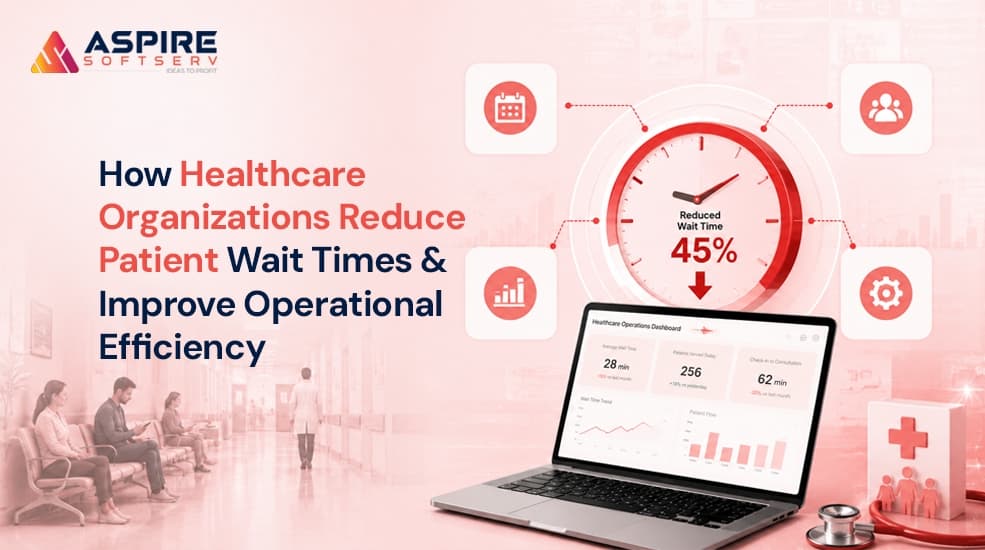
Healthcare organizations that get ahead of delays rely on healthcare operational efficiency built on real-time visibility, predictive analytics, and workflow automation. Rather than reacting once a backlog forms, leading hospitals and clinics use healthcare operations management practices that surface friction in scheduling, patient flow, and resource planning long before it reaches the patient. This guide breaks down where those wait time and bottleneck problems usually start, what they cost, and how a product engineering services partner helps close the gap between the systems you already have and the visibility you actually need.
Signs Your Patients Are Already Waiting Too Long
Knowing how to identify operational bottlenecks in healthcare starts with watching for signs that wait times and healthcare workflow bottlenecks are already embedded in daily operations:
Appointment delays or no-show rates creeping up month over month
Patients waiting longer than expected even when staff are available
Frequent last-minute rescheduling across departments
Low utilization of providers, equipment, or operating rooms
No real-time view into where patients are in their journey
Several systems tracking the same patient with no shared source of truth
If three or more sound familiar, the issue is likely already affecting both patient experience and revenue, even if no single metric looks alarming in isolation.
What Wait Times and Workflow Gaps Actually Cost
The financial impact of healthcare operational challenges rarely shows up in one line item. A hospital running a 10% no-show rate, regular discharge delays, and uneven room utilization can lose thousands of productive appointment hours a year, on top of added staffing pressure to cover the gap. These inefficiencies ripple across reimbursement cycles, provider utilization, and patient satisfaction scores simultaneously, which is why hospital operational efficiency is increasingly a board-level metric rather than an operations team's problem alone.
| Bottleneck Area | Business Impact | Likely Root Cause |
|---|---|---|
| Appointment scheduling | Lost revenue, patient frustration | Manual booking, no demand forecasting |
| Patient flow / bed assignment | Longer stays, ED overcrowding | No real-time location or status data |
| Queue and triage handling | Staff overload, missed SLAs | No automated prioritization |
| Resource utilization | Higher cost per patient | Static, non-predictive capacity planning |
| Disconnected systems | Duplicate work, data silos | No integration layer across platforms |
Why Technology Alone Doesn't Reduce Wait Times
Most organizations already run scheduling software, an EHR, and some form of reporting yet patients still wait and bottlenecks still form, because the problem usually isn't a missing tool, it's how data and workflows connect across the full patient journey. This is where product engineering services earn their place: Product Strategy & Consulting maps the workflow end to end and identifies where the friction actually lives, while Software Product Development builds the healthcare process automation and healthcare workflow optimization logic the existing systems were never designed to share.
A Four-Layer Framework for Catching Delays Before Patients Feel Them
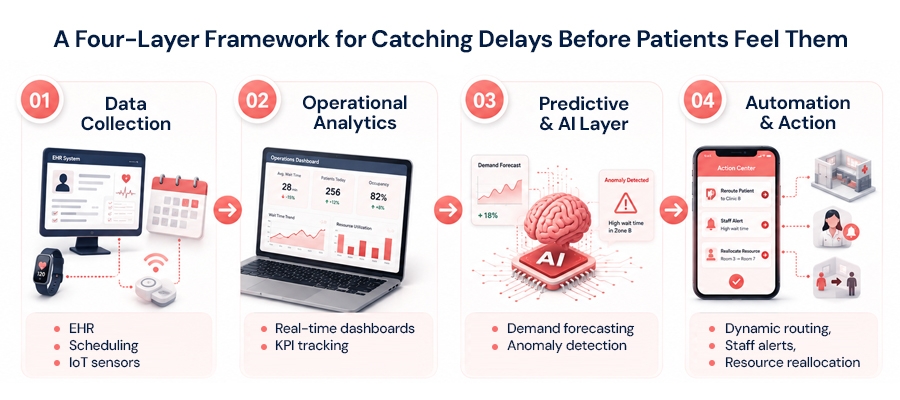
Each layer depends on the one before it. Dashboards without clean data are noise, and predictions without an action layer just become another report nobody acts on. Built as one connected system rather than four separate tools, this is what turns healthcare operational analytics into something that actually prevents wait time escalation before it becomes visible to the patient.
Where Wait Times Usually Start: The Three Highest-Impact Areas
Scheduling is the most visible pressure point. Appointment scheduling optimization through no-show prediction, automated waitlists, and demand-based slot allocation can meaningfully reduce scheduling delays. The improvement depends heavily on baseline no-show rates and how fragmented the current booking process is, but organizations that move from manual scheduling to event-driven, demand-aware systems consistently see both slot utilization and patient satisfaction move in the right direction.
Patient flow is where delays compound fastest. Tracking door-to-doctor time, bed assignment time, and discharge delay reveals exactly where patient flow management breaks down. AI for patient flow optimization can forecast discharge timing several hours ahead often enough lead time to avoid an ED backlog. This is what reducing patient wait times in hospitals looks like in practice: not faster individual steps, but earlier visibility into which steps are about to back up.
Queue and triage handling matters most in outpatient clinics and emergency departments, where automated prioritization and hospital queue management solutions reduce overflow without requiring additional staff. On the resource side, hospital resource utilization monitoring paired with healthcare capacity planning models driven by actual demand signals rather than historical averages can improve scheduling efficiency meaningfully, with the degree of improvement tied directly to how far current utilization is from its theoretical ceiling.
Where AI and Analytics Fit Into the Picture
| AI Capability | Use Case | Expected Outcome |
|---|---|---|
| Predictive analytics | Forecasting discharge timing | Fewer bed shortages, shorter patient waits |
| Anomaly detection | Flagging unexpected delays | Earlier staff intervention |
| Demand forecasting | Predicting daily patient volume | Better staffing decisions before peak hours |
| ML-based triage | Prioritizing urgent cases | Smoother ED flow, reduced wait-related risk |
Healthcare predictive analytics and healthcare decision support systems move an organization from reacting to delays to anticipating them. Predictive healthcare management built on hospital analytics solutions is what separates organizations that stay ahead of wait time pressure from those that document it after the fact.
A Realistic Example: Scheduling Wait Times Reduced at a Multi-Site Provider
A multi-location outpatient provider was dealing with high no-show rates, manual rescheduling, and inconsistent room utilization across sites. After introducing predictive scheduling and automated reminders integrated into their existing booking platform without replacing the EH slot utilization improved by roughly 15%, administrative rescheduling effort dropped by around 20%, and patient satisfaction scores moved up within two quarters. The underlying change wasn't the tool, it was connecting data that already existed but had never been used predictively.
Building Visibility Without Compromising Compliance
Any platform pulling together EHR data, scheduling systems, and real-time patient flow management tracking has to be built around HIPAA from the start, not added after deployment. That means role-based access control, full audit trails on who viewed or changed patient data, and secure cloud architecture with clear data governance. For healthcare buyers in the USA and UK, this is typically one of the first due-diligence questions worth addressing before the bottleneck discussion begins rather than during contract review.
A Quick Readiness Checklist
Before investing in new tools, it's worth checking how much of this infrastructure is already in place:
Real-time dashboards for core wait time and flow metrics
Predictive models for demand and no-show forecasting
Healthcare workflow automation replacing manual handoffs
One integrated data platform instead of several disconnected ones
Anomaly detection for unexpected delays or volume spikes
Capacity planning models tied to actual demand, not last year's averages
Most organizations find they have components of several of these but rarely all of them working together which is usually why the wait time problem persists despite prior technology investment.
Where Product Engineering Fits
Closing these gaps typically touches more than one discipline at once. Product Design and Prototyping validates workflow changes with actual clinical and administrative users before development begins. Cloud and DevOps Engineering makes sure the resulting platform scales reliably across departments instead of becoming one more siloed system with its own maintenance backlog.
Aspire's product engineering teams have supported healthcare and enterprise clients across the USA and globally, working within partner ecosystems including Microsoft and Google Cloud to build healthcare software development solutions that connect existing infrastructure rather than replacing it. That enterprise context matters when the goal is hospital workflow management that survives the first operational peak after go-live, not just a clean demo environment.
For organizations where the gap between "we have the tools" and "we can see wait time pressure coming" is the real problem, a focused assessment is usually the fastest way to find out exactly where that gap is and which of the four framework layers is the weakest link.