


 Updated on 2 March 2026

Healthcare product teams face a brutal paradox: move fast enough to stay competitive or pause long enough to get compliance right. Most choose one and fail at the other. But the reality is simpler than it seems HIPAA doesn't slow innovation. Poor product engineering does.
This blog is for CTOs, product leaders, and founders of mid-sized healthcare software companies building platforms in the US. If you're tired of watching compliance reviews delay launches, security retrofits drain budgets, or architectural shortcuts create technical debt, this is your roadmap to changing that pattern.
The conventional approach treats HIPAA as a legal checklist that engineering deals with later. That's why most healthcare IT solutions either launch late or launch broken. The alternative which leading medical software companies have proven is treating compliance as a product engineering problem from day one.
What Makes Healthcare Product Development Different
When you're building custom software development projects for e-commerce or SaaS, a security bug is expensive. When you're building healthcare platforms, the same bug can trigger federal investigations, destroy patient trust, and cost $50,000 per violation. That's not hyperbole it's the penalty structure under HIPAA's enforcement framework.
Protected Health Information (PHI) includes 18 specific identifiers: names, addresses, medical record numbers, device IDs, biometric data, and more. The moment your platform touches any of these, you're operating under the Privacy Rule (governing disclosure) and the Security Rule (mandating technical safeguards). The Omnibus Rule extends these requirements to every vendor and subcontractor handling PHI, which means your entire technology stack from cloud providers to monitoring tools needs Business Associate Agreements (BAAs) in place.
Here's what most teams miss: HIPAA compliance checklist items aren't just about encryption or access logs. They're about making architectural decisions that reduce risk without reducing velocity. That requires product engineering expertise, not just compliance expertise.
Why Traditional Development Approaches Fail in Healthcare
Standard agile workflows assume you can iterate quickly, break things in staging, and fix them before customers notice. Healthcare platforms don't have that luxury. A staging database leak of patient records isn't a "learning moment" it's a reportable breach with a 60-day notification window to HHS.
The problem isn't agility. The problem is treating security and compliance as validation steps instead of design constraints. When product teams separate "building features" from "making them compliant," they create two backlogs, two review cycles, and double the time to market.
Real-world example: A telehealth platform we worked with spent four months building an AI symptom checker, only to discover during security review that their logging captured full patient conversations including PHI. The fix required re-architecting their data pipeline, rewriting log handlers, and delaying launch by six weeks. The root cause? Their product roadmap never included a compliance engineer in sprint planning.
The Product Engineering Approach to HIPAA Compliance
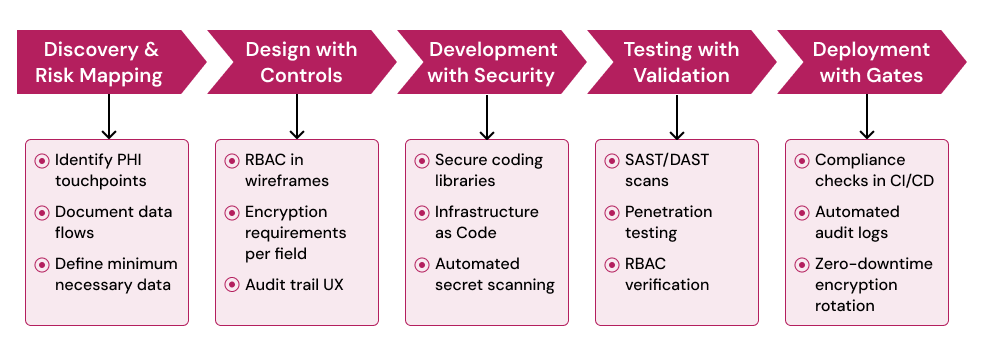
Product Design and Prototyping isn't just about wireframes and user flows. For healthcare SaaS solutions, it's where you map PHI exposure points and design data minimization patterns before writing a single line of code.
Start with this question during discovery: what's the smallest amount of patient data we need to collect to deliver this feature? Every additional field increases your attack surface and your audit burden. A patient portal that collects date of birth for age verification has a smaller compliance footprint than one that stores full medical histories "just in case we need them later".
Role-Based Access Control (RBAC) should be prototyped, not retrofitted. When designers create mockups showing which screens doctors, nurses, administrators, and patients can access, they're not just improving UX they're defining your security model. If your prototypes don't show permission boundaries, your developers will guess. And their guesses will become technical debt.
Embedding Compliance into Engineering Workflows
Here's how Software Product Development changes when product engineering drives HIPAA adherence:
Sprint Planning: User stories are tagged with PHI impact levels (None, Read, Write, Transmit). High-impact stories automatically trigger security review tickets and include acceptance criteria for encryption, logging, and access controls. This isn't extra work it's making implicit requirements explicit.
Code Development: Developers work with pre-approved libraries and frameworks that enforce security patterns. Instead of researching how to implement AES-256 encryption for each feature, they import secure modules with encryption baked in. Infrastructure as Code (IaC) tools like Terraform define compliant cloud configurations that get version-controlled alongside application code.
Continuous Integration: Automated pipelines run Static Application Security Testing (SAST) and Dynamic Application Security Testing (DAST) on every commit. When a developer accidentally logs PHI to console output or stores passwords in plaintext, the build fails immediately not during a quarterly audit.
Compliance violations get caught in minutes, not months. Remediation costs drop by 60-70% because fixes happen during development, not after launch.

Why Cloud Infrastructure Needs Product Engineering Oversight
Every major cloud provider offers "HIPAA-eligible services." That doesn't mean using AWS, Azure, or Google Cloud makes you compliant. It means they'll sign a BAA if you configure their services correctly.
The gap between "eligible" and "compliant" is where Cloud and DevOps Engineering expertise matters. Consider encryption: AWS Key Management Service can automatically rotate encryption keys, but only if your application architecture supports it. If your codebase hard-codes key references or caches decrypted data improperly, automatic rotation breaks your app in production.
You don't need to choose specific tools today you need the right architecture. The technology stack matters less than how it's engineered together.
The Right Technology Stack for Healthcare Products
Table 1: HIPAA-Ready Technology Stack Components
| Layer | Technology | HIPAA Capability | Common Pitfall |
|---|---|---|---|
| Application | Node.js, Python with secure ORMs | Parameterized queries prevent SQL injection | Logging libraries that capture query parameters expose PHI |
| Authentication | Auth0, Okta with MFA | Unique user IDs, session management | Default session timeouts too long (HIPAA recommends <15 min idle) |
| Database | PostgreSQL, MongoDB with encryption at rest | AES-256 encryption, encrypted backups | Backup restoration tests skip encryption validation |
| Cloud Platform | AWS HIPAA services, Azure for Healthcare | BAA coverage, audit-ready logging | Using non-eligible services (e.g., ElastiCache without encryption) |
| Monitoring | ELK Stack, Splunk | PHI-aware log redaction, tamper-proof audit trails | Centralized logging that aggregates PHI across environments |
Table 2: DevOps Compliance Automation
| DevOps Stage | Compliance Control | Tool Example | What Gets Validated |
|---|---|---|---|
| Build | Secret scanning | GitGuardian, TruffleHog | API keys and credentials are not exposed in source code |
| Test | PHI data masking | Delphix, Tonic.ai | Test databases use synthetic or masked patient data |
| Deploy | Auto-encryption | AWS KMS, Azure Key Vault | Data is encrypted both in transit and at rest |
| Monitor | Real-time audits | Splunk, Datadog (with HIPAA modules) | Access logs captured with timestamps and user IDs |
The most common mistake? Assuming that hiring a software development company US with cloud certifications is enough. Certifications prove the vendor understands compliance frameworks not that they'll make the right architectural tradeoffs for your product.
Balancing Innovation Velocity with Risk Management
Here's the uncomfortable truth: some product decisions genuinely conflict with compliance requirements. Adding social sharing features to a patient portal? That creates new PHI disclosure pathways. Integrating third-party analytics? Now you need a BAA with your analytics vendor and controls to prevent patient data from reaching tracking pixels.
Product engineering isn't about saying "no" to these features. It's about saying "yes, if we isolate the risk."
Microservices architecture is the key pattern. Separate your platform into bounded contexts: a PHI-handling core (patient records, prescriptions, clinical notes) and non-PHI peripherals (marketing content, analytics dashboards, user onboarding). The PHI core gets locked down with strict access controls, encryption, and audit logging. The peripherals iterate freely without triggering compliance reviews.
Real-world example: A chronic care management platform wanted to add AI-powered care recommendations. Instead of feeding patient records directly into their machine learning pipeline, they built an abstraction layer that anonymized data before analysis. The AI service never touched PHI, never needed HIPAA controls, and iterated through five model versions in three months. The PHI-handling API that fed it data? That stayed stable and compliant.
This is what Product Strategy & Consulting looks like in practice: finding architectural boundaries that let you move fast on innovation while moving carefully on risk.
Does This Apply to Your Product?
This applies to you if:
You're building or scaling a healthcare product in the US
Compliance reviews are delaying feature launches by weeks or months
Your team is retrofitting security after development instead of designing it in
You're planning AI features, multi-tenancy, or cloud migration
Your existing architecture makes every new feature a compliance review
If two or more of these describe your situation, your challenge isn't HIPAA it's product architecture. We help healthcare product teams assess architectural readiness and design compliance-by-design frameworks that eliminate rework.
Common Pitfalls and How Product Engineering Prevents Them
Slow Audit Cycles: Traditional annual audits create a false sense of security. Your platform changes every sprint; your compliance posture should be validated just as frequently. Continuous monitoring tools like Vanta and Drata automate evidence collection, turning quarterly audit prep from a two-week scramble into a one-click export.
Team Resistance: Developers hate compliance work when it feels like checkbox theater. They embrace it when it's embedded into workflows they already follow. Instead of sending teams to generic HIPAA training, have your security engineer pair-program on high-risk features, showing exactly how to implement audit logs or validate input sanitization.
Legacy System Integration: Connecting modern healthcare IT solutions to legacy EHRs and billing systems is where most technical debt accumulates. The legacy system can't be fixed, so teams build workarounds that bypass security controls. The product engineering solution: tokenization. Translate PHI into non-sensitive tokens at the API boundary, process business logic with tokens, and only de-tokenize data when clinically necessary.
When to Build In-House vs. Partner for Product Engineering
Not every healthcare company needs a full-time product engineering team. But every healthcare product needs product engineering expertise during critical phases: architecture definition, cloud migration, scaling from MVP to multi-tenant SaaS, and regulatory updates.
Here's the decision framework:
Build in-house when:
Your product is your core differentiator (e.g., a novel clinical algorithm)
You have experienced healthcare tech leadership already
Compliance requirements are relatively stable
Partner with product engineering services when:
You're entering healthcare from another industry
Your founding team is clinical experts, not tech architects
You need to move from POC to production-ready in months, not years
Your existing engineering team lacks DevSecOps or HIPAA experience
The most successful healthcare software companies do both: maintain a strong internal product team for domain logic and user experience, while leveraging external expertise for infrastructure, security architecture, and compliance automation.
Preparing for Future HIPAA Evolution
Regulatory frameworks evolve slower than technology. HIPAA's Security Rule was written before cloud computing, before AI, before FHIR APIs became the interoperability standard. That creates ambiguity that product teams must navigate.
For AI-powered diagnostics, there's no explicit HIPAA guidance yet on training data de-identification or model explainability. Product engineering fills that gap by applying the "minimum necessary" principle to machine learning: only train models on the least identifiable dataset that achieves clinical accuracy.
For zero-trust architecture, current HIPAA requirements focus on perimeter security (firewalls, VPNs). Modern healthcare data security solutions assume breaches will happen and design around limiting blast radius: microsegmentation, just-in-time access, continuous authentication. These go beyond compliance requirements but reduce risk dramatically.

The Path Forward
HIPAA compliance isn't what slows down innovation in healthcare SaaS solutions. It's the decision to treat compliance as a checkbox instead of a product requirement. It's hiring developers who can code but not architect. It's choosing cloud platforms without understanding how configuration impacts risk.
Product engineering changes this equation. When compliance is designed into data models, encoded into deployment pipelines, and validated continuously, it stops being a bottleneck. When architects understand both HIPAA requirements and modern software patterns, they find solutions that serve patients and business goals simultaneously.
The medical software companies winning in 2025 aren't the ones with the most conservative security posture or the fastest release cycles. They're the ones that built custom software development practices where compliance and velocity reinforce each other.
If your product roadmap feels like a constant battle between "ship fast" and "stay compliant," the problem isn't HIPAA. The problem is that your development process wasn't built for healthcare products. And that's a problem product engineering can solve.
Build HIPAA-compliant platforms faster with experienced developers.