

 Updated on 7 November 2025


As mid-market companies scale their digital operations, legacy shortcuts and quick fixes often catch up leading to technical debt that silently eats into ROI, delays innovation, and inflates operational costs by 20–30% annually. For CTOs and engineering leaders managing product development engineering services, understanding and managing this debt isn't just a technical concern it's a critical business imperative that directly impacts quarterly budgets and competitive positioning.
Looking to reduce your product's technical debt? Explore how AspireSoftServ's product engineering services help mid-sized teams modernize faster and more cost-effectively.
What is Technical Debt?
Technical debt refers to the future cost incurred when teams opt for quicker, less sustainable solutions over best practices during product development. This trade-off may be deliberate to achieve speed or accidental due to skill gaps or outdated technologies, but it is always a measurable liability affecting long-term digital product engineering services. Think of it as borrowing against your codebase's future the loan always comes due, with interest.
Two Types of Technical Debt
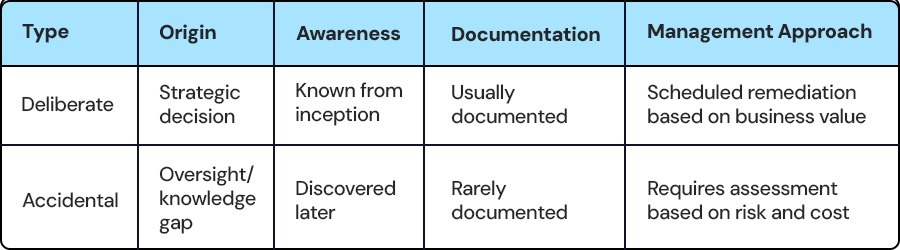
Deliberate Technical Debt represents strategic shortcuts made to meet market needs, with structured plans for correction. Teams consciously choose speed over perfection with a roadmap for remediation. This might include launching with a monolithic architecture knowing you'll break it into microservices later, or hardcoding certain values to meet a critical deadline while planning to make them configurable in the next sprint.
Accidental Technical Debt emerges as the consequence of outdated skills, poor documentation, or legacy system inheritance often unnoticed until it severely impedes progress and escalates costs. This happens when developers leave without documenting their work, when frameworks become obsolete, or when best practices evolve but codebases don't keep pace.
The key differences between these types impact how you should approach remediation:
Hidden Costs of Technical Debt in Product Engineering Services
For mid-market firms, unmanaged technical debt doesn't just slow releases it creates a cascade of financial drains that impact every aspect of product development and operations. Understanding these costs is the first step toward building a business case for remediation.
1. Maintenance Overheads
Maintenance can consume up to 60% of a product's total lifecycle cost. Teams spend 20–40% of development budgets on debt-related tasks money that should be driving innovation instead gets trapped in fire-fighting mode. Every hour spent patching fragile code is an hour not spent building competitive features.
What this means for your quarterly budgets: Frequent patching, support for fragile systems, and constant bug firefighting result in a visible drain on productivity and resources that compounds quarter over quarter. Engineering teams find themselves in a reactive posture, constantly addressing issues rather than proactively building value. This creates a vicious cycle where the best talent spends time on maintenance rather than innovation, leading to frustration and eventual turnover.
2. Opportunity Cost
Developers waste 33–40% of their time dealing with technical debt delaying feature releases, missing market opportunities, and directly impacting revenue potential. This isn't just about slow development; it's about the strategic opportunities you miss while your competitors move faster.
Real business impact: Each extra week to market for a key feature can reduce its lifetime value by 25–50%. While your team struggles with legacy constraints, competitors with modern architectures surge ahead and capture market share. Consider a scenario where you're racing to launch a feature that could capture a new market segment if technical debt delays your launch by just two months, a competitor might establish themselves as the category leader in that time, making your eventual launch significantly less valuable.
3. Compounding "Interest" on Debt
Like financial debt, technical shortcuts incur ongoing "interest" through maintenance overhead and productivity losses that grow exponentially over time. The longer debt remains unaddressed, the more expensive remediation becomes often growing at 15–25% annually in high-complexity environments.
The formula for technical debt growth:
Technical Debt Growth = Initial Technical Debt × (1 + Interest Rate)^Time Period
This compounding effect means that debt you ignore today becomes 2-3 times more expensive to fix in three years. A module that would take two weeks to refactor today might require six weeks in two years, as more code builds dependencies on the flawed foundation.
4. Extended Development Timelines
Feature development cycles lengthen by 40% in heavily indebted environments. New code must carefully "fit" around fragile legacy systems, inflating QA and testing cycles by 30–50%. Developers spend more time understanding existing code, working around limitations, and ensuring they don't break fragile integrations than they do writing new functionality.
Bottom line: What should take 6 weeks stretches to 8–9 weeks, delaying time-to-market and reducing your competitive agility. For product teams operating on quarterly roadmaps, this means consistently missing commitments and struggling to maintain credibility with stakeholders and customers.
5. Emergency Fixes and Risk Premiums
Production issues in debt-ridden codebases multiply urgent incident costs, disrupt operations, and erode customer trust and reputation. When systems fail during peak business hours or in front of customers, the cost goes far beyond the immediate fix.
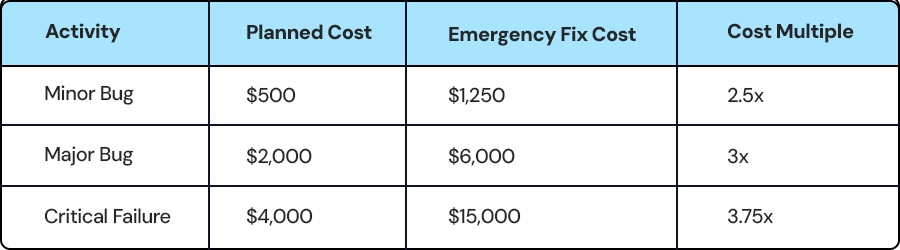
Translation for executives: Fixing critical failures in legacy systems can cost up to 4x more than planned maintenance money that disappears from innovation budgets without warning. These emergency costs often happen at the worst possible times: during product launches, holiday shopping seasons, or critical business periods when the opportunity cost is highest.
Sources and Types of Efficiency Drain
Understanding where technical debt accumulates helps organizations target their remediation efforts for maximum impact. Debt doesn't distribute evenly across systems it tends to concentrate in specific areas that create outsized drag on your entire operation.
Architectural Debt
Tightly-coupled monoliths, outdated frameworks, and hard-coded integrations block adaptability and prevent modern scaling strategies. This multiplies the costs of system expansion and makes cloud migration expensive and risky. Architectural debt is particularly insidious because it affects every new feature you build the foundation determines how easily you can construct new floors.
Real-world challenge: Migrating from legacy platforms forces disruptive choices between expensive workarounds or delayed digital initiatives. Many mid-market companies find themselves locked into outdated architectures that limit growth. The cost isn't just in the migration itself it's in all the opportunities you can't pursue because your architecture won't support them. Learn how cloud-native architectures and microservices can break these constraints and unlock new capabilities.
Common architectural debt patterns include:
Monolithic architectures that prevent independent team scaling and deployment
Tight coupling between components that makes changes risky and expensive
Hard-coded integrations that break when external systems change
Outdated frameworks no longer receiving security updates or community support
Single points of failure that create availability risks and limit scalability
Design & Process Debt
Poorly structured modules, inconsistent workflows, lack of automated testing, and weak collaboration slow teams and reduce delivery quality across the board. Design debt makes codebases harder to understand, modify, and test creating friction at every step of the development process.
Hidden cost: Onboarding times for new developers can increase by 3–6 weeks in complex, undocumented systems multiplying your recruitment and training costs while delaying productivity. When a new engineer joins, they should be productive within days, not months. Design debt extends this ramp-up period dramatically, and during that time, senior engineers must spend their valuable time helping new team members navigate the complexity rather than building new features.
Process debt manifests in several ways:
Manual testing processes that slow releases and introduce human error
Inconsistent coding standards that make code reviews difficult and error-prone
Lack of documentation forcing developers to reverse-engineer system behavior
Inefficient workflows with unnecessary handoffs and approval bottlenecks
Poor collaboration tools that hinder communication across distributed teams
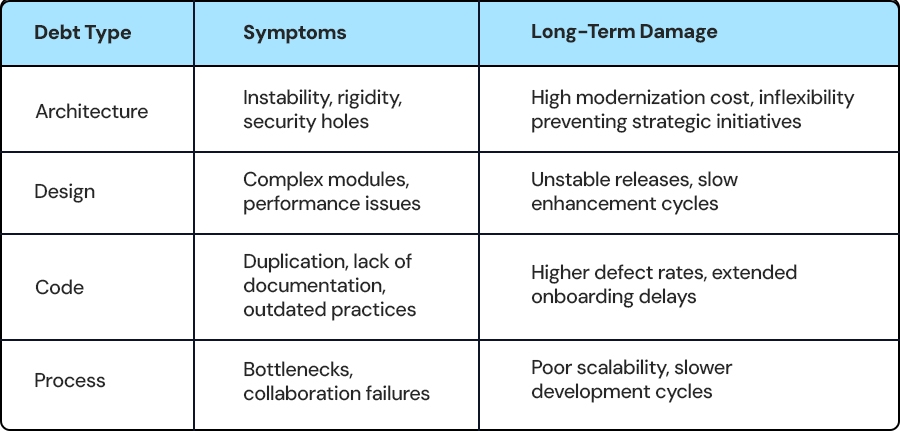
Technical Debt Impact Matrix
Different types of debt create different long-term challenges. Understanding these patterns helps prioritize remediation efforts based on business impact:
How Mid-Market Companies Can Reduce Technical Debt Through Automation
Automation represents one of the most powerful tools for managing technical debt at scale. By automating detection, measurement, and even remediation of certain debt patterns, mid-market companies can systematically address issues without consuming excessive manual resources.
Quantifying Technical Debt in Financial Terms
To make informed decisions, engineering leaders need to translate technical debt into clear financial metrics that resonate with CFOs and boards. Abstract concepts like "code complexity" or "coupling" don't drive executive action—but lost revenue, increased costs, and competitive disadvantage do.
Key Metrics and Formulas
Developer Productivity Loss represents the most direct cost of technical debt. Calculate it by multiplying your team size by average compensation, then applying the percentage of time spent on debt-related work rather than value creation:
Annual Cost = (Team Size × Average Salary) × % Time Spent on Debt
Example: A 20-person team with $100K average salary spending 35% time on debt = $700,000/year in lost productivity. This doesn't include the opportunity cost of features not built or markets not entered during that time. For a mid-market company, this could represent 10-15% of total engineering spend disappearing into maintenance rather than growth.
Feature Delay Impact quantifies how debt slows your ability to respond to market opportunities:
Timeline Expansion Factor = Actual Development Time ÷ Expected Development Time
A factor of 1.4 (meaning features take 40% longer) might seem manageable on a single project, but across a year of development it means you're delivering roughly 70% of the features you could have built with a healthier codebase.
Technical Debt Severity Table
Understanding severity helps prioritize remediation and communicate urgency to stakeholders:
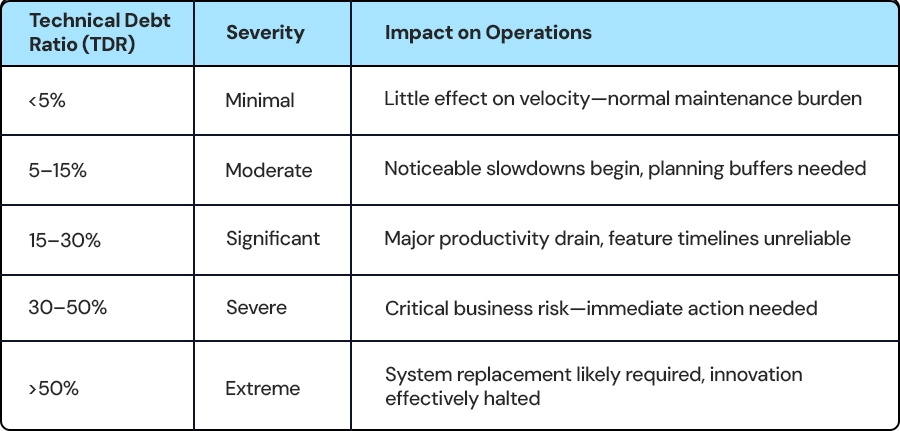
For decision-makers: If your TDR exceeds 30%, every dollar invested in new features costs you an additional 50–70 cents in maintenance and remediation—a tax on innovation that grows every quarter. At this level, even small features become major undertakings, and your ability to respond to competitive threats diminishes significantly.
Hidden Risks: Team and Security Effects
Beyond the direct financial costs, technical debt creates hidden risks that can threaten your organization's long-term viability and competitive position. These risks often remain invisible until they trigger a crisis, making proactive management essential.
Talent Retention Risk
High-debt environments experience 25–35% higher developer turnover. Top engineers don't want to spend careers fighting legacy systems they leave for companies with modern tech stacks where they can learn new skills, work more efficiently, and take pride in their craft. Technical debt doesn't just slow your current team; it makes recruiting and retaining your future team significantly harder.
Cost per departure: Each turnover can cost $50,000–$100,000 in recruitment, onboarding, and lost productivity not including the knowledge drain and project delays. When experienced engineers leave, they take institutional knowledge with them that's often never fully recovered. New hires must spend months learning systems that departing engineers understood deeply, and during that transition, delivery slows and quality suffers.
The talent retention challenge creates a downward spiral: as your best engineers leave, the remaining team struggles even more with the debt burden, leading to more departures and making it harder to attract quality replacements. Companies stuck in this cycle find themselves unable to execute on strategic initiatives even when funding and market opportunity are available.
Security and Compliance Risk
Outdated dependencies, poor documentation, and inconsistent standards heighten vulnerability frequency by 30–50%. Technical debt often means running old versions of frameworks and libraries that have known security issues issues that attackers actively exploit in the wild.
Financial exposure: The cost of a single major security breach can exceed $4 million, with compliance certification and remediation expenses rising annually. For regulated industries, this risk is existential. Beyond the direct costs, breaches damage customer trust, trigger regulatory scrutiny, and can result in business restrictions or even license revocation in highly regulated sectors.
Key security risks from technical debt include:
Outdated dependencies with known vulnerabilities that remain unpatched
Poor access controls in legacy systems never designed for modern security threats
Inconsistent security practices across different parts of the codebase
Lack of audit trails making it difficult to detect or investigate incidents
Compliance gaps where systems don't meet current regulatory requirements
Process Flow: Technical Debt Lifecycle
Understanding how debt accumulates helps organizations intervene at the right points. Technical debt follows a predictable lifecycle, and effective management means breaking the cycle before costs compound beyond control.
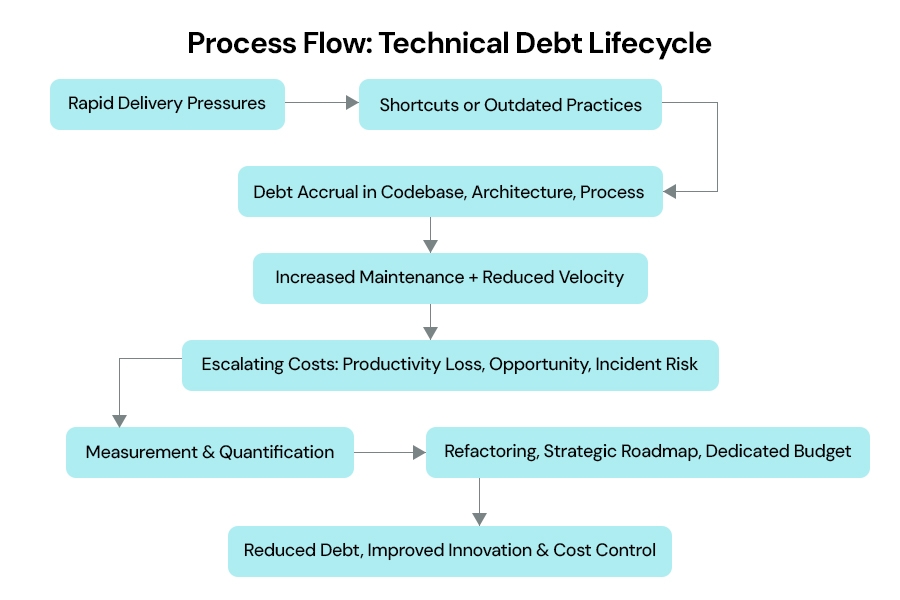
The key insight from this lifecycle is that debt starts with delivery pressure but only becomes visible later through reduced velocity and increased costs. By the time symptoms are obvious, significant damage has already occurred. Proactive measurement and scheduled remediation break this cycle before it reaches crisis levels.
Practical Strategies for Managing Hidden Costs
Effective technical debt management requires a multi-faceted approach combining technical practices, organizational discipline, and financial planning. No single strategy eliminates debt entirely the goal is to keep it at manageable levels while continuously paying down the most costly portions.
1. Regular Architectural Reviews
Architectural reviews catch systemic issues before they become entrenched and expensive to fix. These reviews should be scheduled quarterly or tied to major release milestones, involving both technical leadership and business stakeholders to ensure alignment.
Key actions include:
Modularize monolithic systems into manageable components with clear boundaries
Migrate to cloud-native microservices for better scalability and team independence
Validate architecture decisions against current business strategy and growth projections
Use automated tools for static code analysis to identify hotspots objectively
Document architectural decisions to prevent future teams from repeating past mistakes
Mid-market focus: For companies handling legacy systems, modernizing without downtime is critical to maintaining operations while reducing debt. The biggest barrier to modernization is often fear of disruption but with proper planning and phased approaches, you can transform systems incrementally while keeping business operations running smoothly.
2. Continuous Refactoring and Sprint Debt Repayment
Treating technical debt like financial debt means making regular payments rather than letting it accumulate until a crisis forces action. Continuous refactoring builds debt reduction into your normal development rhythm rather than treating it as a special project that competes for resources.
Best practice: Dedicate 15–20% of sprint capacity to debt reduction, with backlog items explicitly tied to business value and ROI. This isn't wasted time it's an investment that pays dividends in faster future development and fewer production incidents.
Employ frameworks like PAID (Prioritize–Address–Investigate–Document) to select high-payoff refactoring items that deliver measurable improvement:
Prioritize based on business impact and cost of delay
Address root causes rather than symptoms for lasting improvements
Investigate to understand full scope before committing resources
Document decisions and outcomes to build organizational knowledge
3. Automation and CI/CD Pipelines
Integrate advanced code analysis with AI-driven or ML-powered platforms to detect, flag, and forecast technical debt hotspots before they become critical. Automation removes emotion and politics from debt discussions by providing objective data on code quality, complexity, and risk.
Modern approach: Leverage predictive debt management tools powered by product engineering consulting expertise for better prioritization and data-driven decision support. These tools can identify which modules are most likely to cause production incidents, which areas of code are hardest to maintain, and where refactoring will provide the biggest productivity gains.
Effective automation includes:
Automated testing to prevent new debt from entering the codebase
Continuous integration to catch issues early when they're cheap to fix
Code quality gates that enforce standards before code reaches production
Dependency scanning to identify outdated or vulnerable libraries automatically
Technical debt dashboards that make debt visible to all stakeholders
4. Organizational Discipline and Cultural Change
Technology solutions alone won't solve technical debt you need organizational commitment and cultural change to sustain improvements over time. This means making technical debt visible in business terms and treating it as a first-class concern in planning and resource allocation.
Executive alignment: Elevate debt metrics in financial reporting ensure executive dashboards reflect technical liabilities alongside financial ones. When executives can see technical debt affecting quarterly results, they're much more likely to support investment in remediation.
Foster cross-functional education between engineering teams, product managers, and finance departments to create shared understanding and accountability. Product managers need to understand how debt affects their roadmap velocity, finance teams need to see it as a real cost with real remediation options, and engineering teams need to communicate these impacts in business terms.
Cultural elements that support debt management:
Celebrate refactoring wins with the same enthusiasm as new features
Include technical health metrics in team performance evaluations
Give engineers time to learn new patterns and technologies
Make quality visible through dashboards and regular reviews
Reward long-term thinking rather than just short-term delivery speed
5. Cost-Benefit and ROI Calculation
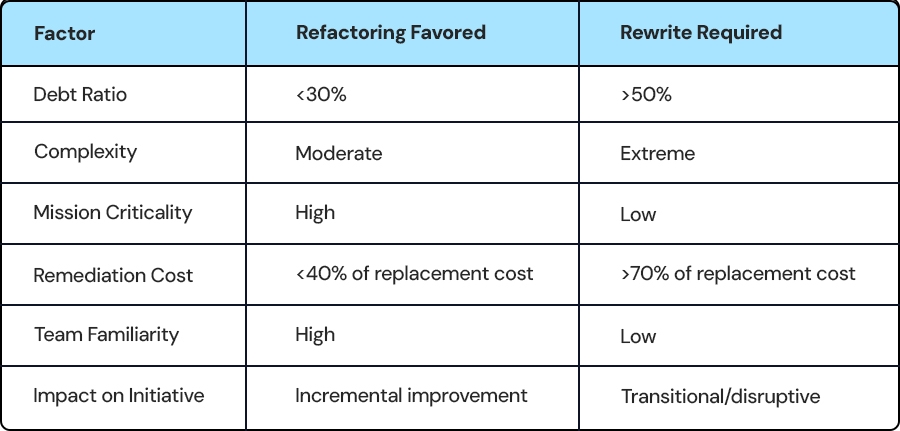
Not all technical debt deserves equal attention, and not all remediation approaches deliver equal value. Systematic cost-benefit analysis helps prioritize efforts and choose between refactoring existing systems versus building new ones.
Break-even point formula:
Months to Break-Even = Refactoring Cost ÷ Monthly Interest Cost
Decision framework: If break-even is under 18 months and debt ratio is below 40%, refactoring typically delivers better ROI than complete rewrites. Rewrites are tempting because they promise a clean slate, but they're risky, expensive, and often introduce new debt of their own. Refactoring preserves existing functionality while incrementally improving structure, making it lower risk for mission-critical systems.
Case Studies: Real-World ROI from Technical Debt Reduction
Real-world examples help illustrate what effective debt management looks like in practice and the tangible returns it can deliver for mid-market companies.
Mid-Sized Fintech Company (North America)
Challenge: The company faced a 35% productivity drain due to accumulated technical debt in their payment processing systems. Feature development that should have taken weeks was taking months, and the team spent most of their time fixing bugs and addressing production incidents rather than building new capabilities. Customer acquisition was outpacing their ability to deliver the features needed to retain and monetize those customers.
Solution: The company partnered with digital product engineering services provider to systematically address architectural and code debt through a phased approach that maintained business continuity while progressively improving system health.
Results achieved over 12 months:
Reallocated 30% of engineering resources from maintenance to innovation
Reduced average feature delivery time by 40%
Cut operational costs by 28%
Improved system stability by 60%, reducing customer-facing incidents
Decreased average onboarding time for new developers from 8 weeks to 3 weeks
ROI: $1.2M invested returned $3.8M in cost savings and accelerated revenue over 18 months. The company was able to enter two new market segments a year ahead of schedule because their improved development velocity allowed them to build required features faster than competitors.
E-commerce Platform (Mid-Market)
Challenge: A legacy monolithic architecture prevented rapid feature deployment and seasonal scaling during peak shopping periods. During Black Friday and holiday seasons, the platform struggled with performance issues that directly impacted revenue, and the team couldn't deploy fixes without taking the entire site down for maintenance windows.
Solution: The platform modernized to microservices architecture with dedicated product development engineering services support, breaking the monolith into independently deployable services that could scale based on demand. For similar transformations, see our guide on transforming e-commerce platforms.
Results achieved:
Developer velocity improved by 40% with teams able to work independently
Bug fix times decreased by 55% due to better isolation and testing
Deployment frequency doubled, enabling rapid response to business needs
Customer conversion increased 8% due to faster checkout and better performance
System successfully handled 3x Black Friday traffic without performance degradation
Business impact: Seasonal revenue capacity increased by $2.3M annually, and the platform could now rapidly test and deploy new features like personalized recommendations and dynamic pricing that were previously too risky to attempt
Healthcare SaaS Provider
Challenge: Security vulnerabilities and compliance risks in their legacy patient management system threatened their ability to win new contracts and maintain certifications required for healthcare customers. Technical debt had accumulated to the point where they failed two consecutive SOC 2 audits, putting existing customer relationships at risk.
Solution: The provider implemented systematic debt reduction focused on security, documentation, and automated testing, with particular attention to areas affecting audit compliance and patient data protection.
Results achieved:
Security and compliance costs fell 44% post-remediation
Passed SOC 2 audit on first attempt after remediation (previously failed twice)
Reduced critical vulnerabilities by 78% through dependency updates and security hardening
Cut incident response time by 62% with better monitoring and automated alerts
Accelerated HIPAA compliance certification for new features by 60%
Risk mitigation value: Avoided potential $3–5M breach exposure and maintained customer trust during a period when competitors were suffering high-profile security incidents. The improved security posture also became a competitive differentiator in sales conversations, helping win contracts from security-conscious healthcare organizations.
Best Practices for Sustainable Risk Management
Long-term technical debt management requires more than one-time remediation projects it demands ongoing discipline and systematic approaches that become part of your normal development culture.
1. Translate Technical Debt into Business Terms
Make technical debt visible in language that resonates with all stakeholders express it in lost revenue, delayed launches, and operational cost increases, not just lines of code or complexity scores. When you tell your CFO that technical debt is "high," they don't know what to do with that information. When you tell them it's costing $700K annually in lost productivity and delaying a feature worth $2M in annual revenue, they understand the urgency and can make informed resource allocation decisions.
Create regular reports that show:
Monthly costs of maintaining debt-heavy systems
Feature delays attributed to technical constraints
Incident costs from debt-related production issues
Productivity trends showing velocity changes over time
Comparative costs of remediation versus continued debt service
2. Build a Clean-Code Culture
Invest in training and standards enforcement across product engineering teams. Make code quality a shared responsibility with clear metrics and recognition. Culture change happens when behaviors are measured, rewarded, and reinforced consistently over time.
Cultural elements include:
Code review standards that treat quality as seriously as functionality
Pair programming sessions to spread knowledge and maintain standards
Technical lunch-and-learns where teams share refactoring wins and lessons
Quality metrics in performance reviews alongside delivery metrics
Documentation requirements treated as essential, not optional
Protected refactoring time that can't be reallocated to features under pressure
3. Balance Speed with Sustainability
Strategic insight: Some debt makes sense for competitive reasons the key is making conscious choices with planned repayment schedules, not letting debt accumulate accidentally. There are legitimate reasons to take on technical debt: beating a competitor to market, testing a hypothesis before over-investing, or meeting a critical customer deadline. The problem isn't strategic debt it's untracked debt that compounds invisibly.
Rule of thumb: For every 4 weeks of feature development, allocate 1 week for debt reduction to maintain sustainable velocity. This 20% investment in technical health prevents the accumulation that eventually forces much more expensive remediation projects or even system rewrites.
Successful teams distinguish between:
Strategic debt taken consciously with repayment plans
Tactical debt that accumulates from daily development decisions
Legacy debt inherited from earlier phases or acquisitions
Avoided debt prevented through good initial design and practices
Future Outlook: AI and Predictive Approaches
AI-assisted code analysis and automated cloud infrastructure management are rapidly transforming how organizations detect and address technical debt. The next generation of product engineering solutions will make debt management more proactive, precise, and cost-effective than ever before.
Emerging capabilities include:
Predictive models that identify debt hotspots before they impact production, using historical patterns to forecast which modules are most likely to cause incidents
Automated refactoring suggestions with estimated ROI, helping teams prioritize work based on impact rather than intuition
Generative AI tools that may cut modernization costs by up to 70% by automating routine refactoring tasks and generating test coverage for legacy code
Natural language interfaces that let non-technical stakeholders query debt status and understand its business impact
Continuous debt assessment that monitors code quality in real-time rather than periodic snapshots
Strategic advantage: Organizations adopting these product engineering solutions early can tackle inefficiencies proactively, transforming debt management from reactive firefighting to strategic optimization. Early adopters will have cleaner codebases that benefit more from AI assistance, while companies with heavy debt will struggle to apply these tools effectively creating a competitive gap that widens over time.
The future of technical debt management isn't just about better tools it's about shifting from manual, reactive approaches to automated, predictive systems that prevent debt from accumulating in the first place. Companies that build this capability now will have significant advantages in development speed, quality, and cost structure over the next decade.
Conclusion
Technical debt is a real, quantifiable, and often underestimated threat to growing products and digital product engineering services initiatives. For mid-market technology companies, the difference between thriving and stagnating often comes down to how effectively they measure, manage, and remediate this hidden liability.
By translating technical debt into clear financial metrics, implementing systematic remediation strategies, and leveraging modern product engineering consulting approaches, organizations can transform what was once a silent growth limiter into a manageable even strategically advantageous part of their business operations. The companies that treat technical debt as seriously as financial debt, with regular measurement and scheduled repayment, will maintain the agility needed to compete in rapidly evolving markets.
The bottom line: Every dollar invested in reducing technical debt returns $2–4 in improved productivity, faster innovation, and reduced operational costs over 24 months. This isn't a cost center it's one of the highest-ROI investments you can make in your product engineering infrastructure.
Ready to Tackle Your Technical Debt?
If your team is facing delayed releases, mounting maintenance costs, or difficulty scaling operations, it's time to assess your technical debt systematically. The longer you wait, the more expensive remediation becomes and the wider the gap grows between your capabilities and your competitors'.
AspireSoftServ's product engineering services help growing companies:
Modernize legacy systems without disrupting operations or requiring big-bang migrations
Automate processes to reduce manual technical debt and prevent future accumulation
Regain engineering efficiency and competitive velocity through systematic debt reduction
Transform technical liabilities into strategic assets that accelerate rather than hinder growth
Learn how our product engineering solutions have helped mid-market companies reduce operational costs by 28–44% while accelerating feature delivery and improving system reliability. Our assessment process quantifies your current debt in business terms, identifies high-impact remediation opportunities, and provides a roadmap for sustainable technical health.
Don’t Let Technical Debt Slow Growth