

 Updated on 10 July 2026

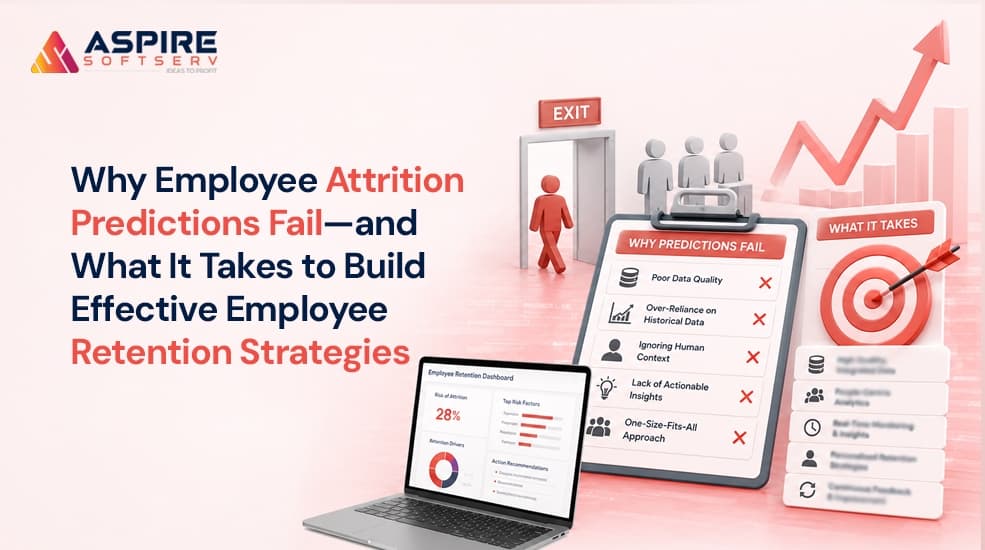
Every year, companies pour budget into HR Analytics and predictive analytics in HR, expecting a dashboard that tells them exactly who's about to quit. Most of the time, that dashboard either gets ignored by managers or quietly stops being accurate within a few months. The problem usually isn't the model. It's that nobody designed the system around how HR teams actually make decisions, or built the data infrastructure to keep it reliable over time. For CEOs, CTOs, and HR technology leaders evaluating where to invest, understanding why these initiatives stall and what a properly engineered solution looks like matters more than understanding the math behind the model itself.
Key Takeaways
Employee turnover prediction tools often fail in production because of poor data, not poor algorithms.
Predictions only create value when they're connected to manager workflows and retention actions.
Building a reliable workforce analytics platform is fundamentally a product engineering problem, not just a data science one.
Companies that treat this as infrastructure not a one-off model see measurable retention improvements.
The Real Cost of Employee Turnover
Before investing in any employee retention analytics initiative, it helps to put a number on the problem. According to the Work Institute's annual Retention Report, the cost of replacing an employee can reach up to 33% of that employee's annual salary and for senior or highly specialized roles, estimates from SHRM place total replacement cost between 50% and 200% when you factor in lost productivity, extended ramp-up time, and knowledge transfer. For critical engineering or product roles, unplanned attrition can also delay roadmaps and strain customer commitments, a cost that rarely appears on an HR spreadsheet but is very real to a CTO managing delivery timelines.
| Cost Driver | Business Impact |
|---|---|
| Recruiting & hiring | Direct cost of sourcing, interviewing, and onboarding replacements |
| Productivity ramp-up | Months of reduced output while a new hire reaches full speed |
| Lost institutional knowledge | Slower delivery, repeated mistakes, weaker customer continuity |
| Critical role vacancies | Delayed product timelines and strained customer relationships |
These numbers are why Employee Turnover Rate has become a board-level metric in many organizations, not just an HR KPI buried in a quarterly report.
Why HR Leaders Don't Trust Attrition Dashboards
Plenty of organizations have already built a model that technically predicts employee attrition reasonably well. The challenge is what happens after the prediction lands on a manager's screen. In practice, most of these tools get quietly abandoned within a year, and the reasons are almost always organizational rather than technical:
Predictions aren't tied to any specific retention action, so managers see a risk score and don't know what to do with it.
Black-box scores feel arbitrary, especially when a "high risk" flag turns out to be wrong, which erodes trust quickly.
Alerts often surface too late after an employee has already mentally checked out or accepted another offer.
Teams lack a clear way to prioritize who needs attention first when dozens of names show up as "at risk."
Without a clear bridge from prediction to action, even a statistically accurate model produces close to zero retention improvement. This is the gap that separates a research project from a system that actually changes business outcomes.
A Real-World Example: Recruitment Platform
A recruitment technology company saw rising attrition among consultants and struggled to identify which teams were most affected until it was too late. Rather than building another standalone model, the company centralized HRIS, performance, and engagement data into a single analytics platform that leadership could actually use. The result was measurable: attrition rates in the highest-risk teams dropped noticeably within two quarters of deployment, and leadership shifted from reacting to resignations after the fact to running targeted retention programs before critical employees reached the point of exit.
Why Attrition Prediction Is a Product Engineering Challenge
This is the part most attrition projects get wrong. Teams hire a data scientist, build a model, and assume the hard part is done. In reality, the model is usually the easiest piece. Making predictions reliable, secure, and usable across an organization requires the same discipline that goes into building any production software product:
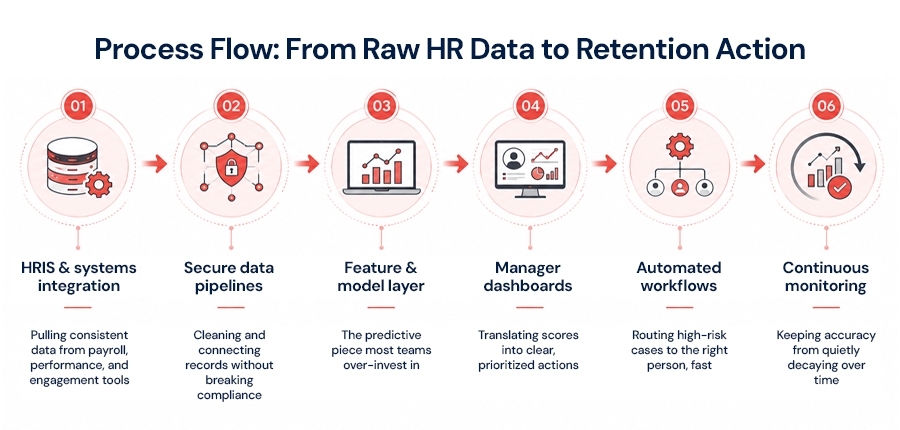
Each of these steps sits squarely in the domain of AI & Data Engineering and product engineering services, not just data science. Companies that skip straight to modeling without this infrastructure tend to end up with an accurate prediction that nobody trusts or uses which is exactly the failure pattern showing up across the industry.
Aspire has worked with enterprise and growth-stage HCM clients across the US and Europe to build this kind of integrated workforce analytics infrastructure, bringing both deep AI/ML Development Services expertise and a partnership ecosystem with leading cloud and HR technology platforms. That combination engineering discipline alongside AI capability is what separates a pilot that gets shelved from a platform that scales across departments. Partnering with a team experienced in product engineering services is often the deciding factor.
What Goes Into a Reliable Workforce Analytics Platform
| Data Source | What It Tells You |
|---|---|
| HRIS & payroll | Tenure, role history, compensation trends |
| Performance reviews | Engagement with growth, ratings trajectory |
| Engagement surveys | Sentiment shifts, satisfaction trends |
| Manager & team data | Manager turnover, team-level risk patterns |
| External market signals | Competitive salary pressure, hiring demand by role |
Mapping these sources into a single, governed platform is what allows predictive workforce management to actually function day to day, instead of living in a one-time report.
Why Attrition Models Lose Accuracy Over Time
Even a well-built model doesn't stay accurate forever. Employee expectations shift, remote and hybrid policies change, and compensation benchmarks move with the market. Without ongoing attention, prediction accuracy quietly erodes usually unnoticed until leadership stops trusting the tool altogether. Keeping a system reliable requires a few ongoing disciplines:
Regular data quality checks across HR systems
Scheduled model retraining as workforce conditions shift
Monitoring for early signs of declining accuracy
Clear governance over who can update or act on predictions
This is less about chasing a perfect algorithm and more about treating the platform as a living product that needs maintenance, the same way any other business-critical software does.
Signs Your Organization Is Ready for Attrition Intelligence
Not every company is ready to invest in a full AI-powered workforce analytics platform, and that's fine. A few signals tend to indicate the timing is right:
Turnover in critical or hard-to-replace roles has been rising for several quarters
Hiring and onboarding costs are climbing year over year
HR data is scattered across multiple disconnected systems
Leadership has limited real visibility into where retention risk is concentrated
Workforce planning decisions are based on gut feel rather than data
If most of these sound familiar, the conversation worth having isn't "which model should we use," but "what does our data and workflow foundation need to look like first."
Questions to Ask Before Starting an Attrition Prediction Initiative
Before committing budget to a predictive analytics in HR project, it's worth getting honest answers to a short set of questions:
Is your HR data centralized, or spread across disconnected systems?
Can your current platform realistically support AI-driven insights?
Do you have workflows in place to act on a risk prediction once it's made?
How will you actually measure whether retention improves?
Can the architecture scale across departments, regions, and future growth?
If the honest answer to most of these is "not yet," the real challenge probably isn't the AI model it's the underlying product and data foundation. That's exactly where AI & Data Engineering and product engineering services work together to create something usable, rather than another shelved pilot.
Privacy and Trust Matter As Much As Accuracy
Any system that touches employee data needs to be built with consent and transparency from the start. Employees should understand what data is being used and why, sensitive signals like communications metadata should be approached cautiously if at all, and any automated risk flag should go through human review before it influences a real decision. Skipping this step doesn't just create legal exposure it quietly destroys the trust that makes the whole system useful in the first place.
Frequently Asked Questions
How to predict employee turnover with limited data?
Start with the basics you already have tenure, promotion history, and compensation trends rather than waiting for a perfect dataset.
Can we use email or Slack data for employee churn prediction?
Only with explicit consent and strong anonymization, and ideally after legal review; aggregate activity patterns are safer than content analysis.
How often should retention models be reviewed?
Quarterly is a reasonable default for most organizations, with more frequent checks during periods of major organizational change.
Conclusion
Employee attrition is a solvable problem, but solving it takes more than a model. It takes integrated data, workflows that managers actually use, and a platform built to stay accurate as conditions change. Organizations that treat this as a genuine product engineering effort not just a one-off AI project are the ones who turn predictions into measurable retention gains.
If you're evaluating where your organization stands, an Employee Attrition Readiness Assessment is a practical first step. It covers your current data maturity, HR analytics capability, AI readiness, and a recommended product roadmap giving you a clear picture of what to fix first before investing further.
Build Intelligent Employee Retention Systems