

 Updated on 4 June 2026

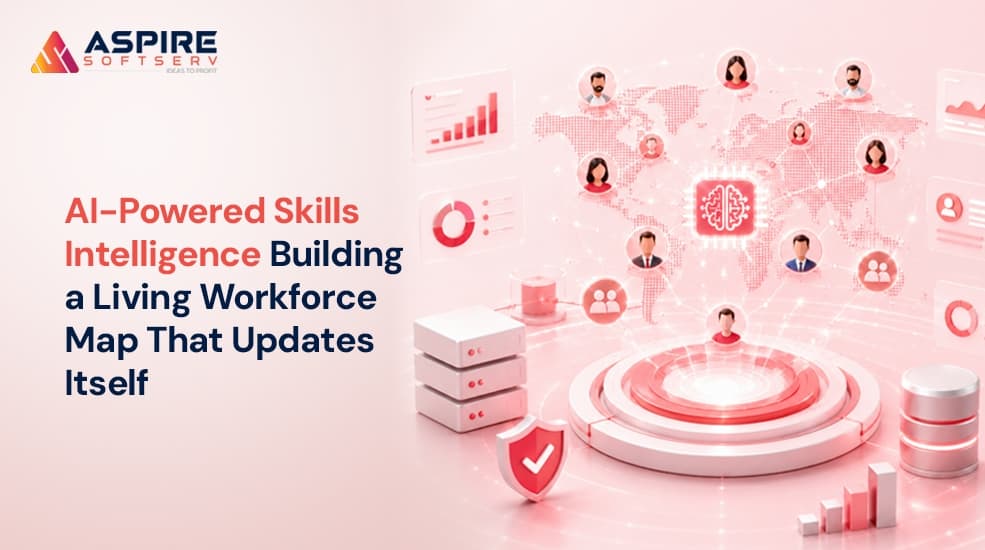
Engineering leaders do not have a skills-shortage problem as much as a skills-visibility problem inside modern product engineering organizations. In many mid-market SaaS and digital product companies, the React expert, QA automation contributor, DevOps problem-solver, or cloud migration engineer already exists inside the team, but that capability is hidden across product engineering workflows, cloud operations, QA automation initiatives, and delivery systems. When delivery pressure increases, outdated skills data turns into slower staffing decisions, repeated dependency on a few senior engineers, uneven QA automation coverage, delayed modernization, and reskilling plans that arrive after the roadmap has already changed. For CTOs, VP Engineering leaders, Engineering Managers, Product Managers, QA Leads, and DevOps Leads, the real question is how to keep engineering capability data current without asking every engineer to manually update yet another profile.
CORE IDEA
A living skills map uses responsible AI to infer engineering capabilities from work signals such as project history, code contributions, testing ownership, cloud certifications, incident participation, documentation, and delivery outcomes. It does not replace manager judgment; it gives leaders better evidence for staffing, modernization, QA automation, and reskilling decisions.
Why Static Skills Data Hurts Product Delivery
In a growing product company, skills change every sprint. A backend engineer may start leading observability work. A QA engineer may become the strongest contributor to Playwright automation. A DevOps engineer may quietly become the go-to person for Kubernetes cost optimization. If the organization only updates skill data during annual reviews, leaders make delivery decisions using an old snapshot of a fast-moving team.
This becomes expensive when the company is trying to scale a SaaS product, modernize cloud infrastructure, improve QA automation coverage, reduce technical debt, or accelerate digital product engineering initiatives. The people with the right skills may already exist inside the organization, but leaders cannot see them quickly enough.
A product manager waits longer to form a team because skill ownership is unclear.
A QA lead delays automation because only one person appears to know the framework.
A DevOps lead depends on the same engineers for every production incident.
A CTO approves hiring before checking whether adjacent skills can be developed internally.
An engineering manager misses retention risk when high-skill contributors are underutilized.
From Manual Skills Inventory to an AI-Powered Engineering Capability Map
A traditional skills database depends on employees remembering to update their profiles and rating themselves accurately. A living capability map is different. It continuously combines multiple signals and presents them as evidence-backed insights that managers can review.
| Traditional Skills Database | AI-Assisted Living Skills Map |
|---|---|
| Updated annually or only during HR cycles | Updated as work signals change across projects and teams |
| Depends heavily on self-reported proficiency | Uses evidence from delivery work, learning signals, and manager validation |
| Often disconnected from engineering output | Connects skills to software product development, QA automation, cloud engineering, DevOps workflows, and product delivery outcomes |
| Hard to keep taxonomy current | Detects emerging tools and practices that teams are already adopting |
| Useful for record keeping | Useful for staffing, modernization, QA automation, and reskilling decisions |
How AI Skills Intelligence Works in a Product Engineering Context
The best approach is not to scrape everything and call it intelligence. A trustworthy system should use relevant signals, clear governance, manager review, and transparent evidence. For SaaS and digital product engineering companies, the most useful signals usually fall into four groups.
Work output signals: Pull requests, code reviews, CI/CD ownership, infrastructure-as-code contributions, observability initiatives, QA test suites, incident reviews, deployment ownership, and product delivery artifacts show which skills are being applied in real work.
Learning and certification signals: Cloud certifications, internal training, conference notes, guild participation, and knowledge-sharing sessions help identify recently developed capabilities.
Delivery and quality signals: Sprint outcomes, defect trends, automation coverage, release frequency, recovery patterns, and peer feedback help distinguish declared skill from effective application.
Manager validation: Engineering managers and leads should review AI-inferred skills before they are used for decisions. This keeps the map accurate, fair, and explainable.
TRUST NOTE Skills intelligence should be used to support better conversations, not to silently score employees. Clear consent, role-based access, explainable evidence, and human review are essential for trust.
Practical Use Cases for Mid-Market Product Companies
1. Faster staffing for software product development and roadmap delivery
When a new product initiative needs React, Node.js, payment integration, cloud security, and automated regression testing, leaders can quickly identify employees with proven or adjacent experience. This reduces the dependency on informal manager memory and speeds up team formation.
2. QA automation skills-gap discovery for faster release quality improvement
A QA lead can see which teams already have automation experience, which frameworks are actively used, and where manual testing is creating release bottlenecks. This helps prioritize automation investments where they will reduce delivery risk fastest.
3. Cloud and DevOps modernization planning
For companies migrating from legacy infrastructure to cloud-native architecture, a skills map can highlight who has hands-on experience with containers, CI/CD, monitoring, security, infrastructure as code, and cost optimization. This supports realistic modernization planning. This is especially useful for organizations adopting cloud-native product engineering practices.
4. Technical debt and architecture risk reduction
If only a few engineers understand a critical legacy module, database, or deployment pipeline, the organization has a capability risk during modernization or cloud migration initiatives. A living map makes those single points of failure visible and helps leaders plan mentoring, documentation, and succession coverage.
5. Targeted reskilling instead of generic training
Instead of sending everyone to the same training program, leaders can identify adjacent skills for AI engineering, DevOps, QA automation, and cloud modernization initiatives. For example, engineers with strong API experience may be close to microservices ownership, and manual QA engineers with scripting experience may be ready for automation enablement.
Anonymized Example: Turning Hidden Capability into Delivery Capacity
In an anonymized composite example, an 82-person SaaS engineering organization was preparing for a 6-month cloud modernization roadmap. The leadership team believed only a 7-person platform group had meaningful cloud experience. During a 3-week capability discovery exercise, work-signal review surfaced 14 additional application engineers and QA engineers who had already contributed to infrastructure automation, monitoring dashboards, deployment documentation, and regression automation in previous projects.
The company used this insight to form a 12-member cross-functional modernization group instead of overloading the platform team. The practical outcome was not magic automation; it was better visibility. Leaders could staff the work with more confidence, reduce dependency on a few specialists, and create a focused mentoring plan for engineers with adjacent cloud, QA automation, and DevOps skills. The exercise also improved visibility into internal DevOps, cloud engineering, and QA automation capabilities across teams.
Implementation Framework: How to Start Without Overcomplicating It
1. Define business-critical skill areas: Start with the skills connected to your next 6–12 months of software product development, cloud modernization, AI adoption, QA automation, or DevOps transformation roadmap.
2. Connect only useful signals first: Begin with project history, documented ownership, training data, and manager validation. Avoid collecting data that does not improve decisions.
3. Use evidence levels, not absolute labels: Replace vague tags like expert with evidence-backed categories such as observed, validated, recently applied, or ready for mentoring.
4. Review with engineering leaders: Ask managers and technical leads to validate the map before it informs staffing or training decisions.
5. Tie insights to action: Use the map to decide staffing, mentoring, hiring, automation priorities, and modernization readiness. A skills map has value only when it improves decisions.
What Leaders Should Measure
A living skills map should improve engineering decisions. Track outcomes that matter to product companies rather than vanity metrics.
Time required to identify a project team with the right skills.
Reduction in single-person dependency for critical systems or processes.
Improvement in QA automation coverage across critical product engineering workflows.
Cloud or DevOps readiness by team and roadmap priority.
Training completion that converts into real project application.
Internal mobility and mentoring opportunities created from adjacent skills.
Common Mistakes to Avoid
Treating AI-inferred skills as final truth without manager validation.
Building a huge skills taxonomy before defining the business decisions it will support.
Using the system only for HR reporting instead of software delivery optimization, product engineering planning, QA automation maturity, and cloud modernization readiness.
Ignoring privacy, consent, and explainability.
Measuring profile completion instead of product-engineering outcomes.
Conclusion
For mid-market SaaS and digital product companies, engineering capability changes faster than annual review cycles. A static skills database cannot support fast roadmap decisions, QA automation planning, DevOps maturity, cloud modernization, or targeted reskilling.
AI skills intelligence helps product engineering leaders build a living, evidence-backed view of workforce capability across software development, QA automation, cloud engineering, DevOps operations, and modernization initiatives. The value is not just better data. The value is faster staffing, smarter reskilling, lower delivery risk, and a clearer path to product modernization. For growing SaaS companies, this creates a stronger foundation for scalable digital product engineering and long-term platform evolution.
Identify Skill Gaps Before They Delay Roadmaps