

 Updated on 20 May 2026


Products become expensive to change because early architecture decisions prioritize speed over structure. Most software products hit a flexibility wall within 12 to 18 months of launch not because the engineering team made poor decisions under pressure, but because the product was optimized for launch day rather than for the 18 months that follow it.
When business needs shift and they always do teams discover that every new feature requires touching five other things, every integration breaks something else, and every release feels like a calculated risk. In one recruitment platform, redesigning hiring workflows took 3x longer than planned due to tightly coupled services built during the MVP phase. In a hospital scheduling system, a poor data model decision made at launch caused the entire system to fail under scale during peak demand.
If you're working with a Product Engineering Services partner or building an in-house team for a SaaS, HCM, or healthcare product, the principles in this guide will help you avoid those outcomes. Strong product development services go beyond feature delivery they build the structural foundation that allows a product to evolve without collapsing under its own complexity.
An MVP is not a prototype. It is the foundation of your future system.
If you're scaling a SaaS, HCM, or healthcare product and planning new features, integrations, or market expansion this guide will help you identify and fix structural risks before they cost you months of rework.
Why Most Products Become Expensive to Change Within 12–18 Months
Flexibility is a product strategy problem not just a technical one. Business needs change for predictable reasons: new customer segments emerge, regulations shift, competitors add features, and operational workflows scale faster than the original product plan anticipated.
When a product lacks structural flexibility, the cost compounds fast. Development slows by 2–3x. Release cycles extend from weeks to months. Maintenance costs rise 30–50% as every change requires touching interconnected parts. In HCM platforms, for example, adding a new compliance workflow can require rewriting core onboarding logic if the two were never properly separated. In healthcare, a scheduling feature built on a shared database model can block three other teams from shipping independently.
The root cause is almost always the same: the first version was built around what was convenient at the time, not what would be maintainable at 2x or 5x scale.
What a Flexible Product Actually Looks Like
Flexible products are built on three practical traits. They are easy to extend without rewriting existing logic. They are safe to modify because changes are contained within clear boundaries. And they are simple to operate as the business grows in users, workflows, and integrations.
Scalable product development means making decisions about UX, APIs, data models, and deployment with future change in mind not just the current sprint. This is precisely where software product development partners who combine product thinking with engineering execution deliver more value than build-only execution models. The difference shows up at month 18, not month 3.
The Architecture Foundation: Where Flexibility Is Won or Lost
Flexible software architecture is the single biggest factor in whether a product stays adaptable or becomes a maintenance liability. Good software architecture design separates core business logic from technical concerns, so teams can change one part without breaking the rest.
Architecture Choices That Improve Flexibility
| Architectural Choice | Why It Helps | When It Works Best |
|---|---|---|
| Modular monolith | Manageable complexity with clear boundaries | Early to mid-stage products |
| Microservices | Independent scaling and deployment | Large products with clear domain separation |
| API-first design | Easier integration across channels | Web, mobile, and partner ecosystems |
| Event-driven patterns | Reduces tight coupling | Asynchronous workflows |
| Cloud native architecture | Elasticity, resilience, operational efficiency | Products expecting variable demand |
One of the most damaging defaults in custom product development is reaching for microservices too early. A well-structured modular monolith is almost always the better starting point it supports modular software design without the operational complexity of distributed systems. The key is preserving module boundaries so the architecture can evolve when the business demands it, rather than when the team has no other choice.
Process Flow: How Flexible Products Are Built Intentionally
A flexible product doesn't happen by accident. It requires a deliberate build process that treats change as normal rather than exceptional.
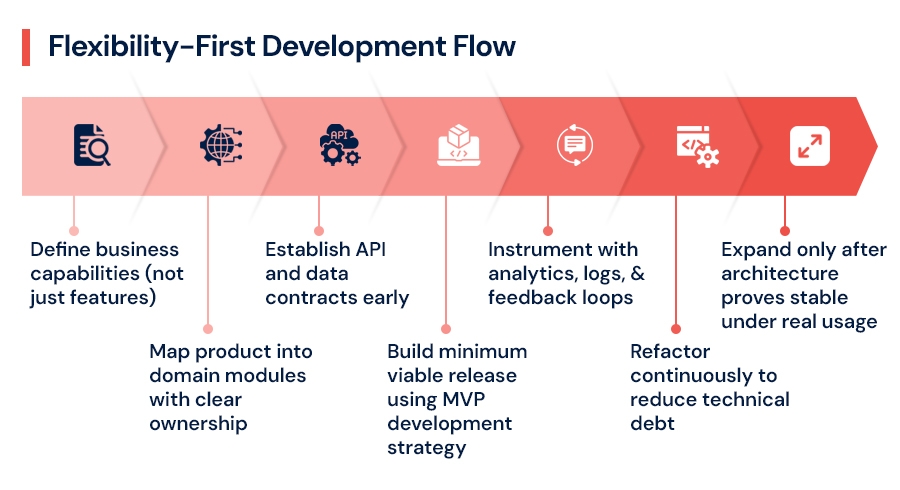
This process supports a sound product development strategy because it balances speed with long-term maintainability. It also prevents the most common trap: optimizing for launch day while ignoring how the product will need to change in the months that follow.
A critical mindset shift here is treating your MVP development strategy not as a throwaway prototype, but as the structural foundation of a real product. Teams that skip this thinking end up rebuilding their MVP within a year at 30–50% higher cost than if they had built it right the first time.

Common Mistakes That Kill Flexibility Early
Most products lose flexibility because the first version is built around what's convenient now, not what's maintainable later. These mistakes show up consistently across software product development projects and create compounding scalability problems within 6 to 18 months:
Hardcoding business rules into the UI or service layer instead of isolating them in domain logic
Letting every feature share the same database logic, creating a hidden web of coupling that makes every change risky
Building custom exceptions for every edge case instead of establishing stable, reusable domain rules
Treating the MVP as disposable rather than as the foundation of a real system
Ignoring operational concerns like monitoring, deployment pipelines, and rollback strategies
Delaying documentation until the product is already difficult to understand or onboard new engineers into
These mistakes don't just create technical problems they create business problems. Scaling a product means supporting more workflows, more teams, more integrations, and more change. Without structural discipline, every new capability becomes more expensive than the last, and delivery timelines stretch by 2–3x compared to products built with modularity in mind.
How to Design Modular Software That Scales Without Rewrites
Modular software design starts with business capabilities, not technical layers. A module should represent one meaningful part of the business billing, onboarding, permissions, reporting, scheduling. Each module owns its own logic and data.
Rules that make modularity work in practice:
Keep each module responsible for exactly one domain capability
Minimize shared state across module boundaries
Expose interactions through APIs or events never through direct database access
Make dependencies point inward toward stable business rules, not outward toward infrastructure
Separate infrastructure code strictly from domain logic
This approach is central to scalable software architecture for both startups and scaling companies. Startups need speed; they also need a product that can survive growth. Modular design gives teams a way to move fast without building a structure they'll need to tear down in 18 months.
Monolith vs. Microservices: Choosing the Right Foundation
This is one of the most consequential decisions in custom product development, and it's frequently made for the wrong reasons usually because microservices sound more modern, not because the business is actually ready for them.
| Situation | Better Choice | Why |
|---|---|---|
| Small team, uncertain product-market fit | Monolith | Faster iteration, simpler operations |
| Clear domain boundaries, multiple teams | Microservices | Independent deployment and scaling |
| Heavy integration needs | API-first monolith | Better interface discipline |
| Rapid experimentation phase | Modular monolith | Easier change with lower overhead |
| Large enterprise platform | Microservices or hybrid | Supports team autonomy at scale |
The rule is simple: use microservices when the business and the organization are actually ready for them. A well-structured monolith built on a solid scalable software architecture foundation can carry a product much further than teams expect especially when the codebase is modular and teams are disciplined about boundaries. Getting this wrong costs 6–12 months of rework on average.
Cloud, DevOps, and the Operational Layer of Flexibility
Flexibility isn't only about code structure. It's also about how quickly and safely you can ship, monitor, and recover when something goes wrong. This is where cloud native architecture and strong Cloud and DevOps Engineering practices become essential components of any serious product development services engagement.
A cloud-native product can scale elastically, support environment automation, and recover faster from incidents. These operational capabilities make it possible to test change without unnecessary risk and in HCM or healthcare products, where deployment errors carry significant business and compliance risk, they are non-negotiable:
Automated testing for regression and release confidence across environments
Blue-green or canary deployments for safer rollouts with immediate rollback capability
Centralized logging and tracing for faster incident resolution and root cause analysis
Infrastructure as code for repeatable, consistent environments across teams
Feature flags for controlled experimentation without full production releases
These capabilities reduce software maintenance cost by 20–40% over time and ensure that releases don't become firefights. They are a direct investment in long-term delivery speed, not just operational safety.
Reducing Technical Debt Before It Slows You Down
Every product accumulates technical debt. The teams that stay fast are the ones that treat debt as a continuous management challenge not a one-time cleanup project that never actually gets scheduled.
Practical debt management isn't complicated, but it requires consistent discipline:
Refactor after each meaningful product change, not in a big quarterly push that gets deprioritized
Write tests around critical business flows so changes don't silently break existing behavior
Remove duplicate logic rather than layering workarounds on top of it
Document architectural decisions as they are made not months later when no one remembers why a choice was made
Track debt alongside feature work in the product roadmap so it gets actual priority rather than being perpetually deferred
Technical debt slows onboarding, increases defect rates, and makes every future product change more expensive. It is a product development strategy problem as much as an engineering one. Teams that manage it continuously ship 2–3x faster than teams that let it accumulate.
The Role of AI and Product Design in Keeping Products Flexible
AI in product development works best as an enabler of better decisions, not a replacement for architectural discipline. Used well, AI can accelerate prototyping, surface usage patterns faster, generate test coverage for edge cases, and improve documentation quality across teams.
In Product Design and Prototyping, AI tools help validate ideas with users before significant engineering investment reducing the risk of building the wrong thing at scale and discovering the problem 12 months too late. Product Strategy & Consulting informed by AI-driven usage analysis also helps teams identify which parts of their architecture will need to change first as the business grows, rather than discovering those gaps reactively.
The important caveat: AI accelerates the work. It does not replace the thinking behind the work. Sound product engineering judgment remains the foundation.
A Decision Framework for Leaders
CEOs and CTOs don't need more architectural jargon. They need decision clarity. Before committing to a build approach, ask these questions:
| Decision Area | Key Question |
|---|---|
| Business model | Will customer workflows change often? |
| Architecture | Can core modules change independently? |
| Delivery | Can we release safely without large regressions? |
| Cost | Will maintenance stay manageable at 2x or 5x scale? |
| Team structure | Can multiple teams work without blocking each other? |
| Strategy | Are we building for the next feature or the next product phase? |
These questions help avoid the two most common failure modes: over-engineering (building microservices before the business is ready) and under-engineering (building without any structural discipline). Both are expensive but over-engineering costs money upfront, while under-engineering costs significantly more over time through slower delivery, higher defect rates, and eventual rebuilds.

Building for Long-Term Adaptability
The most adaptable products are designed around the expectation of change not the fear of it. That means the team plans for new customer demands, new integrations, new pricing models, and new operating rules from day one, rather than treating each as a surprise that disrupts the roadmap.
Strong product organizations combine Product Strategy & Consulting, design, architecture, and delivery under one product lens. This is why many companies prefer working with a Product Engineering Services partner when they need more than coding execution they want a team that can shape the product, not just ship tasks against a backlog.
Scalable product development means building a foundation that remains useful as the business matures. It means every decision made today about data models, APIs, deployment pipelines, and module boundaries is made with the next phase of the business in mind, not just the next sprint. Teams that build this way ship faster at month 18 than they did at month 6. Teams that don't are usually rewriting core systems by then.
If you want a product that stays flexible, don't optimize only for launch speed. Optimize for structural clarity, modular software design, operational discipline, and decision-making that anticipates change. That is the real work of software product development done well and it starts with the decisions you make before the first line of code is written.