

 Updated on 30 September 2025

Artificial intelligence has fundamentally changed how enterprises approach digital product development. For CTOs and engineering leaders, AI-powered product engineering services now deliver measurable advantages: faster time-to-market, reduced operational costs, and compliance-ready architectures that meet stringent regulatory requirements.
The convergence of generative AI, machine learning analytics, and intelligent automation has created unprecedented opportunities for digital product engineering services. Organizations leveraging these capabilities are seeing 40-60% reductions in design-to-deployment cycles while simultaneously improving product quality and maintaining regulatory compliance. For U.S. companies facing pressure to innovate while managing risk, AI-integrated product engineering consulting has evolved from a competitive advantage to a business necessity.
The Foundation: Why AI Matters in Product Engineering
Modern product engineering solutions, supported by advanced AI development services, use AI across three key areas. Generative AI and deep learning make it possible to create automated design options, run faster system simulations, and generate intelligent content. ML-based predictive analytics find hidden patterns in large datasets to improve forecasting, resource planning, and requirements management. At the same time, intelligent automation brings together CI/CD pipelines, infrastructure-as-code, and continuous monitoring into self-improving product delivery systems.
The business impact is substantial. Companies implementing AI-driven digital product engineering services report 20-35% reductions in cloud infrastructure costs, 70% fewer security incidents through automated vulnerability management, and 85% accuracy in predicting customer churn before it occurs.
AI-Driven Requirements Engineering: From Market Signals to Actionable Roadmaps
Product teams traditionally struggle to synthesize disparate sources of intelligence into coherent requirements. Customer feedback arrives through support tickets, user reviews, sales conversations, and usage analytics often containing contradictory signals that require significant manual effort to reconcile.
AI-powered product engineering services transform this process through Natural Language Processing tools that analyze millions of data points simultaneously. These systems consume user reviews, competitive intelligence, patent filings, and market trend signals to identify whitespace opportunities. More importantly, they generate structured user stories and acceptance criteria automatically, complete with effort estimates and prioritization scores based on predicted business value.
A U.S. fintech platform faced exactly this challenge. After implementing AI-powered requirements engineering through product engineering consulting, they identified critical gaps in their fraud detection logic within days rather than months, achieving a 65% reduction in fraud incident response time.
The technology includes domain-specific language models fine-tuned on industry terminology, sentiment analysis engines that weigh stakeholder urgency, and predictive algorithms that score feature concepts against market timing and competitive threat factors.
Generative Design and AI-Augmented Architecture
System architecture decisions directly impact product scalability, security posture, and operational costs. Traditional approaches require architects to manually evaluate trade-offs between performance, cost, compliance, and maintainability a time-intensive process that often results in over-engineered or under-optimized systems.
AI-augmented digital product engineering services leverage generative AI algorithms that explore thousands of architectural permutations based on specified constraints and objectives.
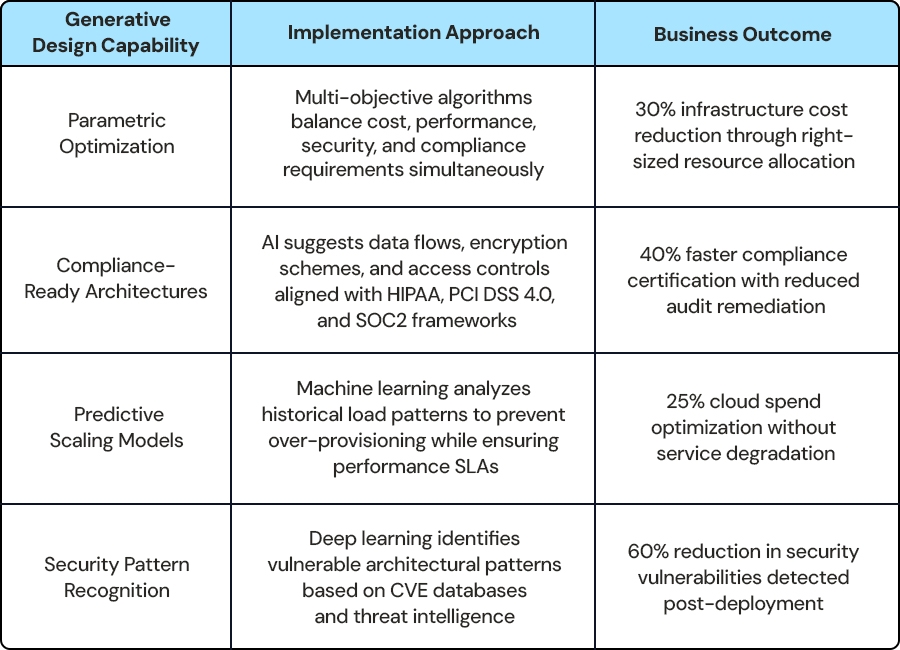
Consider a healthcare SaaS provider building a patient engagement platform. Through product engineering consulting with AI-powered design tools, they received validated architectural options within days complete with compliance validation, cost projections, and performance benchmarks. The AI-designed microservices architecture accelerated their HIPAA certification by 40% while reducing projected infrastructure costs by 28%.
Intelligent Code Generation and DevOps Automation
Development velocity and code quality have traditionally been opposing forces. AI-powered product engineering solutions resolve this tension through context-aware code generation and intelligent automation.
Code assistants like GitHub Copilot and Amazon CodeWhisperer now generate syntactically and semantically correct code that matches project-specific style guides. These tools understand architectural patterns, suggest optimal algorithms, and even refactor legacy code for improved performance and maintainability.
DevOps intelligence delivers measurable improvements:
ML-driven pipeline orchestration reduces build times by 35% through intelligent job scheduling
Predictive deployment validation prevents 70% of would-be production incidents
Automated security hardening continuously updates vulnerable dependencies, reducing security incidents by 70%
Cost optimization algorithms achieve 28% average cloud infrastructure savings
A retail e-commerce platform implemented AI-powered DevOps through digital product engineering services during their PCI DSS 4.0 certification process. The intelligent automation accelerated their compliance timeline while deployment frequency increased from weekly to multiple times daily with zero downtime.
Automated Testing and Quality Assurance at Scale
Testing bottlenecks have plagued software development since the industry's inception. AI-driven product engineering services fundamentally solve this problem through self-healing test automation and intelligent test generation.
The quality assurance transformation includes:
Self-healing test automation that adapts to interface changes automatically, reducing QA maintenance overhead by 60%
LLM-powered test generation that creates comprehensive test suites from user stories
Defect prediction models that flag likely problem areas in code before testing begins
Root cause analysis that accelerates debugging by correlating test failures with code changes
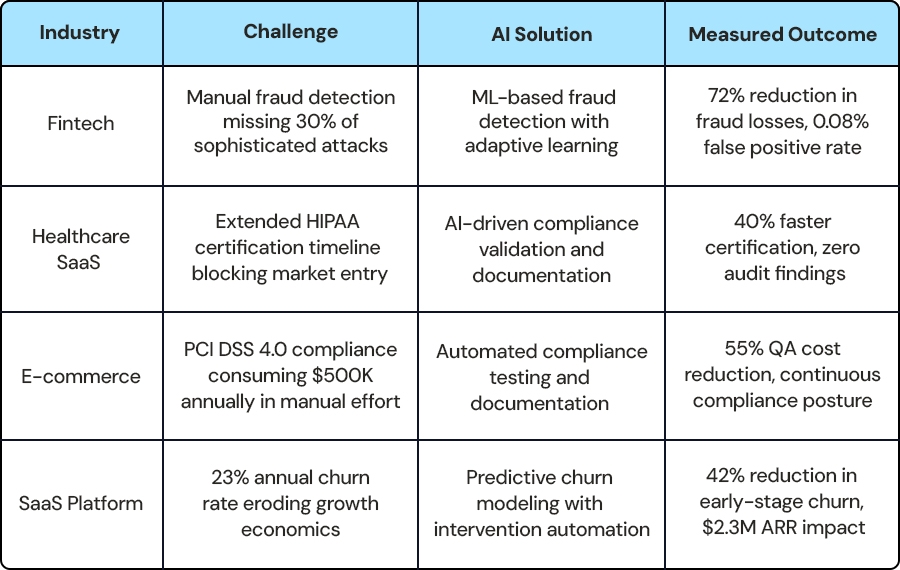
For regulated industries, this capability is particularly valuable. A payment processor achieved PCI DSS 4.0 compliance while reducing QA costs by 55% through AI-powered testing provided by product engineering consulting experts.
Industry-Specific Applications: AI Where It Matters Most
Fintech: Fraud Detection and Dynamic Compliance
Financial services face unique challenges fraud tactics evolve daily, regulatory requirements change frequently, and customer expectations for seamless experiences continue to rise.
Real-time fraud detection systems process transaction patterns in milliseconds, adapting to new fraud tactics without manual rule updates. Leading payment processors now detect fraud with 95% accuracy while maintaining false positive rates below 0.1%.
LLM-powered compliance copilots parse regulatory changes, validate existing implementations against new requirements, and generate compliance documentation automatically. A payment processor implementing AI-driven fraud detection and compliance automation achieved a 72% reduction in fraud losses and 60% faster compliance audit preparation.
Healthcare: HIPAA-Compliant Digital Products
Healthcare technology providers operate under intense regulatory scrutiny. Product engineering services specializing in healthcare leverage AI for privacy-preserving analytics, automated audit trail generation, and continuous compliance monitoring.
Technical implementation includes differential privacy techniques that enable analytics while mathematically guaranteeing individual privacy, automated encryption key management, and continuous compliance monitoring that alerts teams immediately when configuration changes create compliance risks.
SaaS: Adaptive Personalization and Churn Prevention
Software-as-a-Service companies face intense competition and rising customer acquisition costs. AI-powered digital product engineering services deliver behavioral analytics engines that track granular usage patterns, identifying at-risk customers with 85% accuracy well before they churn.
Business outcomes from SaaS personalization:
35% improvement in trial-to-paid conversion through optimized onboarding sequences
42% reduction in early-stage churn via proactive intervention
28% increase in expansion revenue from AI-recommended upsell timing
50% reduction in support ticket volume through predictive assistance
Implementation Framework: From Strategy to Production
Successful AI integration in product engineering requires systematic execution:
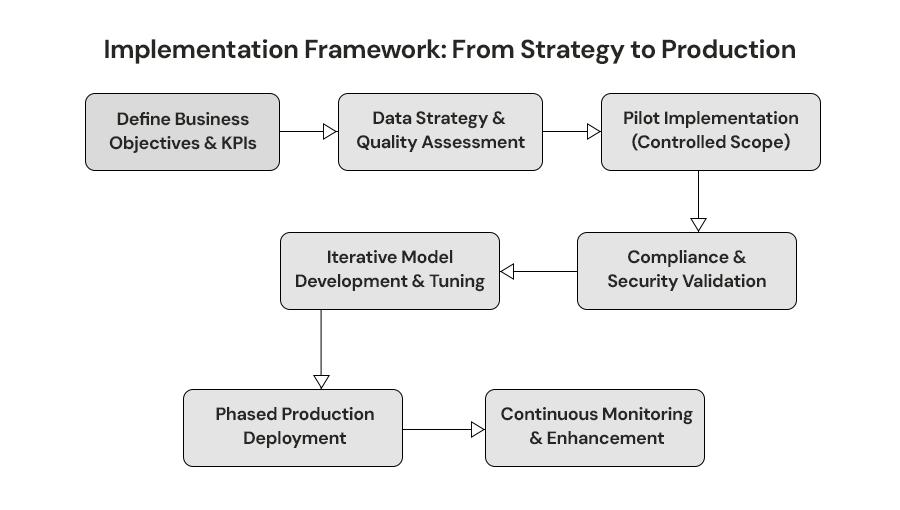
Phase 1: Define Business Objectives & KPIs - Successful AI projects begin with clear, measurable objectives tied to business outcomes: faster time-to-market, reduced operational costs, improved compliance posture, or enhanced customer experience.
Phase 2: Data Strategy & Quality Assessment - AI models are only as good as their training data. This phase audits existing data quality, establishes data labeling pipelines, and implements versioning systems.
Phase 3: Pilot Implementation - Start with a controlled pilot focused on a high-impact, achievable use case in a non-production environment with clear success criteria.
Phase 4: Compliance & Security Validation - Execute comprehensive security testing including OWASP vulnerability assessment, penetration testing, and privacy impact analysis.
Phase 5: Iterative Model Development & Tuning - Fine-tune models using production-like data, feedback loops, and automated hyperparameter optimization.
Phase 6: Phased Production Deployment - Deploy gradually using feature flags, canary releases, or blue-green deployment strategies with comprehensive observability.
Phase 7: Continuous Monitoring & Enhancement - Establish ongoing monitoring for model accuracy, bias, and drift with automated retraining pipelines.
Overcoming Common Implementation Challenges
Data Quality and Availability
Digital product engineering services address insufficient training data through automated ETL pipelines, data versioning systems, and synthetic data generation techniques. A fintech company implemented synthetic fraud generation based on known patterns, improving model accuracy by 40% without compromising customer privacy.
Model Bias and Regulatory Risk
Addressing bias requires continuous fairness audits across demographic segments, explainability frameworks, and human-in-the-loop validation for high-stakes decisions. Technical implementation includes fairness metrics integrated into model evaluation pipelines and adversarial testing.
Legacy System Integration
Product engineering solutions solve integration challenges through wrapper APIs, event-driven architecture, and containerized adapters. A manufacturing company integrated AI-powered quality inspection with decades-old factory systems, delivering ROI in months rather than years.
Choosing the Right Product Engineering Partner
When evaluating partners, U.S. decision-makers should assess several critical factors:
Regulatory expertise matters enormously for compliance-critical industries. Providers should demonstrate proven track records with HIPAA, PCI DSS 4.0, SOC2, and emerging AI-specific regulations.
Industry-specific experience translates directly to faster implementation and better outcomes. A provider with deep fintech experience understands fraud patterns, payment processing architecture, and financial regulatory requirements.
End-to-end capability ensures continuity from strategy through ongoing optimization, preventing integration challenges and accountability gaps.
Transparent ROI frameworks demonstrate provider confidence and client focus with clear KPI definitions and measurement methodologies defined upfront.
Scalable architecture prevents technical debt accumulation, handling 10x user scaling without architectural rewrites.
Real Results: Measured Outcomes from AI-Driven Product Engineering
The Future: Where Product Engineering Is Heading
AI will autonomously execute significant portions of the product engineering lifecycle. Multi-agent systems will coordinate across development, testing, deployment, and monitoring with minimal human intervention.
Forward-thinking organizations are already implementing:
Compliance-as-code frameworks that adapt automatically to regulatory changes
Self-optimizing architectures that continuously benchmark performance and cost
Autonomous quality assurance where AI agents generate tests, execute validation, and fix detected defects
The question for technology leaders isn't whether AI will transform digital product engineering services it's whether your organization will lead this transformation or scramble to catch up.
Getting Started: Your Path to AI-Powered Product Engineering
Whether you're building new digital products, modernizing legacy systems, or seeking faster compliance certification, specialized product engineering services can compress your timeline while reducing execution risk.
Our digital product engineering consulting team helps enterprises:
Design and architect AI-ready, compliance-compliant systems that meet regulatory requirements from day one
Implement intelligent DevOps and automated quality assurance that accelerates delivery
Integrate AI capabilities across your product lifecycle from requirements through post-launch optimization
Navigate U.S. regulatory requirements including HIPAA, PCI DSS 4.0, SOC2, and emerging AI-specific regulations
TL;DR
Key Takeaways on AI-Driven Product Engineering Services:
AI transforms every product lifecycle stage - AI-powered product engineering services deliver 40-60% faster time-to-market while improving quality and compliance
Industry-specific applications drive ROI - Fintech fraud detection (72% loss reduction), healthcare HIPAA compliance (40% faster certification), and SaaS churn prevention (42% retention improvement) demonstrate measurable business outcomes
Generative design optimizes architecture - AI suggests compliant, scalable architectures that reduce infrastructure costs by 25-30% while accelerating regulatory certification
Self-healing test automation solves QA bottlenecks - AI-powered testing reduces maintenance overhead by 60% while generating comprehensive test coverage automatically
Systematic implementation ensures success - Proven frameworks starting with pilot validation deliver measurable ROI before scaling to full production
Choosing the right partner matters - Look for regulatory expertise, industry-specific experience, end-to-end capability, and transparent ROI frameworks when evaluating digital product engineering consulting providers
About Our Product Engineering Services: We partner with U.S. enterprises to design, build, and optimize digital products using cutting-edge AI and automation. Our expertise spans fintech, healthcare, and SaaS with proven success in regulatory compliance, cloud architecture, and accelerated time-to-market.
From idea to compliance-ready launch let AI optimize your product lifecycle.