

 Updated on 25 June 2026

Picture a Monday morning in the emergency department. Volume climbs faster than the weekend schedule anticipated, two nurses called in overnight, and the discharge queue from the previous shift still hasn't cleared. Beds aren't turning over, wait times cross four hours by mid-morning, and the operations team spends the rest of the day reacting to a situation that had visible early signals buried in scheduling, admissions, and bed-management data well before anyone noticed anything was wrong on the floor.
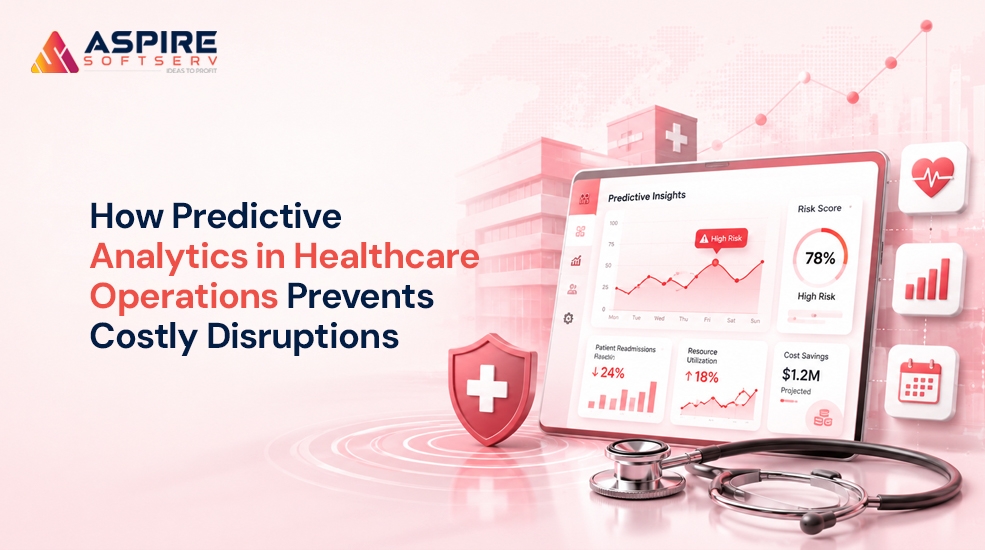
Predictive analytics in healthcare operations addresses exactly this gap. It takes data that already exists inside most hospital systems and turns it into operational foresight: a staffing shortfall visible 48 hours before the shift, a discharge bottleneck flagged before it backs up into the ED, a seasonal demand surge anticipated days in advance rather than absorbed mid-week. The goal isn't a perfectly accurate algorithm. It's enough visibility, early enough, to make a different decision.
When It's Worth Considering
Most organizations already have the data needed to start forecasting. The question is whether the operational problems showing up regularly are the kind that earlier visibility would actually help solve. A few patterns consistently signal the timing is right:
Staffing shortages appearing unpredictably across different shifts and units
Emergency department wait times trending upward despite no change in volumes
Bed utilization swinging between overcapacity and underuse without clear cause
Discharge delays pushing readmission risk higher, driven by transport or pharmacy lag rather than clinical factors
Demand forecasting still done manually, based on last week's census
If two or more of these are familiar, the data for a forecasting program almost certainly already exists it just isn't being used that way yet.
Key Takeaways
Predictive analytics in healthcare operations helps teams anticipate staffing gaps, patient surges, and bed shortages before they escalate shifting the operating model from constant reaction to informed planning
The forecasting model is rarely the hard part; the data pipelines, infrastructure, and workflows that turn an alert into an action are what determine whether a pilot survives past the first department
Most analytics initiatives fail not because the model is wrong, but because the surrounding engineering foundation data integration, cloud infrastructure, user-facing workflow was never properly built
A short readiness check (below) can clarify what needs to be addressed before investing in a full platform build
The Operational and Financial Cost of Reacting Too Late
The same handful of issues drive most hospital operational disruptions, and they compound each other in a predictable cycle: a staffing gap drives overtime, overtime drives burnout, and burnout drives turnover that makes the next staffing gap worse.
According to the NSI Nursing Solutions 2023 National Healthcare Retention Report, the average cost of replacing a single registered nurse including recruitment, onboarding, and temporary agency coverage exceeds $52,000. The Agency for Healthcare Research and Quality estimates that unplanned ED crowding delays care for admitted patients by three to eight hours on average, with downstream effects on both patient satisfaction and length-of-stay costs. These aren't edge-case expenses; they're recurring operational losses that most systems have simply accepted as the cost of running a hospital.
Predictive analytics in healthcare operations changes the math by making the warning visible earlier not by eliminating operational variance, but by giving teams time to respond before variance becomes a crisis.
| Operational Challenge | Typical Downstream Impact |
|---|---|
| Unplanned staffing shortages | Higher overtime spend, burnout acceleration, elevated RN turnover |
| Bed capacity gaps | Admission delays, declining patient satisfaction scores |
| Discharge bottlenecks | Extended stays, higher readmission risk |
| Seasonal demand surges | Overcrowding, strained on-call coverage |
| Equipment or resource shortages | Delayed procedures, underutilized high-cost assets |
Where Predictive Analytics Creates the Most Operational Value
Hospital staffing forecasts are usually where organizations start, and for good reason. Analyzing historical admission patterns, seasonal trends, and shift-by-shift variation can surface staffing demand 24 to 72 hours ahead giving managers time to call in coverage before a shortage becomes an emergency rather than after. The data requirements are also typically the most manageable: scheduling, HR, and admissions feeds that most systems already maintain. Getting from raw data to a reliable forecast, though, requires clean, integrated pipelines a data engineering challenge that needs to be solved before any model can be trusted for operational decisions.
Patient flow and bed management is where the second wave of value tends to come from. Long ED waits and slow discharges often share the same root cause: no one can see a bottleneck forming until it's already cascading through the department. Forecasting admission and discharge volumes by hour helps bed managers reallocate ahead of the backlog rather than after it. According to AHRQ data, discharge delays alone extend average stays by several hours a direct driver of both cost and patient satisfaction that earlier visibility can meaningfully reduce.
Seasonal demand forecasting matters most in the weeks surrounding flu season, major holidays, and summer injury peaks, when volume spikes can arrive faster than traditional staffing processes can respond. Combining historical admission data with external signals regional health trends, school calendars, local events gives operations leaders enough lead time to pre-position staff and inventory without waiting for the surge to become visible on the census.
Discharge queue management is a quieter but consistent bottleneck. Transport delays, bed-cleaning backlogs, and pharmacy sign-off timing often hold beds unavailable for new admissions even when the clinical team has cleared the patient. Flagging these a few hours in advance, before they compress bed availability for incoming cases, supports faster throughput without requiring additional headcount
Each of these use cases depends on more than a well-trained model. The forecast has to connect to the system the floor manager actually uses, route to someone with the authority and time to act, and update as patient patterns shift. That's not a modeling problem it's a product engineering problem.
Why Most Healthcare Analytics Projects Don't Outlast the Pilot
The failure pattern is consistent across organizations. The model works in testing, the pilot runs across one or two departments, and then nothing really changes about how the floor operates. The most common reasons:
Operational data lives in systems EHR, HR, scheduling, bed management that weren't designed to share information, so the data pipeline is rebuilt manually and breaks
No scalable cloud foundation, so expanding beyond the pilot environment becomes a months-long infrastructure project
The dashboard was designed for the analytics team, not the operations manager who needs a clear action in the first 30 seconds of looking at it
Models aren't monitored after go-live, accuracy drifts quietly, and trust erodes before anyone can diagnose the problem
The project was treated as a one-time deliverable rather than an ongoing product that needs to be maintained and improved
This is the practical reason most successful implementations treat predictive analytics as a product engineering initiative rather than a data science project because the model is only one layer of what actually has to work.
| Operating Mode | What It Looks Like Day to Day |
|---|---|
| Reactive operations | Staffing decided shift by shift, bottlenecks discovered after they form, manual spreadsheet forecasting, high and unpredictable overtime |
| Predictive operations | Staffing gaps visible 48–72 hours ahead, bed alerts surfaced before backlogs form, models maintained and retrained on a regular cycle |
What a Well-Built Implementation Actually Requires
A forecast that reaches the right person at the right time, in a format they trust enough to act on, requires four layers working together not just the AI layer:
Clean, integrated data across HR, EHR, scheduling, and bed management, with consistent quality checks and HIPAA-aligned governance throughout.
Scalable cloud infrastructure that can handle real-time data feeds from multiple systems, grow as the program expands beyond the pilot, and maintain the security controls that healthcare data demands. This is the work of Cloud and DevOps Engineering, not an add-on once the model is ready.
AI and forecasting models trained on the organization's own historical patterns, monitored for accuracy drift, and retrained as patient volumes and seasonal norms shift. Aspire's AI/ML development work in healthcare and HCM including engagements with enterprise and Fortune 500 clients consistently shows that model maintenance is where most organizations underinvest, and where accuracy quietly deteriorates.
An operational workflow that routes each forecast to the person with both the authority and the time to act on it. The best model in the world doesn't change outcomes if the alert lands in an inbox that a floor manager checks twice a day.
These four layers are also where Product Strategy & Consulting, Product Design and Prototyping, Software Product Development, and Cloud and DevOps Engineering connect to the analytics work directly. A readiness assessment, early prototyping with actual operations managers, and a proper integration plan are the upstream decisions that determine whether the downstream model ever gets used. Explore how Aspire approaches healthcare software development end-to-end for more on how these layers are sequenced in practice.
A Quick Readiness Check Before You Start
Before committing to a platform build or even a serious vendor evaluation a short internal readiness check usually surfaces the most expensive surprises early:
Data readiness: Is operational data from HR, EHR, and scheduling centralized and consistently formatted, or does it require manual reconciliation today?
Infrastructure readiness: Is there a secure, scalable cloud environment in place, or would a forecasting platform be the first workload of this type?
Integration readiness: Can a new tool connect to existing bed management and scheduling systems, or would significant middleware work be required first?
Workflow readiness: Is there a named owner for each type of forecast alert someone with the authority to act on it within the window the alert provides?
Security readiness: Are HIPAA-aligned access controls and audit trails already built into the data environment, or would those need to be established as part of the implementation?
Scoring honestly against these five areas typically reveals more about implementation risk than any vendor demo will. Organizations that skip this step usually discover the gaps mid-project, when changing direction costs significantly more.
A Realistic First 90 Days
Most organizations don't need a 12-month program to generate early operational value. A phased approach gets to a working pilot faster and surfaces integration issues while they're still cheap to fix:
Weeks 1–4: Audit data sources across HR, EHR, and scheduling. Define the top two or three operational problems to address first staffing forecasts are typically the fastest to validate. Assess what tooling fits the existing environment without requiring a full infrastructure rebuild.
Weeks 5–8: Build a pilot focused on one use case. Test with one or two departments and collect structured feedback from the managers using the tool daily, not just from the analytics or IT team.
Weeks 9–12: Expand to additional departments, formalize cloud infrastructure and security controls, and measure early impact on overtime spend, wait times, or discharge timing before committing to a broader rollout.
Starting narrow builds the operational trust that forecasting tools need to scale and surfaces the data and integration issues that are always easier to fix at pilot scale than at enterprise scale.

Conclusion
The operational pressures facing healthcare systems staffing volatility, unpredictable demand, bed constraints aren't disappearing. What changes with predictive analytics in healthcare operations is how much of that volatility can be anticipated rather than absorbed. A forecast that fires 48 hours before a staffing gap appears, or a few hours before a discharge bottleneck blocks a dozen beds, gives operations teams genuine choices they don't have when the signal only arrives after the problem is already visible on the floor.
Getting there requires more than a good model. It requires clean data, secure cloud infrastructure, and a workflow that people will actually use built as a unified product rather than assembled in pieces over time. Organizations that treat this as a product engineering initiative from the start tend to see results that hold past the pilot phase. Those that don't usually end up rebuilding the foundation anyway, at higher cost and with more organizational friction.
If the patterns described here feel familiar, the most useful next step is a readiness conversation not a model selection, but an honest look at what your current data and infrastructure can actually support today.
Build predictive healthcare solutions faster