

 Updated on 9 June 2026

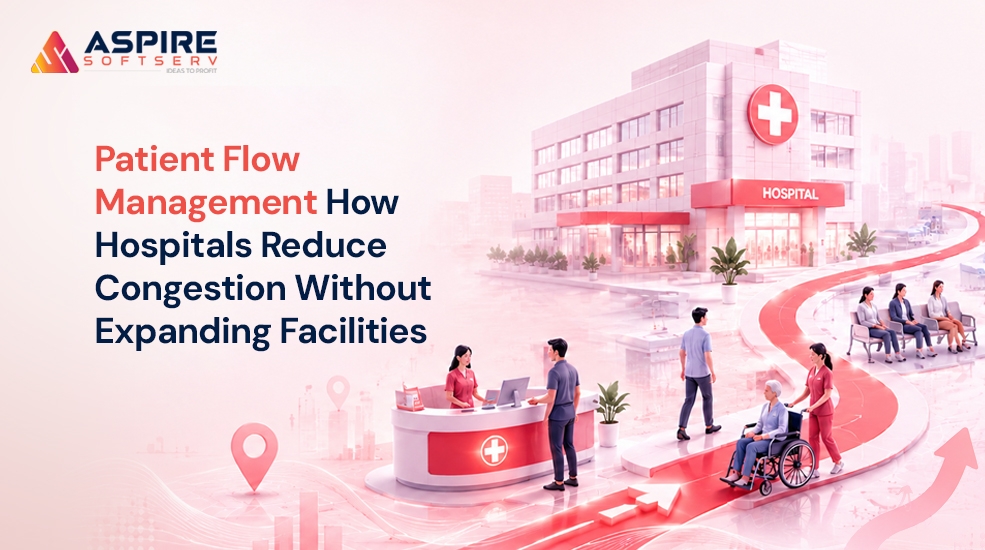
The Real Cost of Patient Congestion
Every minute a patient spends waiting in a crowded ED or outpatient clinic has a measurable cost not just to their experience, but to hospital revenue, staff morale, and clinical outcomes. Yet most hospitals already have EHR systems, scheduling software, and reporting tools in place. So why does congestion persist?
The answer is almost never a lack of technology. It is a lack of integration. Patient data, scheduling data, and operational data live in disconnected systems that cannot communicate in real time. Staff make decisions based on incomplete information. Bottlenecks go undetected until they become crises.
At Aspire Softserv, our healthcare engineering teams have seen this pattern consistently hospitals with the right integration architecture reduce congestion measurably within the first 90 days of implementation. This is precisely where product engineering services become critical. A hospital does not need more software it needs a connected digital platform built around its actual clinical workflows.
Why Congestion Happens: Understanding the Root Causes
Before designing any solution, operations and technology teams need to diagnose the specific causes of congestion in their facility. The most common root causes include:
Mismatched capacity and demand: Arrival patterns vary widely between scheduled appointments and walk-ins, and most hospitals lack enough buffer capacity during peak hours.
Inefficient scheduling: Overbooking, poorly designed appointment slots, and high no-show rates create uneven load throughout the day.
Bottlenecks in care pathways: Diagnostic imaging, lab results, registration, and discharge processes frequently create serial delays that ripple downstream.
Poor real-time visibility: Without live patient flow analytics, supervisors cannot intervene quickly when queues build up.
Fragmented workflows: Handoffs between departments that are not coordinated lead to cascading waits that no single team can see or solve alone.
A data-driven assessment combining time-motion studies, EHR event timestamps, and hospital bottleneck analysis is the essential starting point for any meaningful improvement program.
The Core Framework: Measure, Optimize, Automate
Reducing hospital operational efficiency gaps requires a structured approach. The most effective framework moves through three stages:
Measure comes first. Hospitals must build full observability into their patient journeys collecting timestamps at arrival, registration, triage, room entry, diagnostics, consult start and end, and discharge. Integrating EHR events, scheduling system logs, and RTLS data into centralized healthcare operational dashboards gives operations teams the situational awareness they currently lack.
Optimize follows. Using queueing theory and hospital capacity management analysis, teams identify where to redesign appointment templates, parallelize diagnostic workflows, adjust triage rules, and realign staffing to match actual demand patterns rather than historical assumptions.
Automate is where technology creates lasting change. Scheduling platforms, pre-authorization workflows, digital intake forms, and rules-based escalation alerts all reduce the human effort required to manage routine processes freeing clinical staff to focus on care rather than coordination.
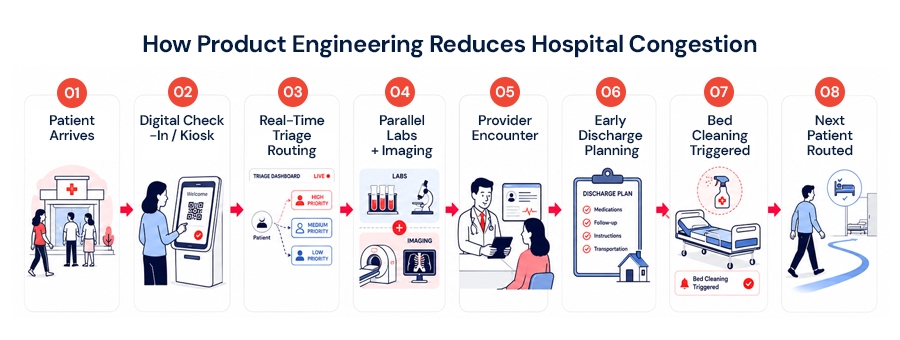
Integrated healthcare platforms built through software product development enable each step to communicate automatically, eliminating the handoff delays that cause congestion.
How Healthcare Product Engineering Solves What Software Alone Cannot
A hospital congestion solution is rarely a single product. It requires multiple systems scheduling, queue management, analytics, EHR integrations, and AI models working as a unified platform. This is what modern healthcare product engineering delivers.
Teams specializing in Product Strategy & Consulting help hospitals map their current workflows, identify integration gaps, and define a technology roadmap aligned to operational goals. This phase prevents the common mistake of deploying tools that do not connect to each other or to clinical realities on the ground.
Product Design and Prototyping ensures that dashboards, patient-facing apps, and clinical decision interfaces are built around how staff and patients actually behave not how engineers assume they do. Usability at the point of care is not optional; a dashboard that nurses ignore is worthless regardless of how sophisticated its data model is.
Software Product Development then brings the integrated platform to life building or customizing the scheduling engine, queue management system, patient intake workflows, and analytics layer as a cohesive system rather than a collection of bolt-on tools.
Finally, Cloud and DevOps Engineering provides the infrastructure backbone. Cloud-native architectures give hospitals the elasticity to handle demand spikes, while DevOps pipelines allow rapid iteration and continuous improvement without system downtime.
Real Solutions That Reduce Patient Congestion
Hospitals investing in patient journey optimization typically deploy three interconnected platform components:
Doctor Appointment & Scheduling Platforms Modern patient scheduling software goes far beyond a booking calendar. Effective platforms support dynamic slot allocation based on service time distributions, predictive no-show modeling, staggered block scheduling for resource-intensive procedures, and multichannel booking across web, mobile, and phone.
Key benefits include:
Reduced no-show rates through automated reminders and confirmation workflows
Smarter overbooking based on historical demand data
Better utilization of specialist time and procedure rooms
Seamless EHR integration via HL7/FHIR standards
Hospital Queue Management Systems Real-time hospital queue management platforms give operations teams live visibility into every queue in the facility. Using RTLS tags or mobile-based geolocation, these systems track patient movement, flag prolonged waits, and surface bottlenecks before they escalate.
Key benefits include:
Predictive wait time estimation displayed to patients and staff in real time
Department-level patient flow analytics for continuous monitoring
Automated escalation alerts when wait thresholds are breached
Data feeds for retrospective hospital workflow management analysis
Patient Registration & Digital Intake Workflows Pre-visit digital registration eliminates one of the most consistent congestion points: the front desk. When patients complete consent forms, insurance verification, and intake questionnaires before they arrive, registration becomes a brief confirmation rather than a data-collection session.
Key benefits include:
Faster patient onboarding and reduced front-desk queuing
Fewer downstream errors from manual data entry
Earlier insurance and authorization confirmation
Reduced registration time enabling faster triage
TABLE 1: Common Congestion Causes and Product Engineering Solutions
| Root Cause | Product Engineering Solution | Expected Outcome |
|---|---|---|
| Appointment overloading | Dynamic scheduling platform with no-show prediction | Balanced daily load, reduced no-shows |
| No real-time visibility | RTLS + healthcare operational dashboards | Faster bottleneck detection, reduced idle time |
| Serial diagnostic delays | Parallel order workflows via standing orders | Lower visit duration, higher patient throughput |
| Manual registration | Digital intake + automated pre-authorization | Faster onboarding, fewer admin errors |
| Discharge delays | Predictive discharge planning tools | Shorter length-of-stay, better bed availability |
| Fragmented data systems | Cloud-native integrated platform | Single source of truth for patient flow management |
AI and Predictive Analytics: Where the Biggest Gains Come From
AI in hospital operations is not a future concept it is deployable today through well-structured healthcare analytics pipelines built on clean operational data.
Predictive wait time estimation combines current queue lengths, staffing levels, scheduled appointments, and historical arrival patterns to forecast wait times one to four hours ahead. This gives charge nurses and flow coordinators the lead time to act proactively rather than reactively.
Demand forecasting uses time-series models trained on historical arrival data to predict daily and hourly patient volumes for clinics and emergency departments. According to McKinsey Health research, hospitals that implement AI-driven demand forecasting reduce scheduling inefficiencies by up to 30%, directly improving healthcare resource utilization.
Patient flow analytics built on process-mining techniques applied to EHR event logs can uncover hidden serial dependencies places where one step cannot begin until another completes, even when that dependency is not clinically necessary. Eliminating unnecessary sequential steps is one of the fastest ways to drive patient wait time reduction without adding any resources.
Healthcare resource planning using optimization algorithms can propose shift schedules, room assignments, and staff deployment patterns that meet forecasted demand while respecting budget and compliance constraints.
GRAPH 1 Bar Chart
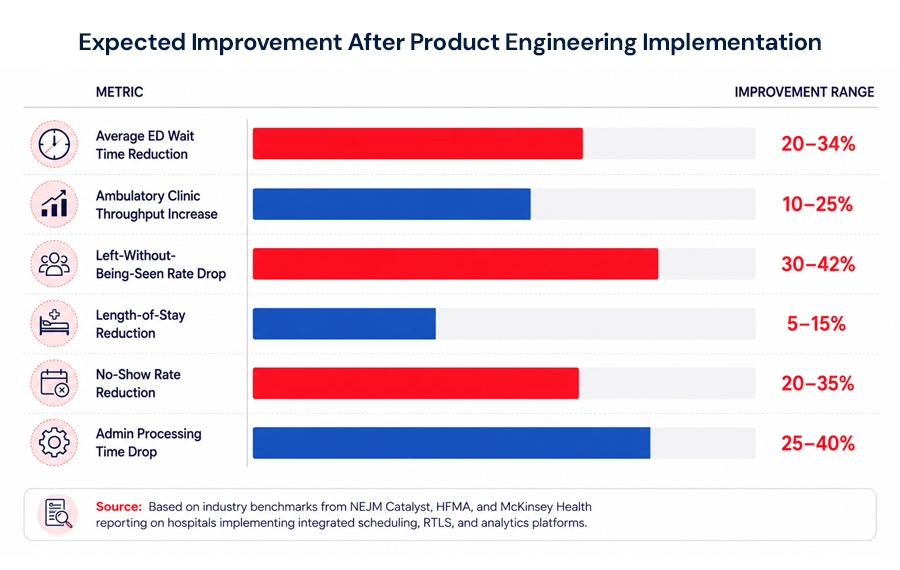
ndustry-reported outcomes for hospitals implementing hospital queue management, scheduling optimization, and healthcare workflow automation through structured product engineering programs. Source: NEJM Catalyst, HFMA, McKinsey Health.
GRAPH 2 Line Chart
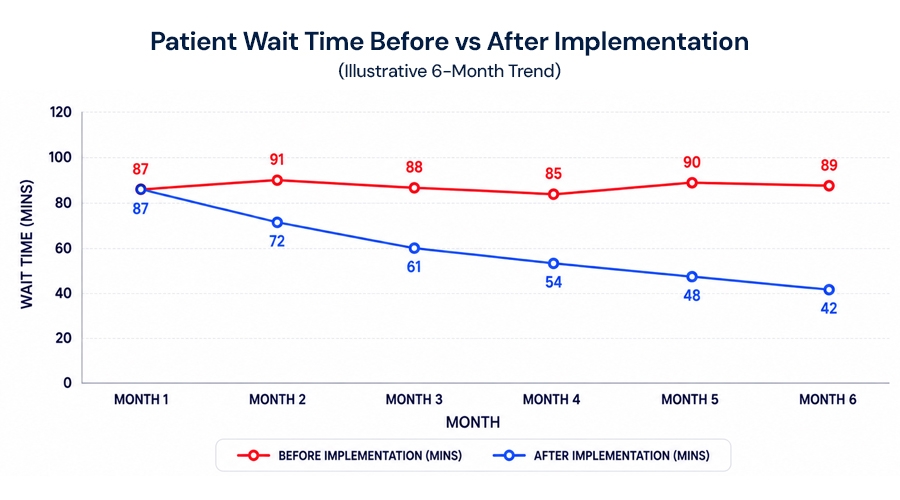
Hospitals using predictive wait time estimation and hospital queue management platforms consistently see wait time reduction accelerate after Month 2 as the system learns demand patterns. Projection modeled on HFMA and NEJM Catalyst benchmark ranges.
TABLE 2: Typical Interventions vs. Business Outcomes
Outcome ranges sourced from NEJM Catalyst, HFMA operational benchmarks, and McKinsey Health hospital efficiency research.
| Intervention | Business Outcome | Timeline to Impact |
|---|---|---|
| Appointment scheduling optimization | Reduced no-shows, balanced load, higher revenue per slot | 1–3 months |
| RTLS + real-time dashboards | Faster bottleneck response, reduced overtime | 2–4 months |
| Parallel diagnostic workflows | Lower visit duration, higher daily throughput | 1–2 months |
| Digital intake + admin automation | Reduced registration time, fewer delays | 1–3 months |
| AI-powered demand forecasting | Better staff utilization, lower agency costs | 3–6 months |
| Integrated cloud platform | Organization-wide visibility, scalable improvement | 6–12 months |
Business Impact: What Hospital Leadership Actually Cares About
For hospital CEOs, COOs, and digital transformation leaders, the question is not which technology to buy it is what outcome it delivers and how quickly. According to HFMA research on hospital operational efficiency, integrated digital platforms consistently deliver:
Increased patient throughput without adding beds or staff headcount
Reduced staff overtime costs through smarter scheduling and healthcare automation solutions
Improved patient satisfaction scores, which directly affect reimbursement in value-based care models
Lower patient abandonment rates in emergency departments
Higher utilization of specialist time, procedure rooms, and diagnostic equipment
Fewer elective surgery cancellations caused by bed shortages
Modeling these interventions across a 300-bed regional hospital implementing integrated scheduling, RTLS-based hospital queue management, and operational dashboards projects potential outcomes of: ED wait time reductions of 30–35%, ambulatory throughput gains of 15–20%, and left-without-being-seen rate improvements of 35–45% within a six-month implementation window. These projections align with ranges published by NEJM Catalyst and validated through Aspire Softserv's healthcare engineering engagements.
Implementation Roadmap: How to Start
Healthcare workflow optimization at scale does not happen in a single deployment. The most successful programs follow a phased approach:
Baseline measurement Run process mining on existing EHR event logs to identify the top three to five bottlenecks
Pilot analytics Deploy dashboards and run retrospective predictive models on historical data to validate hypotheses
Scheduling improvements Implement appointment scheduling optimization and no-show prediction for the highest-volume service lines first
Real-time tracking Instrument high-volume units with RTLS or mobile tracking and connect to live dashboards
Automation layer Automate registration, pre-authorizations, and administrative handoffs
Scale and govern Expand successful pilots across the facility with a dedicated flow governance team maintaining performance cadence
What to Look for in a Product Engineering Partner
Hospitals evaluating technology partners for hospital capacity management and healthcare process improvement should look beyond software features. The right product engineering services partner brings:
Proven EHR integration experience with HL7/FHIR compliance
API-first architecture enabling real-time data exchange between systems
Healthcare regulatory expertise covering HIPAA and relevant data privacy requirements
Cloud and DevOps Engineering capabilities for scalability and rapid iteration
Domain knowledge of clinical workflows, not just software development skill
End-to-end capability spanning Product Strategy & Consulting, Product Design and Prototyping, and Software Product Development under one roof
Teams that combine strategy through implementation under one roof deliver faster results because they maintain continuity reducing the translation loss that occurs when strategy consultants hand off to separate development teams. Aspire Softserv's healthcare engineering practice is structured precisely this way, ensuring that what is designed in discovery is what gets built and deployed.
Conclusion
Patient flow management is an operational problem with an engineering solution. Hospitals that reduce wait times and improve throughput without building new facilities do so by replacing disconnected legacy systems with integrated, cloud-native platforms built on real-time data, intelligent scheduling, and AI-powered forecasting.
The technologies required patient scheduling software, hospital queue management systems, healthcare operational dashboards, and predictive analytics engines exist today. The challenge is integrating them into a coherent platform that clinical staff will actually use and that operations leaders can rely on for real-time decision-making.
That integration challenge is where healthcare product engineering creates decisive value. By combining Product Strategy & Consulting, Product Design and Prototyping, Software Product Development, and Cloud and DevOps Engineering into a unified delivery model, the right partner does not just install software they build the operational infrastructure that makes sustainable hospital operational efficiency improvement possible.
If your hospital is experiencing the warning signs of congestion long wait times, overloaded front desks, underutilized physicians, or poor real-time visibility a focused healthcare workflow optimization assessment is the right starting point. The bottlenecks are identifiable. The solutions are proven. The question is whether your current systems are connected enough to act on them.
Need Healthcare Product Engineering Talent?