

 Updated on 12 May 2026

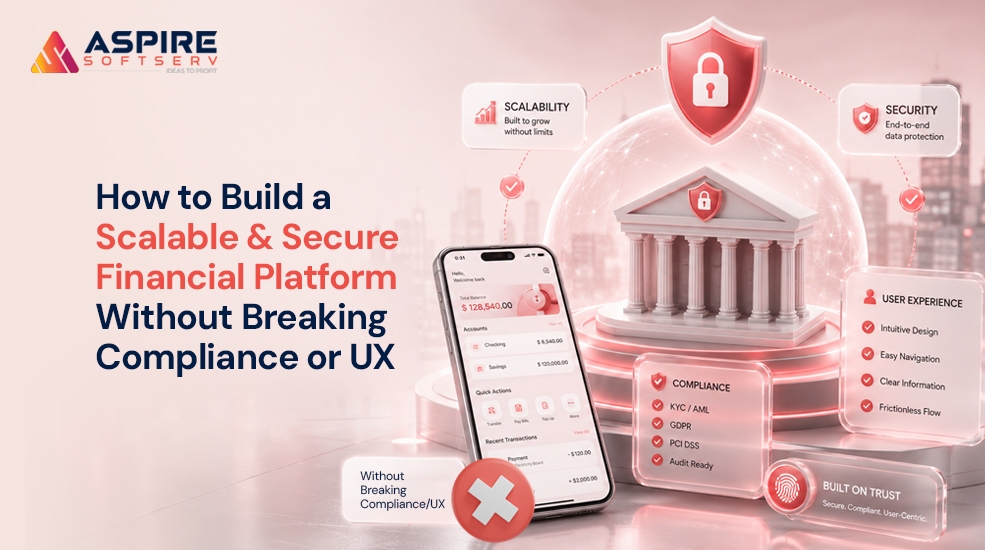
In simple terms: A scalable fintech platform is built using cloud-native microservices, embedded compliance, and DevOps automation designed from day one to handle growth, audits, and user experience together.
If you're a CTO, founder, or product leader working on financial platform development, you already know the pressure: users want speed, regulators want control, and investors want growth. Getting all three right simultaneously is where most teams stumble and where the cost of getting it wrong compounds fastest. Many scaling teams turn to specialized product engineering services at this exact stage, not because their internal team lacks skill, but because the architecture decisions made in the next 60 days will define their cost structure for the next three years.
A 2025 Deloitte report found that 68% of fintech failures trace back to weak fintech compliance solutions or scalability bottlenecks. These aren't execution failures they're architecture failures that started in the first few weeks of design. The cost shows up later as compliance fines, revenue-killing downtime, and onboarding drop-off that wastes every dollar of CAC you've spent.
This guide covers exactly how to approach financial software development so compliance, performance, and user experience reinforce each other rather than pulling in opposite directions whether you're leading fintech product development at a startup or scaling enterprise fintech solutions toward your next funding round.
"Most fintech failures happen because compliance and scalability are treated as afterthoughts instead of architecture decisions."
Is Your Fintech Platform Heading for Failure?
Before diving into solutions, recognize the warning signs. Most teams don't catch these early enough:
Onboarding flows taking longer than 3 minutes (average abandonment hits 40% per Forrester)
Infrastructure costs rising faster than user growth
Compliance reviews delaying every release cycle
Frequent downtime during transaction peaks
Security reviews happening after development, not during
If any of these sound familiar, your platform's architecture not your team is the root cause.
Should You Re-Architect Your Fintech Platform?
Before committing to a full architecture overhaul, run through this checklist. If you answer yes to three or more, your platform has architectural debt that will cost more the longer you wait to address it.
Are releases consistently taking more than two weeks from code-complete to production?
Are compliance audits blocking or delaying release cycles?
Is infrastructure cost growing faster than your active user base?
Do transaction failures during peak load require manual intervention to resolve?
Has adding a new product line (lending, insurance, investments) required significant refactoring?
Are your engineers spending more time on operational firefighting than feature development?
Do different teams share the same database, creating deployment dependencies?
If you checked three or more boxes, the sections below on architecture patterns and re-architecture timing apply directly to your situation.
What This Means for Business Outcomes
Technical debt in financial application development doesn't stay technical. It becomes a business problem fast and the numbers are specific enough that they belong in board-level conversations.
Poor architecture → 2–3x development cost. Retrofitting compliance and scalability after the fact costs exponentially more than designing for them upfront. Teams spend months re-engineering instead of shipping features that generate revenue.
Compliance rework → 40–60% project delays. When regulatory requirements aren't embedded from the start, they surface during testing or post-launch halting releases at the worst possible time. For US fintech companies facing SEC, FINRA, or OCC oversight, these delays aren't just expensive they're legally consequential.
Downtime during peak loads → direct revenue loss. The 2024 Robinhood outage is the most cited example, but it happens at every scale. A platform that can't handle a traffic spike on a high-volume day loses user trust permanently.
UX drop-off → CAC waste. If 40% of users abandon your KYC flow, every dollar of customer acquisition spent on those users is gone. A smoother fintech user experience is a direct financial lever, not a design preference.
"Architecture decisions made in the first 8 weeks determine 80% of your platform's long-term cost structure."
When Should You Fix Your Architecture?
The right time to address scalable fintech architecture is before you hit the wall not after. Critical trigger points:
Scaling from 10,000 to 100,000+ users monolithic systems that handled early growth will fracture under 10x load. The failure mode is rarely gradual; it's sudden and expensive.
Entering regulated US markets operating under SEC, FINRA, OCC, or state-level money transmitter licenses each brings distinct compliance layers that require architectural support, not just legal review. FedNow and ACH integrations, Stripe Treasury partnerships, and real-time payment rails all require infrastructure that monoliths can't safely accommodate.
Preparing for enterprise deals or Series B+ funding technical due diligence at this stage will expose architectural debt immediately. Institutional investors and enterprise clients both run infrastructure audits. A modernized financial system architecture is a fundraising asset.
Launching new product lines adding lending, insurance, or investment products to a payments platform requires service isolation that monolithic architectures can't safely provide without high risk of cross-contamination between regulated and unregulated components.
US Fintech Regulatory Context: What Your Architecture Must Support
Building a financial platform development project for the US market means your architecture isn't just a technical decision it's a compliance surface. US-specific regulatory frameworks shape every layer of your system.
SEC and FINRA compliance for investment and brokerage platforms requires immutable audit trails, real-time reporting capabilities, and strict data residency controls. Your architecture must support on-demand audit exports without degrading production performance.
OCC and state money transmitter licensing for payment platforms requires transaction monitoring, suspicious activity reporting (SAR), and customer due diligence (CDD) capabilities baked into the data layer not added as middleware later.
FedNow and ACH integration for real-time payment rails requires sub-second transaction processing with idempotency guarantees. Your payment platform development services architecture must handle duplicate transaction detection at high throughput without sacrificing speed.
CCPA compliance for California users and increasingly similar state-level laws requires data minimization, consent tracking, and the ability to execute right-to-deletion requests across distributed data stores. This is architecturally harder than GDPR because it often catches teams by surprise mid-scaling.
FINRA recordkeeping rules for communications in regulated contexts require that certain data be preserved in a format that cannot be altered a use case where blockchain-based audit logs provide both compliance value and architectural elegance.
Any fintech architecture consulting engagement worth its cost will map your service design to these requirements before the first microservice is deployed.
Understanding the Core Challenges in Fintech Product Development
Challenges in fintech product development stem from three tensions that pull in opposite directions simultaneously.
Regulatory overhead creates friction at every layer. Frameworks like PCI DSS, GDPR, KYC, and SOX layered on top of US-specific requirements like FINRA, OCC, and CCPA don't just require documentation. They shape how data flows, how users are verified, and how transactions are recorded. When treated as an afterthought, they slow iteration to a crawl and create expensive rework cycles.
Security versus speed is a constant trade-off. Encryption, anomaly detection, and token validation add latency. Done poorly, these measures make platforms feel sluggish. Done well, they're invisible to the user and actually improve conversion by building trust signals that sophisticated users recognize.
UX friction kills conversion. Overly complex KYC flows, cluttered dashboards, and slow mobile experiences push users away before they ever experience your product's core value. This is particularly acute for fintech software development services targeting US consumers, where the competitive bar for mobile UX is set by Chase, Robinhood, and Chime not legacy banking.
Step-by-Step Process: How to Build a Fintech Platform
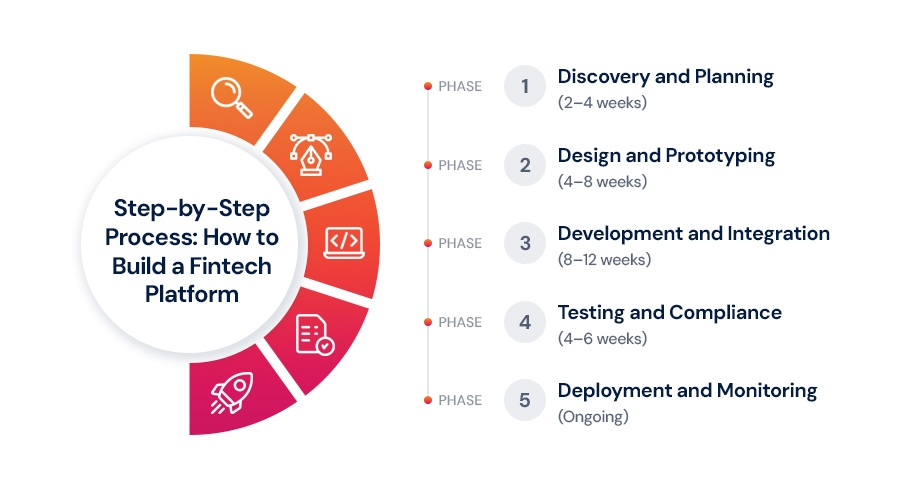
How to build a fintech platform the right way starts with a structured, phased methodology not sprinting straight to code.
Phase 1 Discovery and Planning (2–4 weeks) Start with Product Strategy & Consulting to align stakeholders on compliance requirements, scalability targets, and user journeys. Map your US regulatory obligations SEC, FINRA, OCC, or state MTL before a single line of architecture is drawn. This phase prevents the most expensive category of mistakes.
Phase 2 Design and Prototyping (4–6 weeks) Product Design and Prototyping happens in parallel with architecture blueprinting not sequentially. Wireframes, user flows, and compliance checkpoints get built together. This is where KYC step sequencing, dashboard information hierarchy, and error state communication get resolved before they're expensive to change.
Phase 3 Development and Integration (8–12 weeks) Core Software Product Development begins here, integrating payment gateways, ACH/FedNow rails, identity verification APIs, and third-party data sources. Cloud and DevOps Engineering pipelines are established in parallel not after the fact.
Phase 4 Testing and Compliance (4–6 weeks) Security audits, penetration testing, load testing at 2–3x projected peak, and UX validation with real users. Compliance sign-off including US regulatory mapping happens here, not at launch.
Phase 5 Deployment and Monitoring (Ongoing) CI/CD pipelines, real-time observability, and iterative releases. The platform evolves with regulatory requirements, market conditions, and user feedback on a continuous basis.
Embedding compliance from Phase 1 reduces rework by 40–60% compared to retrofitting it during testing a figure that holds consistently across banking software development engagements at every scale.
Choosing the Right Architecture: Monolith vs. Microservices vs. Serverless
One of the most consequential decisions in financial platform development is also one of the most commonly mishandled: choosing the wrong architectural pattern for your current stage.
| Factor | Monolith | Microservices | Serverless |
|---|---|---|---|
| Scalability | Low scales as a single unit | High each service scales independently | Medium scales per function, not per service |
| Initial Cost | Low simple to build and deploy | High requires DevOps, orchestration, monitoring | Variable low upfront, unpredictable at scale |
| Operational Complexity | Low single deployment target | High requires Kubernetes, service mesh, observability | Medium managed by cloud provider |
| Compliance Auditability | Difficult changes affect entire system | Strong isolated services, independent audit trails | Moderate depends on logging configuration |
| Best For | MVP validation, <10K users | Growth stage, 10K–1M+ users | Early scale, bursty workloads, specific functions |
| Team Size Required | 2–5 engineers | 8+ engineers with DevOps capability | 3–6 engineers |
| Migration Timeline | — | 3–6 months from monolith | 1–2 months for specific workloads |
When NOT to Use Microservices
This is the section most fintech architecture consulting guides skip because it doesn't sound impressive. But it's often the most valuable advice a technical team can receive.
Don't use microservices if you have fewer than 10,000 active users. The operational overhead of Kubernetes orchestration, distributed tracing, and service mesh configuration will consume more engineering time than the scalability benefits justify at this stage. A well-structured modular monolith will serve you better and migrate cleanly when you need to scale.
Don't use microservices if your team is smaller than 8 engineers. You need dedicated DevOps capacity, service ownership per team, and observability expertise. Without these, microservices become a coordination burden rather than an acceleration.
Don't use microservices if you're under serious budget constraints. The infrastructure cost of running Kubernetes clusters, service meshes, and distributed monitoring is significantly higher than a monolith or serverless approach. Serverless-first is the right answer for budget-constrained early-stage fintech app development.
The right progression for most teams: Modular monolith for MVP → Serverless for specific high-load functions → Full microservices at growth stage with proper DevOps investment.
Designing Scalable Financial Application Architecture
Key idea: Use microservices and event-driven design so each component scales independently without cascading failures across the system.
The best architecture for fintech platforms at growth stage is cloud-native microservices, orchestrated via Kubernetes on AWS, Azure, or GCP. Each service scales independently, which means a spike in payment processing doesn't bring down your KYC verification service.
How to design financial software architecture that holds up under real conditions:
Event sourcing creates immutable transaction logs without performance penalties. Every state change is recorded as an event critical for audits, debugging, and US regulatory reporting obligations.
Saga patterns manage distributed transactions across services. When a payment spans multiple microservices, sagas ensure partial failures don't leave accounts in inconsistent states non-negotiable for payment platform development services at scale.
Horizontal pod autoscaling (HPA) in Kubernetes scales service replicas automatically when CPU usage exceeds 70%. Your cloud fintech architecture grows with demand rather than after demand overwhelms it.
| Architecture Layer | Key Components | Benefits | Tools |
|---|---|---|---|
| Presentation Layer | React Native / Vue.js | Responsive fintech user experience | Next.js with PWA support |
| API Gateway | Kong / AWS API Gateway | Rate limiting, auth, 10k+ RPS | Kong Enterprise |
| Business Logic | Node.js / Go microservices | Scalable fintech architecture | Kafka event streaming |
| Data Layer | PostgreSQL + Redis | Low-latency queries at scale | Sharding for 1M+ TPS |
| Compliance Layer | Blockchain audit trails | Immutable records, US regulatory reporting | Hyperledger Fabric |
"A platform built on microservices doesn't just scale better it fails smaller. One service goes down, the rest keep running."

Implementing Secure Financial Software and Compliance
Key idea: Security isn't a layer you add at the end it's the skeleton your platform is built on from day one.
Secure financial software isn't a feature it's the foundation. Fintech compliance and security best practices start with a zero-trust model: no user, service, or network is inherently trusted, regardless of location or internal origin.
Encryption everywhere. AES-256 for data at rest, TLS 1.3 for data in transit. For privacy-preserving analytics, homomorphic encryption allows computations on encrypted data without ever decrypting it enabling compliant data use that would otherwise be prohibited under GDPR and CCPA.
Identity management. OAuth 2.0 with OpenID Connect, mandatory MFA, and biometric authentication via WebAuthn. For banking software development in the US market, passwords alone haven't been sufficient security for years and FINRA guidance increasingly reflects this.
Threat detection. ML-based anomaly detection using Splunk or ELK stack. Velocity checks on transactions, behavioral analysis on login patterns, and automated alerts on deviations catch fraud before it compounds and generate the audit logs that US regulators require.
Regulatory alignment. RegTech tools like Theta Lake for GDPR/CCPA, automated PCI DSS scanning, and KYC/AML integrations with LexisNexis or Chainalysis convert manual compliance reviews into continuous automated monitoring.
| Compliance Framework | Key Requirements | Implementation |
|---|---|---|
| PCI DSS | Tokenization of card data | HashiCorp Vault for token management |
| GDPR / CCPA | Data minimization, consent tracking, right-to-deletion | OneTrust consent management |
| SOX | Financial reporting controls | Immutable blockchain audit logs |
| KYC / AML | Real-time screening | LexisNexis / Chainalysis integrations |
| FINRA / SEC | Communication recordkeeping, audit trail | Immutable log storage with on-demand export |
How to build secure payment systems at scale: tokenize card data immediately post-entry so raw PAN data never touches your application layer. Use Istio service mesh for mutual TLS between all microservices this reduces lateral breach surface by up to 90% and directly satisfies PCI DSS network segmentation requirements.
Banking software development that handles these compliance layers correctly doesn't just avoid fines. It builds institutional trust that converts enterprise clients and passes technical due diligence in US fundraising rounds where architectural security posture is now a standard diligence item.
Optimizing Fintech User Experience Without Sacrificing Speed
Key idea: The best UX decisions in fintech are almost always also the most secure ones compliance and experience aren't in conflict when designed together from the start.
How to improve fintech user experience starts with progressive disclosure: show users only what they need at each moment. Don't front-load compliance steps that can be deferred to later in the onboarding sequence.
A/B testing across fintech platform design implementations consistently shows that gamified KYC flows progress bars, clear step indicators, estimated time remaining improve completion rates by 25% compared to linear form-based flows. For US users accustomed to Chime and Robinhood onboarding, the bar for acceptable friction is low and falling.
| UX Challenge | Solution | Impact |
|---|---|---|
| Lengthy onboarding | Biometric + AI document verification | Reduces steps from 10 to 3, under 2 seconds each |
| Transaction friction | Apple Pay / Google Pay integration | Sub-100ms payment latency |
| Dashboard overload | ML-personalized widgets | 30% higher daily active engagement |
| Mobile gaps | PWAs with offline support | Functional in low-bandwidth environments |
Biometric verification is both faster and more secure than manual document review. Tokenized payments are both simpler and more PCI-compliant than retyped card numbers. The fintech user experience improvements that drive retention are the same ones that reduce attack surface.
Atomic design principles building reusable UI components for dashboards, transaction history, and alert state speed up future iterations significantly. For digital banking solutions competing in the US market, the target is a UI that a first-time user can navigate without documentation and a compliance officer can audit without difficulty.
Where Product Engineering Services Fit In
Internal engineering teams are often highly capable but fintech scaling creates specific challenges that go beyond headcount. This is where product engineering services provide the most leverage, and where the ROI is most measurable.
When internal teams are stretched across too many priorities. Scaling architecture, shipping product features, maintaining compliance, and managing DevOps simultaneously is beyond the capacity of most internal teams under 20 engineers. External fintech software development services provide focused execution without the ramp-up time of new hires.
When compliance complexity increases faster than team expertise. Entering a new US regulatory jurisdiction moving from payments into lending, or from B2C into B2B enterprise requires regulatory architecture expertise that most product engineering teams don't have on staff. Getting this wrong means fines, not just delays.
When scaling complexity outpaces internal architecture experience. The jump from 10,000 to 500,000 users requires architectural patterns distributed caching, event sourcing, service mesh, multi-region failover that teams building at smaller scale haven't encountered in production before.
What the right partner contributes:
Product Strategy & Consulting regulatory mapping, architecture planning, and technology selection before development begins
Cloud and DevOps Engineering CI/CD pipelines, Kubernetes orchestration, and observability infrastructure that most product teams don't have capacity to build correctly under delivery pressure
AI and Data Engineering fraud detection models, personalization engines, and risk scoring systems that require ML expertise beyond standard software development
QA and Compliance Testing security audits, penetration testing, and regulatory validation that catch issues before regulators or users do
The right fintech architecture consulting engagement doesn't replace your team it extends their capacity at the exact moments where the cost of mistakes is highest.
Integrating Cloud and DevOps for Speed and Reliability
Key idea: DevOps isn't just about deployment speed in regulated industries, it's your primary mechanism for compliant, auditable, repeatable releases.
Cloud and DevOps Engineering is what separates platforms that ship weekly from platforms that ship quarterly. Cloud fintech architecture built on CI/CD pipelines, Infrastructure as Code, and observability tooling enables compliant, frequent releases without manual compliance gates on every deploy.
Serverless for variable workloads. AWS Lambda handles bursty operations like fraud checks and document processing scaling to zero when idle and to thousands of concurrent executions during peaks. For build fintech app scenarios where traffic is unpredictable, serverless is the most cost-efficient starting point.
Observability trinity. Prometheus for metrics, Grafana for dashboards, Loki for log aggregation. Without these, you're operating blind during incidents which in a regulated US environment also means you're non-compliant with incident reporting requirements.
Disaster recovery. Multi-region active-active deployments with RTO under 5 minutes. For financial software development under OCC or FINRA oversight, this isn't just reliability engineering it's a regulatory expectation in most licensing frameworks.
GitOps with GitHub Actions and ArgoCD ensures every infrastructure change is versioned, reviewable, and auditable. This directly supports SOX controls, PCI DSS audit trails, and FINRA recordkeeping requirements without adding manual overhead to your release process.
Real-World Lessons: What Goes Wrong and Why
Revolut's compliance pivot is the most instructive case in financial platform development. Early architecture prioritized velocity and it drove explosive growth, until 2019 compliance investigations exposed gaps in transaction monitoring and KYC processes. The mandatory pivot to automated RegTech and microservices architecture was expensive. But the result was a platform capable of 10x user growth with full regulatory confidence. The lesson: the cost of retrofitting compliance always exceeds the cost of designing for it.
The legacy modernization pattern repeats itself across mid-market fintech product development engagements. A payments company running monolithic architecture faced 6-month deployment cycles, rising infrastructure costs, and an inability to enter new regulated US markets without significant rework. Migrating to scalable financial application architecture cut deployment cycles from months to days, reduced infrastructure spend by 35%, and enabled same-day compliance updates when regulatory requirements changed.
Common root causes in both cases:
Compliance treated as a release gate rather than an architecture constraint
Architecture decisions made for current scale rather than projected 10x scale
UX and security handled as separate workstreams rather than unified design decisions
"The teams that avoid these failures aren't smarter they just make architecture decisions before scale forces their hand."

Emerging Trends Shaping Financial Application Development
AI-driven risk scoring is replacing static rule-based fraud detection. Models trained on transaction patterns, device fingerprints, and behavioral signals make real-time decisions that static systems can't match with fewer false positives, better fraud catch rates, and lower compliance overhead. For US platforms under FinCEN oversight, AI-assisted SAR filing and AML monitoring are becoming competitive necessities.
FedNow adoption is reshaping payment platform development services across the US. Real-time payment settlement changes the latency requirements and fraud detection windows for every platform connected to the rails and creates new architectural requirements around idempotency and instant reconciliation.
Blockchain for settlements reduces reconciliation costs and settlement times significantly. DeFi protocols applied to institutional settlement infrastructure are cutting costs by up to 70% in pilot deployments with particular traction in cross-border payment corridors.
Embedded finance via open APIs allows non-financial companies to offer banking, lending, and insurance products within their own platforms. This expands the market for fintech app development well beyond traditional banking interfaces and is driving significant platform investment in 2025.
For fintech development for startups and growing companies, the practical path: serverless MVP to validate product-market fit → modular monolith to build core product → full microservices architecture once transaction volume and team size justify the operational investment.
Recommended Tech Stack
| Category | Recommended Stack | Why It Fits |
|---|---|---|
| Backend | Go + Gin | High concurrency for financial system architecture |
| Frontend | React + Tailwind CSS | Fast iteration, superior fintech platform design |
| Database | CockroachDB | Distributed SQL built for global and US-regional scale |
| DevOps | GitHub Actions + ArgoCD | GitOps-native, full audit trail for US regulatory compliance |
| Monitoring | Datadog | AI-powered alerting with compliance reporting |
| Secrets Management | HashiCorp Vault | PCI DSS tokenization and key management |
| Service Mesh | Istio | mTLS, zero-trust networking between microservices |
| Payment Rails | Stripe Treasury / FedNow / ACH | US-native payment infrastructure |
Frequently Asked Questions
What is the best architecture for a fintech platform?
It depends on your stage. For early-stage validation, a modular monolith is faster and cheaper. For growth stage (10,000+ users), cloud-native microservices on Kubernetes provide the scalable fintech architecture needed to handle regulatory requirements and traffic growth simultaneously. For bursty workloads, serverless components complement both approaches.
How do I ensure US compliance without slowing down development?
Embed compliance checkpoints into your CI/CD pipeline using automated RegTech tools. Map PCI DSS, GDPR/CCPA, FINRA, and OCC requirements to your architecture constraints from day one not as QA gates at the end of your sprint cycle. Treat compliance as a design input, not a deployment blocker.
How to build a fintech platform for startups on a limited budget?
Start serverless. Use managed services for authentication, payments, and KYC. Validate your core value proposition before investing in custom infrastructure. Scale into microservices once you have product-market fit and the transaction volume to justify operational complexity. A modular monolith in between is underrated and underused.
When NOT to use microservices?
If you have fewer than 10,000 users, a team smaller than 8 engineers, or serious budget constraints, microservices will cost you more than they save. Start with a modular monolith or serverless architecture and migrate when scale justifies the overhead.
What is the biggest UX mistake in financial application development?
Front-loading compliance steps. Progressive disclosure showing users only what they need at each stage improves completion rates by 25% or more without reducing security or regulatory compliance. The best fintech user experience decisions are usually also the most secure ones.
How to balance compliance and user experience in fintech?
Design them together, not sequentially. Biometric auth is both faster and more secure than passwords. Tokenized payments are simpler and more PCI-compliant than card re-entry. Compliance-by-design produces better UX outcomes than compliance-by-addition.
What are the main challenges in fintech product development?
Regulatory overhead slowing iteration, security measures adding latency, and UX complexity driving drop-off. All three are solvable with upfront architecture planning. The US market adds a layer of regulatory complexity SEC, FINRA, OCC, CCPA, and state-level MTL requirements that requires explicit architectural accommodation from the start.
When should a company invest in architecture modernization?
Before scaling past 10,000 active users, before entering new regulated US markets, and before Series B fundraising or enterprise client onboarding. These are the three moments when architectural debt becomes immediately visible and maximally expensive to address.
What does a fintech platform development company look for in an engineering partner?
Domain expertise in regulated industries, a track record of navigating US compliance requirements, and the ability to contribute to architecture decisions not just execute on them. The right fintech software development services partner should reduce your regulatory risk exposure while accelerating delivery.
Conclusion: Building Financial Platforms That Last
The teams that win in financial software development aren't the ones who move fastest or comply most strictly in isolation they're the ones who architect for all three requirements simultaneously: scale, security, and user experience.
The path is clear: structured phasing with Product Strategy & Consulting embedded from day one, scalable financial application architecture matched to your current stage and growth trajectory, secure financial software using zero-trust principles and automated US compliance controls, and fintech user experience designed around progressive disclosure rather than compliance friction.
Enterprise fintech solutions that stand up to regulatory scrutiny and user expectations don't happen by accident. They're the result of disciplined architecture decisions made early before scale compounds the cost of getting them wrong, and before a US regulator or enterprise client's due diligence team finds the gaps first.
"The difference between a fintech platform that scales and one that breaks isn't talent. It's whether the architecture was built for where you're going not just where you are today."
If you're building or scaling a financial platform development project right now whether you're approaching your first 100,000 users, entering a new US regulated market, or preparing for enterprise deals this is exactly the stage where architecture decisions matter most.
Build Secure Fintech Platforms With Experts