


 Updated on 16 February 2026

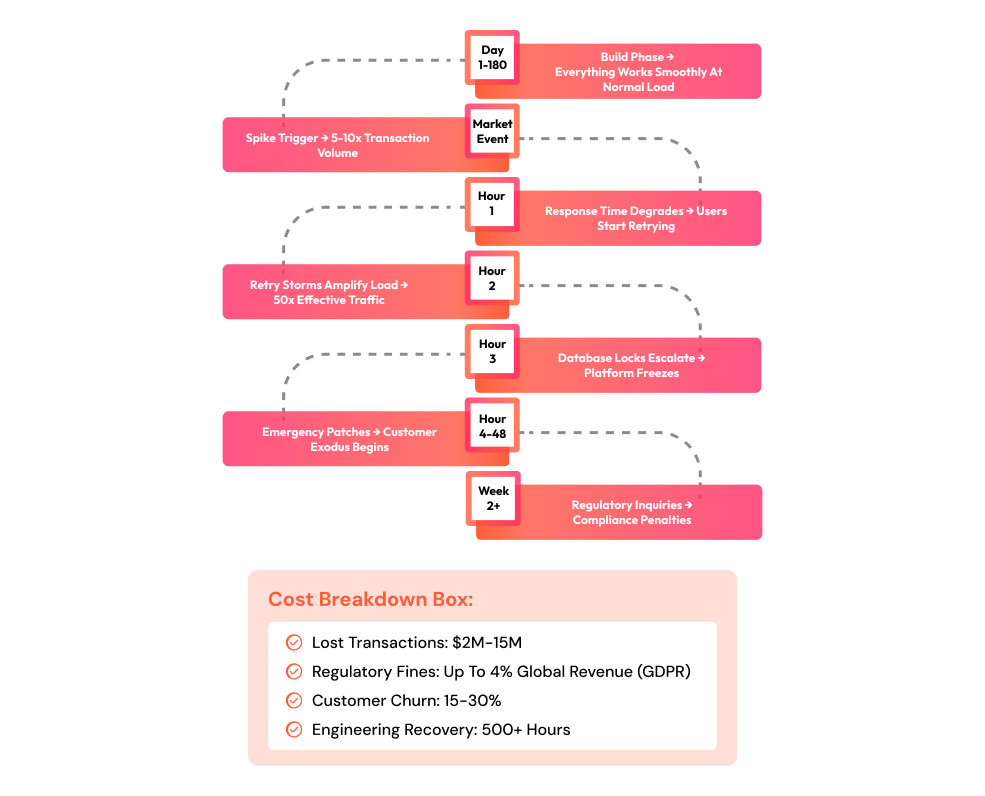
When Robinhood's platform froze during the 2021 GameStop trading frenzy, millions of users couldn't execute trades for hours. The outage wasn't caused by infrastructure failure it was a product architecture decision made years earlier that assumed steady-state trading volumes. This incident reveals a fundamental truth about financial technology: the choices made during product engineering determine whether platforms thrive or collapse under pressure.
Transaction spikes in fintech platforms often expose hidden architectural flaws that only appear at scale. For CTOs and engineering leaders, the challenge isn't just building fast it's building systems that remain secure and compliant when market chaos strikes. This is where financial software development services become critical, transforming regulatory requirements from obstacles into competitive advantages.
This article is written for engineering and product leaders building regulated platforms that must remain fast, secure, and compliant under unpredictable load.
The Cost of "Working Fine Until It Doesn't"
Most financial products operate smoothly at 70% capacity. Teams celebrate fast feature releases, infrastructure seems adequate, and compliance audits pass. Then a market event triggers 10x transaction volume, and everything breaks. Not gradually catastrophically.
The hidden cost isn't downtime alone. When trading platforms fail during volatility, users lose money. When payment processors go offline during Black Friday, merchants lose revenue. When lending platforms crash during rate changes, applicants abandon applications. Each failure erodes trust that took years to build.
Why Product Strategy Matters Before Code
Here's where most fintech companies miscalculate they treat Product Strategy & Consulting as a planning phase, not an engineering discipline. The result? Beautiful roadmaps that ignore how PCI-DSS network segmentation impacts microservices communication, or how SOC 2 audit trails affect database architecture.
Effective product engineering consulting starts by mapping business goals against regulatory constraints and technical feasibility simultaneously. When a payments company wants to process transactions in under 200ms while maintaining PCI-DSS compliance, the strategy phase must answer: Which encryption approach preserves speed? Where do we tokenize data? How do transaction logs remain immutable without blocking writes?
A mid-sized lending platform we analyzed spent nine months building a loan origination system with synchronous credit checks. Fast during testing, it collapsed when a rate drop triggered simultaneous applications. The problem wasn't infrastructure it was a product decision to prioritize consistency over availability. Custom software development services could have designed an eventual consistency model with asynchronous workflows, maintaining responsiveness under load while ensuring no loan gets approved twice.
Strategic Decision Framework:
| Decision Point | Speed-Focused Approach | Compliance-First Approach | Balanced Product Engineering |
|---|---|---|---|
| Data Storage | NoSQL optimized for performance | SQL ensuring strict ACID compliance | Polyglot persistence: SQL for transactions, NoSQL for analytics |
| Authentication | API keys for simplicity and fast integration | MFA and biometrics enforced by default | Adaptive authentication driven by risk scoring |
| Deployment Model | Continuous deployment prioritizing release velocity | Change-controlled, approval-driven releases | Automated compliance gates embedded in CI/CD |
| Monitoring Strategy | Performance metrics only | Regulator-centric audit logs | Unified observability: performance, security, and compliance |
Key Insight: The "Balanced Product Engineering" column isn't a compromise it's recognizing that regulatory requirements drive architectural decisions that ultimately improve product quality. PCI-DSS's mandate for network segmentation forces better microservices boundaries. GDPR's data minimization principles create leaner, faster databases.
From Prototypes to Production: Where Security Intersects Speed
Product Design and Prototyping in fintech carries unique constraints. A consumer app can launch with 80% functionality and iterate. Financial products need 99.99% accuracy from day one a failed payment that charges twice isn't a bug to patch later, it's a regulatory violation and customer trust breach.
This is where software product engineering services differentiate from generic development. High-fidelity prototypes must include:
Threat modeling sessions that simulate attack vectors before writing production code • Privacy-by-design interfaces where KYC/AML workflows feel seamless, not interrogative.
Performance testing under compliance load (encryption overhead, audit logging latency)
Failure mode analysis what happens when a fraud detection API times out mid-transaction?
Consider mobile payment wallets. Early prototypes often show instant transfers with delightful animations. But production reality involves: validating sender account status, checking recipient account validity, executing fraud rules, maintaining transaction atomicity, logging for regulatory audit, updating balances across distributed systems, and sending confirmations all within 2-3 seconds to match user expectations.
Enterprise software development services solve this by prototyping with production-like constraints. Load tests run against encrypted databases. Prototypes include circuit breakers and retry logic. Security scans happen in design tools, not just code reviews. This iterative loop design, secure, prototype, validate reduces rework by 40-50% compared to "build first, secure later" approaches.

Qualifier Text: "Best suited for fintech platforms processing 10K+ daily transactions with regulatory compliance requirements (PCI-DSS, SOC 2, GDPR)."
Building the Core: Where Code Meets Compliance
Software Product Development for financial products demands architectural choices that non-financial software never encounters. When a financial software development company builds payment infrastructure, every technical decision has compliance implications:
Choice 1: Synchronous vs. Asynchronous Processing
Synchronous APIs provide immediate confirmation critical for point-of-sale payments. But they create tight coupling that amplifies failures. When a fraud detection service experiences 200ms latency, every dependent transaction waits. At 1,000 transactions per second, that's 200 blocked threads.
Asynchronous designs with event-driven architecture decouple services, allowing graceful degradation. A payment can be accepted, queued, validated, and confirmed in stages. If fraud detection slows, payments still process with post-validation. The trade-off? More complex state management and eventual consistency challenges.
Key Insight: Most financial outages are caused by early product architecture decisions (sync vs. async, consistency models, service coupling), not real-time infrastructure failures. These decisions, made during initial development, determine whether platforms thrive or collapse under pressure.
Choice 2: Microservices Granularity
PCI-DSS requires network segmentation between card data processing and other systems. This naturally suggests microservices separate services for payment processing, user management, and reporting. But excessive granularity creates operational overhead. Ten microservices mean ten deployment pipelines, ten monitoring dashboards, ten sets of logs to correlate during incidents.
The optimal architecture recognizes that compliance boundaries define service boundaries. Card data handling lives in isolated services with strict access controls. Non-sensitive operations can share services for operational efficiency.
Choice 3: Data Residency and Encryption
GDPR mandates EU customer data stays in EU regions. PCI-DSS requires encryption at rest and in transit. SOC 2 demands evidence of who accessed what data when. These aren't just checkboxes they're architectural constraints that affect:
Database selection (geo-replication capabilities, encryption performance)
Cloud provider choice (regional availability, compliance certifications)
Caching strategies (can't cache unencrypted PII)
API design (minimizing data exposure across boundaries)
Cloud engineering services become essential here, providing infrastructure that scales while maintaining compliance. AWS offers GuardDuty for threat detection, Azure provides Sentinel SIEM for regulatory reporting, and GCP enables Confidential Computing for analytics on encrypted data. The platform choice depends on which compliance controls your product architecture prioritizes.
Development-Compliance Integration Table:
| Development Practice | Security Integration | Compliance Outcome |
|---|---|---|
| Code Commits | SonarQube static analysis and secret scanning | PCI-DSS Requirement 6.5 (secure coding practices) |
| Containerization | Trivy vulnerability scanning and image signing | SOC 2 CC6.6 (change management & system integrity) |
| API Development | OWASP Top 10 testing and rate limiting | PCI-DSS Requirement 6.6 (web application protection) |
| Database Changes | Schema migration auditing and encryption validation | GDPR Article 32 (data protection & security) |
| Deployment | Blue-green deployments with automated rollback | SOX (change control & auditability) |
This table isn't theoretical it's how DevOps engineering services embed compliance into velocity. Traditional approaches treat security and compliance as gates that slow delivery. Modern product engineering makes them automated validations that maintain speed while proving continuous control.
The DevOps Transformation: Compliance as Code
Here's the paradigm shift: compliance isn't a document your legal team maintainsit's infrastructure you deploy. When DevOps engineering services treat PCI-DSS requirements as code, compliance becomes testable, versionable, and automatable.
Consider PCI-DSS Requirement 1: "Install and maintain network security controls." Traditionally, this means a network engineer manually configures firewalls, a compliance team documents it, and an auditor reviews it annually. In a cloud-native product engineering approach:
Network policies deploy via Terraform (Infrastructure-as-Code)
Kubernetes network policies enforce segmentation between services
Policy-as-code tools like Open Policy Agent validate configurations
Continuous compliance monitoring flags deviations in real-time
Audit evidence generates automatically from infrastructure logs
A payment processor using this approach reduced SOC 2 audit preparation from 3 months to 2 weeks. Not because they lowered standards because compliance evidence existed in version-controlled infrastructure code, not scattered spreadsheets.
Secure CI/CD Pipeline Flow:
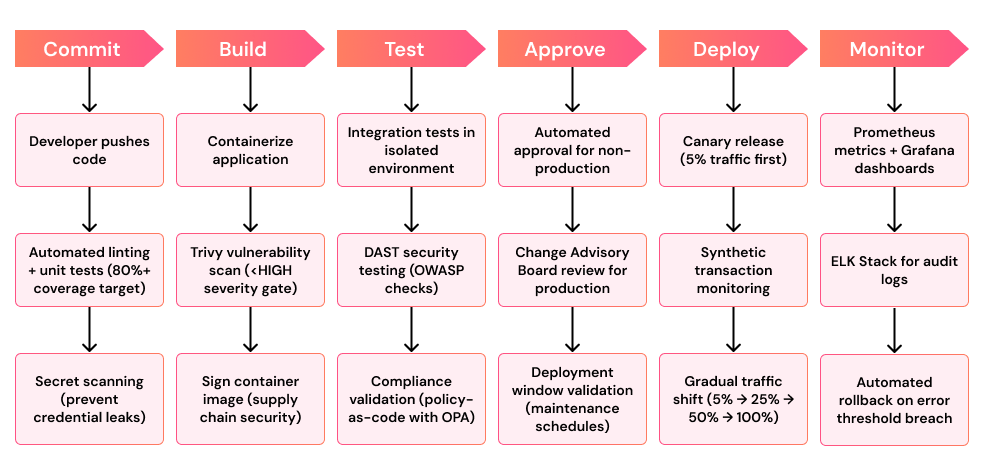
Cycle Time Comparison:
Traditional: 2-4 weeks commit-to-production
Modern FinTech: 2-8 hours commit-to-production
Compliance violations: 0 (automated gates prevent deployment)
Trust Signal: "Trusted by fintech platforms processing $2B+ in annual transactions"
Cloud Architecture: Elasticity Meets Security
The promise of cloud engineering services is infinite scale. The reality for financial products is constrained scale you can't just spin up 1,000 instances when traffic spikes if those instances haven't passed security hardening, don't have proper encryption keys, or violate data residency requirements.
This is where cloud-native product engineering differs from cloud migration. A migrated monolith runs in AWS but doesn't leverage cloud capabilities. A cloud-native financial product:
• Uses auto-scaling groups with pre-baked AMIs that include security agents and compliance controls
Implements serverless functions (AWS Lambda, Azure Functions) for event-driven workflows that scale to zero cost when idle
Leverages managed services (RDS, DynamoDB) that provide built-in encryption, automated backups, and point-in-time recovery
Deploys across multiple availability zones for 99.99% SLA while maintaining data sovereignty
The trade-off matrix becomes complex. Serverless reduces operational overhead but increases vendor lock-in. Multi-region deployment improves resilience but complicates compliance (which region's laws apply to a transaction processed across three continents?). Managed databases simplify operations but limit custom security controls.
Financial software development services navigate these trade-offs by aligning cloud architecture with product requirements, not just technical preferences. A high-frequency trading platform needs edge computing for sub-10ms latency. A lending platform prioritizes data consistency over speed. A mobile wallet balances both instant UI feedback with eventual consistency in backend settlement.
Real-World Impact: Metrics That Matter
A Series B fintech startup approached us processing 50,000 daily transactions with a deployment cycle of 2-3 weeks. Their platform handled normal load but struggled during month-end payment spikes. Compliance preparation for SOC 2 consumed 4 months annually.
After implementing integrated product engineering services across strategy, development, cloud, and DevOps:
Before vs. After Transformation:
| Metric | Before Product Engineering | After 6 Months | Impact |
|---|---|---|---|
| Deployment Frequency | Weekly with manual approvals | 8–12 times daily via automation | 50× improvement |
| Transaction Processing Time | 1.2s average response time | 280ms average (p95) | 4.3× faster |
| Spike Handling Capacity | Stable at 3× load (crashes at 4×) | Stable at 15× load with elastic scaling | 5× resilience |
| Compliance Audit Preparation | Four months of manual evidence collection | Two weeks with automated reporting | 87% time reduction |
| Security Incident Response | 18 hours MTTR | 45 minutes MTTR with auto-remediation | 24× faster |
| Infrastructure Cost | $47K per month (over-provisioned) | $31K per month (right-sized) | 34% cost reduction |
Key Insight: The breakthrough wasn't technology adoption it was product thinking applied to engineering decisions. Instead of asking "How do we scale our database?" they asked "Why does our product generate this database load?" The answer led to architectural changes that addressed root causes, not symptoms.
The answer led to architectural changes: caching user preferences to reduce reads, batching analytics updates to reduce writes, and implementing read replicas for reporting queries.
The Decision Framework for Financial Product Leaders
CTOs and engineering leaders face constant pressure: ship faster, secure better, comply thoroughly. These seem contradictory until you recognize they're interconnected outcomes of sound product engineering.
When to invest in product engineering transformation:
Your platform experiences degraded performance during predictable spikes (month-end, market volatility, promotional periods)
Compliance audits require manual evidence gathering across teams and systems
Security reviews happen after development, creating expensive rework cycles
New feature deployment requires weeks of coordination and testing
Your cloud infrastructure costs grow faster than transaction volume
What product engineering addresses:
Architectural decisions that determine scalability, security, and compliance simultaneously
Development practices that embed regulatory requirements into automated pipelines
Cloud infrastructure that elastically responds to load while maintaining control boundaries
Monitoring strategies that unify performance metrics, security alerts, and compliance evidence
This isn't about adopting specific technologies. Kubernetes, Terraform, and microservices are tools. Product engineering services provide the craft knowing when to use event-driven architecture vs. request-response, where to apply synchronous vs. asynchronous processing, how to balance consistency vs. availability based on product requirements.
Looking Forward: Financial Products in 2026 and Beyond
The regulatory landscape intensifies. AI-driven fraud detection becomes mandatory, not optional. Quantum computing threatens current encryption standards, requiring quantum-safe cryptography adoption. Composable finance built on blockchain creates new integration challenges.
Simultaneously, customer expectations escalate. Instant settlement replaces T+2 processing. Personalized financial products require real-time data analytics. Global operations demand 24/7 availability across jurisdictions with conflicting regulations.
Financial software development companies that thrive will master three capabilities:
Adaptive Architecture: Systems that reconfigure based on load, threat levels, and regulatory changes without manual intervention
Compliance Automation: RegTech integration that tracks regulatory changes and auto-updates pipelines with new requirements
Product-Led Security: Treating security and compliance as product features that create competitive advantages, not cost centers
Edge computing will enable sub-millisecond trading in decentralized finance. AI will shift from detecting fraud to predicting and preventing it. Zero-knowledge proofs will allow compliance verification without exposing sensitive data.
Conclusion: Engineering Your Financial Future
The financial products that succeed over the next decade won't be built by teams choosing between speed, security, and compliance they'll be built by teams who recognize these as integrated outcomes of disciplined product engineering.
When Robinhood's platform froze, the technical failure was a product engineering failure. Architecture decisions made years earlier prioritized rapid feature development over resilience. The result? Billions in market value lost, regulatory penalties, and permanent customer distrust.
Your product engineering decisions today determine your platform's resilience tomorrow. Whether you're building payment infrastructure, lending platforms, trading systems, or wealth management tools, the question isn't if you'll face extreme load and regulatory scrutiny it's whether your architecture can handle both simultaneously.
AspireSoftserv's product engineering consulting brings expertise across Product Strategy & Consulting, Product Design and Prototyping, Software Product Development, and Cloud and DevOps Engineering integrated disciplines that transform regulatory requirements from obstacles into competitive advantages.
Ready to future-proof your financial product?
Contact our financial software development services team for a comprehensive architecture assessment. We'll evaluate your current system against spike scenarios, compliance requirements, and security threats then design a transformation roadmap that accelerates delivery while strengthening controls.
Let's engineer your financial future. Together.