

 Updated on 10 November 2025


In today's digital health ecosystem, where sensitive data flows between patients, devices, and systems, the security and compliance of healthcare products are paramount. Healthcare companies are under immense pressure to innovate building connected, intelligent, and interoperable solutions while also maintaining HIPAA, GDPR, and FDA compliance. Achieving this balance requires a disciplined and systematic approach powered by advanced product engineering services.
This article examines how modern engineering practices enable healthcare organizations to design and deliver secure, compliant, and scalable solutions. It explores the frameworks, technologies, and best practices that anchor healthcare innovation while ensuring patient safety, data protection, and regulatory adherence.
The Healthcare Industry's Digital Shift
Healthcare is transitioning from reactive care delivery to proactive, data-driven experiences. This transformation is guided by technologies such as AI, machine learning, IoT-enabled medical devices, telemedicine platforms, and cloud-native architectures.
However, innovation cannot come at the cost of security or compliance. Every connected device, electronic health record (EHR) platform, and healthcare mobile application introduces risk. The challenge is to innovate responsibly to apply systematic engineering practices that unify innovation with governance.
Key forces driving this transformation include:
Growing adoption of telehealth and remote monitoring solutions
Integration of IoT medical devices with analytics ecosystems
Strict global regulations like HIPAA (U.S.), GDPR (EU), and MDR (Europe)
Growing patient expectation for personalized, secure, digital care
Proliferation of AI-based diagnostics and predictive health platforms
What Is Product Engineering in Healthcare?
Product engineering services represent the end-to-end discipline of designing, developing, testing, deploying, and maintaining software or device-based products. In the healthcare domain, it encompasses building systems that collect, analyze, and protect medical and personal data.
Healthcare-focused engineering goes beyond building functional products — it ensures safety, cybersecurity, interoperability, and compliance.
Core components include:
Patient data security and encryption
Regulatory compliance-by-design
Scalable and modular microservices architecture
Cloud-native deployment for availability and resilience
Continuous integration and validation
Medical device interoperability and data standardization
Need expert guidance for your healthcare product development? Explore how we help healthcare companies build compliant solutions →
The Compliance Framework: Building "Security-First" Products
Security and compliance in healthcare product development cannot be retrofitted after delivery; they must be built into the engineering lifecycle from day one. This is the concept of "compliance by design."
Below is a framework outlining how compliance and security are embedded across each stage of the engineering process.
Product Lifecycle Integration
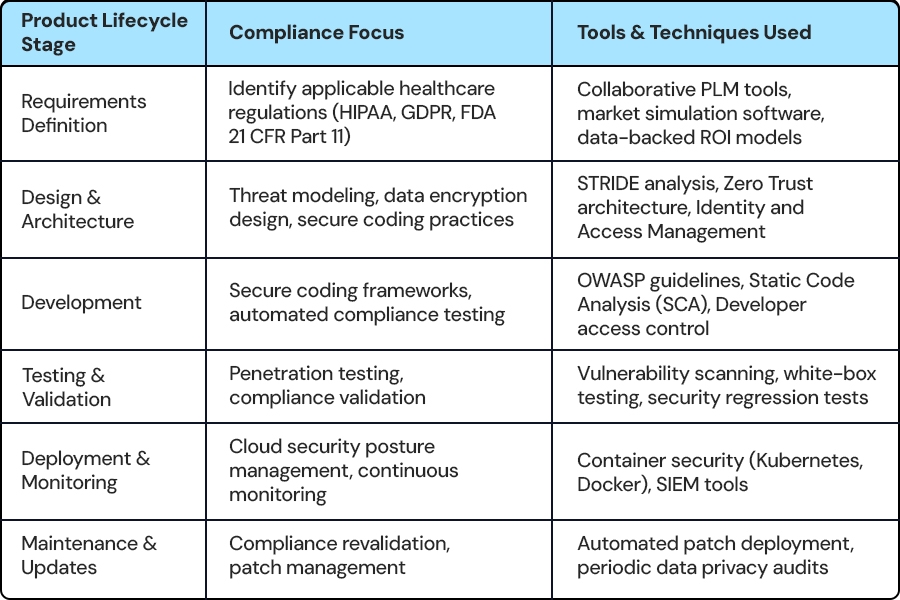
This approach ensures that compliance evolves alongside product features, reducing legal and operational risks throughout the product lifecycle.
Core Regulations Guiding Healthcare Product Engineering
Engineering practices must align with multiple compliance standards depending on geography and deployment model. Below are the primary frameworks healthcare companies must navigate:
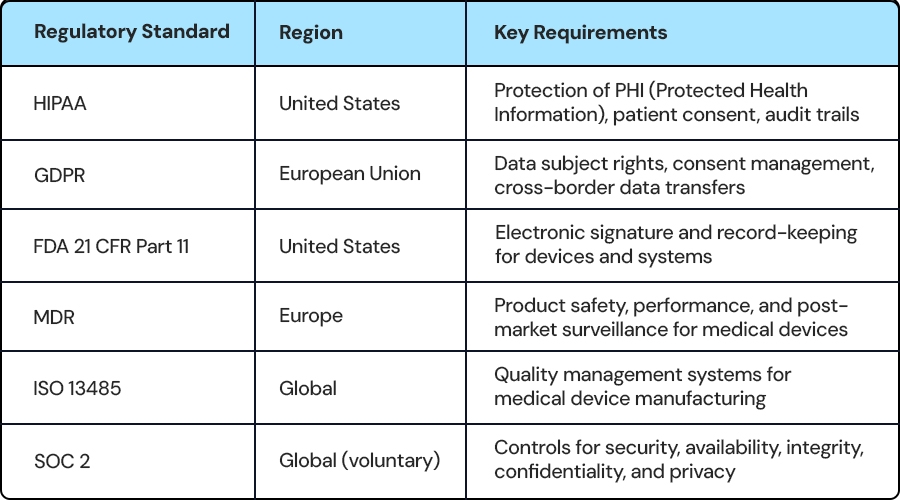
The Product Engineering Lifecycle for Secure Healthcare Products
Healthcare product development follows a structured lifecycle that integrates compliance verification and security testing into every development phase. Below is a process flow representing the secure engineering model.
Secure Healthcare Product Engineering Process Flow
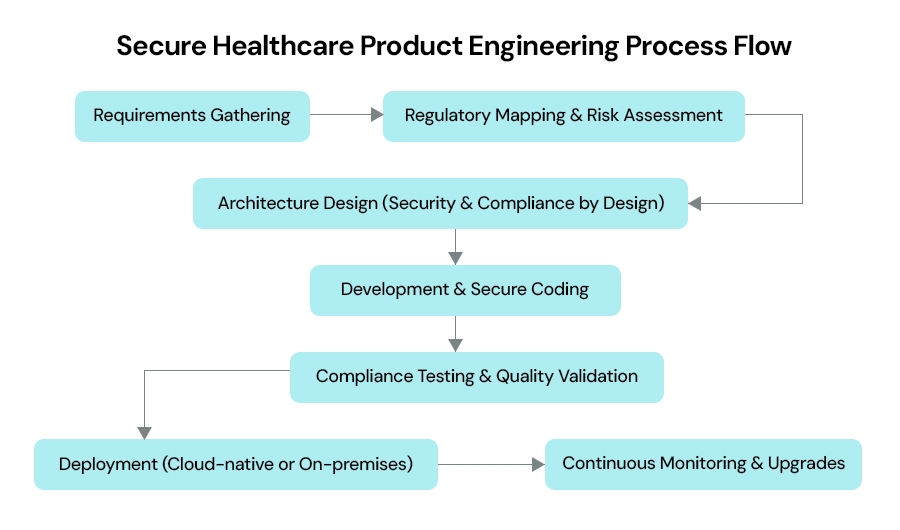
Every phase is subject to traceability and validation, ensuring accountability in how data is captured, processed, and stored.
Key Technologies Powering Secure Healthcare Systems
The convergence of cloud computing, IoT, and machine learning has transformed how healthcare systems operate. However, the complexity of these systems introduces new attack surfaces. Robust engineering leverages emerging technologies with security-first principles.
1. Cloud-Native Platforms
Building healthcare products on cloud-native infrastructure enables scalability, but demands advanced cloud security frameworks. Technologies like AWS HealthLake, Azure Health Data Services, and GCP Healthcare API integrate compliance configurations aligned with HIPAA and HITRUST.
2. IoT and Smart Medical Devices
IoT medical devices continuously capture vital data from patients. Engineering these devices involves secure firmware development, encrypted data transmission, and OTA (over-the-air) updates to prevent exploitation.
3. Artificial Intelligence and Machine Learning
AI-driven healthcare applications require explainable and auditable models. Regulatory bodies require model transparency for diagnostic systems. Engineering teams implement bias detection, model versioning, and governance layers.
For healthcare SaaS companies specifically, integrating AI with automation in product engineering while maintaining HIPAA compliance and patient safety requires specialized frameworks that balance innovation with regulatory requirements.
4. Blockchain for Data Integrity
Blockchain ensures immutability and traceability of patient data exchange, reducing risk from data tampering or unauthorized access.
5. DevSecOps for Continuous Compliance
DevSecOps integrates security into CI/CD pipelines, automating vulnerability scanning and compliance reports before production deployment.
Role of Specialized Engineering Partners
Many healthcare companies rely on specialized partners to navigate both technology and compliance challenges. A mature engineering partner brings:
Deep domain knowledge of healthcare regulations
Expertise in scalable architectures (microservices, cloud-native)
Implementation of automated testing frameworks for compliance
Integration of AI and IoT modules with data protection
Continuous delivery pipelines with compliance gating
By leveraging end-to-end product engineering solutions, healthcare organizations can accelerate go-to-market timelines while ensuring adherence to mandatory standards.
AspireSoftServ brings 8+ years of healthcare engineering expertise. Schedule a consultation to discuss your project →
Designing for Data Protection and Patient Privacy
Patient trust hinges on how organizations treat their data. Engineering teams embed privacy-by-design, encryption, and access control at every architecture layer.
Key techniques include:
Role-Based Access Control (RBAC) for user management
End-to-end data encryption (AES-256, TLS 1.3)
Tokenization of personal identifiers
Secure data lifecycle management (creation to deletion)
Audit logging and immutable logs
Multi-region data residency mechanisms (for GDPR compliance)
Secure data architectures ensure that both structured and unstructured healthcare data whether clinical images or EHRs are protected through their lifecycle.
Integrating AI and Predictive Analytics Securely
AI holds transformative promise in diagnostics, drug discovery, and patient triage. Yet, integrating AI into healthcare workflows introduces governance and compliance complexities.
Healthcare engineering teams follow a framework that ensures responsible AI deployment:
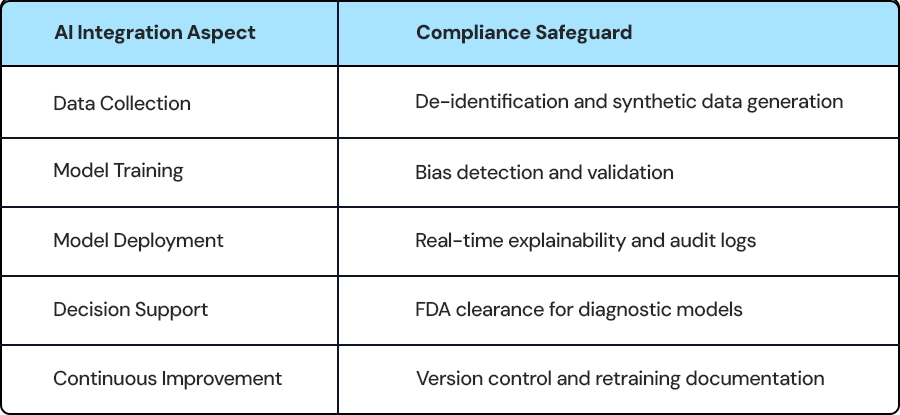
By embedding this framework, healthcare companies ensure AI systems remain transparent, ethical, and compliant.
Interoperability and Standards-Based Engineering
Healthcare products must seamlessly integrate across systems such as EHRs, lab management systems, and wearable devices. This requires engineering for interoperability through adherence to industry standards:
HL7 and FHIR for structured data exchange
DICOM for medical imaging
LOINC and SNOMED CT for terminology standardization
Engineering teams design APIs and interfaces that comply with these protocols, ensuring compatibility across devices and providers.
Continuous Validation and Automated Compliance Testing
Modern healthcare products are dynamic updates occur frequently through continuous delivery. Automated compliance testing ensures each new feature maintains adherence to security and privacy requirements.
Automation tools include:
Continuous Compliance Frameworks (CCF) integrated into CI/CD
Security-as-Code scripts validating configurations
Real-time compliance dashboards for risk visibility
Automated traceability matrices linking code to compliance requirements
This automation reduces manual validation cycles and accelerates delivery without compromising audit-readiness.
Modernization of Legacy Healthcare Systems
Legacy systems often expose vulnerabilities due to outdated software or siloed architectures. Through digital product engineering services, enterprises can modernize their infrastructure to meet current compliance and scalability needs.
Modernization strategies include:
Refactoring legacy EHR or PMS systems into microservices
Migrating to cloud-native or hybrid environments
Implementing API gateways for secure data sharing
Rebuilding authentication and encryption modules
Integrating legacy data into modern analytics frameworks
Engineering modernization brings resilience, interoperability, and improved patient experience.
Measuring Success: KPIs for Secure Product Engineering
Evaluation metrics for healthcare engineering go beyond functional success. They emphasize compliance maturity, security posture, and product performance.
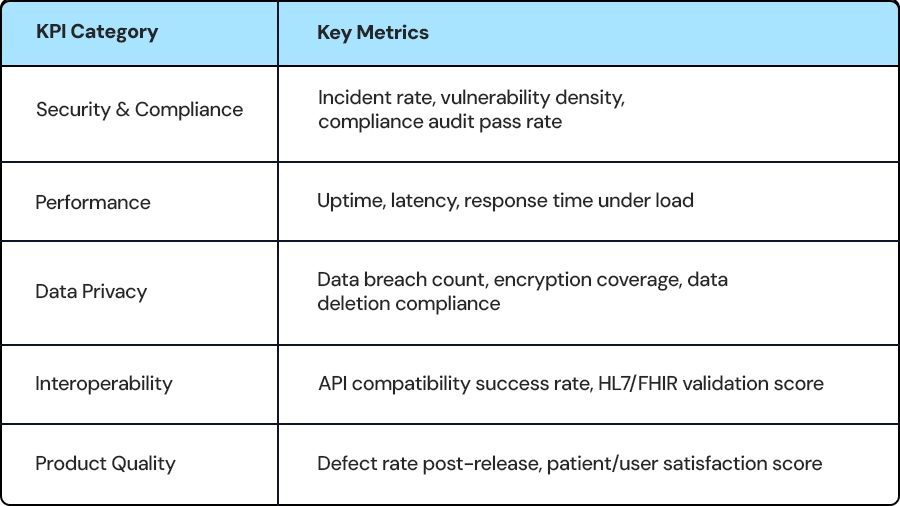
Engineering leaders use these KPIs to continuously enhance reliability and compliance assurance.
Case Example: Building a HIPAA-Compliant Telehealth Platform
A healthcare startup aiming to launch a real-time teleconsultation platform required an architecture that would meet HIPAA standards from day one. By partnering with a specialized engineering team:
Implementation approach:
The product was architected on a microservices-based, cloud-native design
Role-based access and video encryption were integrated via WebRTC and AES encryption
Automated CI/CD pipelines included security scanning and penetration testing steps
Data storage was implemented through HIPAA-compliant cloud providers
Regular compliance audits ensured ongoing adherence to evolving regulations
The result: a scalable, secure telehealth platform fully auditable for HIPAA and GDPR, ensuring safe virtual care delivery.
The Future of Healthcare Product Engineering
As healthcare continues to digitalize, security threats and compliance requirements will intensify. The engineering discipline is evolving to anticipate these changes through:
AI-assisted risk monitoring and anomaly detection
Quantum-ready encryption systems
Federated learning for decentralized medical AI
Increased adoption of zero-trust architectures
Patient-centric data sovereignty models
Healthcare companies investing in next-generation product engineering consulting will not only comply but lead the charge toward proactive, intelligent, and accountable digital health ecosystems.
Building Compliant Healthcare Products: What You Need
When evaluating engineering approaches for your healthcare product, consider these essential capabilities:
Technical Excellence:
Proven experience with HIPAA, GDPR, and FDA compliance frameworks
Expertise in cloud-native architectures and microservices
Implementation track record with HL7 FHIR, DICOM, and healthcare APIs
Security-first development practices (OWASP, threat modeling, penetration testing)
Process Maturity:
Automated CI/CD pipelines with integrated compliance testing
DevSecOps practices for continuous security validation
Agile methodologies adapted for regulated environments
Comprehensive documentation and audit trail management
Domain Knowledge:
Understanding of clinical workflows and healthcare operations
Experience with EHR integration and medical device connectivity
Knowledge of healthcare business models and reimbursement
Awareness of emerging regulations and compliance trends
Ready to build or modernize your healthcare product? Learn more about our specialized approach →
Conclusion
The intersection of technology, compliance, and care defines the modern healthcare industry. Strategic engineering empowers healthcare companies to harness innovation responsibly building solutions that are secure, compliant, and transformative.
By integrating compliance-by-design methodologies, secure architectures, advanced automation, and AI governance, organizations can create products that protect both patient data and business credibility. As healthcare accelerates into its digital future, engineered compliance is not just a necessity it's the foundation of sustainable innovation.
Whether you're building a new telehealth platform, modernizing legacy systems, or developing AI-powered diagnostics, the right engineering approach makes the difference between market success and costly setbacks.
Strengthen Your Healthcare Product Security