

Healthcare SaaS companies handling Protected Health Information (PHI) face unprecedented regulatory complexity. Evolving HIPAA Security Rule interpretations, proposed NPRM requirements, and emerging AI safety mandates demand sophisticated product engineering solutions that go far beyond annual compliance checkboxes.
Executive Summary
What leaders need to know: Healthcare SaaS must now prove continuous HIPAA readiness and AI safety compliance. Modern product engineering services deliver audit-ready architectures, automated evidence collection, and explainable AI pipelines that reduce audit preparation time by 60-80% while cutting breach risk exposure.
Key business outcomes:
Reduce audit preparation from months to weeks through automated evidence collection
Cut potential breach costs (average $10.93M for healthcare per IBM's 2024 Cost of Data Breach Report)
Accelerate time-to-market with compliance-by-design architecture
Who this is for: CTOs, CPOs, and CISOs at healthcare SaaS companies seeking practical implementation roadmaps for modern regulatory requirements.
Why Modern Compliance Changes Everything for Healthcare Product Engineering
The regulatory landscape has fundamentally shifted. The HHS Office for Civil Rights (OCR) issued new HIPAA guidance emphasizing continuous monitoring over periodic audits. Meanwhile, the proposed HIPAA NPRM introduces potential 72-hour recovery requirements for covered entities, while the NIST AI Risk Management Framework and FDA's Good Machine Learning Practice guidelines create new obligations for clinical AI systems.
According to IBM's 2024 Cost of Data Breach Report, healthcare data breaches cost an average of $10.93 million—the highest of any industry for the 14th consecutive year. Organizations with extensive use of security AI and automation experienced breach costs that were $2.2 million lower than those without.
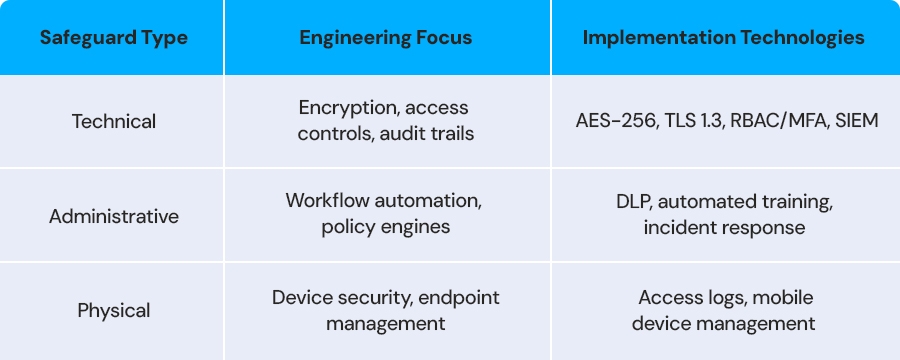
Technical HIPAA Safeguards: Engineering at Every Layer
Modern HIPAA compliance demands demonstrable, automated security practices integrated into product development lifecycles. Compliance becomes a continuous engineering discipline managed across IT, development, and operations teams.
Core Engineering Framework
1. PHI Data Flow Mapping and Traceability
Modern healthcare SaaS architectures require comprehensive PHI flow documentation using automated tracing tools. Implement distributed tracing with OpenTelemetry or AWS X-Ray to map PHI ingress, routing, processing, and egress across microservices, cloud storage, APIs, and external partner systems.
Best practices:
Document all PHI touchpoints in version-controlled Architecture Decision Records (ADRs)
Implement automated discovery tools to identify unexpected PHI flows
Create visual PHI flow diagrams updated with each deployment
2. Automated Risk Assessment and Vulnerability Management
Continuous risk assessment replaces point-in-time evaluations. Deploy vulnerability scanners like Qualys or Snyk at the container and dependency levels, generating Software Bill of Materials (SBOM) automation at every build cycle.
Implementation approach:
Integrate SBOM generation using CycloneDX or SPDX formats
Overlay vulnerability data with real-time threat intelligence from CrowdStrike or SentinelOne
Quantify risk using CVSS scores and CISA's Known Exploited Vulnerabilities catalog
Establish remediation SLAs: critical vulnerabilities within 7 days, high within 30 days
3. CI/CD Pipeline Security Integration
DevSecOps practices embed security controls directly into development workflows. Every code commit triggers automated security validation before production deployment.
Pipeline security gates:
Static Application Security Testing (SAST) and Dynamic Application Security Testing (DAST)
Dependency vulnerability scanning with build failures for critical CVEs
Secrets scanning to prevent credential exposure
Policy validation ensuring Business Associate Agreement (BAA) compliance for new integrations
Advanced Cloud Architecture for HIPAA-Ready Healthcare SaaS
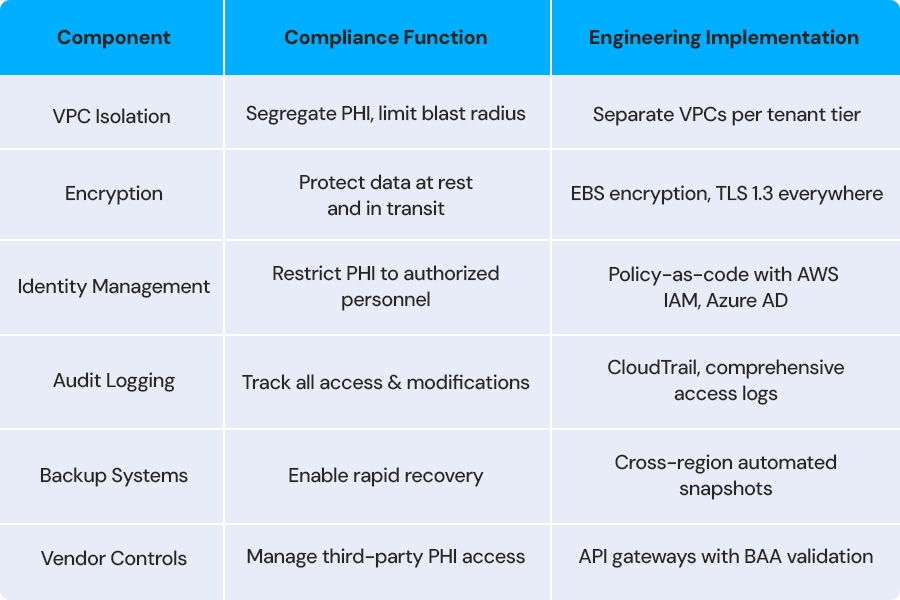
Most healthcare SaaS platforms operate as multi-tenant applications requiring sophisticated cloud-native security architectures. Engineering teams must balance shared infrastructure efficiency with tenant isolation requirements.
Cloud Infrastructure Blueprint
Microservices Security Pattern
A telehealth SaaS implementation demonstrates effective PHI isolation. Medical workflow microservices handle encrypted PHI storage and processing, while authentication and billing services operate with de-identified proxy references. All API requests undergo rate limiting and comprehensive access logging, with compliance dashboards tracking which services, users, and roles accessed specific PHI records.
API Security for Healthcare Integrations
Healthcare APIs form the backbone of modern clinical workflows, requiring end-to-end security and continuous monitoring aligned with HIPAA requirements.
API Security Engineering Practices
Authentication and authorization:
Implement JWT tokens with strong claims validation
Require OAuth 2.0 authorization for all external API requests
Enforce explicit API scopes with granular permissions
Deploy rate limiting to prevent abuse and denial-of-service attacks
Data protection:
Apply input validation and output encoding at all API boundaries
Implement SQL and NoSQL injection defenses
Log comprehensive metadata for every PHI-related API call
Monitor APIs using SIEM platforms with anomaly detection for unusual access patterns
Implementation Roadmap: Structured Engagement Approach
Phase 1: Assessment and Planning
Deliverables:
Comprehensive PHI mapping across all systems
Business Associate Agreement inventory and compliance status
Risk assessment with prioritized remediation backlog
Technical architecture review with security gaps identified
Phase 2: DevSecOps Implementation
Deliverables:
CI/CD pipeline security gates deployment
SBOM generation and vulnerability scanning automation
Secrets management and encrypted storage implementation
Policy-as-code enforcement mechanisms
Phase 3: Monitoring and Incident Response
Deliverables:
SIEM/SOAR platform deployment with custom healthcare use cases
Automated audit evidence collection systems
Incident response playbooks with breach notification workflows
Compliance dashboard with real-time risk metrics
Navigating AI Safety: Engineering for Clinical AI Compliance
Healthcare SaaS incorporating artificial intelligence must address evolving regulations including the EU AI Act, FDA Good Machine Learning Practice guidelines, and NIST AI Risk Management Framework requirements.
AI Safety Engineering Practices
Model governance and transparency:
Classify AI models using risk categorization matrices (high/medium/low/minimal risk)
Implement model versioning with comprehensive lineage tracking
Deploy explainable AI tools like LIME or SHAP for decision pathway documentation
Establish human-in-the-loop validation for all clinical decision support
Bias and fairness validation:
Automate ML pipeline testing for demographic and clinical biases
Document remediation efforts in version-controlled compliance logs
Implement continuous monitoring for model drift and performance degradation
Maintain audit trails linking training data composition to model outcomes
Clinical AI Use Case: Predictive Analytics Engine
A population health analytics platform demonstrates comprehensive AI safety implementation. The system validates data quality at ingestion, runs automated fairness assessments across demographic groups, and maintains detailed metadata about dataset composition and feature importance. When data distribution shifts trigger alerts, the system automatically notifies compliance teams and implements temporary feature restrictions pending investigation.
Vendor Management and Business Associate Agreements
Healthcare SaaS platforms typically integrate dozens of third-party services, each requiring careful BAA management and ongoing compliance monitoring.
Automated vendor compliance:
Maintain real-time inventory of all vendors with PHI access
Implement digital contract management with automated renewal alerts
Deploy API gateways that enforce vendor-specific access controls
Monitor vendor security posture through continuous assessment platforms
Incident Response and Breach Notification
The proposed HIPAA NPRM emphasizes rapid response capabilities, with potential requirements for 72-hour system recovery (subject to final rulemaking by HHS OCR).
Automated incident response:
Deploy Security Orchestration, Automation, and Response (SOAR) platforms
Implement predefined incident playbooks with legal counsel integration
Establish automated breach detection with notification triggers
Maintain forensic evidence collection capabilities for regulatory reporting
Measuring Success: Key Performance Indicators
Effective healthcare SaaS security programs track specific metrics that demonstrate both compliance posture and operational efficiency:
Compliance metrics:
Time to evidence collection: Reduce audit preparation from months to hours
Automated evidence coverage: Achieve 80-95% of audit artifacts through automation
Patch compliance: Remediate 95% of critical CVEs within 7-day SLA
Mean Time to Detect (MTTD) PHI incidents: Target sub-15-minute detection
Mean Time to Remediate (MTTR) security issues: Achieve sub-4-hour resolution for critical issues
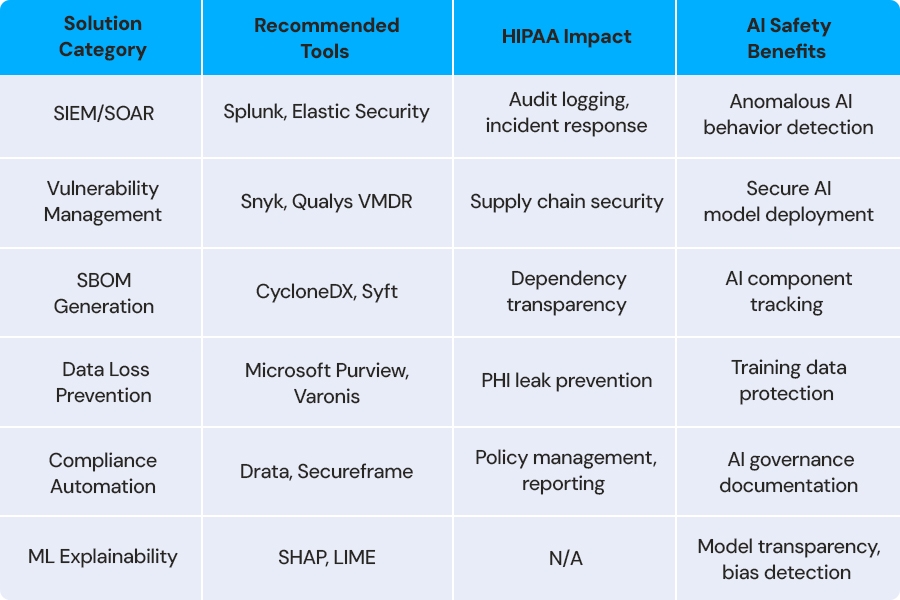
Technology Stack Comparison
How We Engage: Product Engineering Services Approach
Our product engineering consulting methodology addresses the full spectrum of healthcare SaaS compliance challenges through a structured three-phase approach:
Rapid Assessment: Comprehensive PHI mapping, risk quantification, and compliance gap analysis
Implementation Sprint: DevSecOps deployment, automated controls, and monitoring systems
Ongoing Operations: Continuous compliance monitoring, vendor management, and regulatory update integration
Frequently Asked Questions
What evidence does a HIPAA audit require?
HIPAA audits require documentation of administrative, physical, and technical safeguards, including policies, training records, risk assessments, incident response plans, and audit logs. Automated evidence collection systems can provide this documentation in hours rather than weeks.
How long does HIPAA remediation typically take?
Implementation timelines vary based on existing architecture maturity. Organizations with modern DevSecOps practices can achieve compliance readiness more quickly, while legacy systems may require comprehensive modernization efforts.
Does HITRUST certification replace HIPAA compliance requirements?
No. HITRUST provides a framework that maps to HIPAA requirements but doesn't replace the underlying regulatory obligations. Many healthcare organizations use HITRUST as a structured approach to demonstrate HIPAA compliance.
What are the proposed changes in the HIPAA NPRM?
The HHS NPRM (subject to final rulemaking) proposes new requirements including potential 72-hour system recovery timeframes, enhanced breach notification procedures, and stronger third-party risk management obligations.
How do AI safety requirements intersect with HIPAA?
AI systems processing PHI must meet both HIPAA security requirements and emerging AI safety standards from NIST, FDA, and other regulators. This includes model transparency, bias testing, and human oversight for clinical decisions.
What's the ROI of automated compliance systems?
Organizations typically see 60-80% reduction in audit preparation time, 50% reduction in compliance staffing requirements, and significantly lower breach risk exposure. The average healthcare data breach costs $10.93 million according to IBM research.
Next Steps: Transform Your Healthcare SaaS Architecture
Modern regulatory requirements demand sophisticated product engineering solutions that embed compliance into every aspect of software development and operations. Organizations that implement automated audit systems, real-time threat detection, comprehensive vendor controls, and explainable AI governance will not only pass regulatory scrutiny—they'll establish competitive advantages in security, reliability, and time-to-market.
The path forward requires partnership with experienced product engineering services teams who understand both healthcare regulations and modern cloud-native architecture patterns.
TLDR
New Reality: Modern healthcare SaaS must demonstrate continuous HIPAA compliance and AI safety, not just annual audits
Key Technologies: Automated SBOM generation, CI/CD security gates, SIEM/SOAR platforms, and explainable AI tools
Business Impact: 60-80% reduction in audit prep time, $2.2M lower breach costs with security automation (IBM data)
Implementation Path: Structured engagement covering PHI mapping, DevSecOps deployment, and automated monitoring
Regulatory Updates: HHS NPRM proposes 72-hour recovery requirements; NIST AI RMF creates new AI governance obligations
Next Step: Assess current compliance posture and develop implementation roadmap with experienced product engineering services
Ready to modernize your Healthcare SaaS for continuous HIPAA and AI safety compliance?