

 Updated on 15 October 2025

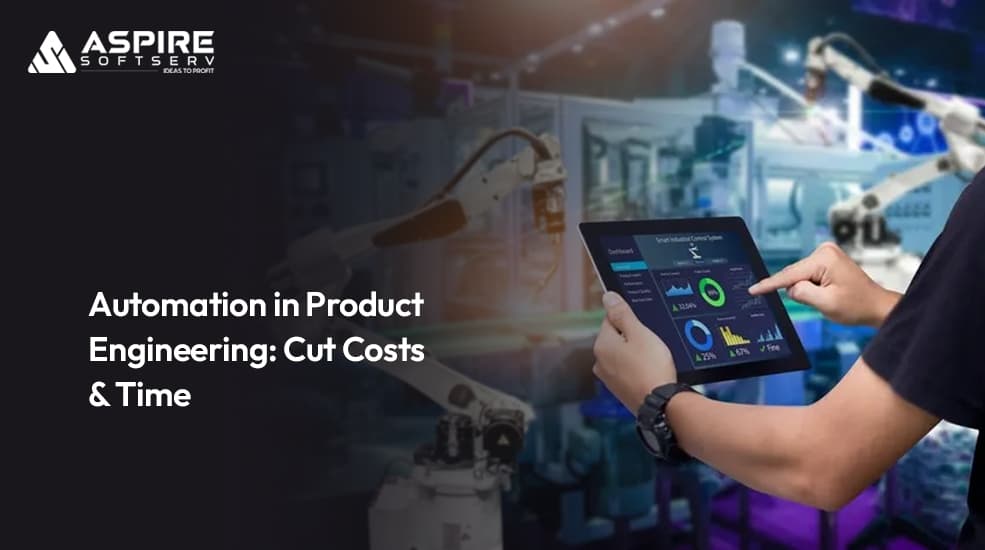
Product engineering in 2025 sits at the intersection of rapid innovation, increasing complexity, and relentless cost pressures. For CTOs, CIOs, and product leaders, leveraging automation within product engineering services is no longer optional it's a strategic imperative that directly impacts your bottom line, competitive position, and market velocity.
Automation doesn't just accelerate time-to-market; it fundamentally transforms how organizations design, test, build, deploy, and maintain digital products. According to Gartner's 2025 Product Engineering Study, 73% of high-performing technology teams credit automation for meeting aggressive delivery timelines while maintaining quality standards. Organizations partnering with product engineering consulting firms report achieving positive ROI within 6-9 months through strategic automation investments.
The Business Case: Why CTOs and Product Leaders Prioritize Automation
For technology executives navigating 2025's competitive landscape, automation in product engineering services directly impacts three critical business metrics:
Time-to-Market Velocity: 30-50% faster product releases enable first-mover advantage and revenue acceleration
Total Cost of Ownership: 25-40% reduction in engineering overhead, infrastructure costs, and operational waste
Risk Mitigation: 60% fewer production defects translates to reduced compliance exposure, brand protection, and customer retention
McKinsey's Digital Manufacturing Report reveals that AI-integrated product development engineering services reduce design iterations by 47% in regulated industries like healthcare and financial services where compliance and precision are non-negotiable. This level of efficiency improvement directly translates to millions in cost savings and faster market entry, particularly for organizations managing complex, multi-stakeholder product ecosystems.
The Automation Imperative in Product Engineering
Modern product engineering from initial concept and design to final delivery entails multifaceted activities involving cross-functional teams, diverse technologies, and constantly evolving requirements. Manual processes, repetitive testing, and integration challenges create bottlenecks that inflate costs and delay launches. Industry data illustrates the scale of impact: AI-driven automation within digital product engineering services can reduce design time by as much as 50% while increasing product quality metrics by 40%.
Product engineering services that embed automation address these inefficiencies through:
Accelerated development cycles via streamlined, intelligent workflows
Enhanced product quality by embedding automated checks and AI-powered validations
Reduced operational costs through elimination of manual effort and resource waste
Increased agility by enabling continuous integration and deployment at scale
Closed human error gaps inherent in manual, repetitive processes
These gains directly support the ROI justifications necessary for funding advanced engineering initiatives. Organizations that successfully implement automation across their product lifecycle report compound benefits each automated process creates efficiencies that amplify the impact of subsequent automation initiatives, creating a virtuous cycle of improvement.
Key Automation Domains in Product Engineering Services
Design Automation and Generative Engineering
Modern CAD platforms integrated with AI algorithms enable generative design an approach where engineers specify business goals and technical constraints, and AI generates multiple optimized variations. This accelerates innovation cycles while offloading iterative tasks to intelligent systems. The technology leverages topology optimization, finite element analysis (FEA), and machine learning models trained on performance datasets to produce designs that often outperform human-created alternatives.
A U.S. medical device manufacturer leveraged product engineering services to implement generative design for surgical instrument optimization. Using advanced simulation techniques, they reduced component weight by 35% while increasing strength by 22% cutting material costs by $2.3M annually and accelerating FDA approval timelines by 4 months. Leading automotive OEMs use similar approaches to create lighter, stronger vehicle components rapidly, reducing material costs by 30% and prototyping time by 60%.
Automated Testing Frameworks
Testing represents one of the highest-maturity automation domains crucial for ensuring quality without compromising development velocity. Product engineering consulting experts deploy comprehensive automated testing across unit, integration, functional, performance, and security layers. Technologies including Selenium, JUnit, Pytest, Jest, and Cypress enable continuous validation through CI/CD pipelines, while intelligent test automation employs machine learning to identify code risk areas and auto-generate test cases.
A U.S. payment processing platform partnered with product development engineering services providers to automate API security testing. The implementation delivered measurable results:
65% reduction in manual QA effort, freeing teams for strategic testing
40% more vulnerabilities identified pre-production, preventing costly breaches
Compression of release cycles from bi-monthly to weekly deployments
Improved compliance adherence in PCI-DSS regulated environments
Early bug detection through automated testing prevents costly downstream fixes studies show production bugs cost 10x more to resolve than those caught during development. Forrester research indicates companies with mature CI/CD automation achieve 5x deployment frequency with 50% lower failure rates compared to manual deployment processes.
Continuous Integration / Continuous Deployment (CI/CD)
CI/CD pipelines automate code integration and deployment, compressing the DevOps cycle for product engineering projects while maintaining stability. Tools like Jenkins, GitLab CI/CD, Azure DevOps, and CircleCI enable end-to-end automation with infrastructure as code integration for complete environment reproducibility. Automated builds, tests, and deployments reduce integration conflicts by 80%, enabling teams to focus on innovation rather than firefighting merge issues.
A major U.S. retailer implemented product engineering services focused on CI/CD maturity, achieving transformative results:
Deployment frequency increased from monthly to daily releases
Mean time to recovery (MTTR) reduced from 4 hours to 12 minutes
45% reduction in production incidents through automated quality gates
$8.5M annual savings in downtime costs and emergency response
The business impact extends beyond technical metrics. Faster deployment cycles enable rapid experimentation with new features, A/B testing at scale, and immediate response to competitive threats critical capabilities in today's dynamic markets.
Build Automation and Dependency Management
Build automation tools automatically compile source code, manage dependencies, perform static code analysis, and generate deployable artifacts with zero manual intervention. Technologies like Maven for Java ecosystems, npm and Webpack for JavaScript applications, MSBuild for .NET environments, and Gradle for Android development create consistent, reproducible builds that eliminate "works on my machine" inconsistencies.
The benefits for product engineering services include:
Reproducible builds supporting compliance auditing and regulatory requirements
Seamless integration into CI pipelines for automated quality gates
Dependency vulnerability scanning preventing security exposures before production
Version-controlled artifact generation enabling rapid rollback capabilities
Automated dependency management has become particularly critical as modern applications integrate dozens or hundreds of third-party libraries. Security vulnerabilities in dependencies represent a major attack vector automated scanning and updating reduce this risk while maintaining development velocity.
Infrastructure as Code (IaC) and Configuration Management
Managing deployment and test environments manually is error-prone and limits agility in modern product engineering services. Infrastructure as Code enables teams to provision infrastructure via Terraform, AWS CloudFormation, and Azure ARM templates, while configuration management through Ansible, Puppet, and Chef ensures environment parity across dev, staging, and production. Version-controlled infrastructure enables rollback capabilities and audit trails that satisfy compliance requirements.
A U.S. industrial IoT provider leveraged product engineering consulting to implement IaC across 200+ edge deployments. The initiative delivered quantifiable business value:
90% reduction in environment provisioning time, from days to minutes
Zero configuration drift incidents across distributed infrastructure
35% reduction in DevOps staffing requirements through automation
Rapid scaling supporting 3x customer growth without infrastructure team expansion
These automation approaches minimize environment discrepancy issues that plague traditional deployments. The "it works in dev but fails in production" scenario becomes virtually impossible when infrastructure is defined as code and automatically replicated across environments.
Monitoring, Logging, and Automated Issue Resolution
Post-deployment automation provides real-time system health visibility and proactive issue resolution critical for maintaining SLAs and customer satisfaction. Modern monitoring stacks combine Prometheus, Datadog, and New Relic for metrics collection, ELK Stack (Elasticsearch, Logstash, Kibana) and Splunk for log aggregation, and AI-powered anomaly detection via PagerDuty AIOps and Moogsoft for intelligent alerting. Automated remediation through AWS Lambda and Azure Functions enables self-healing systems that resolve common issues without human intervention.
A U.S. healthcare provider automated compliance monitoring across their patient portal through digital product engineering services. AI-powered anomaly detection identified potential HIPAA violations in real-time, reducing audit findings by 92% and preventing potential $4.2M in regulatory penalties. The system achieved:
75% reduction in mean time to detect (MTTD) incidents
60% improvement in mean time to resolution (MTTR)
Proactive issue prevention reducing customer-impacting outages by 80%
Data-driven decision-making for continuous improvement initiatives
The shift from reactive to proactive monitoring represents a fundamental change in how organizations manage production systems. Rather than waiting for customers to report issues, automated monitoring detects and often resolves problems before they impact users.
AI-Powered Product Engineering Automation
Leading-edge product engineering services integrate machine learning and AI to deliver transformative capabilities beyond traditional automation. Predictive maintenance anticipates system failures before they occur, reducing downtime by 40-50% through analysis of historical patterns and real-time telemetry. AI coding assistants generate functions from natural language descriptions, accelerating development by 30% while maintaining code quality standards. Reinforcement learning optimizes product parameters across millions of simulations, discovering design solutions that human engineers might never consider.
According to McKinsey, organizations implementing AI-embedded automation in product development engineering services achieve 2-3x faster innovation cycles while reducing technical debt accumulation by 35%. The technology enables:
Intelligent prioritization of testing and defect fixing based on business impact rather than arbitrary criteria
Automated code review that catches security vulnerabilities, performance issues, and style inconsistencies
Predictive resource allocation that optimizes cloud spending based on usage patterns
Natural language interfaces that allow non-technical stakeholders to query system status and metrics
These AI capabilities future-proof product engineering investments and maximize long-term ROI. As AI models continue to improve, the automation capabilities compound systems become increasingly intelligent at optimizing their own operation.
Measuring ROI in Product Engineering Automation
Achieving rapid return on investment is the critical business driver behind automation initiatives. However, quantifying ROI requires balancing tangible savings with strategic benefits. Organizations that track automation metrics systematically achieve 2x higher ROI compared to those relying on anecdotal evidence, making measurement frameworks essential for success.
Core Metrics for ROI Analysis
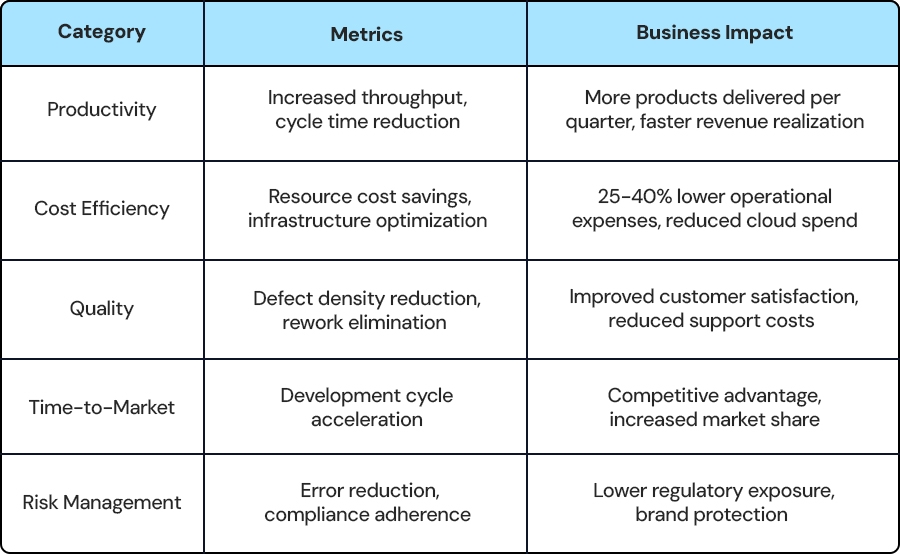
The basic ROI formula (Benefits - Costs) / Costs × 100% provides a starting point, but sophisticated analysis requires consideration of net present value (NPV), internal rate of return (IRR), and total cost of ownership (TCO) across multi-year horizons.
Real-World ROI Analysis
A U.S. retail chain implemented AI-powered chatbots through product engineering consulting partners, automating 70% of customer inquiries. The financial analysis revealed the typical automation ROI pattern:
Initial investment: $150,000 for platform, integration, and training
Annual maintenance: $30,000 for hosting, updates, and model retraining
Annual cost savings: $70,000 in reduced labor costs
Revenue increase: $45,000 from improved satisfaction driving retention
Year 1 ROI: -56.4% (expected for major automation initiatives with upfront investment)
Year 2 ROI: +183% (benefits compound as scale increases and learning improves)
3-Year NPV: $285,000 accounting for time value and compounding effects
This example illustrates why automation ROI must be evaluated across multi-year horizons. The initial investment period shows negative returns, but the compounding benefits of scalability, customer lifetime value improvements, and system learning create substantial long-term value that far exceeds the initial costs.
Addressing Automation Gaps and Implementation Challenges
Despite clear benefits, organizations encounter several obstacles when implementing automation in product engineering services. Cultural resistance often proves more challenging than technical hurdles teams fear job displacement or show reluctance to change established workflows that have worked for years. Integration complexity multiplies when connecting heterogeneous tools with legacy systems that weren't designed for automation. Over-automation risk emerges when organizations remove necessary human oversight and judgment, while maintenance overhead for automated frameworks requires ongoing updates and optimization that many organizations underestimate.
Security and compliance challenges arise as automated processes must meet regulatory requirements, often in industries with strict audit trails and approval workflows. Skills gaps represent another significant barrier internal teams may lack expertise in modern automation technologies, requiring substantial training investments or external partnerships.
Organizations achieving automation excellence follow proven strategies:
Start with pilot programs that prove value in low-risk domains before enterprise-wide rollout
Invest in continuous training, allocating 15-20% of implementation budgets to upskilling teams
Establish strong governance with automation standards, monitoring, and accountability frameworks
Treat automation as continuous optimization, not one-time projects with fixed endpoints
Partner strategically with product engineering consulting experts to accelerate maturity and avoid common pitfalls
A U.S. aerospace manufacturer partnered with digital product engineering services providers to automate quality inspection using computer vision. By starting with a single product line pilot, gathering ROI data, and iterating based on operator feedback, they achieved 95% adoption within 18 months compared to industry average implementation timelines of 3+ years. The phased approach built trust, demonstrated value incrementally, and allowed for course corrections before large-scale investment.
Future Trends Shaping Product Engineering Automation
Technology leaders must prepare for emerging automation capabilities that will reshape competitive dynamics over the next 3-5 years. AI-driven self-optimizing systems represent the next frontier product engineering services will deploy AI agents that continuously optimize workflows without human intervention, achieving 50-70% efficiency improvements beyond current automation levels. These systems learn from their own operation, identifying bottlenecks and automatically reconfiguring processes to maximize throughput and quality.
Low-code/no-code automation platforms are democratizing automation to business users and domain experts, reducing dependence on specialized engineering resources and accelerating automation ROI by 40%. Edge computing integration processes data at the source for sub-millisecond response times—critical for IoT, autonomous systems, and real-time product experiences that cannot tolerate cloud latency.
Quantum computing applications will tackle complex engineering simulations in molecular modeling, aerodynamics, and materials science that are computationally infeasible today, potentially reducing R&D cycles by 10x for certain problem domains. Collaborative robots (cobots) in product development will provide physical automation that enhances human capabilities in prototyping, testing, and manufacturing bridging digital and physical product engineering services.
Sustainable automation architectures are emerging as energy-efficient automated systems reduce carbon footprint by 30-50% while maintaining performance increasingly important for ESG-conscious enterprises facing regulatory pressure and customer expectations around environmental responsibility.
According to Gartner, organizations investing in these emerging automation capabilities achieve 3x competitive advantage in product innovation velocity by 2027, making early adoption a strategic imperative for market leaders.
Conclusion: The Automation Advantage in Product Engineering
Automation in product engineering services unlocks exceptional business value by reducing time-to-market, cutting operational costs, and improving product quality throughout the entire development lifecycle. From AI-enhanced generative design to self-healing CI/CD pipelines, from intelligent testing frameworks to predictive maintenance automation drives competitive advantage through measurable business outcomes.
By adopting a data-driven, strategic approach to automation investments and systematically addressing implementation gaps, organizations achieve rapid ROI while positioning themselves for long-term market leadership. The imperative for CTOs and product leaders is clear: integrate automation deeply across product engineering functions, combine human expertise with intelligent systems, and embrace emerging trends to sustain competitive differentiation.
If your goal is to deliver innovative, high-quality products faster and with lower cost structures, partnering with experienced product engineering consulting firms that offer mature automation capabilities is the definitive path forward. The organizations that succeed will be those that view automation not as a cost reduction exercise, but as a fundamental capability that enables innovation at scale.
TL;DR
Automation in product engineering services delivers measurable business value:
40-50% faster product development cycles through AI-powered design, automated testing, and CI/CD pipelines
25-40% reduction in engineering costs via elimination of manual processes, infrastructure optimization, and resource efficiency
60% fewer production defects through continuous automated validation, intelligent testing, and real-time monitoring
6-9 month ROI realization for organizations partnering with experienced product engineering consulting firms
Key automation domains: Generative design, automated testing frameworks, CI/CD pipelines, infrastructure as code, AI-powered monitoring, and predictive maintenance
Success factors: Start with pilot programs, invest in training, establish governance frameworks, and partner strategically with digital product engineering services providers
Future trends: AI-driven self-optimization, low-code platforms, edge computing, quantum simulations, and sustainable automation architectures
Organizations that strategically implement automation across product engineering achieve competitive advantage through faster time-to-market, lower operational costs, and superior product quality critical differentiators in today's innovation-driven markets.
Automate. Innovate. Scale Your Business.