

 Updated on 15 October 2025

Why Digital Product Engineering Services Matter Now More Than Ever
Modern enterprises face an impossible paradox: innovate faster, cut costs, maintain quality, and stay compliant all simultaneously. The companies winning aren't those building apps fastest; they're the ones delivering resilient, scalable, and intelligent digital products that evolve with market demands.
The gap is widening. Organizations relying on traditional software development are drowning in technical debt, security breaches, and rising cloud costs. Meanwhile, enterprises leveraging digital product engineering services are shipping features 40% faster, reducing infrastructure costs by 30%, and maintaining 99.9% uptime.
A true product engineering partner merges strategic consulting with deep technical expertise across cloud, IoT, AI, and DevOps ecosystems. They transform organizations from reactive app builders into proactive product innovators ensuring seamless evolution across technology generations and user expectations.
What Digital Product Engineering Services Actually Deliver
Unlike conventional software development, product engineering services (PES) manage the entire product lifecycle: ideation, design, development, deployment, maintenance, and continuous modernization. The focus isn't just on building it's on designing resilient systems that scale, adapt, and anticipate market shifts.
Key Functional Layers
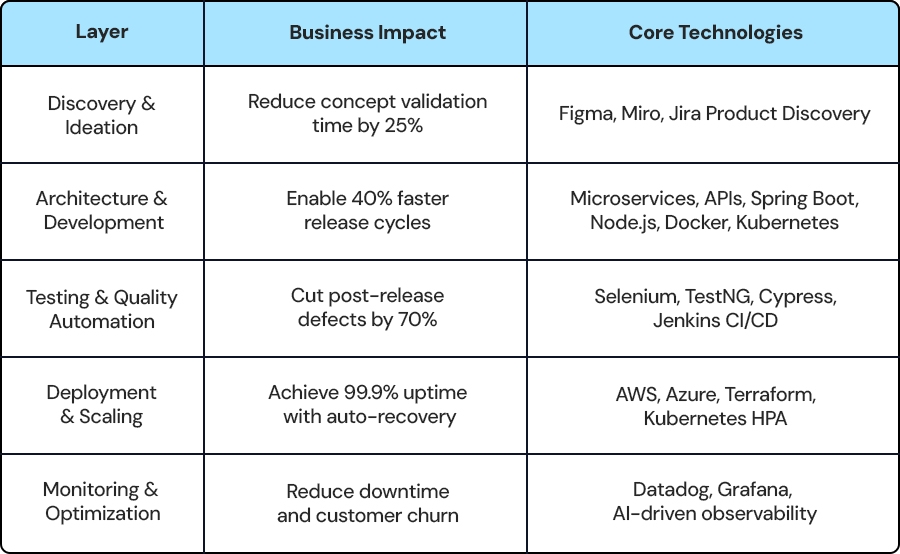
This end-to-end scope ensures technology scales with business vision not against it.
7 Signs You Need a Product Engineering Partner
Sign #1: Development Delays and Technical Debt Accumulation
The Problem: Your releases constantly slip. Sprints end with unresolved backlog items. Manual testing introduces bugs post-launch. Every new feature takes longer than the last.
Why This Happens: Monolithic architecture, siloed dev-test-deploy cycles, and the absence of automated build verification create a compounding debt spiral.
Business Impact:
Release cycles extending from weekly to monthly (or longer)
50%+ of engineering capacity spent firefighting
Customer frustration and churn from delayed features
How Digital Product Engineering Services Solve It: Product engineering experts establish Continuous Integration/Continuous Deployment (CI/CD) pipelines using Jenkins or GitLab CI. Automated regression suites run in containerized environments (Docker + Kubernetes), ensuring consistent validations every commit.
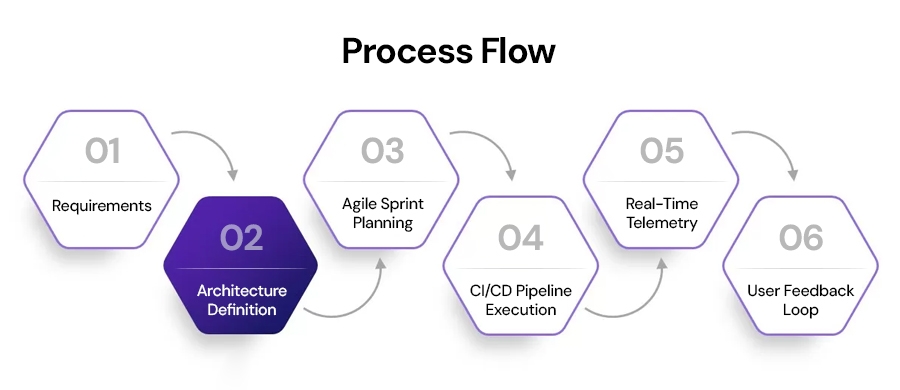
Real-World Outcome: A fintech platform with a manual weekly deployment cycle achieved 60% faster releases (2 days) after implementing fully automated pipelines and microservices refactoring through a product engineering consulting engagement.
Quick Win: Migrating to CI/CD pipelines typically yields 2–3x faster release cycles within 3–6 months.
Sign #2: Outdated Architecture Blocking Innovation and Scalability
The Problem: Your legacy system can't integrate with modern IoT, AI, or cloud-native platforms. You're dependent on deprecated libraries. Infrastructure scaling fails under peak demand, leading to downtime and lost revenue.
Why This Matters: Enterprises stuck on monolithic or on-premises architectures can't compete. Cloud-native organizations are shipping features 3x faster and scaling infinitely.
Business Impact:
High downtime costs (e.g., $5,600/minute for e-commerce)
Inability to support containerized deployment
Missing competitive advantages in AI/ML integration
How Digital Product Engineering Services Modernize: Product engineering partners perform strategic architecture refactoring, transitioning from monolithic systems to microservices, serverless compute (AWS Lambda, Azure Functions), and Kubernetes orchestration. They introduce API-first design, enabling scalability and loose coupling across services.
Modernization Playbook: Old Architecture → Service-Based REST/GraphQL APIs → Cloud-Native Kubernetes Pods → Infrastructure-as-Code (Terraform/Ansible) → Auto-Scaling Policies
Transformation Example: A legacy retail platform moved from on-premises monolith to Kubernetes-based microservices. Result: 99.9% uptime, horizontal scaling to 1M+ concurrent users, and 40% infrastructure cost reduction.
Quick Win: Containerization alone reduces deployment risk and infrastructure overhead by 30–40%.
Sign #3: Rising Maintenance Costs and Recurring Bug Issues
The Problem: Your QA team is overwhelmed. Manual testing misses bugs that users find in production. Monthly maintenance costs are spiraling. User trust is eroding due to frequent failures.
Why This Happens: Insufficient test automation, lack of observability, and reactive (not proactive) monitoring create an endless cycle of reactive firefighting.
Business Impact:
30–50% of engineering capacity spent on bug fixes
Post-release defects damaging customer satisfaction
High operational overhead
How Digital Product Engineering Services Solve It: Product engineering teams integrate test orchestration frameworks (Selenium, TestNG, Cypress) with monitoring platforms (Prometheus, Grafana). They implement AIOps models to detect anomalies before they affect users, enabling predictive incident prevention.
Quality Optimization Cycle: Define SLAs → Instrument Code with Observability Hooks → Simulate Load (JMeter) → Run A/B Performance Comparisons → Automated Rollback Strategies → Continuous Learning Loop
Proven Result: A SaaS enterprise reduced post-deployment incidents by 72% through AI-led test automation integrated into CI/CD pipelines, cutting support costs by $500K annually.
Quick Win: Automating just 30% of test coverage typically prevents 50%+ of production bugs.
Sign #4: Lack of Specialized Skills and Engineering Gaps
The Problem: Your in-house team lacks deep expertise in data engineering, IoT integration, MLOps, or cloud-native architecture. You're dependent on external contractors or losing top talent to burnout.
Why This Matters: Modern product ecosystems demand cross-domain specialization that rarely exists in a single in-house team.
Business Impact:
Delayed feature launches due to skill gaps
High contractor costs and knowledge leakage
Retention issues top engineers leave overstretched teams
How Digital Product Engineering Services Bridge It: A strong partner provides ready availability of cross-domain architects and solution engineers who integrate seamlessly within your teams. They introduce hybrid models combining on-site product leaders with offshore agile pods for cost-effective, continuous expertise.
Typical Specialist Roles Provided:
Data engineering architects (ETL, ML pipelines)
IoT firmware engineers (edge computing, device management)
Cloud infrastructure specialists (Kubernetes, serverless)
DevSecOps engineers (compliance, zero-trust architecture)
AI/ML engineers (automation, predictive analytics)
Real Example: An industrial automation firm needed to build a digital twin platform. This required specialists in predictive modeling, embedded systems, and real-time data processing expertise consolidated only through a product engineering partnership. Result: 8-month delivery (vs. 18+ months in-house).
Quick Win: Outsourcing specialized teams reduces hiring time by 60% and provides immediate expertise transfer.
Sign #5: Inability to Scale Without Performance Bottlenecks
The Problem: As adoption grows, your platform crumbles. API latency exceeds 200ms. Database queries slow down. Users churn due to poor performance. You're paying 5x more for infrastructure than you should.
Why This Happens: Inefficient database design, lack of caching, poor load distribution, and absent performance testing create scaling nightmares.
Business Impact:
Exponential cloud spend growth (sometimes 300%+)
User churn from poor performance
Lost conversion and revenue
How Digital Product Engineering Services Optimize: Product engineering solutions introduce distributed computing (Kafka, Spark), horizontal scaling, intelligent cache layers (Redis, Memcached), and Domain-Driven Design (DDD) to decouple modules for elasticity.
Performance Engineering Flow: User Load Simulation → Real-Time Monitoring → Resource Scaling Scripts → Auto-Healing Orchestration → Predictive Capacity Forecasting → Continuous Optimization
Scaling Success Story: An e-commerce platform scaled from 20K to 1M concurrent users with negligible latency increase using Kubernetes Horizontal Pod Autoscaler (HPA) + Redis caching + optimized database queries.
Typical Improvements:
API response time: 500ms → 50ms
Cloud costs: reduced by 25–35% through efficient resource allocation
User retention: improved by 20–30%
Quick Win: Implementing Redis caching can reduce API latency by 60% and cut database load by 70%.
Sign #6: Security and Compliance Gaps Risking Fines and Breach
The Problem: Your security posture is fragmented. User data isn't properly encrypted. Access controls are weak. You lack vulnerability scanning. Compliance audits reveal critical gaps (HIPAA, SOC2, PCI-DSS, GDPR).
Why This Matters: A single breach can cost millions in fines, incident response, and brand damage. Compliance violations can shut down operations.
Business Impact:
Regulatory fines: $2.7M average per GDPR violation
Loss of customer trust and revenue
Inability to land enterprise deals requiring compliance
How Digital Product Engineering Services Secure It: Product engineering partners embed DevSecOps culture, integrating static and dynamic security testing into CI/CD pipelines. They implement zero-trust architecture with encryption, audit logging, and data governance frameworks.
Security Architecture Components:
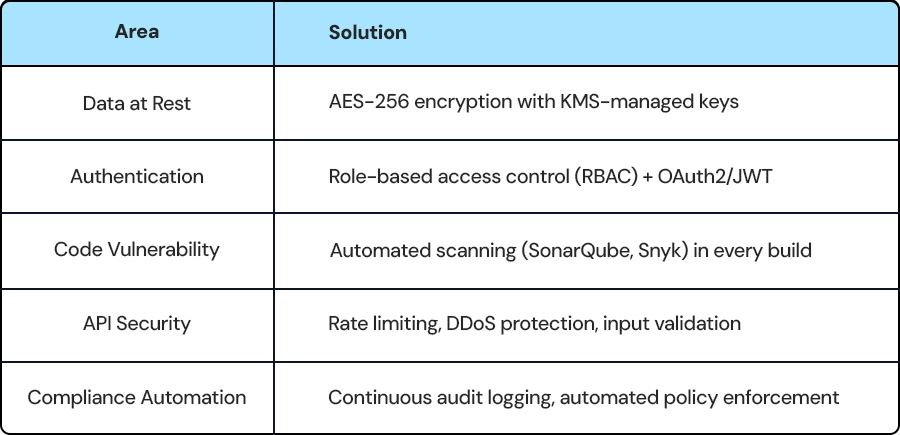
Compliance Success: A healthcare SaaS startup achieved HIPAA compliance in 4 months through role-based access control, patient data encryption, and audit logging enabling them to land 5 enterprise customers worth $2M+ in annual revenue.
Quick Win: Integrating security testing into CI/CD catches 85% of vulnerabilities before production.
Sign #7: Poor User Experience and Slow Market Adaptation
The Problem: Your app has a 4.2-star rating with complaints about sluggish features. Churn is rising. You can't adapt quickly to user feedback or competitive moves. Feature launches take months to show results.
Why This Happens: Disconnect between product analytics, UX research, and engineering execution. Rigid release processes. Lack of personalization.
Business Impact:
High churn rates (losing 5–10% of users monthly)
Negative app store ratings (3.5 stars or below)
Missed revenue opportunities from feature gaps
Competitor advantage
How Digital Product Engineering Services Enhance UX: Digital engineering partners use DesignOps, UX Analytics, and feature toggle frameworks to continuously improve experiences. They embed telemetry through Mixpanel, Segment, or custom analytics, and integrate machine learning for real-time sentiment analysis.
UX Modernization Process: User Behavior Capture → Feature Heatmap Analysis → A/B Testing → UI Component Optimization → Continuous CX Feedback → Predictive Personalization
Real-World Impact: A mobility app improved retention by 38% and reduced churn by 22% after implementing real-time analytics-driven personalization via ML pipelines. Users received personalized recommendations based on behavior patterns, increasing engagement and lifetime value.
Quick Win: A/B testing and feature toggles can improve conversion by 15–25% within weeks.
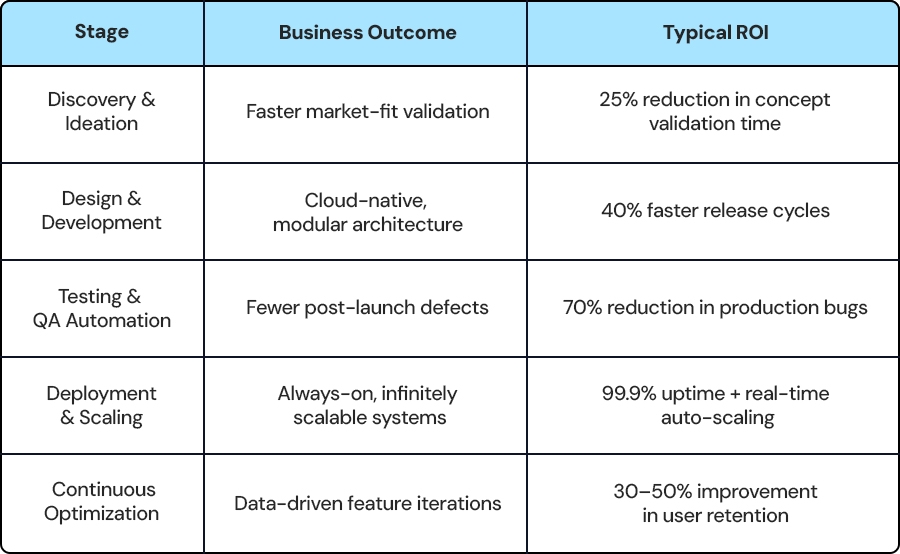
Strategic Value Chain: What a Product Engineering Partner Delivers
2025 Emerging Trends in Digital Product Engineering
The product engineering landscape is evolving rapidly. Forward-thinking enterprises are adopting:
AI-Enhanced Code Generation & Testing: Generative AI is automating 40% of routine coding and test case generation, freeing teams for higher-value work. Tools like GitHub Copilot and AI-powered test automation are becoming table stakes.
Cloud Cost Optimization (FinOps): As enterprises face sky-high cloud bills, FinOps practices combining engineering, finance, and ops are critical. Product engineering partners now include cloud cost audits and optimization as standard services.
Edge Computing for Low-Latency Experiences: Distributed edge infrastructure enables real-time personalization, IoT processing, and compliance-friendly data residency.
Sustainable Engineering (GreenOps): Carbon-efficient infrastructure, optimized algorithms, and sustainable data practices are becoming competitive advantages especially for enterprise deals.
No-Code / Low-Code Integration: Product engineers are building modular, API-first systems that integrate with low-code platforms, enabling faster feature composition.
Outcome: Organizations don't just adapt to market shifts they anticipate them with data-enabled intelligence.
How to Know If It's Time to Partner
Ask youself:
1. Are we shipping slower than we were 12 months ago?
2. Do security or compliance audits reveal critical gaps?
3. Are cloud costs growing 20%+ year-over-year without proportional growth?
4. Can we scale to 10x our current user base without a major rewrite?
5. Do we have in-house expertise in microservices, DevOps, and AI/ML?
6. Are we losing engineering talent to burnout or skill gaps?
If you answered "no" to 3+ questions, it's time to explore a digital product engineering partnership.
Key Takeaways
Ignoring these 7 signs is equivalent to capping your growth potential. Technical debt, outdated architecture, and security gaps compound exponentially costing millions in missed revenue and incident response.
Partnering with a specialized digital product engineering service enables organizations to evolve from product delivery to continuous innovation. You shift from being reactive to proactive, from paying for firefighting to investing in acceleration.
Integration of AI, DevSecOps, and microservices ensures sustained competitiveness across industries from fintech to healthcare SaaS, manufacturing IoT to e-commerce platforms.
Future-ready enterprises don't win through code velocity alone. They win through engineering intelligence the strategic combination of technical excellence, architectural foresight, and continuous market adaptation. This is precisely what a digital product engineering partner delivers.
Conclusion
In today’s competitive digital landscape, ignoring technical debt, outdated architecture, and skill gaps risks growth and customer trust. The seven signs from delayed releases to poor user experience signal that traditional development may be holding your business back.
Digital product engineering services transform this by modernizing systems, automating processes, strengthening security, and integrating emerging technologies like AI, edge computing, and low-code platforms. The results are faster releases, lower costs, improved uptime, and access to specialized expertise.
Partnering with a product engineering service shifts organizations from reactive maintenance to proactive innovation, ensuring technology drives growth, enhances competitiveness, and future-proofs digital products for long-term success.
Fix Delays, Build Faster