


Who This Article Is For
This article is for you if:
Your product releases take days or weeks instead of hours
Deployment depends on one or two "hero" engineers
You delay releases because manual processes feel risky
Hiring more engineers hasn't improved your release velocity
You're a CTO, VP Engineering, or Product Leader looking to scale delivery without scaling costs
Problem solved: Manual deployment processes create bottlenecks that hiring alone cannot fix. This article explains how to accelerate release cycles using proven DevOps practices and automation.
The "Hiring Trap" in Product Engineering
In many growing companies, release delays are not caused by lack of talent but by inefficient engineering systems. We see leadership teams at mid-market SaaS companies (usually 50–200 people) forced into a tough decision: "Do we hire more engineers or accept slower product delivery?"
The product backlog is growing, customers are demanding new features, and the release cycle is sluggish. The natural reflex is to hire more developers. "If we have 10 developers releasing 5 features a month, surely 20 developers will release 10 features," right?
Unfortunately, software engineering doesn't follow linear math. Here's the hard truth we've learned at Aspire SoftServ after helping dozens of product companies scale: Adding more people to a slow deployment process doesn't make you faster; it just creates a more expensive bottleneck.
There's a concept in software engineering known as Brooks' Law: "Adding manpower to a late software project makes it later." When you add new hires to a team with a fragile, manual deployment process, you aren't increasing velocity. You're increasing the communication overhead and the "wait time" for your staging environments. If your deployment process is manual or dependent on a single "hero" engineer, hiring five more developers will only increase the queue of code waiting to be shipped.
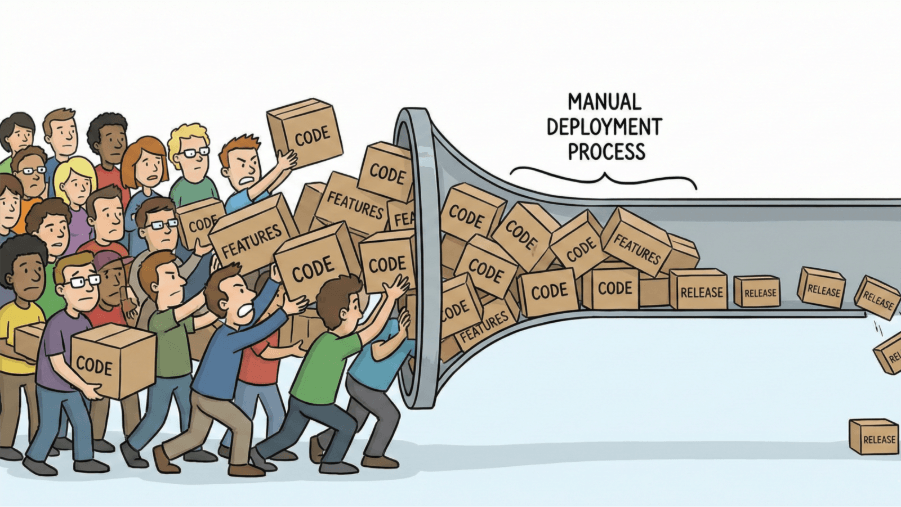
Key insight: Automation removes inefficient processes, not people, as the limiting factor in releases.
Here's how we help engineering teams break this cycle using DevOps automation, CI/CD pipeline implementation, and Infrastructure as Code accelerating delivery without blowing up the payroll.
A Real-World Scenario: The "4-Hour Deployment" Nightmare
Let me share a specific example from a recent engagement with a Fintech client. They had a talented team of 15 developers, but their release cycle was painful.
The Situation:
Every time they wanted to release to production, their Lead DevOps Engineer had to manually provision servers, SSH into them, and run update scripts.
The challenges were clear:
Time cost: Deployment took 4 hours of active monitoring
Risk: If the Lead Engineer was sick or on vacation, no releases happened. The "Bus Factor" was 1
Fear: Because deploying was hard, they waited weeks to bundle features together. This resulted in "Big Bang" releases pushing 50 changes at once which inevitably broke things and required hotfixes
They wanted to hire two more Junior DevOps engineers to "help with the load." We advised against it.

Business impact: Instead of adding headcount, we overhauled their architecture to focus on automation over administration, reducing deployment risk and removing single-person dependency.
Here are the four specific shifts we made to solve this.
1. How Infrastructure as Code Removes Deployment Risk and Delays
Answer: Manual infrastructure slows releases and increases risk. Treating infrastructure as code removes environment drift and enables fast, repeatable deployments.
The biggest slowdown for mid-market teams is "Environment Drift," often caused by what we call Snowflake Servers. A Snowflake Server is a server that has been manually configured and tweaked over time. Maybe a developer SSH'd in six months ago to update a library, or changed a permission to fix a bug, but never wrote it down. When you try to spin up a new Staging environment, it breaks because it doesn't match the unique, delicate "Snowflake" running in Production.
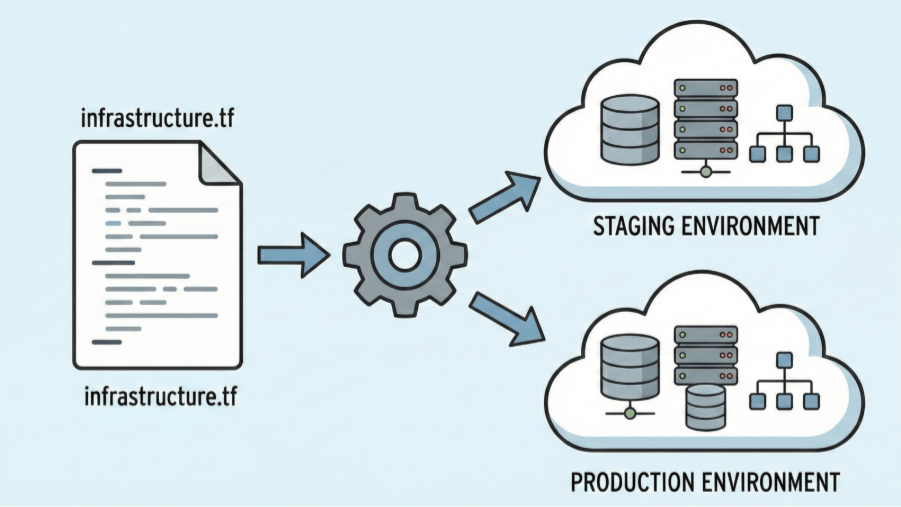
We don't rely on documentation for server configs; we rely on code. Using tools like Terraform or AWS CDK, we define the entire infrastructure in code repositories as part of our product engineering services approach.
The Shift:
We stopped clicking buttons in the AWS console. We treat infrastructure definitions just like application code it goes through version control, code review, and automated deployment testing.
The Result:
We could tear down and rebuild their entire staging environment in 15 minutes, guaranteed to be an exact replica of production (Immutable Infrastructure). For Engineering Managers, this eliminates the "It works on my machine" excuse. If it passes in the codified staging environment, it will work in production.
2. The "Pull Request" Environment Strategy: Accelerating Feedback Loops
Answer: Ephemeral environments enable parallel development and catch bugs days earlier by giving each feature its own isolated testing space.
In the old workflow, 15 developers were merging code into a single dev branch, creating a messy traffic jam for the QA team. If Developer A broke the dev environment, Developer B couldn't test their work.
We implemented Ephemeral Environments using Kubernetes as part of our continuous delivery strategy. Now, whenever a developer opens a Pull Request (PR), the system automatically spins up a temporary, isolated environment just for that feature. The URL is posted directly into the PR comments.
The "Data" Challenge:
The most common question we get is, "What about the database? You can't copy the production DB for every PR." You're right. To solve this, we built a Data Seeding Script within the CI/CD pipeline. When the ephemeral environment spins up, it populates a lightweight PostgreSQL container with a sanitized, synthetic dataset required for testing.
The Impact:
This approach transformed our development workflow in several ways:
The Product Manager can click a link and see the feature live before it merges
Automated Cypress tests run against that specific isolated code
Once the PR is merged, the environment destroys itself to save cloud costs
QA moved from the end of the cycle to the middle
Key takeaway: We caught bugs days earlier through software release automation, preventing the "end-of-sprint panic" and significantly improving deployment frequency.
3. Democratizing DevOps Through Self-Service Pipelines
Answer: Self-service pipelines remove DevOps as a bottleneck without compromising safety, enabling developers to deploy independently with automated guardrails.
The bottleneck in our Fintech example was that developers had to ask permission (ticket) to get resources. This "Gatekeeper" model is outdated. We believe that DevOps shouldn't be a gatekeeper; it should be a platform builder.
We built a self-service pipeline. If a backend developer needs to deploy a microservice update, they push the tag. The CI/CD pipeline (GitLab CI/Jenkins) handles the deployment automatically.
"But isn't that dangerous?"
This is where Policy as Code comes in. We implemented automated "Guardrails" using tools like SonarQube and OPA (Open Policy Agent) that enforce quality standards:
If code coverage drops below 80%, the pipeline blocks the deploy
If a security vulnerability is detected in a library, the pipeline blocks the deploy
If performance tests fail, the pipeline blocks the deploy
We didn't need to hire more DevOps engineers to run scripts. We utilized the existing talent to build a "paved road" with safety barriers, allowing application developers to drive fast safely.
Business impact: This approach reduced deployment dependency on specific individuals and enabled the team to scale release velocity without adding DevOps headcount.
4. Measuring What Matters: DORA Metrics for Release Velocity
Answer: You cannot improve what you don't measure. DORA metrics provide objective data to optimize for flow, not just utilization.
Before we started, the client "felt" slow, but they had no data. We set up a dashboard to track the four key DORA (DevOps Research and Assessment) Metrics, which are the industry standard for elite engineering teams:
The Four Key Metrics:
Deployment Frequency: How often do we ship? (Goal: On-demand)
Lead Time for Changes: How long from "Commit" to "Production"? (Goal: < 1 hour)
Change Failure Rate: How often do deployments cause a failure? (Goal: < 5%)
Mean Time to Recovery (MTTR): How fast can we restore service if it breaks? (Goal: < 1 hour)
By visualizing these metrics, the team shifted their mindset. They stopped optimizing for "utilization" (keeping everyone busy) and started optimizing for "flow" (getting code to production). This data-driven approach made it clear where bottlenecks existed and which improvements delivered the highest impact on release velocity.
How Product Engineering Teams Approach This Differently
Instead of hiring more engineers, experienced product engineering teams focus on removing systemic friction. This represents a fundamental shift in how leadership thinks about scaling product delivery.
The Strategic Shift:
Modern product engineering services prioritize process optimization over headcount expansion. This means focusing on five core areas:
Removing deployment bottlenecks through DevOps automation
Automating infrastructure provisioning and testing cycles
Creating self-service CI/CD pipelines with built-in safety
Measuring delivery performance using DORA metrics
Enabling continuous delivery without manual intervention
This approach transforms engineering operations from reactive to proactive, allowing teams to scale product velocity without linearly scaling costs. The investment shifts from ongoing salary expenses to one-time automation infrastructure that continues delivering value.
Important consideration: This approach requires upfront investment in automation infrastructure and team discipline. Teams without basic CI/CD maturity may need a phased rollout over 2-3 months, but the ROI typically appears within the first quarter.
The Outcome: Speed Without Bloat
Returning to that Fintech client after 3 months of refactoring their pipeline and implementing Infrastructure as Code:
Results:
Release Frequency: Went from once every 3 weeks to 3 times a day
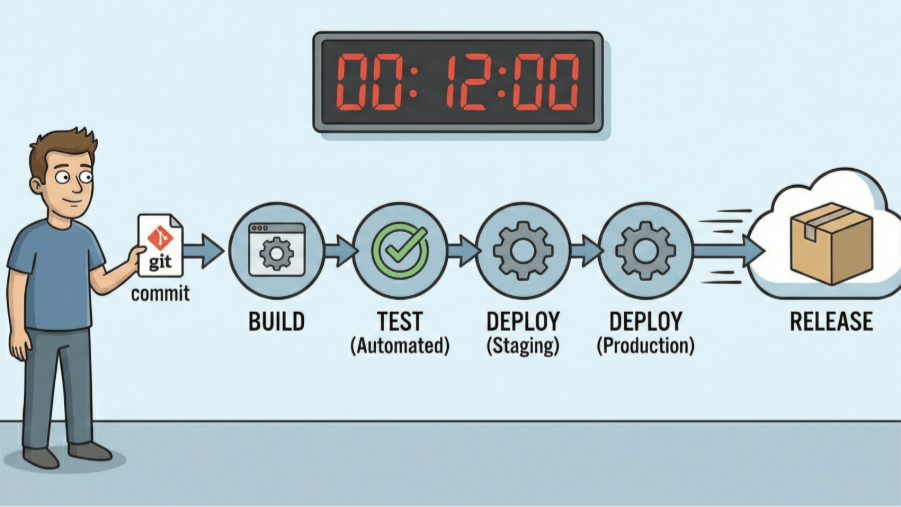
Deployment Time: Reduced from 4 hours to 12 minutes
Headcount: Zero new hires in the DevOps team
Change Failure Rate: Dropped from 18% to 4%
Mean Time to Recovery: Improved from 3+ hours to under 45 minutes
The existing team wasn't working harder; the friction was simply removed through automated deployment and systematic DevOps practices.
Cost Impact: By avoiding two additional DevOps hires ($180K+ annually) and reducing deployment failures, the client saved an estimated $250K in the first year while tripling their release capacity. The initial automation investment of $75K paid for itself in less than four months through improved efficiency and eliminated emergency fixes.
Conclusion
If your engineering team is feeling the pressure to deliver faster, look at your process before you look at your hiring plan.
The core principle is simple: Automation removes process bottlenecks faster and more cost-effectively than adding people. By implementing CI/CD pipeline automation, Infrastructure as Code, and proven DevOps practices, mid-market product teams can achieve elite release velocity without proportionally scaling headcount.
At Aspire SoftServ, we specialize in helping mid-market product companies modernize their engineering stacks through comprehensive product engineering services. We don't just patch holes; we build architectures that allow you to scale your product without linearly scaling your costs.
Is your release cycle stuck in manual mode?
Free Release Velocity Assessment
In a 30-minute consultation, we'll review:
Your current deployment frequency and CI/CD pipeline maturity
Key bottlenecks slowing your release velocity
Automation opportunities for faster ROI
A roadmap for implementing DevOps automation without disrupting ongoing development
Let's assess your current pipeline and identify how you can accelerate release cycles through proven automation strategies. We can help you automate the heavy lifting so your best engineers can get back to building features that drive revenue.
Find what slows your releases