


 Updated on 29 October 2025


How Digital Product Engineering Transforms Compliance into a Competitive Advantage
Modern financial institutions face converging pressures rigorous regulations, escalating cyber risks, and the need for rapid innovation. This guide reveals how product development engineering services embed compliance into every stage of the software lifecycle, reducing costs, accelerating time-to-market, and transforming regulatory requirements from obstacles into strategic advantages. Leading firms leverage RegTech automation, AI-driven monitoring, and compliance-first architectures to achieve 40-60% faster regulatory approvals while reducing technical debt by up to 50%.
Why Compliance-Driven Product Engineering Services Matter for Your Business
Financial institutions investing in compliance-first digital product engineering services are seeing remarkable returns. Organizations report:
50-70% reduction in audit preparation time
40-60% faster regulatory approval cycles
30-50% lower compliance-related technical debt
3-5x ROI on RegTech automation investments within just 18 months
The fundamental shift happening across the industry is treating compliance not as a post-development checklist, but as an integrated discipline throughout product development. Forward-thinking firms integrate regulatory requirements directly into product engineering solutions from initial design through deployment and continuous monitoring.
Traditional approaches fail spectacularly when organizations attempt regulatory compliance after MVP launch. The compliance retrofit problem manifests as 3–6 month delays for retroactive changes, 200-300% cost overruns versus proactive compliance, cascading technical debt requiring major architectural rewrites, and increased risk of regulatory penalties that averaged $2.7M per violation in 2024. Compliance-by-design reduces total cost of ownership by 40% while accelerating market entry by 6-12 months compared to retrofit approaches.
Core Technical Compliance Domains in Digital Finance
Modern digital product engineering services must address multiple compliance layers simultaneously. Authentication and access control prevent unauthorized access and fraud through multi-factor authentication, single sign-on, OAuth protocols, and role-based access controls, all governed by regulations like PSD2, SOX, and NIST standards. Data security and privacy require AES-256 encryption, tokenization, and data loss prevention to avoid breaches and fines under GDPR, CCPA, DPDP, and ISO 27001.
KYC (Know Your Customer) and identity verification form the foundation of financial compliance, requiring digital identity verification with biometric authentication, document validation through AI-powered OCR and liveness detection, continuous customer due diligence with risk-based screening, and automated sanctions list checking against OFAC, UN, and EU databases. Modern KYC automation reduces onboarding time from 3-5 days to under 10 minutes while maintaining 99.5% accuracy, adhering to BSA/CIP, eKYC guidelines, and 40 Recommendations from FATF.
Anti-Money Laundering (AML) and transaction monitoring leverage real-time analytics and AI-powered anomaly detection to combat money laundering and terrorist financing. Advanced AML systems include transaction pattern analysis with machine learning models, suspicious activity report (SAR) automation with intelligent case management, customer risk scoring with continuous monitoring, and cross-border transaction surveillance. These systems adhere to Bank Secrecy Act (BSA), AMLD5/AMLD6, FATF requirements, and FinCEN regulations, reducing false positives by 85% while detecting sophisticated money laundering schemes.
PCI DSS (Payment Card Industry Data Security Standard) compliance protects cardholder data through network segmentation with DMZ architecture and firewall configurations, cardholder data encryption both at rest and in transit, secure payment gateway integration with tokenization, quarterly vulnerability scanning and annual penetration testing, and comprehensive access control with multi-factor authentication. PCI DSS compliance prevents costly data breaches and maintains payment processing capabilities non-compliance results in $5,000-$100,000 monthly fines plus potential loss of card processing privileges.
Audit logging and activity tracking depend on immutable logs and SIEM integration to prevent compliance failures and penalties under PCI DSS, SOX, and DORA.
Infrastructure resilience through disaster recovery failover and automated backups protects against service disruption and data loss according to DORA and ISO 22301 standards.
Multi-Jurisdictional Compliance Complexity
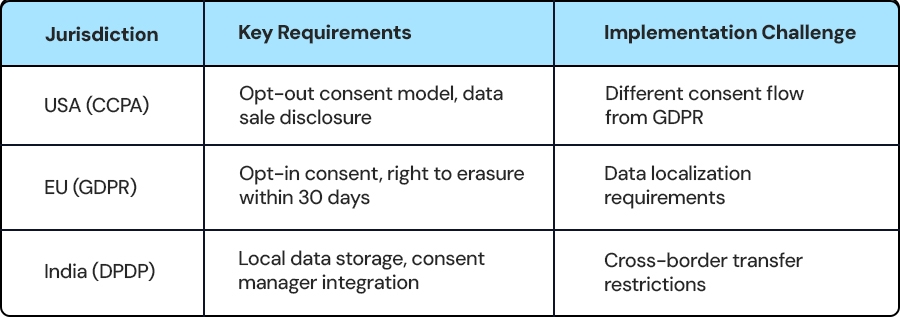
The challenge intensifies when products operate across USA, EU, and Asia, requiring region-specific consent management flows that differ between GDPR and CCPA, data localization requirements for EU data residency and Indian data protection, and transaction logging standards with varying retention periods. Modular product engineering consulting approaches enable jurisdiction-specific feature gating without code duplication, allowing firms to audit their current architecture for multi-jurisdictional flexibility rather than facing 6-12 month rewrites for new market entry.
RegTech & Compliance Automation: Reducing Costs by 40-60%
Manual compliance processes consume 15-25% of IT budgets at financial institutions, but RegTech automation is changing this equation dramatically. Organizations implementing automated compliance solutions achieve 60% reduction in manual compliance work, 80% faster regulatory change adaptation, 90% accuracy in automated reporting versus 70% manual accuracy, and $3-5M annual savings for mid-sized institutions.
Modern product engineering services integrate RegTech through automated regulatory monitoring that delivers alerts within 24 hours of regulatory changes versus 2-3 week manual discovery. Natural language processing engines parse regulatory updates from SEC, FINRA, and ECB sources, automatically generate compliance requirement tickets in existing backlogs, and trigger impact assessments across affected product modules.
Policy-as-code represents another breakthrough, enabling deployment of compliance changes in days versus months and reducing time-to-compliance by 70%. Regulatory rules become executable policies through tools like Open Policy Agent and AWS Service Control Policies, with automated enforcement in CI/CD pipelines that prevents non-compliant code from deploying. Version-controlled compliance libraries sync with regulatory calendars, creating a living compliance infrastructure.
Real-World RegTech Impact: AML Transaction Monitoring Case Study
Consider a multinational bank processing 50 million daily transactions across SWIFT, ACH, and SEPA networks requiring comprehensive AML surveillance with 99.5% accuracy. Their AI-driven AML transaction monitoring platform uses Apache Kafka and AWS Kinesis for real-time data ingestion with zero data loss, custom machine learning models with TensorFlow for anomaly detection that achieved 85% reduction in false positives, blockchain-based immutable logs ensuring 100% audit readiness with zero disputes, and automated SAR generation with XBRL formatting saving 90% of time on regulatory reporting.
The AML-specific capabilities include pattern recognition for structuring and smurfing schemes, network analysis detecting mule account chains, velocity checks identifying unusual transaction frequencies, and geographic risk scoring for cross-border transfers. The results speak for themselves: 75% reduction in compliance analyst workload, $8M annual cost savings, 40% faster suspicious activity reporting filing, and 60% improvement in SAR quality as rated by FinCEN. Automated AML transaction monitoring pays for itself within 12-18 months while significantly reducing regulatory risk and improving detection rates for sophisticated money laundering schemes.
Building Compliance-First Product Engineering Lifecycles
Siloed teams create friction, delays, and increased costs when business, compliance, and engineering operate independently. Integrated product development engineering services with compliance embedded at every stage eliminate these problems through a unified workflow from regulatory analysis through requirement mapping, security-first design, secure development with DevSecOps integration, production environment deployment, automated reporting, release management, and continuous monitoring that feeds back into the cycle.
The business impact at each stage proves transformative. Regulatory analysis and mapping eliminates 60% of late-stage compliance surprises by mapping regulations to product features before coding begins, identifying KYC/AML/PCI DSS compliance gaps during competitive analysis, and estimating compliance costs during business case development.
Security and privacy by design reduces security vulnerabilities by 70% versus post-development fixes through threat modeling during architecture reviews, privacy impact assessments for data flows, and compliance test cases generated directly from requirements.
DevSecOps integration delivers 50% faster defect resolution with automated compliance checks through static and dynamic code analysis for security flaws, automated dependency scanning for vulnerable libraries, PCI DSS security controls validation in pre-production environments, and compliance gates built into CI/CD pipelines.
Automated audit and reporting achieves 80% reduction in audit preparation time through continuous evidence collection for SOC 2, ISO 27001, and PCI DSS, one-click regulatory report generation including SAR filings and PCI compliance reports, and regulator-accessible sandbox environments for pre-approval testing.
Compliance Engineering Team Structure
Building these capabilities requires specialized teams combining compliance architects who translate KYC/AML/PCI DSS regulations into technical requirements, security engineers implementing cryptography and access controls for cardholder data protection, AML data scientists building machine learning models for transaction monitoring, ML Ops specialists ensuring AI explainability and fairness in credit and risk decisions, DevOps and SRE professionals building auditable and resilient infrastructure, and QA automation engineers validating regulatory test scenarios across KYC onboarding flows and AML detection rules.
The challenge? Only 15% of engineers have combined expertise in cloud, security, and regulatory requirements. Organizations must decide whether to build internal capabilities over 18-24 months or partner with specialized product engineering solutions providers that provide interdisciplinary teams already trained in financial compliance. Firms with dedicated compliance architects reduce regulatory issues by 60%.
Real-World Use Cases & ROI Analysis
European FinTech: GDPR Compliance & Market Expansion
A European FinTech with 500,000 users expanding to Asian markets faced GDPR data privacy requirements, cross-border data transfer restrictions, user-driven data access and erasure within 30 days, and regional data residency mandates. The product engineering solution implemented attribute-based access controls and API filtering for data minimization, achieving 40% reduction in data storage costs. Format-preserving encryption for pseudonymization resulted in zero privacy breaches over two years. Dynamic policy-as-code with signed consent receipts delivered 99.7% consent audit accuracy, while network segmentation and regional cloud deployment ensured 100% data residency compliance. Hash-chained logs with SIEM integration enabled 90% faster audit responses.
Business Outcomes:
Launched in three new markets within six months versus an 18-month typical timeline
Maintained zero GDPR violations or fines
Saved $2.5M in avoided penalties and manual compliance costs
Achieved 35% improvement in customer trust scores
US Digital Bank: Comprehensive KYC/AML/PCI DSS Implementation
A US digital bank serving 2 million customers needed integrated compliance covering identity verification, transaction monitoring, and payment security. They faced regulatory requirements including BSA/CIP for customer identification, FinCEN AML program requirements with SAR filing obligations, PCI DSS Level 1 compliance for card processing, and FFIEC cybersecurity standards. Their comprehensive compliance engineering solution integrated AI-powered KYC with facial recognition achieving 99.3% accuracy, automated document verification reducing onboarding from 4 days to 8 minutes, real-time AML screening against 40+ sanctions lists with 95% false positive reduction, behavioral transaction monitoring detecting structuring patterns with 90% accuracy, end-to-end payment tokenization with PCI DSS validated P2PE solutions, and quarterly vulnerability management with automated remediation workflows.
Business Impact:
$12M annual savings from KYC/AML/PCI automation
90% faster customer onboarding while maintaining regulatory compliance
Zero PCI DSS violations across 3 years of quarterly audits
200% improvement in SAR quality reducing regulator inquiries by 75%
65% reduction in fraud losses through integrated AML and payment security
US FinTech: AI-Powered Fair Lending Compliance
A US FinTech serving the subprime lending market needed to meet fair lending requirements under ECOA and FCRA while providing explainability for loan denials, detecting and mitigating model bias, and enabling real-time compliance auditing. Their AI-powered credit scoring system integrated SHAP and LIME for model interpretability, continuous drift monitoring with automatic rollback capabilities, version-controlled datasets with models and explanations, and automated decision logs with differential privacy.
Business Impact:
50% reduction in fair lending complaints
99.2% explainability coverage for all decisions
$4M reduction in legal and compliance costs annually
25% increase in loan approval rates by identifying and fixing bias
Overcoming Common Compliance Engineering Challenges
The technical debt trap catches organizations that retrofit compliance after launch, creating three times the technical debt versus proactive design. A US neobank expanding to the EU discovered their consent management lacked GDPR reconciliation, resulting in a four-month complete data layer rewrite, $6M in unplanned compliance costs, and two major service outages during migration. Compliance-first digital product engineering services embed regulatory requirements from initial architecture, delivering proactive compliance design at 40% less cost and 60% faster completion than retrofit approaches.
Multi-jurisdictional product complexity increases costs by 300% when maintaining separate codebases for USA (CCPA), EU (GDPR), and India (DPDP). Modular service architecture solves this through jurisdiction-specific modules as independent microservices, feature flags for regional compliance variations, and centralized compliance rule engines with regional adapters. Organizations achieve 70% reduction in code duplication, new market entry time reduced from 12 months to 3 months, and 50% lower maintenance costs.
The Talent Gap Challenge
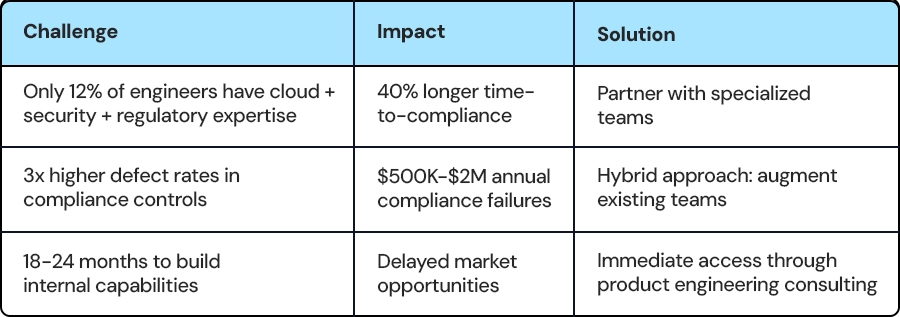
Organizations face three options: building internal expertise over 18-24 months, partnering for immediate access to specialized product engineering teams, or using a hybrid approach to augment existing teams with compliance engineering specialists. ROI comparisons show that partnering with specialized product development engineering services delivers compliance readiness 70% faster at 40% lower total cost than building internal capabilities.
Emerging Trends: Future-Proofing Your Compliance Strategy
Generative AI for regulatory intelligence is reducing regulatory analysis time from weeks to hours by auto-parsing new regulations to extract technical requirements, generating compliance test cases from legal documents, identifying conflicts between existing KYC/AML controls and new rules, and estimating compliance implementation costs automatically. Early adopters report 80% reduction in regulatory change analysis time, with production-ready GenAI compliance tools becoming available in Q2 2025.
Behavioral biometrics for continuous authentication reduces fraud losses by 75% while improving user experience through deep learning models analyzing typing patterns, mouse movements, and device usage for continuous risk scoring without explicit authentication steps and real-time fraud detection at the API level. This technology supports PSD2 strong customer authentication requirements and enhances PCI DSS compliance with impressive ROI: $5-$10 saved in fraud prevention for every $1 spent on behavioral analytics.
Quantum-Safe Cryptography: The Next Frontier
Current encryption methods like RSA and ECC become vulnerable to quantum computers within 5-10 years. Financial data retention requirements of 7-10 years mean data encrypted today must remain secure through the quantum era. NIST Post-Quantum Cryptography algorithms provide the solution through quantum-resistant encryption for long-term data storage, hybrid classical and quantum encryption for the transition period, and crypto-agility frameworks for algorithm migration. Organizations should begin PQC pilot programs now before quantum computers pose practical threats to financial data security, particularly for PCI DSS cardholder data and AML transaction records requiring extended retention.
Strategic Implementation: Building Your Compliance Foundation
Successful compliance transformation requires a strategic approach that balances immediate improvements with long-term architectural changes. Organizations should begin with a comprehensive compliance maturity assessment that evaluates current KYC/AML/PCI DSS processes, identifies technical debt from compliance retrofits, and quantifies compliance costs including manual effort, penalties, and delays. This foundation enables data-driven decision-making and clear ROI projections for stakeholder buy-in.
Architecture reviews are equally critical, assessing multi-jurisdictional flexibility, identifying single points of compliance failure in KYC onboarding or AML monitoring, and evaluating automation readiness through CI/CD maturity and monitoring capabilities. The most successful implementations prioritize quick wins that demonstrate immediate value while building momentum for comprehensive transformation. This includes implementing policy-as-code for the highest-risk compliance areas like AML transaction rules, automating regulatory reporting for SAR filings and PCI DSS compliance documentation, and deploying SIEM integration for comprehensive audit logging across all compliance domains.
Measuring Compliance Engineering Success
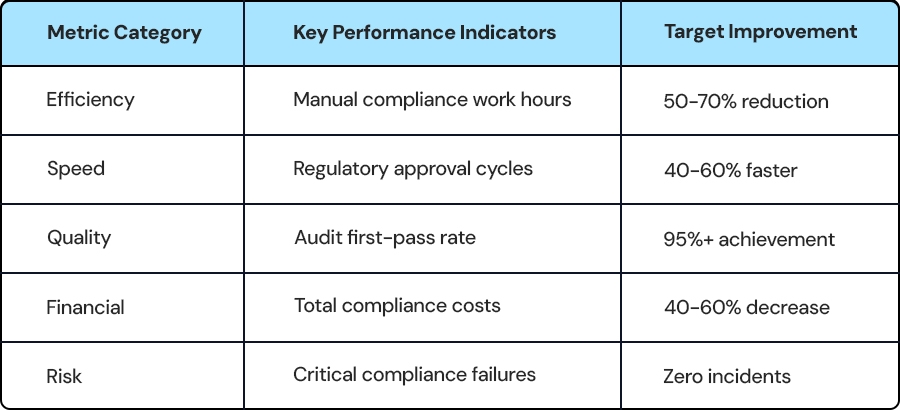
Strategic transformation extends beyond tactical improvements to redesigning product architecture with compliance at its core. This involves selecting product engineering services partners with proven financial compliance expertise in KYC/AML/PCI DSS implementations, designing modular compliance-first architecture for next-generation products, implementing comprehensive RegTech automation platforms covering identity verification through transaction monitoring, and training cross-functional teams on compliance-driven development methodologies. Organizations that invest in this foundation achieve 50% reduction in compliance-related delays, 40% decrease in technical debt from regulatory changes, and create sustainable competitive advantages through superior compliance capabilities.
Transform Compliance from Cost Center to Competitive Advantage
Organizations mastering compliance-driven product engineering achieve:
40-60% lower total compliance costs
50-70% faster regulatory approvals
3-5x ROI on RegTech investments
Zero critical compliance failures
The next generation of financial services leaders won't just manage compliance they'll weaponize it as a strategic differentiator, accelerating market entry, building unshakeable customer trust, and out-maneuvering competitors burdened by legacy compliance debt.
Ready to Transform Your Compliance Architecture?
Our product development engineering services team will audit your current compliance posture and identify cost reduction opportunities, design a compliance-first architecture for your digital products, create a comprehensive roadmap for RegTech automation implementation, and provide detailed ROI projections for compliance transformation.
We combine deep regulatory expertise with cutting-edge engineering capabilities to build secure, scalable, and compliant-by-design digital products. Our teams are SOC 2 Type II, ISO 27001, and PCI DSS Level 1 certified, achieving a 98% regulatory audit first-pass rate and delivering $200M+ in compliance cost savings to clients across 50+ financial services implementations in USA, EU, and APAC regions.
Modernize finance products with built-in compliance.