

 Updated on 14 October 2025

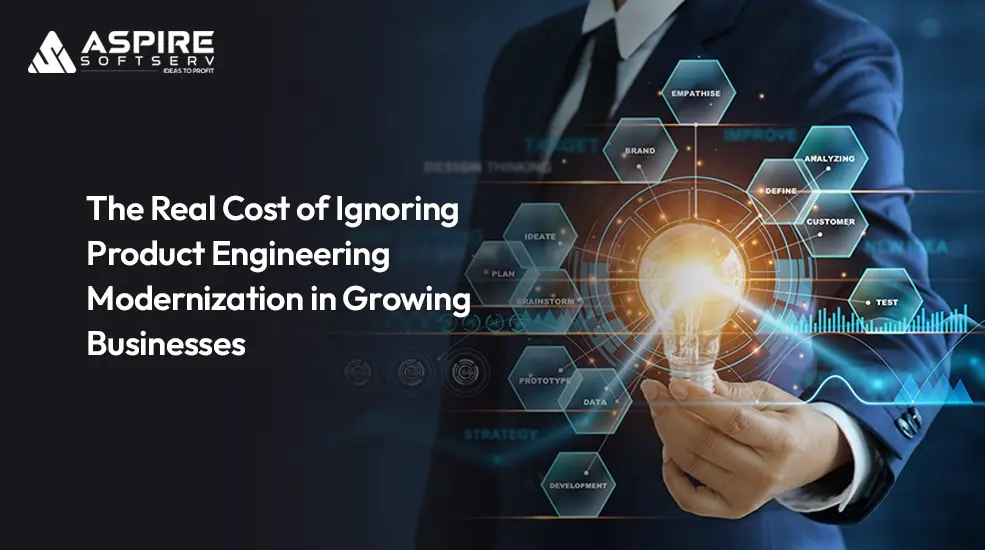
In 2025, U.S. mid-market enterprises are losing up to 25% of IT budgets maintaining legacy platforms. As businesses scale, outdated technology becomes more than an inconvenience it's a strategic liability that drains resources, exposes security vulnerabilities, and blocks innovation. The question isn't whether to modernize, but how quickly you can afford to make the transition before competitors leave you behind.
Legacy systems create a cascading effect of problems that compound over time. What starts as a minor inefficiency a slow database query or an outdated interface gradually evolves into a systemic issue affecting every department. Companies find themselves trapped in a cycle where they're spending more to maintain old systems than they would spend building new ones, all while missing critical market opportunities.
Key Statistics:
Legacy systems increase IT budgets by 15-25% annually through maintenance costs alone
Technical debt wastes 30-50% of operational time in growing businesses
Companies that modernize reduce IT costs by 30% and improve uptime by 45%
Organizations delaying modernization experience 40% slower time-to-market for new features
Understanding the Hidden Costs of Outdated Technology
Outdated IT systems represent a silent drain on organizational resources. While the visible costs server maintenance, licensing fees, and support contracts appear manageable in quarterly budgets, the true financial impact extends far deeper. These hidden costs affect everything from operational efficiency to market competitiveness, creating a compounding burden that grows exponentially with each passing quarter.
The challenge is that most organizations underestimate these costs because they manifest gradually. A system that worked perfectly well three years ago slowly becomes a bottleneck, but the degradation is so incremental that teams adapt their workflows around the limitations. By the time leadership recognizes the full scope of the problem, the organization has already accumulated substantial technical debt that requires significant investment to resolve.
Escalating Maintenance and Operational Expenses
Legacy infrastructure built on unsupported technologies creates a mounting financial burden that extends beyond simple repair costs. Product development engineering services reveal that these systems typically increase IT budgets by 15% or more annually, but the real impact goes much deeper when you factor in opportunity costs and productivity losses.
The scarcity of expertise represents one of the most significant hidden costs. Finding specialists for archaic programming languages and legacy frameworks commands premium consulting rates often 2-3 times standard developer costs. Many organizations find themselves forced to retain aging employees past retirement simply because no one else understands the custom systems they built decades ago. This creates succession planning nightmares and concentrates critical business knowledge in individuals who may leave unexpectedly.
Primary maintenance cost drivers include:
Scarce expertise commanding premium rates (200-300% above market for modern skills)
Hardware obsolescence consuming 40% more energy while requiring hard-to-source components
Extended lead times for replacement parts creating prolonged downtime
Reactive firefighting replacing strategic, cost-effective maintenance cycles
Retention costs for legacy system experts approaching retirement
Hardware obsolescence adds another layer of expense. Older equipment not only consumes significantly more energy increasing operational costs by 40% or more but also requires components that are increasingly difficult to source. Lead times for replacement parts can stretch from weeks to months, forcing businesses into costly workarounds or maintaining expensive parallel redundancy. A 2024 manufacturing industry report showed companies spending an average of $2.4 million annually maintaining systems that should have been modernized five years earlier.
Technical Debt: The Innovation Killer
Technical debt in legacy systems compounds exponentially, creating a maintenance nightmare that slows development velocity by up to 60%. Unlike financial debt where the interest rate remains relatively stable, technical debt accelerates as systems age. Each year of deferred modernization makes the eventual upgrade more complex, more risky, and more expensive.
The architecture of legacy systems presents fundamental challenges. Most were built as monolithic applications where business logic, data access, and user interface are tightly coupled. This design made sense when they were created, but it creates severe limitations in today's environment where businesses need agility, scalability, and the ability to integrate with diverse cloud services and APIs. Making a simple change in one area can trigger unexpected failures across the entire system.
How technical debt manifests in daily operations:
Brittle, monolithic codebases lacking modularity and automated testing coverage
Integration bottlenecks preventing connection to modern cloud services, APIs, and IoT devices
Fragmented data silos that isolate functionality and degrade user experience
Development teams spending 70% of time on maintenance instead of innovation
Lack of documentation forcing developers to reverse-engineer functionality
Outdated frameworks with known security vulnerabilities and no vendor support
A comprehensive 2024 technical study estimates these inefficiencies waste 30-50% of maintenance and operational time resources that could drive competitive advantage instead. Digital product engineering services help organizations systematically reduce this debt through structured refactoring, API development, and microservices architecture that enables incremental modernization without business disruption.
The productivity impact extends beyond the IT department. When systems are slow, unstable, or lack necessary features, every employee who touches those systems becomes less productive. Sales teams manually re-enter data between disconnected systems. Customer service representatives struggle with interfaces that require ten clicks to accomplish what should take two. Operations managers make decisions based on day-old data because real-time reporting doesn't exist.
Security Vulnerabilities and Compliance Nightmares
Legacy technologies create dangerous security exposures that multiply as threat landscapes evolve. In 2025, with AI-powered threats evolving rapidly and sophisticated ransomware attacks becoming commonplace, unpatched vulnerabilities and obsolete encryption protocols represent critical business risks that can destroy companies overnight.
The cybersecurity landscape has fundamentally changed. Attackers now use automated tools powered by machine learning to scan millions of systems simultaneously, identifying and exploiting known vulnerabilities in minutes. Legacy systems running unsupported software contain documented security flaws that are publicly available in vulnerability databases—essentially providing attackers with a detailed instruction manual for breaking in.
Critical security and compliance risks:
Unpatched systems with documented vulnerabilities exploitable by automated attack tools
Obsolete encryption protocols (SSL, early TLS versions) that can be cracked in hours
Lack of multi-factor authentication and modern identity management
Inability to implement zero-trust security architectures
Non-compliance with GDPR, HIPAA, PCI-DSS carrying average fines of $2.8M per incident
New AI Act and updated SOC2 requirements making legacy systems liability
Inadequate logging and monitoring preventing threat detection
Compliance requirements have also evolved dramatically. Regulations like GDPR, HIPAA, and PCI-DSS weren't written with legacy systems in mind, making compliance expensive and sometimes impossible to achieve. The introduction of AI-specific regulations in 2025 creates additional challenges for companies using older systems that lack the transparency and audit capabilities modern frameworks demand. Product engineering consulting services incorporate security-by-design principles, integrating threat modeling, automated compliance validation, and continuous monitoring from inception through deployment.
The reputational damage from security breaches often exceeds the direct financial costs. Customer trust, once lost, takes years to rebuild. A single breach can trigger customer exodus, partnership cancellations, and lasting damage to brand value that far exceeds any regulatory fines. Insurance companies increasingly exclude legacy system vulnerabilities from cyber insurance coverage, leaving organizations fully exposed to breach costs.
Lost Market Opportunity and Innovation Stagnation
Perhaps the most damaging cost of legacy systems is invisible on financial statements: missed opportunity. Organizations trapped in legacy infrastructure operate in perpetual firefighting mode, unable to capitalize on market trends or respond to competitive threats. While IT teams scramble to keep existing systems running, competitors building on modern platforms rapidly iterate, test new business models, and capture market share.
The opportunity cost manifests in multiple dimensions. Companies cannot deploy artificial intelligence and machine learning for predictive analytics because their data is trapped in incompatible formats across disconnected systems. They cannot leverage cloud-native architectures for elastic scaling because their monolithic applications weren't designed for distributed environments. They cannot deliver the real-time, personalized digital experiences customers now expect because their systems batch-process data overnight instead of streaming it continuously.
Innovation barriers created by legacy systems:
Inability to deploy AI and machine learning for predictive analytics and automation
Cannot leverage cloud-native architectures for elastic scaling and resilience
Fail to deliver real-time, personalized digital experiences customers demand
40% slower time-to-market for new features compared to modern competitors
Cannot integrate with partner ecosystems via APIs and microservices
Lack real-time data analytics for informed decision-making
Unable to support remote/hybrid work models with modern collaboration tools
Product engineering services enable organizations to break this cycle. By systematically modernizing architecture, implementing API-first designs, and migrating to cloud platforms, businesses transform from reactive to proactive. Instead of asking "Can our systems handle this?" they ask "What new capabilities can we build?" The competitive gap compounds quarterly companies delaying modernization find themselves 18-24 months behind market leaders within just three years.
The talent acquisition challenge adds another dimension. Top engineering talent increasingly refuses to work with legacy technology stacks. Job postings requiring COBOL or decades-old frameworks attract few qualified candidates, and those who apply command premium compensation. Meanwhile, companies using modern technology stacks attract passionate engineers excited about building innovative solutions, creating a virtuous cycle of innovation and talent retention.
The Complete Cost Breakdown: Technical vs. Business Impact
Understanding the full financial impact of legacy systems requires looking beyond obvious maintenance costs to examine how technical limitations translate to business consequences. The following breakdown connects specific technical problems to their measurable business impacts, helping leadership understand the true cost of inaction.
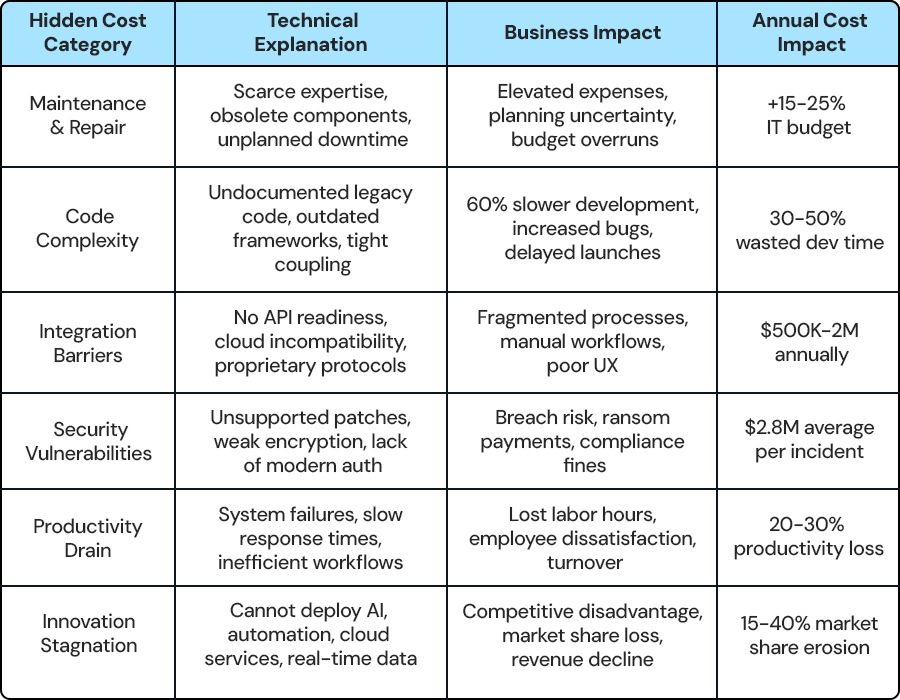
This financial analysis reveals why product engineering modernization delivers 300-400% ROI within 24 months. The savings from reduced maintenance, improved productivity, and avoided security incidents alone often justify the investment before considering the revenue upside from accelerated innovation.
Technical Challenges in Legacy System Modernization
Modernizing legacy infrastructure isn't simply a matter of replacing old servers or upgrading software versions. It requires sophisticated product engineering services to navigate complex technical, organizational, and operational hurdles that can derail projects if not properly managed. Understanding these challenges upfront enables organizations to plan appropriately and set realistic expectations.
Data Migration and Integrity
Legacy systems contain vast amounts of critical business data, often accumulated over decades. This data exists in formats that modern systems don't natively support, uses business logic embedded in database stored procedures, and may lack referential integrity because early systems didn't enforce database constraints. Migrating this data while preserving accuracy and completeness represents one of the most risk-laden aspects of modernization.
Data migration challenges and solutions:
Unstructured or obsolete formats: Legacy data in hierarchical databases, or proprietary formats requiring custom parsers
Solution: Comprehensive data audits identifying format conversions, quality issues, and transformation requirements
Data quality issues: Decades of accumulated duplicates, inconsistencies, and orphaned records
Solution: Automated data quality tools with machine learning to identify and remediate issues
Volume and complexity: Terabytes of transactional history requiring migration without business disruption
Solution: Incremental migration strategies with continuous validation and rollback capabilities
Hidden business logic: Critical rules embedded in stored procedures or application code
Solution: Reverse engineering combined with business analyst review to document and preserve logic
Product development engineering services employ proven methodologies for data migration. This includes creating comprehensive data dictionaries, establishing data quality thresholds, implementing automated validation pipelines, and maintaining parallel systems during transition periods. The goal is ensuring zero data loss while minimizing business disruption a process that typically requires 15-25% of total modernization effort.
Architectural Complexity and Technical Debt
Accumulated technical debt reflects years of design compromises, emergency patches, and evolving requirements. Early systems were built for specific use cases with limited scalability expectations. As businesses grew, developers added functionality through workarounds rather than architectural improvements, creating increasingly fragile systems where even minor changes risk cascading failures.
The challenge intensifies because the original architects and developers have often left the organization, taking institutional knowledge with them. Documentation is typically outdated or non-existent. Current maintainers understand individual components but lack comprehensive knowledge of how everything interconnects. This creates a risk environment where modernization efforts can trigger unexpected failures in seemingly unrelated areas.
Modernization requires:
Extensive refactoring or strategic partial rewrites balancing risk and benefit
Expertise spanning both legacy and modern technology stacks to bridge effectively
Microservices architectures decomposing monolithic systems into manageable components
API layers bridging legacy components to cloud platforms while preserving functionality
Comprehensive automated testing to validate behavior during transition
Gradual cutover strategies allowing rollback if issues emerge
Digital product engineering services bring specialized expertise in legacy modernization patterns. They employ techniques like the Strangler Fig pattern, where new functionality gradually replaces legacy components while maintaining system stability. This incremental approach allows organizations to realize benefits progressively while managing risk, rather than attempting risky "big bang" migrations that frequently fail.
Performance and Scalability Engineering
Legacy systems were designed for yesterday's workloads. A system built to handle 1,000 transactions per hour cannot simply be "upgraded" to handle 100,000 per hour—the fundamental architecture lacks the scalability patterns modern applications require. Monolithic designs create bottlenecks where a single component's capacity limits the entire system's throughput.
Product engineering consulting enables transformation to modern architectures where applications can dynamically scale based on demand. This involves containerization using technologies like Docker and Kubernetes, serverless computing for event-driven workloads, distributed caching to reduce database load, and asynchronous processing to decouple components. The result is systems that automatically scale during peak demand and reduce costs during quiet periods.
Modern scalability approaches:
Cloud migration with containerization (Docker, Kubernetes) enabling horizontal scaling
Serverless computing for elastic resource allocation paying only for actual usage
Performance optimization through load testing, profiling, and targeted improvements
Cost governance strategies using FinOps practices reducing cloud spend 30-40%
Content delivery networks (CDNs) for global performance
Database sharding and replication for improved read/write performance
These architectural improvements don't just enable handling larger workloads they fundamentally change economics. Organizations move from capacity planning based on peak load to dynamic allocation that matches actual demand. This can reduce infrastructure costs 35-50% while simultaneously improving performance and reliability.
User Adoption and Change Management
Technology modernization succeeds or fails based on user adoption. Organizations often underestimate how much users have adapted workflows around legacy system limitations. Features that seem obviously better to engineers may disrupt established processes that employees have perfected over years. Resistance isn't always about change aversion sometimes users have legitimate concerns about how new systems affect their productivity.
Successful modernization includes comprehensive change management that starts early and continues through go-live and beyond. This means involving users in design reviews, conducting usability testing with actual workflows, providing extensive training tailored to different roles, and maintaining support resources during transition periods. Product engineering services with user experience expertise ensure new systems are genuinely better, not just newer.
Change management best practices:
User-centered design ensuring interfaces are intuitive and match actual workflows
Early involvement of power users and champions who advocate for change
Comprehensive training programs with role-specific scenarios and documentation
Phased rollouts minimizing disruption and allowing feedback incorporation
Parallel operation periods where users can verify new system accuracy
Continuous feedback loops for iterative improvement post-launch
Executive sponsorship communicating vision and maintaining momentum
The human factor often determines success more than technical factors. Projects with excellent change management achieve 80%+ user adoption within 90 days, while those neglecting it struggle with resistance for years, never realizing projected benefits despite flawless technical execution.
Case Studies: Real-World Modernization Success
Manufacturing Transformation Through Product Engineering
A leading U.S.-based manufacturing company with operations across 12 plants faced a crisis. Their IT infrastructure consisted of multiple siloed ERP systems, each customized over decades to match specific plant needs. This created an environment where corporate leadership lacked visibility into real-time operations, procurement decisions were made with incomplete data, and launching new products required coordinating changes across disconnected systems.
The challenges they faced:
$8.2 million in annual maintenance costs for aging infrastructure consuming 68% of IT budget
23% system downtime affecting production schedules and customer deliveries
Inability to integrate IoT sensors for predictive maintenance opportunities
18-month timeline for new product introductions missing market windows
No real-time inventory visibility across plants creating excess safety stock
Compliance reporting requiring manual data aggregation consuming 120+ hours monthly
The company partnered with product engineering consulting experts to execute a multi-year modernization program. Rather than attempting a risky "big bang" replacement, they adopted an incremental approach focusing on highest-value opportunities first. The strategy involved re-architecting their monolithic ERP into domain-specific microservices, migrating to AWS cloud infrastructure with containerized deployment, and creating a comprehensive API layer enabling real-time data integration.
The modernization approach:
Component re-architecture breaking monolithic ERP into microservices by business domain
AWS cloud migration with containerized deployment enabling elastic scaling
RESTful API development creating integration layer for all systems
IoT platform deployment connecting 2,400+ sensors across facilities
AI-powered predictive maintenance reducing unplanned downtime
Real-time analytics dashboard providing executive visibility
Phased rollout over 18 months minimizing operational disruption
Results achieved within two years:
34% reduction in IT operational costs translating to $2.8M annual savings
45% improvement in system uptime from 77% to 99.5% reliability
20% faster new product introduction cycles from 18 to 6 months
Real-time IoT integration enabling predictive maintenance across all facilities reducing unplanned downtime by 52%
$12M revenue impact from faster product launches and reduced stockouts
Employee satisfaction improvement with modern, intuitive interfaces
"Moving from legacy infrastructure to modern product engineering practices transformed our competitive position. We're now introducing products at a pace we couldn't have imagined three years ago, and our maintenance costs have dropped dramatically while reliability improved. The ROI exceeded every projection." CTO, Manufacturing Client
FinTech Modernization: Legacy Core Banking Transformation
A regional financial services company providing commercial lending faced competitive threats from digital-first fintech startups. Their core banking system, built in the 1990s, required days to approve loans that competitors processed in hours. Customer onboarding involved paper applications and manual verification. Integration with modern payment networks and fraud detection services was impossible due to architectural limitations.
They engaged product development engineering services to transform their platform while maintaining regulatory compliance and zero data loss. The modernization involved decomposing the monolithic core into microservices for customer management, loan origination, payment processing, and compliance. Each service was independently scalable and could be updated without affecting others.
Results in 14 months:
Loan approval time reduced from 72 hours to 4 hours with AI-powered decisioning
Customer onboarding transformed to fully digital experience completed in 15 minutes
Real-time fraud detection integration reducing losses by $1.8M annually
API platform enabling partnership with fintech companies creating new revenue streams
Regulatory reporting automated, reducing quarterly compliance costs by 85%
Cloud infrastructure costs 40% lower than legacy data center despite handling 3x volume
Modern Product Engineering Services: Your Modernization Blueprint
Strategic digital product engineering services provide comprehensive capabilities for legacy transformation that go far beyond simple technology replacement. These services encompass strategy, architecture, implementation, and ongoing optimization providing end-to-end support that ensures modernization efforts succeed where many internal-only initiatives fail.
Agile Product Engineering Lifecycle
Traditional waterfall approaches to modernization carry enormous risk. Spending 12-18 months designing and building a replacement system before users see anything often results in solutions that don't match actual needs by the time they launch. Market conditions change, requirements evolve, and assumptions prove incorrect but the project continues on its predetermined path toward expensive failure.
Agile product engineering takes a fundamentally different approach. Work is organized into short sprints of 2-4 weeks, each delivering working functionality that users can evaluate. This creates continuous feedback loops where course corrections happen incrementally rather than catastrophically. Stakeholders see tangible progress regularly, maintaining confidence and engagement throughout the project lifecycle.
Agile modernization benefits:
Incremental value delivery through iterative sprints providing visible progress
Continuous feedback loops with stakeholders ensuring alignment
Reduced risk through frequent validation checkpoints catching issues early
Faster ROI realization from phased deployments delivering benefits progressively
Ability to adjust priorities based on emerging business needs
Maintained system stability with gradual cutover rather than risky big-bang launches
This approach transforms multi-year death marches into manageable journeys with regular wins. Teams maintain morale, stakeholders stay engaged, and businesses realize benefits continuously rather than waiting years for a final delivery that may or may not meet needs.
Cloud-Native and Microservices Architecture
Modern product development engineering services embrace architectural patterns that enable flexibility, scalability, and resilience impossible with legacy monolithic designs. Cloud-native architecture means applications are designed specifically for cloud environments, taking advantage of elastic scaling, distributed data stores, and managed services that reduce operational overhead.
Microservices provide:
Containerization enabling consistent deployment across development, testing, and production environments
Serverless computing for event-driven workloads reducing infrastructure management overhead
Independent scaling of components based on actual demand patterns
API-first design ensuring seamless integration with internal and external services
Technology diversity allowing best tools for each specific problem
Fault isolation where issues in one service don't cascade to bring down entire systems
These patterns fundamentally change how applications are built and operated. Instead of deploying massive monolithic applications quarterly, teams deploy individual microservices daily or even hourly. Problems are isolated and resolved quickly. New features reach customers within days of conception rather than months. The organization becomes genuinely agile, able to respond to market changes with speed impossible in legacy environments.
AI-Augmented Development and Testing
2025 modernization efforts leverage artificial intelligence throughout the development lifecycle. AI-powered code generation tools like GitHub Copilot accelerate development by suggesting implementations, catching bugs before they reach production, and even generating comprehensive test suites automatically. This isn't about replacing developers it's about amplifying their capabilities so they focus on creative problem-solving rather than repetitive coding tasks.
AI augmentation includes:
Automated code generation accelerating development 3x while maintaining quality standards
AI-driven testing identifying defects through intelligent exploration beyond scripted tests
Intelligent UI/UX optimization based on actual user behavior patterns and A/B testing
Predictive analytics for capacity planning preventing performance issues before they impact users
Automated security scanning identifying vulnerabilities during development, not after deployment
Natural language interfaces allowing business users to query data without SQL knowledge
Product engineering services incorporate these AI capabilities systematically. The result is faster development, higher quality, better user experiences, and more reliable systems all delivered at lower cost than traditional approaches.
Security-By-Design and Compliance Automation
Security cannot be bolted onto systems after they're built—it must be architectural from day one. Product engineering consulting integrates security considerations throughout the development lifecycle, from initial architecture design through ongoing operations. This "shift left" approach catches security issues when they're easy and cheap to fix, rather than after deployment when remediation is expensive and disruptive.
Security integration includes:
Threat modeling during architecture design identifying risks before code is written
Automated vulnerability scanning in CI/CD pipelines preventing insecure code from reaching production
Zero-trust architectures eliminating implicit trust and requiring verification at every step
Identity-based access control with multi-factor authentication and principle of least privilege
Automated compliance validation for SOC2, GDPR, HIPAA, PCI-DSS, and AI Act requirements
Continuous security monitoring with AI-powered threat detection and automated response
Regular penetration testing by ethical hackers validating security posture
Compliance automation transforms what was a painful manual process into continuous validation. Instead of quarterly fire drills assembling evidence for auditors, systems automatically maintain compliance documentation, flag deviations in real-time, and provide auditors with comprehensive reports at the click of a button. This reduces audit costs by 60-70% while improving actual security posture.
Advanced Strategies for Managing Technical Debt
Technical debt doesn't disappear through wishful thinking it requires systematic, strategic approaches that balance business needs with technical improvement. Organizations that successfully manage technical debt treat it as a portfolio requiring ongoing investment, not a one-time cleanup project. The following strategies enable continuous debt reduction while maintaining business functionality.
Risk-Aware Incremental Refactoring
Product engineering services employ systematic decomposition approaches that minimize risk while maximizing value delivery. The key is identifying which components deliver the most business value if modernized, which carry the highest technical or business risk if they fail, and which are easiest to extract and replace. This creates a prioritized roadmap balancing quick wins with strategic moves.
Incremental refactoring approach:
Identify high-value, high-risk components for priority modernization delivering biggest impact
Create abstraction layers enabling parallel operation of legacy and modern systems
Establish feature parity validation ensuring new components match legacy behavior
Implement automated testing catching regressions before they impact users
Measure and validate improvements at each increment demonstrating ROI
Decommission legacy components only after proven stability of replacements
This approach transforms overwhelming multi-year projects into manageable quarterly initiatives. Each increment delivers measurable value whether cost reduction, performance improvement, or new capabilities maintaining stakeholder confidence and funding for subsequent phases.
Automated Testing and CI/CD Pipelines
Investment in automation delivers compounding returns throughout the modernization journey and beyond. Comprehensive automated testing enables rapid, confident changes because developers know immediately if they've broken something.
Continuous integration catches defects within minutes of code commit, when context is fresh and fixes are trivial. Continuous deployment enables multiple daily production releases, accelerating value delivery.
Automation infrastructure includes:
Comprehensive test suites covering unit, integration, and end-to-end scenarios
Continuous integration systems running tests on every code commit
Continuous deployment pipelines automating release processes from commit to production
Automated rollback capabilities ensuring rapid recovery if issues occur
Performance testing validating system behavior under realistic load conditions
Security scanning catching vulnerabilities before they reach production
Infrastructure-as-code enabling consistent, repeatable environment provisioning
Organizations that invest in automation early in modernization efforts find subsequent phases accelerate dramatically. What took weeks in manual testing and deployment initially happens automatically in minutes, freeing teams to focus on delivering business value rather than wrestling with process overhead.
AI-Augmented Development Acceleration
2025's AI capabilities fundamentally change what's possible in software development. Tools like GitHub Copilot, Amazon CodeWhisperer, and specialized AI coding assistants accelerate development by generating boilerplate code, suggesting optimal implementations, and even writing comprehensive test suites. This doesn't eliminate the need for skilled developers—it amplifies their capabilities by handling repetitive tasks while they focus on creative problem-solving.
AI acceleration techniques:
GitHub Copilot and similar tools accelerating code generation 3x while maintaining quality
AI-powered code review identifying anti-patterns, security vulnerabilities, and optimization opportunities
Intelligent documentation generation from codebases keeping docs current automatically
Predictive analytics forecasting system behavior under load before deployment
Automated refactoring suggestions identifying opportunities for code improvement
Natural language to code generation enabling rapid prototyping and proof of concepts
Digital product engineering services leverage these AI capabilities systematically throughout modernization programs. The productivity gains are substantial development teams report 40-60% faster feature delivery while simultaneously improving code quality and reducing defects.
Modernization ROI: Before and After Analysis
Understanding the financial impact of modernization requires examining specific metrics before and after transformation. The following analysis reflects typical results from mid-market enterprises investing in comprehensive product engineering modernization over 18-24 months.
Before Modernization: The Legacy State
Organizations operating on legacy infrastructure face resource allocation heavily skewed toward maintenance and firefighting. IT budgets show 70-80% spent keeping existing systems running, leaving minimal investment for innovation. Teams operate reactively, responding to issues rather than proactively building capabilities that drive competitive advantage.
Typical pre-modernization metrics:
IT budget allocation: 75% maintenance and operations, 25% innovation and new development
System uptime: 77% average with frequent unplanned outages during business hours
Time-to-market: 12-18 months for major features from concept to production
Security incidents: 4-6 annually requiring incident response, recovery, and remediation
Cloud readiness: 0% with applications tightly coupled to on-premises infrastructure
Developer productivity: 30% on new features, 70% on maintenance and bug fixes
Customer satisfaction: 62% satisfaction score with frequent complaints about system performance
Compliance costs: $850K annually for manual audit preparation and remediation
After Product Engineering Modernization: The Transformed State
Organizations that complete comprehensive modernization experience dramatic shifts in capability, cost structure, and market competitiveness. Resource allocation inverts, with the majority of IT investment flowing toward innovation rather than maintenance. Systems become reliable enough that teams shift from reactive firefighting to proactive capability building.
Post-modernization metrics:
IT budget allocation: 35% maintenance and operations, 65% innovation and new development
System uptime: 99.5% average with SLAs backed by automatic failover and recovery
Time-to-market: 3-6 months for major features, enabling rapid response to market changes
Security incidents: <1 annually due to proactive security and automated threat detection
Cloud readiness: 100% with elastic scaling, multi-region deployment, and disaster recovery
Developer productivity: 70% on new features, 30% on maintenance and enhancements
Customer satisfaction: 89% satisfaction score with positive feedback on performance and features
Compliance costs: $125K annually with automated compliance validation and reporting
Financial Impact Analysis
The business case for modernization becomes compelling when examining total financial impact across all categories. While upfront investment is substantial typically $2-5M for mid-market enterprises the return on investment materializes quickly through multiple channels.
Financial impact for mid-market enterprise (annual):
Direct cost savings: $2.5M-4M from reduced maintenance, infrastructure, and licensing costs
Productivity gains: $1.8M from improved employee efficiency and reduced system downtime
Risk avoidance: $3M+ from prevented security breaches, compliance fines, and business disruption
Revenue acceleration: $5M-10M from faster innovation enabling new products and market expansion
Customer retention: $2M-4M from improved satisfaction reducing churn
Talent acquisition: $500K-1M from reduced recruiting costs and improved retention
Total ROI: 300-400% within 24 months with benefits continuing to compound in subsequent years as the organization builds on its modern foundation.
Why 2025 Is the Inflection Point for Modernization
Current market dynamics create unprecedented urgency for technology modernization. Multiple converging trends artificial intelligence mainstream adoption, cloud infrastructure maturation, regulatory evolution, and talent market shifts combine to make 2025 the inflection point where delaying modernization transitions from expensive to existential.
AI Integration Requirements Demand Modern Architecture
Artificial intelligence and machine learning have moved from experimental to essential. Companies across every industry are deploying AI for customer service, predictive analytics, process automation, and decision support. But AI workloads have fundamentally different requirements than traditional applications—they demand massive parallel processing, access to comprehensive data sets, and real-time inference capabilities that legacy systems simply cannot provide.
Organizations trapped on legacy platforms face a stark reality: they cannot participate in the AI revolution. Their data is trapped in incompatible formats across disconnected systems. Their infrastructure lacks the GPU resources AI training requires. Their application architectures cannot integrate with modern AI services. While competitors deploy chatbots, predictive models, and intelligent automation, they're stuck in the past.
AI-ready infrastructure requirements:
Cloud-native architecture enabling elastic scaling for training workloads
Unified data platform with real-time access across all business domains
API-first design allowing integration with AI services and models
Modern application frameworks supporting real-time inference
Infrastructure flexibility to leverage GPUs, TPUs, and specialized AI hardware
Data governance and lineage capabilities meeting AI regulatory requirements
Product engineering services specializing in AI readiness help organizations modernize with AI capabilities as a core design principle. This ensures businesses don't complete modernization only to discover they need another transformation to support AI a mistake that costs years of competitive positioning.
Cloud Cost Governance Becomes Critical
Early cloud adoption focused on migration speed, often resulting in inefficient architectures and runaway costs. 2025 represents a maturation point where organizations demand cloud cost optimization without sacrificing performance or reliability. This requires sophisticated FinOps practices, architectural optimization, and continuous cost governance that legacy-thinking IT organizations struggle to implement.
Cloud optimization strategies:
Right-sizing compute resources matching actual workload requirements
Automated scaling policies eliminating over-provisioning waste
Reserved instance and savings plan optimization reducing costs 40-60%
Serverless architecture for intermittent workloads eliminating idle resource costs
Storage tier optimization moving infrequently accessed data to cheaper tiers
Multi-cloud strategies preventing vendor lock-in and enabling cost arbitrage
Digital product engineering services implement FinOps practices systematically, typically reducing cloud costs 30-40% while simultaneously improving performance through architectural optimization. Organizations that modernize with cost governance built-in avoid the expensive optimization projects that early cloud adopters now face.
Regulatory Compliance Evolution Accelerates
Regulatory frameworks continue evolving at accelerating pace. The introduction of AI-specific regulations, updates to data privacy requirements, industry-specific compliance frameworks, and international regulatory divergence create complex compliance landscapes that legacy systems cannot navigate. Manual compliance processes that barely worked in simpler times completely break under modern regulatory complexity.
2025 regulatory landscape:
AI Act requirements for transparency, auditing, and human oversight of AI-driven systems are now mandatory for enterprises handling automated decision-making processes. GDPR, CCPA, HIPAA, and industry-specific regulations continue to tighten data privacy and security obligations, while SOC2, PCI-DSS, and ISO standards demand robust operational controls. Legacy systems, often incapable of providing detailed audit trails or real-time compliance reporting, create regulatory blind spots that expose organizations to multi-million-dollar fines and reputational damage.
Key compliance challenges for organizations using outdated systems include:
- Inability to provide AI model explainability and audit trails as required by the AI Act
- Manual and error-prone reporting processes for data privacy audits
- Difficulty maintaining real-time evidence for SOC2, HIPAA, or PCI-DSS assessments
- Limited logging, monitoring, and alerting for suspicious activities
- Lack of integration with regulatory reporting tools and automated validation systems
Product engineering modernization addresses these gaps by implementing security-by-design, automated compliance workflows, and real-time monitoring systems. Modern platforms provide granular access controls, detailed audit logs, and AI governance frameworks that ensure adherence to evolving regulations while minimizing operational friction
Conclusion
Ignoring product engineering modernization in 2025 is no longer a strategic option it's a growing liability. Legacy systems drain budgets, slow innovation, and expose organizations to critical security and compliance risks. The hidden costs from technical debt and maintenance overhead to missed market opportunities compound over time, creating a widening gap between businesses stuck on outdated infrastructure and competitors embracing modern technology.
Modernization delivers measurable business value: it reduces IT costs by up to 30%, improves uptime by nearly 50%, accelerates time-to-market for new features, and strengthens security and compliance posture. Organizations gain agility, scalability, and the ability to integrate AI, cloud services, and real-time analytics. They also unlock a talent advantage, attracting skilled engineers who drive innovation instead of firefighting legacy issues.
The 2025 regulatory and technological landscape AI integration requirements, evolving data privacy standards, and international compliance divergence further reinforces the urgency. Enterprises that delay transformation risk fines, data breaches, operational inefficiencies, and market share loss.
Investing in product engineering modernization is no longer optional; it’s essential for survival and growth. By embracing modern architecture, automated compliance, and AI-ready platforms, organizations secure financial savings, operational efficiency, and competitive advantage, building a foundation for sustainable innovation and market leadership.
Modernize your systems to boost growth today.