

 Updated on 19 June 2026

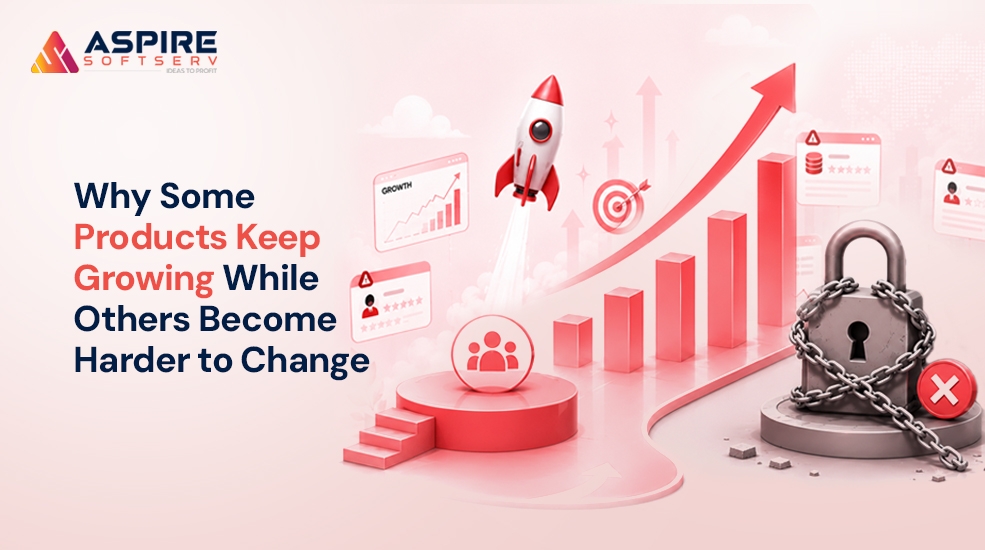
Most software products start the same way: a focused team, a clear problem, and a working build. But a few years in, some products keep accelerating while others feel frozen. Releases slow down, bugs multiply, and every new feature feels riskier than the last. The gap between these two outcomes is rarely about talent. It is almost always about architecture, technical discipline, and whether the system was designed to absorb change.
For CEOs, CTOs, and product leaders in industries like healthcare and Human Capital Management(HCM), this is not a theoretical problem. It shows up as delayed AI initiatives, stalled modernization projects, and engineering teams spending more time preserving old behavior than building new value.
Why Products Drift Into Complexity
Products do not become fragile overnight. They drift when teams optimize for immediate delivery, skip foundational improvements under deadline pressure, and add features without clear domain boundaries. Each shortcut feels reasonable in the moment. Over time, they compound into technical debt in software development and the cost shows up as slower releases, more regressions, and rising maintenance effort.
This is the core reason some teams can scale a software product with confidence while others feel stuck in permanent firefighting. The architecture that worked at launch was never designed for what the product became.
What Makes Change Difficult
There are a few consistent reasons software becomes hard to maintain:
Tightly coupled modules where one update can break multiple dependent areas
Unclear domain boundaries that force engineers to trace impact across the entire codebase
Outdated platforms that make even minor changes expensive, especially in legacy application modernization scenarios
Duplicated logic and brittle integrations that exist only to preserve old behavior
In practice, these issues create software scalability challenges long before the business notices them in revenue or customer retention.
In healthcare platforms, this often looks like a scheduling system that started simple appointment booking, availability checks, basic notifications and later needed to support queue prediction, telemedicine, insurance validation, and patient reminders. Without modular boundaries in place, each new capability slows delivery and increases integration risk.
In HCM products, a recruitment platform built for candidate upload and search may later need AI-based matching, HRIS integrations, and recruiter analytics. Poor architecture makes each addition slower and riskier than the last.
Technical Debt and Architecture
Technical debt is often described as shortcuts in code, but its effects extend beyond code style. It affects maintainability, scalability, and the ability to deliver safely at speed. When teams repeatedly choose the fastest path without a long-term remediation plan, they create structural drag that eventually blocks growth.
Architecture debt is broader: it appears when the system design no longer fits the product's current scale, usage patterns, or business priorities. Teams may spend 30–50% of sprint capacity maintaining existing systems instead of delivering new capabilities a ratio that makes roadmap commitments increasingly unreliable.
This is where software architecture starts shaping product outcomes as much as business strategy does.
How Architecture Affects Scalability
A modular software architecture with clear service boundaries, well-defined APIs, and independent deployment paths gives teams more flexibility to add features safely. In contrast, a system with tangled dependencies can still scale technically for a while, but it scales poorly organizationally. Every team change touches the same shared core.
Cloud native product architecture is usually less about microservices everywhere and more about creating change-friendly boundaries, operational visibility, and a controlled blast radius when something breaks. The goal is not technical elegance for its own sake it is delivery speed at sustainable risk levels.
When product architecture best practices are ignored, teams pay for it in both delivery speed and operational risk. Release cycles that once ran weekly may shift to monthly or longer, and the cost of each release in testing, coordination, and rollback risk keeps rising.
Why AI Projects Fail on Poor Foundations
Many product teams today are trying to add AI capabilities recommendation engines, predictive analytics, AI copilots, intelligent workflows before addressing the architectural issues underneath. The result is fragmented data, unreliable model outputs, and expensive AI initiatives that stay stuck in proof-of-concept mode.
Software modernization is often a prerequisite for successful AI adoption, not a separate initiative. A product's ability to support AI depends on whether its data pipelines are clean, its services are well-bounded, and its infrastructure can support the compute and latency requirements AI features introduce.
This is a pattern Aspire sees regularly in healthcare and HCM products: strong AI ambitions slowed by architecture debt that was never addressed.
Product Growth Patterns
Products that keep growing usually share three traits. First, they maintain strong domain separation so teams can work independently without constant coordination overhead. Second, they practice disciplined delivery small, frequent releases that reduce risk and maintain momentum. Third, they pay down debt before it becomes visible to customers, treating architecture as a product asset rather than an implementation detail.
By contrast, products that become harder to change let the roadmap outrun the platform. The gap between what the business wants and what the system can safely support keeps widening until it becomes a crisis.
When to Modernize
Modernization triggers are usually visible before they become critical:
Release speed has dropped significantly over the past 12–18 months
Defect rates are rising without a clear cause
Cloud infrastructure costs are climbing without proportional business gain
Engineering teams avoid touching certain areas of the codebase because the risk feels too high
AI or integration initiatives are stalled in proof-of-concept mode
New hires take significantly longer to become productive
Legacy application modernization does not always mean a full rewrite. In most cases, the better answer is incremental: isolate the highest-risk areas, replace the most constrained components first, and keep shipping value while the platform evolves underneath.
Product Engineering vs. Software Development
Software product development typically focuses on implementing features correctly. Product engineering extends that work to include user outcomes, system evolution, and strategic alignment. Software development asks, "Can we build this?" Product engineering asks, "Should we build it this way, and how will this choice affect the product over the next two or three years?"
That distinction matters because growing products need more than execution. They need a system that supports continuous adaptation one where the architecture, the team model, and the roadmap process are all aligned toward the same outcome.
A Simple Flow for Keeping Products Adaptable
Keeping a growing product adaptable does not require a transformation program. It requires a consistent practice:
Map the product's highest-change domains
Identify coupling, brittle dependencies, and repeated change failures
Prioritize architecture work that reduces the cost of future changes
Modernize incrementally instead of pausing delivery for a rewrite
Track technical debt, release health, and lead time as product metrics
Reassess boundaries as customer needs, team size, and usage patterns evolve
This flow works because it connects engineering work to business momentum. It also prevents modernization from becoming a separate cleanup project that never finishes.
Change-Friendly vs. Hard-to-Change Products
| Area | Growth-Friendly Product | Hard-to-Change Product |
|---|---|---|
| Architecture | Modular boundaries, clear contracts | Shared logic, deep coupling |
| Delivery | Small, frequent releases | Large, risky deployments |
| Debt handling | Continuous refactoring | Deferred until crisis |
| Team model | Domain-aligned ownership | Ambiguous ownership, many handoffs |
| AI readiness | Clean data, bounded services | Fragmented data, tight integration |
Operating Model Matters Too
Architecture alone does not determine whether a product stays adaptable. Team structure, ownership, and planning discipline matter just as much. If one group builds features, another manages stability, and a third handles platform work with no shared decision framework the system fragments.
A healthier model aligns product strategy with engineering constraints, builds cross-functional ownership around product domains, and gives teams space to address debt continuously. This is why product engineering consulting often includes operating-model design alongside technical assessment.
How Aspire's Product Engineering Approach Helps
Aspire's product engineering services are designed to help product teams navigate exactly these challenges from architecture assessment and software modernization to AI integration and long-term platform evolution.
The approach combines:
Product Strategy & Consulting to align roadmap and platform decisions
Software Product Development with architecture quality built in
Cloud and DevOps Engineering to enable faster, safer delivery
AI & Data Engineering to ensure AI initiatives are built on reliable foundations
Product Sustenance & Support to manage platform health continuously
Signs You May Need a Product Architecture Review
If two or three of the following apply to your product today, you are likely carrying hidden architecture debt:
Feature releases are taking longer than they did 12 months ago
AI or cloud initiatives are stuck in proof-of-concept
Engineering teams avoid certain parts of the codebase
Integrations regularly take longer than estimated
Cloud costs are rising without clear business justification
These are not engineering problems in isolation they are business risks. The earlier they are addressed, the less they cost to resolve.
Talk to Aspire's Product Engineering team to explore what a structured architecture review could uncover for your product.
Frequently Asked Questions
Why do software products become difficult to change?
They become difficult to change when design shortcuts, growing dependencies, and deferred refactoring accumulate into a system where every new requirement creates risk. The product may still work, but the effort required to modify it rises steadily.
What causes technical debt in software products?
Technical debt is typically caused by speed-first delivery, weak boundaries, inconsistent standards, and cleanup work deferred under deadline pressure. Over time, these decisions make change slower and more expensive.
How does software architecture affect scalability?
Software architecture affects scalability by controlling coupling, deployment independence, and how much coordination a change requires. Better-defined boundaries usually mean better scale for both systems and teams.
When should a company modernize its software product?
A company should consider software modernization when maintenance cost, delivery risk, or platform constraints start limiting business goals. If teams avoid certain code areas because they feel too fragile, modernization is likely overdue.
What is the difference between software development and product engineering?
Software product development focuses on building software correctly. Product engineering connects technical decisions to product outcomes, user needs, and long-term evolution. It is broader and more lifecycle-oriented.
How do growing companies avoid product rework?
They design for change, keep architecture modular, pay down debt continuously, and align teams around product domains. The earlier these habits begin, the less rework accumulates later.
Closing View
Products keep growing when their teams treat adaptability as a design goal rather than a cleanup task. The strongest systems are not the ones with zero debt they are the ones that manage change deliberately, modernize continuously, and keep the architecture aligned with the business.
For leadership teams building or scaling products in healthcare, HCM, or finance, that discipline is the difference between a platform that compounds value and one that quietly resists progress.
Explore Aspire's product development services to see how we help product teams build for what comes next.
Discover What's Limiting Your Product's Growth