


 Updated on 16 April 2026

Every talent acquisition team has lived through it: a high-priority role goes live, the job post picks up momentum, and within hours your recruitment software is crawling. Dashboards freeze, candidates hit error screens, and recruiters are left refreshing pages wondering what went wrong. This isn't a rare edge case it's a structural failure that happens when hiring software isn't built to absorb demand spikes.
For CEOs, CTOs, and Heads of Product, this is more than a technical inconvenience. It's a measurable business risk with real revenue and talent consequences.
This is exactly where modern product engineering services become critical. Scaling hiring platforms isn't just a DevOps task it requires deep product development services expertise across cloud architecture, AI, and long-term product evolution. The platforms that handle surges without flinching aren't lucky they're architected differently from the start.
Who Should Read This
This blog is written for:
CTOs scaling hiring software or applicant platforms
HR tech founders building or modernising ATS software
Heads of Product responsible for recruitment marketplace performance
Engineering leaders managing legacy recruiting software that struggles under load
If any of those describe you, what follows will directly apply to decisions you're making right now.
What a Slowdown Actually Costs Your Business
Before diving into the "how," it's worth naming the real stakes. When your ATS software stumbles under load, the consequences ripple far beyond IT:
Top candidates abandon slow application flows drop-off rates spike sharply when load time exceeds 3–4 seconds
Time-to-hire increases, giving competitors a head start on the same talent pool
Recruiter productivity drops when dashboards lag and workflow tools become unreliable
Employer brand takes a quiet hit a broken application experience is often a candidate's first impression
Growth opportunities stall when hiring velocity can't match business demand
These are outcomes that show up in board decks, not just server logs. And they are almost entirely preventable with the right product architecture.
Why This Happens: The Technical Reality (Without the Jargon)
Applicant tracking system platforms are complex distributed systems. During normal operations a few hundred applications per day most platforms handle the load without issue. But at 5,000 to 10,000+ daily submissions, architectural weak points surface fast.
Here is what breaks under the hood, explained for decision-makers:
Database strain is typically the first failure. Every applicant record involves storing resume files, extracting skills data, and connecting records across multiple tables. When volume spikes, these operations start competing with each other, causing delays and cascading errors.
Resume parsing queues back up because most platforms process applications one at a time. Each parse can take 200–500 milliseconds acceptable in isolation, catastrophic at scale when thousands queue simultaneously.
Application interfaces weren't designed for surge traffic. Most recruiting software uses synchronous request handling, meaning each submission waits in line rather than being processed in parallel. Under spike conditions, this creates a traffic jam with no bypass.
Repeated database reads slow everything down when there's no caching layer in place. Job listing data, candidate dashboards, and pipeline views get fetched from disk on every single request instead of being served from memory.
The result is a cascading failure: slower responses trigger retries, retries add load, load causes more slowdowns. A 10x spike in applicant volume can cause a 50x degradation in performance if the architecture wasn't built for scale.
Common Failure Points During a Volume Spike
| Failure Point | What You See | Business Impact |
|---|---|---|
| Database overload | Submission errors, 503 pages | Candidates cannot apply |
| Parser backlog | Delayed skill matching | Recruiter workflows stall |
| No caching layer | Slow dashboards | Recruiter productivity drops |
| API gateway limits | Rejected submissions | Lost applicants, no fallback |
| Memory exhaustion | Full outage after ~30 min | Platform goes completely dark |
Why This Is Hard to Solve Internally
Many engineering teams attempt to fix scalability by scaling vertically adding more CPU and memory to existing servers. This provides temporary relief but doesn't address the root problem, and costs compound quickly with diminishing returns.
Genuine scalability requires rethinking the product architecture itself. That means coordinated expertise across Cloud and DevOps Engineering, distributed systems design, AI-assisted processing, and long-term Product Strategy & Consulting a combination that most internal teams aren't resourced to deliver simultaneously while maintaining day-to-day operations.
It also requires forward-thinking Software Product Development practices: building for tomorrow's traffic, not just today's, with observability, automated scaling, and resilience testing built in from the start rather than bolted on after the first crisis.
How Modern Product Engineering Services Fix Recruitment Platform Scale
This is where a modern product engineering services company delivers real impact combining product engineering services and product development services to redesign platforms for scale. The difference between platforms that buckle and platforms that flex comes down to architectural decisions made well before the spike arrives.
Async processing pipelines replace the synchronous bottleneck. Instead of processing each application in sequence, submissions are queued and distributed across parallel workers that auto-scale with demand. A platform handling 1,000 applicants per hour synchronously can handle 8,000–15,000+ with an asynchronous architecture with no additional manual intervention required.
Intelligent caching eliminates redundant database reads. Job listing views, candidate dashboards, and common queries are served from memory rather than disk, cutting response times dramatically during peak periods.
Database optimisation through read replicas, table sharding, and purpose-built analytics stores ensures that reporting and filtering don't compete with live applicant submissions for the same resources.
AI-assisted filtering, as part of a broader AI & Data Engineering strategy, uses lightweight machine learning models to pre-screen submissions flagging duplicates, filtering spam, and prioritising quality applications before they enter the core processing pipeline. This alone reduces processing load by 15–25% during spikes.
Predictive auto-scaling uses historical patterns and job post metadata to anticipate traffic surges and provision infrastructure proactively rather than reactively scrambling after the slowdown has already begun.
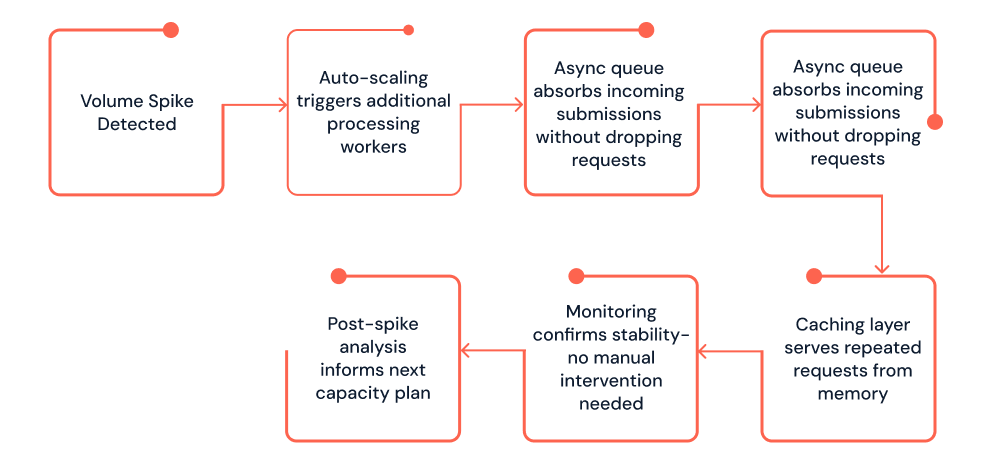
This flow enabled by Cloud and DevOps Engineering and continuous observability reduces mean time to recovery from 45 minutes on legacy ATS software to under 2 minutes on modern architectures.
Real-World Performance: What the Numbers Show
Across platforms analysed during simulated high-volume events, the performance gap between legacy and modern architectures is significant:
| Platform Type | Requests Handled at Spike | Recovery Time |
|---|---|---|
| Legacy on-premise ATS | ~15 req/sec | 45+ minutes |
| Standard SaaS recruiting software | ~120 req/sec | ~10 minutes |
| Custom-built with modern stack | 450–800+ req/sec | Under 2 minutes |
Custom-built platforms using Product Design and Prototyping principles and cloud-native architecture consistently outperform off-the-shelf solutions by 3–5x during volume events. One fintech firm that rebuilt their hiring software on an async pipeline with sharded databases went from 5-second latencies and 25% applicant drop-off to 99.95% uptime handling spikes of 30,000+ applications per day without incident.
The ROI of Fixing Scalability
Executives think in cost, revenue, risk, and speed not infrastructure specs. Here is what modern applicant tracking system software architecture actually delivers in business terms:
Reduce candidate drop-off by 20–30% through faster, more reliable application experiences
Cut hiring cycle time by 25–40% when recruiters can work at full productivity without system lag
Support 10x hiring volume without emergency infrastructure decisions or unplanned spend
Protect employer brand during high-growth periods when every candidate interaction matters
Lower total infrastructure cost over time well-architected systems cost less to operate than perpetually patched legacy ones
Scalability isn't an engineering expense. It is a growth investment with measurable, boardroom-ready returns.
We've helped engineering teams redesign and scale high-traffic digital platforms across fintech, SaaS, and HR tech. Here's what that looks like in practice.
A Practical Roadmap: From Vulnerable to Resilient
If you are evaluating where to start, here is a phased approach that balances quick wins with long-term structural improvements:
Phase 1 Quick Wins (Week 1): Add caching for high-traffic queries, implement rate limiting on submission endpoints, and introduce async queuing for resume processing. These changes alone can absorb 3–4x normal traffic volume without major architectural work.
Phase 2 Core Scaling (Weeks 2–4): Shard your primary database by job or region, introduce auto-scaling worker pools, and instrument your platform with real-time observability dashboards. This phase typically involves deeper Cloud and DevOps Engineering work and is where most teams benefit most from specialist support.
Phase 3 AI & Predictive Layer (Month 2+): Integrate AI & Data Engineering capabilities resume scoring, duplicate detection, predictive scaling to make the platform smarter, not just bigger. This is where applicant tracking system platforms move from reactive to genuinely proactive.
Ongoing: Run regular load tests simulating spike conditions. Set service-level objectives (99.9% uptime, sub-500ms P95 response times). Treat scalability as a product capability, not an operational afterthought.
The Bigger Picture: Scalability as Competitive Advantage
In competitive hiring markets, the fastest and most seamless candidate experience wins. When your recruitment software handles surges without flinching, recruiters move faster, candidates stay engaged, and the business fills roles before competitors do.
Platforms built with modern Software Product Development practices async-first, cloud-native, AI-augmented don't just survive spikes. They convert them into hiring velocity. That's not an infrastructure story; it is a business growth story. And for companies in high-growth phases, the ability to scale hiring without scaling chaos is a genuine competitive differentiator.
The question isn't whether your platform will face a volume spike. It's whether your architecture is ready when it does.