


 Updated on 24 February 2026

Fintech platforms don't collapse because infrastructure can't handle load they fail because the product was never engineered to make decisions under pressure. When Robinhood froze during the GameStop surge or UPI went dark during festival shopping, the root cause wasn't server capacity. It was architectural choices made months earlier: monolithic designs that couldn't isolate failures, synchronous payment flows that blocked everything downstream, and missing fallback mechanisms because someone assumed "normal traffic" would stay normal.
Transaction spikes in fintech platforms often expose hidden architectural flaws that only appear at scale flaws that originated from product decisions, not infrastructure gaps.
This article is for CTOs, Product Leaders, and Engineering Heads building or scaling fintech platforms who need to understand why systems break during spikes and more importantly, how product engineering principles prevent these failures before code is written. If your platform has survived every load test but you're still worried about the next viral moment, regulatory deadline, or competitor launch, this is the decision-making framework you need.
The Hidden Cost of "Working Fine Until It Doesn't"
When Robinhood's platform went dark for 17 hours during the 2021 trading frenzy, the public blamed traffic. But internal post-mortems revealed something different: the platform's order management system couldn't separate high-priority trades from routine operations. Every transaction whether a $50 stock purchase or a million-dollar institutional order hit the same database queue. When retail investors flooded in, the system treated a teenager buying two shares of Tesla with the same urgency as a hedge fund rebalancing its portfolio.
Insight: The technical fix was straightforward: implement priority queuing and isolate payment settlement. The expensive part? Re-architecting core systems while the SEC investigated and users switched to competitors.
This wasn't just an infrastructure problem it was a product engineering failure. The team optimized for speed-to-market but never asked "what happens when our assumptions about user behavior are wrong?" This distinction matters because throwing more servers at poor architectural decisions just amplifies the underlying problems.
India's UPI network faced a similar reckoning in 2025. The system handled 620 million transactions daily without issue until three events converged: IPL cricket finals (impulse betting and food delivery), end-of-month salary crediting, and a surprise flash sale from a major e-commerce platform. Daily volumes didn't just spike; the type of traffic changed. Suddenly, 40% of transactions were retries from failed attempts, creating a death spiral where the system spent more resources rejecting traffic than processing valid payments.
The lesson here isn't "build bigger infrastructure." It's that platforms must engineer products to degrade gracefully, not catastrophically. UPI's architecture couldn't distinguish between a genuine new transaction and a panicked user hitting "retry" fifteen times. Without this product-level intelligence, adding more capacity just meant more machines processing the same doomed requests.
Why Infrastructure Changes Without Product Redesign Make Things Worse
Most failures happen because teams modify infrastructure without redesigning the product workflows that generate load.
Here's what typically happens when a fintech platform starts seeing performance warnings: teams deploy auto-scaling, add caching layers, implement CDNs, maybe introduce message queues. These tactics work until they expose the deeper architectural problems they were masking.
Consider what happens when you auto-scale a poorly designed payment reconciliation service. The original code worked perfectly at 1,000 transactions per hour: match incoming payments against invoices, update balances, trigger confirmation emails. At 10,000 transactions per hour with auto-scaling, you now have ten instances of the same service all querying the same transactions table, creating database lock contention that's ten times worse than before.
Insight: Auto-scaling amplifies bad architecture by multiplying contention, not reducing it.
This is why Product Strategy & Consulting matters before infrastructure decisions. The right question isn't "how do we handle more traffic?" It's "what breaks first, and what's the acceptable failure mode?" For payment platforms, failing fast with a clear error is often better than slow processing that creates double-charges. For trading apps, showing stale prices might be preferable to no prices. These are product decisions, not DevOps configurations.
The Three Architecture Decisions That Determine Spike Resilience
After analyzing dozens of fintech platform failures, three architectural choices consistently predict whether systems survive spikes or collapse:
1. Synchronous vs. Asynchronous Transaction Flow
Most transaction processing systems are built synchronously because it's simpler: user clicks "pay," code calls payment gateway, waits for response, updates database, returns confirmation. This works beautifully until the payment gateway has a 200ms hiccup. Suddenly, every thread in your application is blocked waiting for an external service you don't control.
The asynchronous alternative requires more upfront Product Design and Prototyping: accept the payment request immediately, return a "processing" status, handle the actual transaction in a background worker, and update the user via webhook or polling. This is harder to build but creates natural backpressure your system can't be held hostage by a slow third-party API.
The trade-off? More complex error handling and user communication. You can't show a definitive "payment succeeded" message immediately. For a consumer payments app, this might confuse users. For a B2B invoice system, it's perfectly acceptable. This is a product engineering decision, not just a technical one.
2. Shared Database vs. Service Isolation
Many fintech platforms start with a single database serving all features: user profiles, transaction history, analytics, compliance reporting. It's cost-effective and easy to maintain. But during spikes, a poorly optimized analytics query can lock tables needed for real-time payments.
The isolated approach giving critical services dedicated databases or schemas prevents cascading failures. When your recommendation engine's query times out, payment processing continues unaffected. The cost? More infrastructure complexity, potential data consistency challenges, and harder cross-feature queries.
Here's where real-time transaction challenges force decisions: Do you prioritize fast payments over real-time fraud analytics? Can compliance reports tolerate five-minute-old data? These questions require input from product, legal, and engineering the hallmark of product engineering services.
3. Fail-Fast vs. Retry Logic
When a transaction fails, should your system retry immediately, queue it for later, or return an error to the user? The intuitive answer "retry a few times" often makes spikes worse. If a payment gateway is overloaded, having thousands of clients retry every 100ms just extends the outage.
A product-engineered approach implements tiered retry logic: immediate retry for transient errors (network hiccup), exponential backoff for service degradation (gateway slow), and circuit breakers for systemic failures (gateway down). The product decision: what does the user see during each scenario? A generic "try again later" message, or context like "high transaction volume, your payment is queued"?
| Decision Point | Speed-to-Market Choice | Product-Engineered Choice | Spike Resilience |
|---|---|---|---|
| Transaction Flow | Synchronous (simpler code) | Asynchronous (queued processing) | High |
| Database Strategy | Shared (lower cost) | Isolated per service | Medium–High |
| Failure Handling | Simple retry loop | Circuit breakers + backoff | High |
| Feature Priority | All features equal | Tiered degradation plan | High |
| Observability | Error logs only | Business metrics + tracing | Medium–High |
What "Product Engineering" Actually Means in FinTech
The term "product engineering" gets thrown around, but in the fintech platforms context, it's the discipline of making technical decisions through the lens of user impact, business outcomes, and long-term adaptability. It's not choosing technologies it's choosing trade-offs.
Take payment confirmation timing as an example. A technical team might implement instant confirmations because it's the obvious UX choice. But a product engineering approach asks: What if the payment gateway is eventually consistent? What if our fraud detection system needs three seconds to score the transaction? What if SEC reporting requirements demand a two-phase commit?
The resulting architecture might show users "Payment processing we'll confirm in 2-3 seconds" rather than immediate success. This isn't worse UX; it's honest UX that prevents the disaster of showing "Payment successful!" and then reversing it an hour later when fraud detection flags it.
This is where Software Product Development diverges from pure engineering. The code for instant confirmations is simpler. The code for accurate confirmations that account for real-world inconsistency is more complex but prevents customer service nightmares, regulatory issues, and churn. Compliance with frameworks like PCI DSS and SOC 2 often demands this architectural honesty from day one.
The Real-World Cost of Reactive Engineering
Let's quantify what happens when performance bottlenecks in fintech are addressed reactively rather than proactively:
A mid-sized lending platform experienced 400% growth over six months fantastic for the business, catastrophic for the tech stack. The system started timing out during peak hours (lunch breaks, evenings). The reactive fix: add caching, increase database capacity, implement read replicas. Cost: $80K in infrastructure, three months of engineering time, ongoing performance issues.
The root cause? The loan approval workflow queried the same transaction history table 47 times per application a pattern invisible at 100 applications/day but disastrous at 2,000. The product engineering fix would have been different: denormalize critical data during loan submission, implement materialized views for approval logic, and design the workflow to fetch data once and pass it through the pipeline.
Insight: Proactive cost: $40K in upfront architecture work. Reactive cost: $80K immediate + $30K/year in over-provisioned infrastructure + unknown opportunity cost from users who abandoned slow applications.
| Scenario | Proactive Approach | Reactive Approach | 3-Year TCO Difference |
|---|---|---|---|
| Payment Gateway Integration | Async design, circuit breakers ($35K) | Sync implementation, post-outage rewrite ($85K) | $150K saved |
| Database Architecture | Partitioning strategy upfront ($50K) | Vertical expansion, then migration ($120K) | $210K saved |
| Monitoring Setup | Business metrics + tracing ($25K) | Add after outage ($15K initial + $40K investigation) | $30K saved |
| Compliance Architecture | Policy-as-code from day one ($60K) | Retrofit compliance ($140K) | $240K saved |
When to Address Bottlenecks: The Decision Timeline
The most common question CTOs ask: "When should we invest in resilience engineering?" The unsatisfying answer: it depends on your product's risk profile. But here's a framework:
Address Before Launch If:
You're handling regulated transactions (payments, lending, securities trading)
User data loss or double-charging creates legal liability
Your marketing plan includes viral growth tactics (referral bonuses, PR campaigns)
Integration with systems you don't control (bank APIs, payment gateways)
Address After Product-Market Fit If:
You're in pure discovery mode (MVP, beta testing with <1,000 users)
Transaction volumes are predictable and B2B-controlled
You have manual overrides and customer service can resolve issues within acceptable timeframes
Never Acceptable to Defer:
Security architecture (encryption, authentication, authorization)
Compliance frameworks (PCI DSS, SOC 2, GDPR where applicable)
Basic error handling and transaction rollback logic
The trap many fintech platforms fall into: treating resilience as a "nice-to-have" until the first outage. By then, you're engineering under pressure, with users complaining, investors questioning competence, and competitors highlighting your downtime in their sales pitches.
When Cloud-Native Architecture Helps and When It Doesn't
Cloud-native finance systems aren't just "hosted on AWS" they're architected around failure as the default state. Traditional systems assume components are reliable and add redundancy as a safety net. Cloud-native systems assume every component will fail and design workflows that continue anyway.
This philosophical shift impacts every layer. Consider database selection: a traditional approach might choose PostgreSQL for its ACID guarantees and mature ecosystem. A cloud-native approach might choose DynamoDB or Cosmos DB for automatic distribution and geographic replication, accepting eventual consistency trade-offs.
Neither is "better" they're optimized for different product goals. If you're building cross-border payment processing where transactions must be atomic, strong consistency matters more than elastic capacity. If you're building a personal finance app where showing yesterday's balance is acceptable, eventual consistency buys you massive operational simplification.
Insight: This is where Cloud and DevOps Engineering becomes a product decision, not just an ops concern. The CTO who picks DynamoDB because "it handles spikes better" without evaluating consistency implications has made a technical decision. The CTO who picks it after modeling user journeys and acceptable data staleness has made a product engineering decision.
The Role of Observability in Product Engineering
Most fintech platforms implement monitoring after problems emerge: an outage happens, leadership demands visibility, and teams scramble to add dashboards. This reactive observability captures symptoms (CPU at 90%, database queries timing out) but misses causes (which user action triggered the cascade, what business process created the load).
Product-engineered observability instruments the user journey, not just infrastructure. Instead of alerting when API latency exceeds 500ms, alert when "payment confirmation rate drops below 95%." The first metric measures system health; the second measures product health.
Example: A payment platform noticed database CPU spiking every evening but couldn't find the query. Traditional monitoring showed "high SELECT activity." Product-level tracing revealed users checking their transaction history before making new payments a behavior the team never considered. The fix wasn't database optimization; it was caching historical data in the UI so users could see their last five transactions without a query.
This required collaboration between product (understanding user behavior), engineering (implementing efficient caching), and DevOps for financial applications (instrumenting the right metrics). The solution reduced database load by 30% while improving perceived performance.
The Spotify Model: Feature Flags as Product Engineering Tools
Spotify handles billions of streaming sessions without major outages by treating every feature as optional during degraded performance. When their recommendation engine hits capacity limits, the app still works you just get cached recommendations instead of real-time ones. When their social features slow down, you can still play music; you just can't see what friends are listening to.
This isn't infrastructure magic; it's product engineering. Every feature is behind a feature flag that can be disabled based on system health. The product team decided which features are core to the value proposition (music playback, search) and which are enhancements (recommendations, social features).
For fintech platforms, this framework is even more critical. During transaction spikes, can you:
Disable account analytics dashboards while keeping payments functional?
Turn off personalized offers while maintaining core banking operations?
Pause bulk reporting while processing urgent withdrawals?
These aren't technical questions they're product prioritization decisions that need to be made before the spike, not during the outage war room.
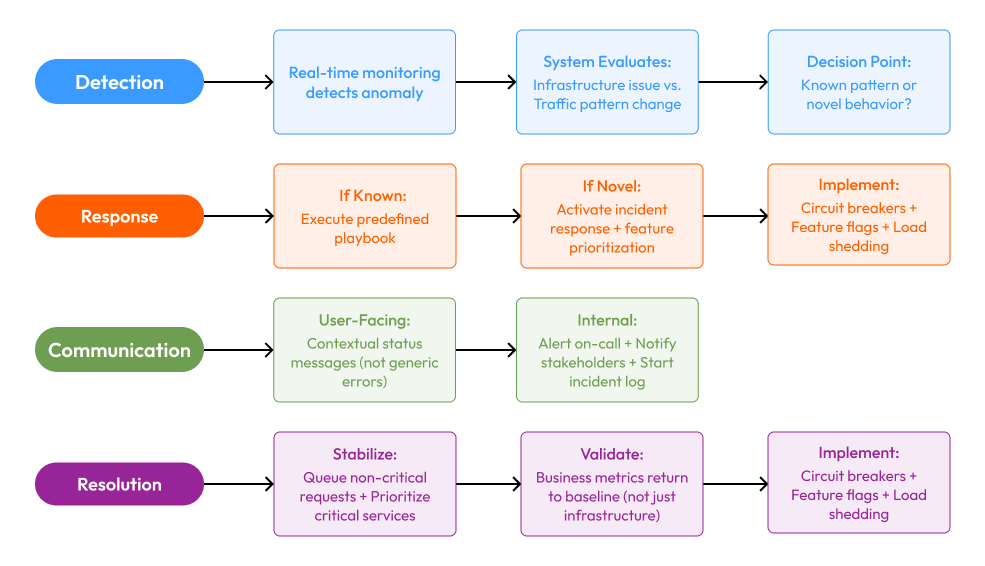
Key Annotation: "Each decision point requires pre-defined product priorities determined months before the spike, not during the crisis"
The Path Forward: Engineering for Uncertainty
The core principle of product engineering for fintech platforms is simple: assume your assumptions are wrong. The traffic model you built? Wrong. The user behavior you predicted? Wrong. The third-party SLAs you negotiated? Wrong when you need them most.
This doesn't mean paralysis or over-engineering everything. It means building systems that degrade predictably, fail safely, and communicate honestly with users. It means instrumenting for unknowns, not just known metrics. And it means making architectural decisions that create options, not commitments.
The platforms that survive spikes aren't necessarily the ones with the most sophisticated tech stacks. They're the ones that made deliberate trade-offs, tested their assumptions, and engineered products that help humans make good decisions under pressure not just systems that execute code efficiently.
Key Recommendations for CTOs and Product Leaders
Based on patterns from platforms that succeeded during spikes, here are the highest-impact actions:
Before Your Next Feature Launch:
Map every external dependency and its failure mode
Document which features are expendable under load
Implement business-metric monitoring, not just infrastructure alerts
Test one realistic failure scenario (payment gateway timeout, database read replica lag)
In the Next Quarter:
Migrate your most critical transaction flow to asynchronous processing
Add feature flags to your top three resource-intensive features
Conduct a "pre-mortem": assume your platform failed during Black Friday, identify why
Assess whether your observability tells you what users can't do or just what servers are struggling
For Long-Term Resilience:
Integrate chaos engineering into your release process
Build relationships with product engineering services teams for architecture reviews
Establish a "resilience budget" acceptable error rates for each feature
Train your team to think in trade-offs, not best practices
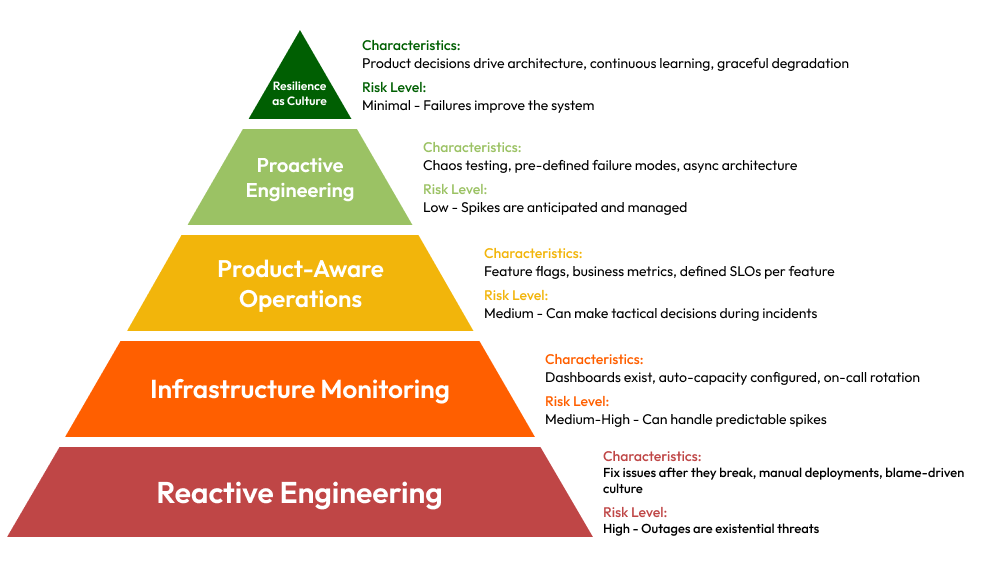
Annotation arrows showing:
Most startups start at Level 1
Most growth-stage companies get stuck at Level 2-3
Mature fintech platforms operate at Level 4-5
Conclusion: From Surviving Spikes to Engineering for Them
The difference between fintech platforms that fail during spikes and those that thrive isn't budget, team size, or technology choices. It's whether they treated architecture as a product decision or an implementation detail.
Every platform will face unexpected load from viral marketing success, competitor failures that send users your way, regulatory changes that trigger urgency, or simply the compound effect of steady growth hitting an inflection point. The question is whether your team made the architectural decisions that create options when assumptions break.
This requires product engineering thinking: understanding that "fast to build" and "fast to change" are different goals, that user trust requires honest communication during failures, and that the most reliable systems aren't the ones that never break they're the ones that break predictably and recover automatically.
If your platform is growing, entering new markets, or facing competitive pressure, the time to engineer for uncertainty is now not after the first outage. The cost of proactive architecture is measured in weeks of engineering time. The cost of reactive fixes is measured in customer trust, regulatory scrutiny, and missed revenue.
Ready to stress-test your architecture before users do it for you?
Schedule a consultation with our product engineering services team. We conduct technical assessments focused on real-world failure scenarios no generic audits, just specific recommendations for your platform's risk profile
Turn spike risks into growth confidence.