






Your engineering team is scaling. Your product roadmap is ambitious. But somehow, releases are taking longer than ever. What used to ship in a week now takes a month. What should feel like progress feels like quicksand.
This isn't a people problem. It's an architecture problem. And it's costing you more than delayed features it's costing you market position, hiring efficiency, and revenue opportunities you can't afford to miss.
Feature velocity the speed at which teams deliver working capabilities from concept to production collapses when product architecture lacks modularity. Tight coupling turns simple changes into system-wide risks. Growing teams collide instead of collaborating. And the infrastructure that once supported your MVP now suffocates your growth.
Here's the reality: most scaling failures aren't caused by poor tooling or inexperienced developers. They're caused by architectural decisions made when the product was smaller, simpler, and fundamentally different from what it needs to be now. This article explains why feature velocity breaks at scale and how product engineering restores it without risky rewrites.
The Hidden Tax of Monolithic Architecture: When Growth Becomes a Liability
Let's start with a scenario you might recognize.
Your team ships weekly at 10 developers. You raise funding, hire aggressively, and hit 50 engineers within 18 months. The roadmap expands. Customer demands intensify. But instead of moving faster, you're moving slower. Monthly release cycles replace weekly ones. Deploy windows get missed. Rollbacks become routine.
This isn't hypothetical. It's the predictable consequence of monolithic architectures systems where all code exists in one deployable unit, sharing dependencies, databases, and deployment pipelines.
At small scale, monoliths are fast. One repository. One build. One deploy. But as the product grows, that simplicity becomes a trap. Changes ripple unpredictably. A bug in the payments module crashes user authentication. A performance tweak in search breaks the dashboard. Every feature becomes a potential regression vector, and every deploy becomes a coordinated event requiring signoff from multiple teams.
The problem compounds with headcount. When 10 developers work in the same codebase, coordination is manageable. At 50, it's chaos. Merge conflicts balloon. Build times stretch from minutes to hours. And the real killer: teams lose autonomy. Frontend engineers wait on backend changes. Billing can't ship without approvals from reporting. Innovation stalls because integration points are shared, brittle, and overcrowded.
This is where software product engineering services become essential not as consultants who tell you what's broken, but as partners who re-architect the system to restore team independence and delivery speed.
What Actually Breaks When Architecture Isn't Modular
The decline in feature velocity isn't gradual. It's a cliff. Here's what happens operationally when modularity is absent:
Deployment Becomes a Bottleneck
In monolithic systems, every change no matter how small requires rebuilding and redeploying the entire application. A one-line CSS fix goes through the same deployment pipeline as a database migration. This creates two problems: unnecessary risk (you're deploying more than you changed) and unnecessary delays (you're blocked by other teams' changes in the same release window).
Faults Propagate Globally
Without clear boundaries, failures cascade. A memory leak in the admin panel can destabilize the customer-facing checkout flow. An exception in the logging module can take down the entire API. Cloud engineering services often encounter this during incident reviews systems designed without fault isolation are fragile by default, where one team's mistake becomes everyone's outage.
Team Coordination Becomes Serial, Not Parallel
When modules aren't isolated, work must be coordinated. Team A waits for Team B's API changes. Team C can't start testing until Team D merges. This serialization kills throughput. What could be parallel becomes sequential. What could ship today waits until next week or next sprint because someone else's work isn't ready.
Scaling Becomes Vertical and Expensive
Monoliths scale by adding more powerful servers, not more instances. You can't scale the payment processing module independently from the user dashboard. You scale everything, or you scale nothing. This creates resource contention, inefficiency, and cost bloat especially in scenarios where horizontal scaling should be trivial.
Modular Software Architecture: Not a Trend, a Necessity
Modular software architecture isn't a buzzword. It's a structural decision that decomposes applications into loosely coupled modules with stable interfaces, clear ownership, and independent deployment paths.
Think of it this way: instead of one massive application where everything touches everything, you have distinct modules user profiles, billing, notifications, analytics each owned by a dedicated team, each deployable independently, each scalable on its own terms.
This isn't microservices by default. Many high-performing teams achieve modularity within a single repository (a "modular monolith") before extracting true distributed services. The key isn't the infrastructure pattern. It's the boundary discipline clear contracts between modules, stable APIs, and a refusal to let dependencies sprawl.
Here's what changes operationally:
Parallel Development: One team ships user profile enhancements while another overhauls billing logic. No merge conflicts. No coordination overhead. No waiting.
Isolated Deployments: Modules deploy independently. A bug in the analytics module doesn't block the checkout flow. Rollbacks are scoped. Blast radius is contained.
Targeted Scaling: High traffic on checkout? Scale that module. Low usage on admin panels? Leave them small. Scalable product architecture becomes cost-efficient and responsive, not bloated and reactive.
This is where DevOps engineering services multiply their impact CI/CD pipelines per module, automated testing scoped to boundaries, infrastructure-as-code that provisions resources module-by-module, not monolith-wide.
The Numbers: What Velocity Looks Like Before and After
Let's ground this in data.
| Metric | Monolithic System | Modular System |
|---|---|---|
| Deployment Frequency | Weekly to monthly | Daily to multiple times per day |
| Build Time | 30–60 minutes (grows with codebase) | < 5 minutes per module |
| Lead Time for Changes | 5–15 days (coordination delays) | < 1 day (autonomous teams) |
| Change Failure Rate | 20–35% (global regressions) | < 15% (isolated failures) |
| Mean Time to Recovery (MTTR) | Hours (full app rollback) | Minutes (module-level rollback) |
| Team Autonomy | Low (shared codebase, serial work) | High (parallel work, clear ownership) |
These aren't theoretical. These are patterns observed across software engineering services engagements in scaling SaaS products, particularly in regulated industries like healthcare and HCM where release discipline is non-negotiable.
The throughput gains alone 2–5x translates directly to competitive advantage. Features that took 3 months now ship in 6 weeks. Experiments that would've required a quarterly planning cycle can be prototyped and validated in a sprint.
Is Your Feature Velocity Actually the Problem You Think It Is?
Before rushing into modularization, answer these questions:
Are deploy windows now measured in weeks instead of days?
Do small changes routinely cause unexpected failures in unrelated features?
Are your engineering teams waiting on each other more than they're shipping?
Is scaling your infrastructure costing more but delivering less performance?
If you answered yes to two or more, your architecture not your team is the constraint.
Discover how Product Strategy & Consulting helps you diagnose architectural bottlenecks and prioritize the right interventions.
Real-World Proof: How Companies Escape the Monolith Trap
Uber: From Hours to Minutes
Uber's early monolith served them well at launch. But as the platform grew to support riders, drivers, payments, routing, and surge pricing, deployments became multi-hour events requiring cross-team signoff. They transitioned to modular boundaries not full microservices overnight, but domain-driven modules with clear ownership. Deploy times dropped from hours to minutes. Feature velocity tripled. Teams regained autonomy.
Spotify: The Squad Model as Architectural Enforcement
Spotify's famous squad model isn't just organizational it's architectural. Each squad owns a bounded module (playlists, search, recommendations) with strict API contracts. This enables 100+ deployments daily across the platform without coordination overhead. The architecture enforces the culture, not the other way around.
These companies didn't succeed because they adopted tools. They succeeded because they adopted product engineering services thinking aligning team structure, architecture, and delivery processes to sustain velocity at scale.
The Migration Path: From Monolith to Modular Without Rewriting Everything
Here's the mistake teams make:they assume modularization means a ground-up rewrite. It doesn't. Rewriting is the highest-risk, lowest-ROI path. What works is gradual extraction a deliberate, phased approach that delivers velocity gains at each step.
Step 1: Domain Analysis and Boundary Definition
Start with Product Strategy & Consulting to map your product domains. Where are the natural boundaries? Auth. Billing. User management. Notifications. Analytics. These aren't technical modules they're business capabilities. Identifying them requires product thinking, not just engineering intuition.
Step 2: The Strangler Fig Pattern
Build new features as modular components alongside the legacy system. Gradually route traffic to the new modules. Over time, the old monolith shrinks as capabilities migrate to bounded contexts. This is safer, faster, and delivers incremental value unlike big-bang rewrites that deliver nothing until they're complete (and often fail before they finish).
Step 3: Modular Monolith as the First Stop
You don't need microservices to achieve modularity. Start with a modular monolith same repository, but strict boundaries enforced through code organization, dependency rules, and interface contracts. Teams can work independently. Modules can be tested in isolation. And when the time comes, extraction to separate services is trivial because the boundaries already exist.
Step 4: Infrastructure Enablement
This is where Cloud and DevOps Engineering accelerates progress. Containerize modules using Docker. Orchestrate with Kubernetes. Implement per-module CI/CD pipelines. Automate testing at boundary edges. The infrastructure doesn't create the modularity the architecture does but it makes modularity operationally viable at scale.
Step 5: Team Reorganization
Architecture and team structure must align. If you have modular code but cross-functional teams, you lose the velocity gains. Reorganize into autonomous squads, each owning a module end-to-end. Product managers, designers, engineers, and QA all aligned to one bounded context. This embodies Software Product Development best practices not just building software,but building the organizational capability to sustain it.
| Phase | Key Actions | Expected Velocity Gain | Timeline |
|---|---|---|---|
| Discovery | Domain mapping, dependency analysis, technical debt assessment | Baseline established | 2–4 weeks |
| Modularization | Internal boundaries, event-driven interfaces, API contracts | +30% throughput | 2–3 months |
| Containerization | Docker, Kubernetes, per-module CI/CD pipelines | +50% deployment frequency | 1–2 months |
| Service Extraction | Optional microservices for high-scale modules | +100%+ in isolated domains | 3–6 months |
| Full Migration | Legacy sunset, autonomous squads, continuous delivery | 2–5× sustained velocity | 6–12 months |
Why Modularity Alone Isn't Enough: The Role of Product Engineering
Here's the uncomfortable truth: modular software architecture is an outcome, not an input. You don't "install" modularity. You earn it through disciplined software product engineering services aligning architecture, team structure, delivery processes, and strategic priorities.
Teams fail modularization when they treat it as a technical refactor. They succeed when they treat it as a product engineering transformation. That means:
Strategic alignment: Modularity must reflect business priorities, not just technical preferences. The boundaries you choose should map to customer value streams, revenue models, and growth vectors.
Prototyping and validation: Before extracting a module, validate that the boundary is stable. Use Product Design and Prototyping to test interfaces, user flows, and integration points. Avoid premature abstraction.
Continuous refinement: Boundaries evolve. As the product grows, domains shift. What started as one module may need to split. What seemed like separate concerns may merge. This is why ongoing product engineering services ensure you're making these decisions based on real product usage, not theoretical purity.
This is why custom web application development services that focus only on feature delivery miss the bigger picture. Sustainable velocity requires architectural thinking embedded in every sprint, every design review, every roadmap decision.
How Cloud-Native and DevOps Amplify Modular Velocity
Modularity creates the potential for speed. Cloud-native architecture benefits and DevOps engineering services realize that potential operationally.
Auto-Scaling at the Module Level
In a monolithic cloud deployment, you scale everything or nothing. In a modular cloud-native system, traffic spikes on checkout? Scale checkout. Low usage on admin? Leave it minimal. This isn't just cost-efficient it's resilient. Modules that don't need resources don't consume them. Modules under load get exactly what they need, when they need it.
Self-Healing and Fault Isolation
Kubernetes doesn't just orchestrate containers it enforces boundaries. Pods restart automatically. Failed modules don't propagate failures globally. Observability tools monitor module health independently. Downtime drops 90% not because the code is perfect, but because the infrastructure contains failures instead of broadcasting them.
GitOps and Continuous Delivery
With modular boundaries, GitOps becomes trivial. Each module has its own repo (or branch), its own pipeline, its own deployment config. Changes merge, tests run, containers build, clusters update all without human coordination. This is the promise of DevOps engineering services in a modular world: automation that accelerates instead of complicates.
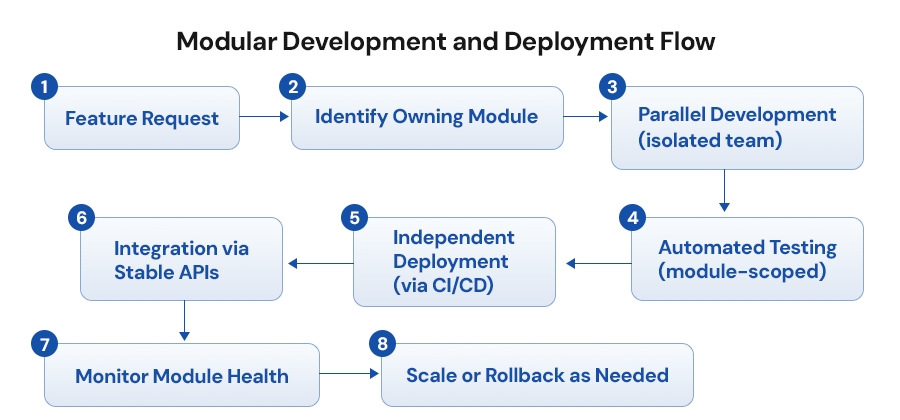
This flow eliminates bottlenecks. No waiting for other teams. No coordinated deploy windows. No cross-module regressions. Just fast, safe, autonomous delivery.
The Metrics That Matter: Tracking Velocity Transformation
You can't manage what you don't measure. Here's what to track before, during, and after modularization:
Deployment Frequency: How often can you ship? Daily is the goal. Weekly is acceptable. Monthly is a red flag.
Lead Time for Changes: How long from commit to production? Under 24 hours is healthy. Over a week indicates coordination friction.
Change Failure Rate: What percentage of deployments cause incidents? Under 15% is industry standard. Over 25% means insufficient isolation.
Mean Time to Recovery (MTTR): When failures occur, how fast do you recover? Minutes is modular. Hours is monolithic.
These are DORA metrics the industry standard for measuring engineering effectiveness. Data engineering services can instrument these into dashboards, but the real value is cultural: making velocity visible, measurable, and improvable.

Future-Proofing: Why Modularity Matters Beyond Today's Roadmap
The real value of scalable product architecture isn't just faster releases today it's adaptability tomorrow.
AI integrations? They slot into modular boundaries as discrete capabilities. Edge computing for latency-sensitive features? Deploy those modules regionally while keeping the rest centralized. New compliance requirements? Isolate regulated data flows in dedicated modules without touching the rest of the system.
Modularity is optionality. It's the ability to evolve the product without rewriting it. To experiment without destabilizing it. To scale parts independently instead of over-provisioning everything.
This is the mindset shift software product engineering company partnerships enable moving from "build features" to "build a platform that can absorb any future feature."
Why Aspire Softserv's Product Engineering Services Are Built for This
Modularization isn't a weekend project. It's a strategic transformation that requires software product engineering services that understand both architecture and business impact.
At Aspire Softserv, we work with scaling HCM and healthcare platforms where release risk isn't an option. We specialize in modular migrations that combine cloud engineering services, DevOps engineering services, and data engineering services into cohesive transformations that deliver measurable velocity gains within 6 months.
From Product Strategy & Consulting to hands-on Software Product Development, we don't just recommend modularity we implement it, measure it, and refine it alongside your team.
Final Takeaway: Modularity Is a Product Engineering Outcome, Not a Technical Pattern
Feature velocity doesn't collapse because teams get lazy or tools get outdated. It collapses because architecture can't sustain the scale, complexity, and pace the product now demands.
Modular software architecture restores velocity by enabling parallel work, isolated deployments, and independent scaling. But modularity isn't something you install. It's something you earn through disciplined product engineering services aligning architecture, team structure, and delivery processes around sustainable growth.
If your releases are slowing down, your teams are stepping on each other, and your roadmap feels like a coordination nightmare the problem isn't your people. It's your architecture. And it's fixable.
Ready to restore feature velocity at scale? Explore our product engineering services for tailored solutions that align architecture, teams, and delivery for long-term growth.
Restore feature velocity with modular architecture