

 Updated on 7 January 2026


When your product is young, speed feels like the only metric that matters. The roadmap is aggressive, investors want traction, and engineering is under pressure to "just ship." In that chaos, many early technical decisions are made with incomplete context, thin documentation, and optimistic assumptions.
This article is for founders and CTOs building growing products who are starting to feel that early speed decisions are quietly slowing everything down.
Those decisions rarely break anything on day one. The real damage appears 18–36 months later when hidden technical debt, escalating software development costs, and constant rework in software projects start to slow down every release. What looked like "engineering pragmatism" turns into a structural handicap and serious long-term product risk.
This is where software architecture stops being "nice to have" and becomes a survival strategy.
Why Early Technical Decisions Matter So Much
The most expensive mistakes in software architecture aren't the ones that break immediately they're the ones that lock you into patterns that become prohibitively costly to change.
Founders and CTOs tend to underestimate how much early choices lock in:
Programming languages, frameworks, and cloud providers
Data models and domain boundaries
Integration patterns and API contracts
Testing and deployment pipelines
These aren't just implementation details. They define how fast you can launch new features, how reliably your product behaves under scale, how expensive software maintenance becomes, and how easily you can replace components or pivot.
The trap is that poor choices in software architecture design often look cheaper and faster in the first 6–9 months and far more expensive in years 2–5.
The Compounding Effect of Hidden Technical Debt
Technical debt in software development isn't just messy code. It's every decision that trades long-term clarity for short-term convenience. Small teams with limited runway can't afford to accumulate this kind of debt every hire must count, and rewrites consume precious capital.
Common sources of hidden technical debt:
"Temporary" hacks that never get refactored
Copy-paste reuse instead of proper modularization
Hard-coded business rules instead of configuration-driven design
Direct database access everywhere instead of well-defined repositories
No clear domain model, just feature-by-feature tables and endpoints
Key takeaway: This debt compounds quietly until your team spends more time understanding, debugging, and patching than actually building.
How Technical Debt Shows Up Over Time
| Timeline | Team Experience | Business Impact |
|---|---|---|
| Month 3–6 | Faster delivery, everyone’s happy. Most issues are small bugs. | High velocity, positive momentum |
| Month 9–15 | New features take longer, regressions increase, engineers need more context to make changes. | Estimates start slipping, minor delays |
| Month 18–30 | Simple changes require multi-team coordination. Releases become stressful. Onboarding new engineers is slow. | Feature delivery slows by 40–60%, hiring doesn’t add proportional velocity |
At this stage, you're no longer discussing features you're negotiating around constraints created by past software architecture decisions.
From Engineering Problem to Business Risk
What begins as "a few corners cut" turns into tangible business impact that affects your bottom line and competitive position:
Slower time-to-market: Roadmap items slip because work is harder than it should be. Strategic opportunities close while you're still wrestling with your codebase.
Higher software development costs: Each feature takes more engineering hours. Firefighting and hotfixes eat into planned work. Your burn rate increases without corresponding feature velocity.
Lower reliability: Frequent production incidents erode customer trust. Churn increases. Enterprise deals stall during technical due diligence.
Lost opportunities: Strategic integrations, new product lines, or enterprise deals are blocked by architectural limitations. Your product development strategy becomes reactive instead of proactive.
In other words, early technical decisions move you from "building a product" to "managing a fragile system."
The Most Expensive Bad Architecture Decisions
Some early software architecture decisions create far more long-term product risk than others, and these are the hardest and most expensive to reverse.
1. Monolith Without Modularity
A monolith isn't inherently bad but a big ball of mud is. Early on, it seems simpler to have "one app, one database." Without clear boundaries, though, responsibilities blur and software maintenance becomes a nightmare.
Symptoms: Any change might break something unrelated. No clear ownership; multiple teams touch the same code. Integration tests become brittle and slow.
Long-term effect: You can't scale teams or features independently, and modernization becomes an "all or nothing" project that blocks progress for months.
2. Over-Engineered Microservices Too Early
The opposite mistake: splitting into microservices before you truly understand the domain. You end up with a network of chatty services, duplicated logic, and operational overhead that small teams can't manage efficiently.
Symptoms: Complex deployments and higher infrastructure costs from day one. Difficult debugging across service boundaries. Versioning and API contract chaos.
Long-term effect: High cost of change and operations, with little benefit in real software scalability.
3. Poor Data Model and Domain Design
Data models are some of the hardest things to change later. Rushing schema design or skipping domain modeling leads to coupled tables, inconsistent naming, and leaky abstractions that ripple through your entire system.
Symptoms: Difficult migrations that frequently fail. Business reporting that doesn't match reality. Multiple interpretations of "what this field means."
Long-term effect: Analytics, personalization, and reporting suffer. Introducing new business capabilities requires dangerous database surgery. AI & Data Engineering initiatives stall because the foundation is unreliable.
4. Tight Coupling to Third-Party Services
It's tempting to wire your core flows directly to payment gateways, identity providers, or messaging tools. Without abstraction layers, those dependencies become part of your core software architecture.
Symptoms: Hard to swap vendors or negotiate better pricing. Vendor outages become your outages. Workarounds for third-party limitations leak across the codebase.
Long-term effect: Your roadmap is constrained by someone else's product roadmap. Budget pressure intensifies when you can't switch to more cost-effective alternatives.
Fast vs Thoughtful Early Decisions
| Dimension | “Ship Fast” Decision | Architecture-Led Decision | Risk Horizon |
|---|---|---|---|
| Service boundaries | Single codebase, unclear modules | Clear domains, modular monolith or well-scoped services | Medium term (12–24 months) |
| Data model | Schema grows per feature | Domain-driven design, normalized where needed | Long term (24–60 months) |
| Integrations | Direct calls everywhere | Abstraction layers, adapters, clear contracts | Medium term (12–36 months) |
| Testing | Few unit tests, manual regression | Automated tests at unit, integration, and API layers | Short to medium term (6–18 months) |
| Infrastructure | Ad-hoc scripts, fragile environments | Managed pipelines, IaC, observability | Medium term (12–24 months) |
The Hidden Cost Center: Rework in Software Projects
Rework in software projects rarely appears as a line item in your budget, but it quietly inflates your software development costs and kills momentum.
Rework categories:
Fixing defects due to unclear requirements and rushed implementation
Re-implementing features because initial versions don't scale
Re-architecting modules that didn't anticipate real-world usage patterns
Untangling dependencies to support a "simple" new use case
Rework becomes especially expensive when the root cause is architectural. Fixing a bug takes hours; fixing a misguided decision about software architecture can take quarters.
For teams with limited runway, every month spent on rework is a month not spent on differentiation or revenue-generating features.
Founder Technical Mistakes That Amplify Risk
Beyond pure tech choices, there are structural founder technical mistakes that shape risk and constrain your ability to execute:
No dedicated time or budget for architecture and software architecture best practices
No explicit product development strategy that aligns roadmap, UX, and architecture
Underinvestment in Cloud and DevOps Engineering, leading to fragile environments and slow deployments
Treating architecture as a "senior engineer's side job," not as a first-class responsibility
These conditions make bad architecture decisions more likely and harder to reverse. When ROI pressure is high, skipping architecture work feels justified but it's a false economy.
What Good Software Architecture Looks Like
Software architecture isn't diagrams on Confluence; it's how your system behaves under real-world stress. Architecture-led does not mean designing for 10x scale on day one it means making deliberate choices that keep your options open.
Characteristics of healthy architecture design software:
Clear boundaries and ownership: Each module or service has a well-defined responsibility
Predictable change impact: Teams can estimate and deliver with reasonable accuracy
Built-in scalability: You can scale read-heavy or compute-heavy components through Cloud and DevOps Engineering without rewriting everything
Testability and observability: Issues are detected early, diagnosed quickly, and fixed safely
Evolvability: You can change major flows without full rewrites, supporting your Product Sustenance & Support needs long-term
This is where software architecture design and software architecture best practices align with business outcomes, not just engineering aesthetics.
Architecture-Led Product Development: Process Flow
An architecture-led development approach doesn't slow you down. It changes when and how you think about risk.
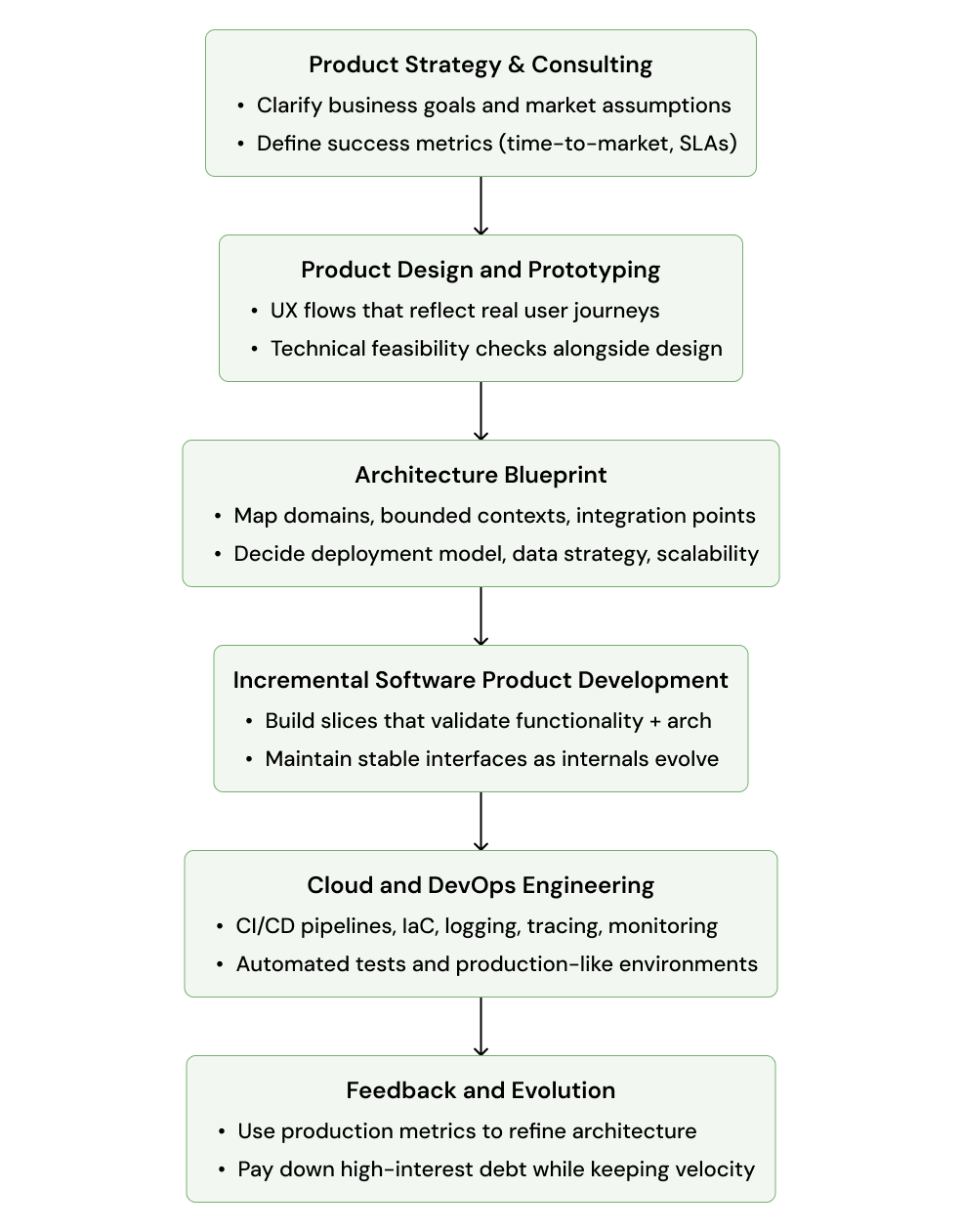
This architecture-first approach aligns your product development strategy with long-term resilience.
How Architecture-Led Engineering Reduces Risk
A partner focused on architecture-led product engineering services brings structure to early ambiguity:
Identifies high-risk components up front (data flows, compliance, multi-tenancy)
Designs for software scalability based on realistic growth paths
Keeps options open where future uncertainty is high (pluggable billing, abstracted providers)
Helps you sequence bets, so you don't over-invest in low-confidence areas
Compared to pure "feature factory" execution, this approach reduces expensive rework in software projects, lowers total software maintenance burden, and prevents architectural lock-in that blocks future business models.
This is where strategic product engineering services act as force multipliers rather than staff augmentation, especially for teams where every hire must count.
Early Warning Signs: When Architecture Becomes a Liability
Watch for these signals that long-term product risk is increasing:
Feature estimates "feel wrong" and constantly slip
Teams are afraid to touch certain parts of the codebase
Onboarding senior engineers takes months to full productivity
Release cycles lengthen, and "stability weeks" become the norm
Simple configuration or pricing changes require deployments
These are not just delivery problems. They are symptoms of bad architecture decisions made earlier in the journey.
Short-Term Speed vs Long-Term Health
| Decision Style | Short-Term Outcome | Long-Term Outcome |
|---|---|---|
| Ignore software architecture | MVP ships faster | High rework in software projects, instability |
| Minimal tests | Less initial effort | Frequent regressions, higher software development risks |
| No DevOps investment | Manual but “good enough” deployments | Slow releases, more incidents |
| Over-customization | Happy early customers | Hard to maintain, costly software maintenance |
| Vendor lock-in | Faster integration | Hard to negotiate or switch later |
Actionable Steps for Founders and CTOs
If you're worried your product carries invisible structural risk, you can act now:
Commission a targeted architecture review focused on software scalability, reliability, and changeability
Map the top 3–5 areas where technical debt could block strategic moves (new markets, enterprise accounts, partner integrations)
Create a focused refactoring roadmap that runs in parallel to feature development
Define what "good enough" architecture means at your current stage and next stage of growth
You don't need perfection. You need a deliberate, explicit approach that keeps you out of the most expensive failure modes.
Turn Architecture from Liability into Advantage
The most successful products are not the ones that made zero mistakes they are the ones that made reversible mistakes and corrected course early. Poor early technical decisions are common; leaving them unaddressed is optional.
By embracing architecture-led development, you reduce hidden technical debt and long-term product risk, control software development costs over time, and preserve your ability to scale, pivot, and innovate.
If you'd like to review your current system for hidden technical debt and long-term architectural risk,
Explore our product engineering services and speak with our team about an architecture-led engagement tailored to your product's stage and ambition.
Is Your Architecture Slowing You Down?