

 Updated on 6 January 2026

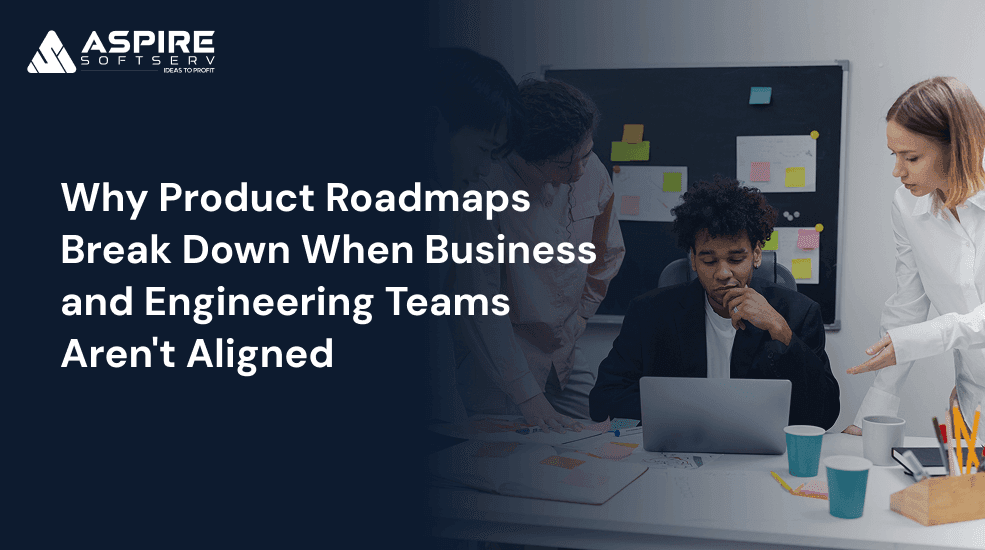
If your product roadmap keeps changing every quarter, teams argue over priorities, and delivery keeps slipping this is not a people problem. It's a misalignment problem between business goals and engineering reality.
In growing companies, a solid product roadmap should provide clarity and drive results. Yet for many CEOs and Product Owners, roadmaps turn into sources of frustration. Deadlines slip, budgets balloon, and ROI crawls along often because business and engineering teams optimize for completely different goals.
This misalignment isn't just a communication gap; it's a systemic momentum killer. When business pushes for features that win customers now while engineering insists on stability fixes for tomorrow, the result is predictable: wasted effort, scope creep, and team burnout. This article explains why misalignment between business and engineering causes product roadmaps to fail and how growing companies can fix it.
The Real Cost of Misaligned Product Roadmaps
Misaligned product roadmaps create measurable damage in growing companies where resources are already stretched thin.
The pattern looks like this: Your business team pushes for flashy features to win customers now. Engineering warns about technical constraints and long-term scalability. Neither side fully understands the other's pressures. Six months becomes eighteen months. A $2M project burns $500K extra. Features get cut post-launch.
What Happens When Alignment Breaks
| Failure Mode | Business Impact | Engineering Impact | Real Cost Example |
|---|---|---|---|
| Misaligned Priorities | Delayed revenue from unmet customer needs | Overwork on non-core tasks | $500K overrun on a $2M project |
| Scope Creep | Bloated budgets, slow time-to-market | Technical debt accumulation | 40% of features cut post-launch |
| Poor Visibility | Uninformed strategic decisions | Rework loops (20–30% of cycles) | Missed Q4 sales target by 25% |
| No Feedback Loops | Stale product strategy and roadmap | Ignored scalability concerns | 2× maintenance costs in Year 2 |
Slow ROI: Features ship late or miss market needs entirely. What should take 6 months stretches to 18 months, missing critical market windows.
Wasted Development Effort: Engineers build what business deprioritizes mid-cycle. Industry data shows this burns 30-50% of development hours effort that could have driven actual value.
Team Silos and Distrust: Business views engineering as "too slow." Engineering sees business as "unrealistic." Trust erodes, making future alignment even harder.
I've seen this pattern repeatedly across companies from 10 to 500 employees. A FinTech startup ignored engineering scalability warnings during planning. Launch delayed 9 months. $1.2M burned. The roadmap looked great in slides but collapsed under real-world constraints.
Where Business and Engineering Actually Diverge
Product roadmap failures rarely start with bad intentions. They emerge from structural gaps that most leaders don't see until it's too late.
Conflicting Goals Drive Opposite Priorities
Business teams chase customer acquisition cost (CAC), lifetime value (LTV), and revenue growth. Success means shipping features customers will pay for fast.
Engineering focuses on system velocity, uptime, code health, and technical sustainability. Success means building systems that won't break under scale.
Without aligning business and engineering goals, your product strategy and roadmap becomes a tug-of-war. A CEO demands AI integrations for competitive advantage. Engineering warns about integration complexity and API reliability risks. Leadership pushes forward. The buggy release erodes customer trust and creates months of cleanup work.
The problem isn't that either side is wrong it's that they're optimizing for different outcomes without a shared framework.
Communication Gaps Turn Into Execution Failures
Business shares high-level visions in slides and strategy docs. Engineering lives in implementation details, technical constraints, and system dependencies. Tools like Jira track tasks but don't convey the why behind priorities.
This creates product development challenges where requirements get misinterpreted. Business says "simple dashboard." Engineering hears "custom analytics engine." Neither realizes the gap until two months into development.
Rushed Planning Skips Critical Input
When product roadmap planning happens under pressure, stakeholder input gets skipped. Business creates the roadmap. Engineering sees it afterward. By then, timelines are set, commitments are made, and there's no room to adjust for technical reality.
Data from Productboard shows 62% of roadmaps lack proper engineering buy-in during planning. The result: timeline estimates miss reality by 50% or more, creating new product development risks and challenges in project management that compound over time.
How to Actually Align Business and Engineering
Fixing misalignment requires deliberate product roadmap strategy and practical processes that rebuild trust between teams.
Start With Shared Prioritization
Rule of thumb: Both teams must influence what gets built before commitments are made.
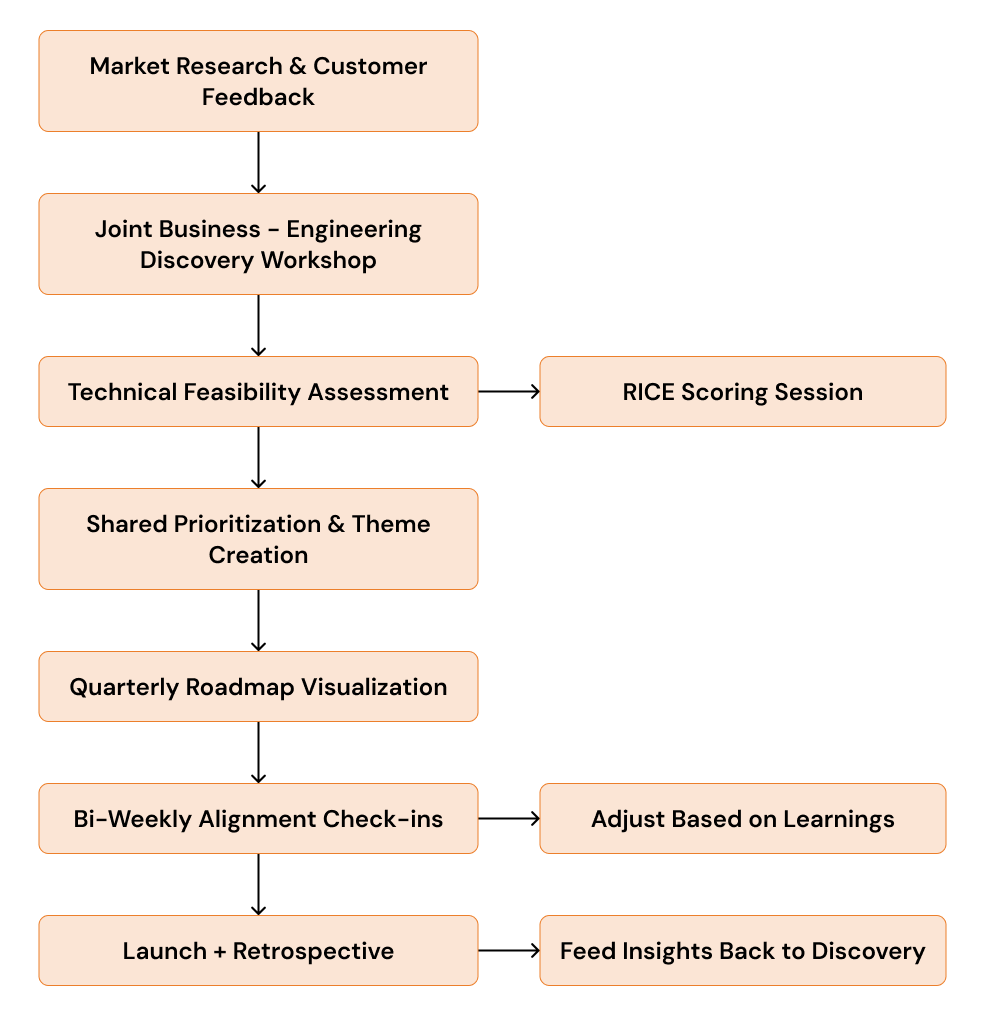
The most effective product roadmap best practices I've seen follow this pattern:
Discovery Phase (Week 1): Joint workshops where business shares market data, customer feedback, and revenue goals. Engineering shares technical constraints, existing debt, and capacity realities. Both sides hear the same information at the same time.
Prioritization Phase (Week 2): Score features together using frameworks like RICE (Reach, Impact, Confidence, Effort). The key is that both business and engineering have equal weight in scoring. Business can't override engineering effort estimates. Engineering can't ignore business impact data.
Roadmap Building (Week 3): Create visual roadmaps organized by themes and outcomes, not rigid dates. Use tools that both teams access: Aha!, ProductBoard, or even structured Notion pages.
Continuous Review (Ongoing): Bi-weekly alignment syncs where both teams review progress, surface blockers, and adjust priorities based on what's been learned.
This process transforms product roadmap planning from a business exercise into genuine collaboration. When engineering feels heard during prioritization, they commit to timelines differently. When business understands technical constraints early, they make better strategic bets.
Proven Frameworks for Alignment
| Framework | Best For | Alignment Benefit | Example Use Case |
|---|---|---|---|
| Outcome-Based Roadmapping | Startups (10–50 employees) | Ties features directly to business outcomes | Product roadmap for startups: Prioritize MVP features by activation rate impact |
| WSJF (Weighted Shortest Job First) | Scale-ups (50–200 employees) | Balances business value against engineering effort | FinTech app: Defer nice-to-haves in favor of core payment reliability |
| OKR-Aligned Planning | Growing companies (100–500 employees) | Aligns business and engineering goals through measurable objectives | ERP rollout: OKR to achieve 20% faster user onboarding with 99.5% uptime |
Balance Technical Debt With Innovation
One of the most common breakdowns happens when engineering pleads for refactoring while business demands new features. Both are legitimate needs, but without a framework, it becomes a fight.
The fix: Allocate at least 20% of sprint capacity to technical debt and infrastructure work.
This isn't optional overhead it's roadmap insurance. Teams that skip debt work see velocity drop by 30-40% over 12 months as systems become increasingly fragile. The "urgent" feature work that seemed critical today creates the fires that derail next quarter's roadmap.
One SaaS company adopted this rule after shipping three major features in 6 months, then spending the next 4 months firefighting production issues. Once they built in the 20% buffer, their actual feature delivery accelerated because they weren't constantly interrupted by system failures.
Create Shared Metrics That Matter
Traditional setups give business one dashboard and engineering another. Business tracks revenue, activation, and churn. Engineering tracks deployment frequency and system uptime. Neither understands the other's numbers.
Aligned teams track hybrid metrics that connect engineering output to business outcomes:
Feature delivery velocity tied to revenue impact (not just tickets closed)
System reliability measured against customer satisfaction scores
Technical debt reduction tracked alongside customer retention
Time-to-market for new capabilities compared to competitive response time
When a VP of Engineering can show that infrastructure investment reduced customer churn by 15%, suddenly that "invisible" technical work has business credibility. When engineering sees how Cloud and DevOps Engineering improvements shortened sales cycles, they understand the business value of their work.
Use Phased Validation to Reduce Risk
For significant initiatives, staged validation prevents massive misalignment failures. This is where Product Design and Prototyping creates enormous value before full development begins.
Instead of committing to a 6-month build based on assumptions, run a 2-week prototype sprint. Show it to actual users. Let engineering validate technical approach. Discover the misalignments when they're cheap to fix not after months of development.
This strategy for product development cuts failure rates dramatically. One mid-sized company building a new analytics platform initially planned an 8-month project. After a 3-week prototype phase, they discovered users needed something fundamentally different. The pivot cost 3 weeks instead of 8 months.
Overcoming Common Product Development Challenges
Even with strong processes, specific challenges require targeted solutions.
| Challenge | Mitigation Tactic | Expected Impact |
|---|---|---|
| Limited engineering bandwidth | Outsource non-core work via product engineering consulting | 30–40% faster delivery cycles |
| Unclear business–engineering goals | Implement shared KPIs (feature velocity + revenue impact) | 25% improvement in on-time delivery |
| High new product development risks | Use Product Design and Prototyping for early validation | Cut failure rate by 50% |
| Legacy system constraints | Invest in Software Product Development modernization | Reduce maintenance burden by 40% |
| Data architecture limitations | Leverage AI & Data Engineering expertise | Enable advanced analytics capabilities |
When Product Engineering Services Make Practical Sense
Sometimes internal alignment hits structural limits. Your teams want to collaborate but lack the frameworks, bandwidth, or neutral perspective to break existing patterns.
This is where product engineering services add measurable value not as outsourcing, but as strategic capability that bridges the business-engineering gap.
You might need external product engineering support when:
Your roadmap keeps slipping despite good intentions from both teams
Engineering spends more time firefighting than building new capabilities
Leadership can't see clear ROI from development investments
Hiring internally feels risky or too slow given your growth timeline
You need specialized capabilities in AI & Data Engineering or complex Software Product Development that your current team doesn't have
Product engineering consulting teams bring two things internal teams often lack: battle-tested frameworks for alignment and the neutral authority to push back on both business and engineering when needed.
I've seen product engineering solutions run "alignment audits" that surface hidden assumptions on both sides. They refactor roadmaps for real-world scalability. They translate business requirements into engineering specifications that actually work and translate engineering constraints into business language that executives understand.
A 200-person SaaS company brought in product development engineering services after their third consecutive roadmap failure. The external team identified that business was planning features assuming infinite engineering capacity, while engineering was saying "yes" to timelines they knew were impossible to avoid conflict. Neither side saw the pattern. The external perspective broke the cycle.
For companies investing in Product Strategy & Consulting or needing comprehensive Product Sustenance & Support, having engineering expertise embedded in strategic planning prevents misalignment from the start.
Real Example: From Breakdown to Breakthrough
A 50-person FinTech startup built their product roadmap entirely from business priorities. Engineering raised concerns about payment processing scalability during planning but was told "we'll handle that later."
Launch day came. The system handled 100 concurrent users fine. At 500 users their modest growth target payment processing started failing. Customer complaints flooded in. The team spent 9 months rebuilding core infrastructure, burning $1.2M they'd planned to spend on growth features.
The fix: They adopted outcome-based product roadmap strategy focused on aligning business and engineering goals. Business defined the outcomes (reliable payments at scale, 99.9% uptime). Engineering proposed the technical approach to achieve those outcomes. Both teams scored priorities using shared criteria.
They added Cloud and DevOps Engineering capabilities to handle scale properly. They allocated 20% of sprints to infrastructure work. They ran bi-weekly alignment sessions where engineering showed business the actual system constraints and business showed engineering the market pressures.
Result: 40% faster iteration cycles. $3M ARR in Year 2. Most importantly, the roadmap became a shared document both teams trusted instead of a source of conflict.
Your Next Steps for Better Roadmap Alignment
If you recognize these patterns in your own organization, start with these concrete actions:
This week: Audit your current product roadmap. Score alignment on a simple 1-10 scale: Do both teams understand priorities the same way? Did engineering have real input during planning? Are there shared success metrics?
This month: Schedule a joint business-engineering workshop using the discovery and prioritization process outlined above. Don't try to build the full roadmap yet just practice the collaborative prioritization on 5-10 items.
This quarter: Implement shared metrics that connect engineering work to business outcomes. Start tracking them visibly for both teams.
When needed: Explore product engineering services if internal alignment keeps failing despite good-faith efforts. Sometimes you need external expertise to break established patterns.
Moving From Conflict to Collaboration
Misaligned product roadmaps don't have to define your growth trajectory. The companies that win aren't necessarily the ones with the best technical talent or the sharpest business strategy they're the ones where business and engineering work as genuine partners rather than opposing forces.
By embracing practical product roadmap best practices and aligning business and engineering goals through shared frameworks, you reclaim control over ROI and momentum. Whether you build this capability internally or partner with proven product engineering solutions, the path forward starts with recognizing that alignment isn't a soft skill it's a competitive advantage.
The roadmap breakdowns you're experiencing aren't inevitable. They're solvable with the right approach, the right processes, and sometimes the right external support.
Ready to fix your product roadmap?
Schedule a alignment audit and discover how product engineering services can turn your roadmap from a source of friction into a driver of growth.
Fix roadmap misalignment with expert guidance