


 Updated on 11 November 2025

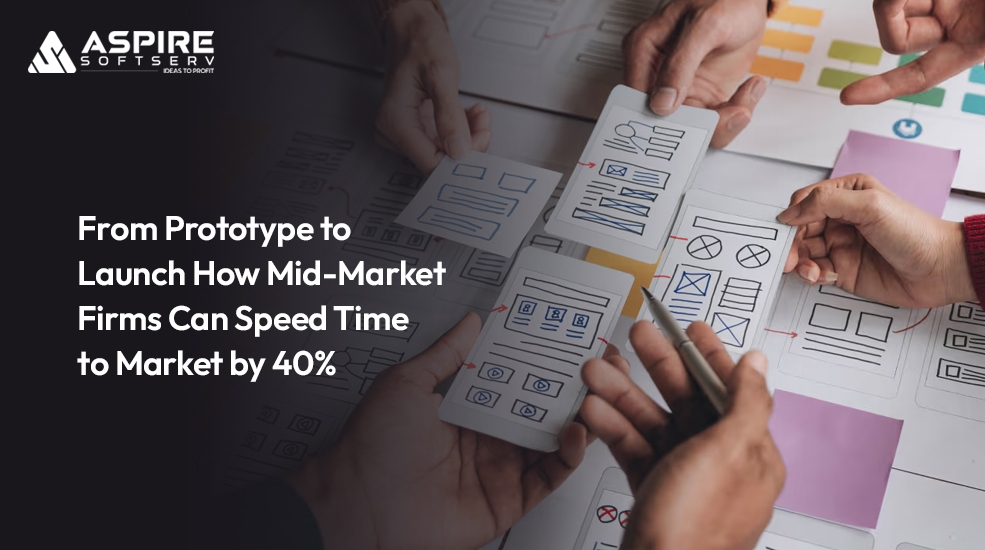
In today's fast-moving market, speed can make or break a product. For mid-market firms, every delay costs opportunity and often customers. While large enterprises leverage massive R&D budgets, mid-market organizations must be smarter, not just faster.
The good news? With the right product engineering services and digital tools, mid-market companies are now cutting time-to-market by up to 40%. This isn't just about working harder it's about working intelligently through automation, agile processes, and continuous feedback loops.
In this guide, you'll discover why mid-market firms struggle with product launch speed, a proven 6-stage roadmap from prototype to production, key automation enablers that compress development cycles, real ROI metrics and a case study showing 42% faster launches, and implementation steps to start accelerating your product lifecycle.
Let's dive into how you can transform your product engineering approach and capture market opportunities before your competitors do.
The Mid-Market Challenge: Innovation vs. Execution Speed
Mid-market firms occupy a unique and often challenging position in the competitive landscape. You're facing the same innovation pressures as large enterprises but operating with leaner engineering teams and tighter budgets. This creates a perfect storm of constraints that can significantly slow down your product development cycles.
The most common friction points that delay product launches include prolonged design and prototyping phases driven by manual workflows and disconnected tools. Teams often struggle with fragmented collaboration between design, engineering, and QA departments, where information gets lost in handoffs and communication gaps create bottlenecks. Limited automation in product testing and release cycles means engineers spend valuable time on repetitive tasks rather than innovation. Many organizations also face heavy dependency on specific individuals for project continuity, creating single points of failure that can derail timelines when key team members are unavailable.
Perhaps most critically, slow market feedback integration delays the improvements needed for next-version releases. By the time customer insights make it back to the engineering team, competitors may have already addressed similar pain points in their offerings.
This isn't just a technical inefficiency it's a revenue problem with real business consequences. A delay of even 3-4 months can allow competitors to establish market dominance, capture your target customers first, or lock in strategic partnerships that were meant for you. In markets where timing is everything, being second to launch often means fighting for scraps rather than commanding premium positioning.
The solution lies in structured product engineering solutions designed to compress your timeline through intelligent digitization and strategic automation. By reimagining how work flows through your organization, you can achieve the speed of larger competitors without their overhead.
Redefining Product Engineering for Speed and ROI
Product engineering today goes far beyond traditional design and development activities. It's about building a continuously evolving digital ecosystem that sustains speed without sacrificing quality or introducing technical debt. When implemented strategically, modern product development engineering services integrate product lifecycle management, cloud infrastructure, automated testing, and continuous delivery pipelines into one unified flow that eliminates handoff delays and manual bottlenecks.
The transformation for mid-market organizations comes from three critical levers that work synergistically to accelerate every phase of development.
Process Automation and DevOps Acceleration forms the foundation of modern speed. By integrating CI/CD pipelines, automated testing frameworks, and containerization, teams can reduce build and release cycles by 30-50%. This means features move from code commit to production deployment in hours instead of weeks, with automated quality gates ensuring nothing breaks along the way.
Digital Twin and Simulation technology enables faster prototyping and validation through high-fidelity digital replicas of physical products. Engineers can test hundreds of design variations virtually, identifying optimal configurations without the cost and delay of building physical prototypes. This approach is particularly powerful for hardware-software integrated products where iteration costs have traditionally been prohibitive.
AI-Driven Insights and Predictive Analytics leverage historical data and real-time telemetry to detect potential delivery or performance issues before they become costly delays. Machine learning models can predict which code changes are most likely to introduce defects, which features will drive adoption, and where technical debt will create future bottlenecks.
When these levers align under a cohesive digital product engineering services framework, organizations drastically reduce rework, eliminate manual dependencies, and compress the delay between iterations. The result is a development organization that operates more like a high-performance engine than a collection of disconnected parts.
The Roadmap: From Prototype to Launch in 6 Stages
A disciplined product engineering roadmap can shrink lifecycle timelines without compromising quality or introducing technical shortcuts that create problems later. The following 6-phase process provides a structured approach that mid-market firms can customize to their specific product types and organizational maturity.
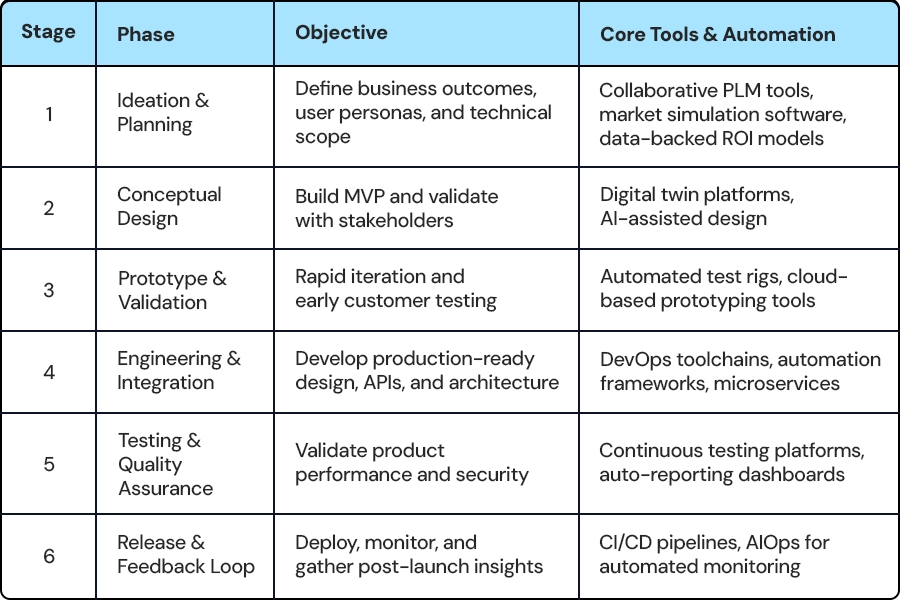
This closed-loop approach encourages continuous improvements at every stage, with feedback from later phases informing earlier ones in subsequent product iterations. The key is treating each stage not as a gate to pass through but as an opportunity to learn and optimize, minimizing both time and cost while maximizing quality and market fit.
Five Key Enablers That Cut Time-to-Market by 40%
1. Agile and DevOps Integration
Traditional waterfall models create rigidity and dependency chains that make rapid response impossible. Each phase must complete fully before the next begins, creating artificial barriers that prevent teams from working in parallel or responding to new information. Agile product delivery infused with CI/CD pipelines enables continuous iteration without requiring full-cycle regression testing on every change.
Automated deployments and continuous feedback loops allow faster sprints often shortening release cycles by 30-50%. Teams can push updates daily or even hourly, with automated testing providing confidence that nothing breaks. This creates a rhythm where small, incremental improvements compound into major competitive advantages over traditional competitors still operating on quarterly release cycles.
2. Cloud-Native Architecture
Moving from on-premise infrastructure to cloud-native systems supports on-demand scalability and parallel testing environments that would be cost-prohibitive to replicate in traditional data centers. Engineers can spin up complete production-equivalent environments in minutes, experiment with new architectures, and roll back failures instantly rather than spending days recovering from deployment issues.
For example, a SaaS company reduced their release time from 10 months to 6 months by migrating to cloud-native CI/CD infrastructure. The ability to run hundreds of automated tests in parallel, rather than sequentially on shared hardware, cut their quality assurance cycle from weeks to hours. When they discovered issues, cloud-based rollback capabilities meant reverting to the last stable version took minutes instead of days of emergency patching.
3. Modular Product Design
Component-based architecture eliminates redundancy and enables true parallel development across teams. By designing products as collections of well-defined, loosely-coupled modules with clear interfaces, organizations can have multiple teams simultaneously develop independent parts without stepping on each other's toes. The modules integrate seamlessly at defined touchpoints, dramatically improving throughput without the communication overhead of tightly-coupled architectures.
This approach also enables reuse across product lines, turning previous investments into accelerators for future projects. A well-designed authentication module, payment processing system, or data visualization component becomes an asset that speeds up every subsequent product rather than code that must be rebuilt from scratch.
4. Data-Driven Decision-Making
Product analytics platforms embedded early in the prototype stage provide actionable insights that prevent costly late-stage discoveries. Rather than waiting for formal user testing or post-launch feedback, teams instrument their prototypes with telemetry from day one. This data reveals how users actually interact with features, which workflows cause confusion, and which capabilities drive the most value.
Telemetry data from early users helps refine features before full launch, preventing the expensive rework that happens when fundamental design assumptions prove incorrect after production deployment. Teams can A/B test different approaches with small user groups, make evidence-based decisions about feature prioritization, and confidently cut features that look good in theory but fail in practice.
5. Low-Code and No-Code Accelerators
Modern product engineering consulting emphasizes the strategic deployment of low-code tools for building prototypes, internal tools, and even production workflows where appropriate. These platforms allow business analysts and product managers to collaborate more directly with developers, translating requirements into working prototypes without waiting for engineers to code every detail.
This dramatically minimizes handover delays and accelerates validation cycles. Business stakeholders can iterate on workflows and user experiences themselves, calling in engineering expertise only for the custom logic and integrations that truly require coding. The result is faster alignment on requirements and fewer cycles of "that's not what I meant" feedback that plague traditional development processes.
→ Learn How We Help Mid-Market Firms Accelerate Launch Timelines
Case Study: IoT Manufacturer Speeds Launch by 42%
A mid-sized IoT equipment manufacturer was struggling with 14-month product release cycles that made it nearly impossible to respond to market shifts or capitalize on new opportunities. Their engineering team spent more time fighting with legacy tools and manual processes than actually innovating. Recognizing that incremental improvements wouldn't solve the problem, they partnered with an engineering firm offering comprehensive product development engineering services to completely modernize their design-to-release pipeline.
The transformation touched every aspect of their engineering operation. Migration of legacy CAD design workflows to a cloud-based simulation platform enabled distributed teams to collaborate in real-time rather than passing files back and forth. Engineers could test design variations virtually, running thousands of simulations overnight that would have taken months with physical prototypes.
Implementation of unified API management and real-time QA automation meant that software updates could be tested across the entire product line simultaneously. What previously required weeks of manual testing across device configurations now ran automatically in hours, with detailed reports highlighting exactly where issues occurred.
Integration of predictive analytics to forecast performance issues let the team address potential problems before they reached production. Machine learning models trained on years of field data could predict which component combinations were likely to fail under specific conditions, guiding design decisions toward more reliable configurations.
Impact Achieved Within 12 Months
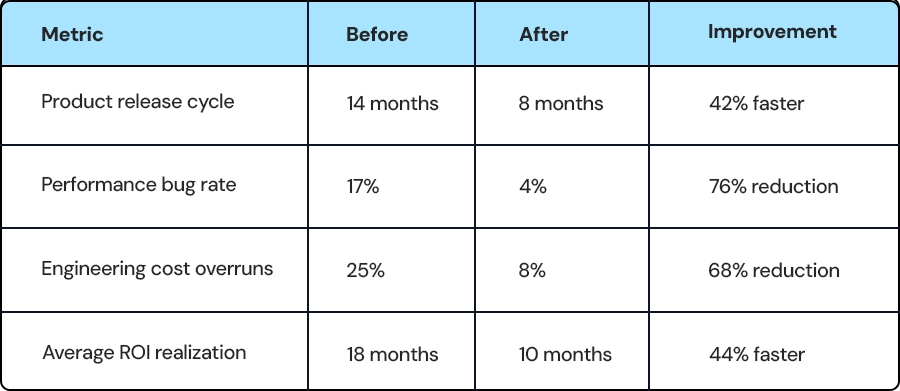
This case demonstrates how aligning automation in product engineering with agile practices directly improves both operational metrics and financial outcomes. The faster cycles didn't just mean getting products to market sooner they enabled the company to iterate based on market feedback, launching improved versions while competitors were still working on their first release.
For a deeper dive into how automation drives these results, explore our guide on Automation in Product Engineering: Cut Costs & Time.
ROI Model: Quantifying the Acceleration Advantage
Accelerating time-to-market delivers measurable value only when you can connect speed improvements to specific business outcomes. Many organizations struggle to justify the upfront investment in automation and process transformation because they focus solely on cost reduction rather than revenue acceleration and opportunity capture.
The following ROI framework demonstrates how automation and process redesign contribute to quick payback across multiple dimensions:
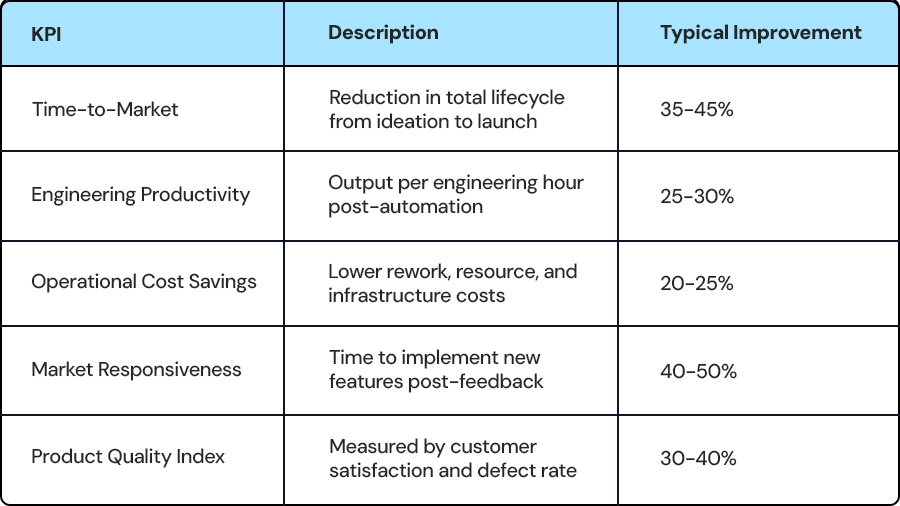
Most mid-market firms achieve breakeven in less than a year when they merge agile engineering practices with digital automation into their core product strategy. The key is measuring not just cost avoidance but revenue acceleration the additional sales captured by being first to market, the premium pricing commanded by higher quality, and the reduced customer churn from faster feature delivery.
Beyond the direct financial returns, organizations report significant improvements in team morale and retention. Engineers who previously spent 60% of their time on repetitive manual tasks can now focus on creative problem-solving and innovation. This not only makes the work more satisfying but also helps retain top talent who might otherwise leave for more technically progressive environments.
Automation: The Core of Modern Product Engineering
Automation now sits at the heart of competitive product engineering, touching every phase of the development lifecycle. It's not about replacing engineers it's about amplifying their capabilities by eliminating the repetitive, error-prone manual work that consumes time better spent on innovation and problem-solving.
The automation layers that drive the most impact include design automation for auto-generation of design configurations, variant management, and documentation that previously required manual effort from senior engineers. Test automation enables parallel execution of functional, regression, and performance tests across all supported platforms and configurations. Release automation creates pipelines for building, validating, and deploying to staging and production environments with zero-touch deployment. Monitoring automation provides real-time performance tracking with intelligent anomaly detection and automated alerting when metrics deviate from expected patterns.
By standardizing these automation layers through digital product engineering services, organizations create resilient, repeatable value chains where iterative speed and predictability coexist. The goal isn't 100% automation some decisions will always require human judgment but rather automating everything that can be automated so humans can focus on what they do best: creative thinking, strategic decisions, and solving novel problems.
The transformation happens gradually. Start with the manual processes that consume the most time or create the most errors. Automate those first, capture the efficiency gains, and reinvest them in automating the next bottleneck. This incremental approach builds momentum and demonstrates ROI at each step, making it easier to secure ongoing investment and organizational buy-in.
Your 5-Step Implementation Roadmap
Successfully transforming your product engineering approach requires a structured journey that builds capability and demonstrates value progressively.
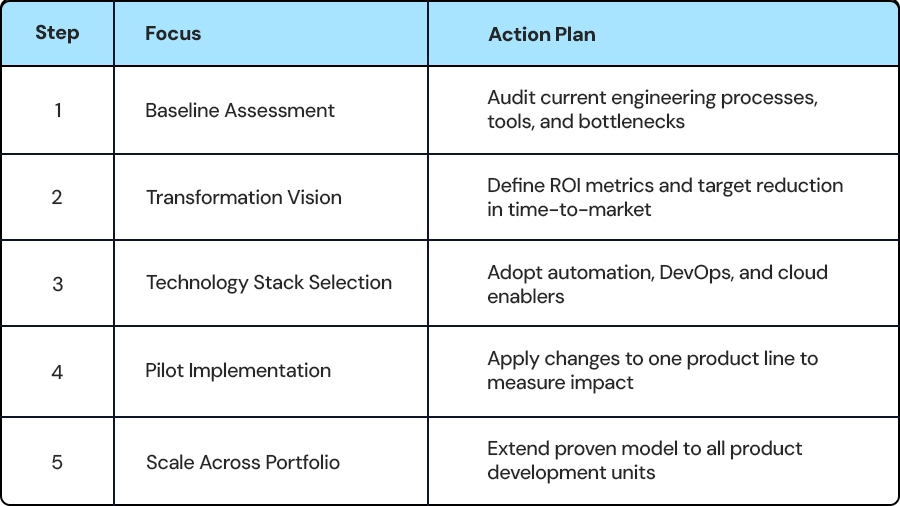
Baseline Assessment creates a factual foundation by documenting exactly how products move through your organization today. This typically reveals that actual cycle time is far longer than anyone realized, with most time spent waiting rather than in active work. The assessment identifies which bottlenecks consume the most time and which create the most variability, helping prioritize where to focus improvement efforts.
Transformation Vision translates assessment findings into specific, measurable targets for improvement. Rather than vague goals like "be more agile," define concrete metrics like reducing release cycles from 14 months to 8 months or cutting defect rates by 75%. These targets become the North Star guiding all subsequent decisions about where to invest and what to change.
Technology Stack Selection matches your specific needs with appropriate tools and platforms. This isn't about chasing the latest trends but rather choosing proven technologies that integrate well with your existing systems and match your team's skill level. The right stack for a software company looks very different from one serving IoT hardware, and recognizing those differences prevents expensive mistakes.
Pilot Implementation applies your planned changes to a single product line or business unit, treating it as a controlled experiment rather than an all-or-nothing rollout. This approach lets you measure actual impact, refine processes based on real experience, and build case studies that demonstrate ROI to skeptical stakeholders. Success with the pilot creates momentum and credibility for broader adoption.
Scale Across Portfolio extends your proven model to all product development units, customizing where necessary but maintaining core principles that drive results. This is where transformation moves from project to culture, becoming "just how we work" rather than a special initiative requiring constant management attention.
This phased adoption reduces transition risks and ensures quick wins that build support for continued investment. It also allows teams to learn incrementally rather than being overwhelmed by too much change at once.
Ready to Accelerate Your Product Launch?
Accelerating time-to-market by 40% isn't achieved by simply speeding up individual development tasks or pushing teams to work longer hours. It comes from fundamentally reengineering your entire product lifecycle around automation, agility, and continuous feedback loops that eliminate waste and focus effort where it creates the most value.
For mid-market firms, product engineering services provide the scalable methodologies and digital enablers required to bridge innovation with execution. These aren't just tools and processes they're strategic capabilities that transform how your organization competes. When executed strategically, firms convert acceleration into tangible ROI through faster product launches, improved user satisfaction, and continuous innovation momentum that compounds over time.
In a market where timing increasingly defines growth trajectories, speed isn't just a competitive advantage it's the new baseline for success. Organizations that can't match the pace of innovation in their industry will find themselves perpetually reacting to competitors rather than leading their markets.
Next Steps: Transform Your Product Engineering Approach
Ready to reduce your time-to-market by 40%?
Talk to our product engineering experts and discover how AspireSoftServ helps mid-market firms achieve faster ROI through intelligent automation and agile methodologies tailored to your specific product challenges and organizational maturity.
Explore Our Product Engineering Services