

 Updated on 5 February 2026

Most healthcare platforms collapse under their first compliance audit. Fintech apps buckle when transaction volumes spike beyond 10,000 concurrent users. Enterprise SaaS products hemorrhage costs because their cloud architecture wasn't designed for multi-tenancy from day one.
The problem isn't the code. It's the architecture or more accurately, the absence of product-level architectural thinking before a single line is written.
Cloud-native product architecture isn't about choosing Kubernetes over VMs or Docker over bare metal. It's about building systems that anticipate failure, scale without rewriting core logic, and embed security into every layer from inception. When cloud computing becomes the foundation rather than an afterthought, products don't just survive growth they monetize it.
Who This Is For:
CTOs, product owners, and engineering leaders building platforms in healthcare, fintech, and regulated SaaS industries that must scale securely while generating predictable revenue.
The Real Cost of Architectural Debt: What Fails First
A monolithic healthcare platform launches successfully. Six months later, patient data requests timeout during peak hours. The database can't handle concurrent reads. The team adds caching band-aid #1. Then vertical scaling band-aid #2. By year two, the entire engineering budget is consumed by infrastructure firefighting instead of feature development.
Most architecture failures surface not as outages, but as stalled roadmaps, missed compliance deadlines, and rising attrition inside engineering teams. Cloud computing systems don't eliminate this risk they expose it faster. The difference is whether your system was designed with distributed failure in mind.
Traditional architectures couple everything tightly: authentication sits in the same process as payment processing, patient records, and notification logic. When one component needs to scale, the entire application must scale. When a memory leak appears in the notification module, the whole system crashes. Cloud scalability becomes impossible because you can't scale what you can't isolate.
Cloud-native design inverts this model. Each business capability becomes an independent service with its own data store, deployment cycle, and failure boundary. When payment processing spikes during open enrollment, only those instances scale. When a regulatory change requires rewriting patient consent logic, you deploy one service without touching the rest.
What this means for leaders:
Architectural decisions made in week one dictate limitations for years
Tight coupling creates scaling bottlenecks that compound over time
Cloud-native isolation enables surgical scaling and faster iteration
Cloud-Native vs. Traditional: The Architectural Divide
| Decision Point | Traditional Monolith | Cloud-Native Microservices | Business Impact |
|---|---|---|---|
| Scaling bottleneck | Entire application scales together | Services scale independently | 60–80% cost reduction under variable load |
| Deployment risk | All-or-nothing releases | Incremental, isolated deployments | Zero-downtime updates and faster time-to-market |
| Failure radius | Single bug can crash the entire system | Failures contained within service boundaries | 99.9%+ uptime becomes achievable |
| Team velocity | Changes require heavy cross-team coordination | Teams own services end-to-end | 3–5× faster feature delivery |
| Compliance isolation | Entire codebase falls under audit scope | Only regulated services require certification | HIPAA/SOC 2 audits cost 40–60% less |
This isn't theoretical. When Product Strategy & Consulting guides a fintech client through cloud migration, the first question isn't "what cloud provider?" it's "which parts of your system need to scale independently, and which regulatory boundaries must remain isolated?"
A payments platform might separate transaction processing (high throughput, low latency) from fraud detection (compute-intensive, batch-optimized) from user authentication (stateful, session-dependent). Each has different cloud performance requirements, security models, and scaling patterns.
Trying to solve this with traditional architecture means over-provisioning for peak load everywhere even components that rarely spike. Cloud engineering enables surgical scaling: only the transaction engine gets 50 instances during Black Friday, while authentication runs at baseline capacity.
Why This Requires Product Engineering (Not Just Cloud Development)
The Critical Distinction:
Most teams think cloud platform adoption is a DevOps problem. It's not it's a product engineering problem.
Here's why:
Architecture decisions affect monetization: Usage-based pricing requires metering infrastructure built from day one.
Compliance is cross-functional: HIPAA compliance isn't just encryption it's data isolation, audit logging, and access patterns architected into every service.
Failures happen between teams: Most scalability issues aren't technical they're coordination failures between product, infrastructure, and security.
Cloud and DevOps handles deployment. Product engineering services ensure what you're deploying can actually scale, monetize, and comply.
The Twelve-Factor Foundation: Why These Principles Matter
Most teams reference the Twelve-Factor App methodology without understanding which factors prevent real failures.
Stateless processes aren't academic they're the difference between a system that recovers from crashes automatically and one where every outage requires manual intervention. When a container dies mid-request in a stateless architecture, the load balancer routes the retry to another instance without data loss. In a stateful monolith, that user's session is gone.
Declarative configuration means your infrastructure is code-reviewed, version-controlled, and reproducible. Without it, "staging" and "production" drift silently until a deployment that worked in testing fails catastrophically in production because an environment variable was set manually six months ago.
Immutable infrastructure prevents the single worst anti-pattern: servers that work "because we applied patches in a specific order two years ago and nobody remembers what or why." When infrastructure is immutable, every deployment starts from a known-good state. Configuration drift becomes impossible.
These aren't best practices for elegance they're survival mechanisms for products under real-world load.
The Technology Stack: Not Tools, But Capabilities
Cloud services aren't purchased they're composed. The mistake is treating Kubernetes, Docker, and serverless as interchangeable options rather than complementary capabilities solving different problems.
Kubernetes orchestrates stateful, long-running workloads microservices that need sophisticated health checks, rolling updates, and persistent storage. A patient management system running 24/7 with strict uptime SLAs belongs here.
Serverless platforms like AWS Lambda handle event-driven, variable workloads background jobs that run occasionally but must scale instantly when triggered. Processing uploaded medical images or generating compliance reports fits this model.
Using Kubernetes for infrequent batch jobs wastes resources. Using serverless for constant-throughput APIs introduces unnecessary cold-start latency. The cloud native question isn't "which is better?" it's "which capability matches each workflow's characteristics?"
Service meshes add observability and traffic management between services. Without them, debugging why Service A occasionally times out calling Service B requires instrumenting every service manually. With a mesh, traffic patterns, latency percentiles, and failure rates become visible automatically.
This is where Product Design and Prototyping must involve infrastructure engineers not as consultants after designs are finalized, but as co-designers ensuring the architecture can deliver what the product promises.
Security as Architecture, Not Audit
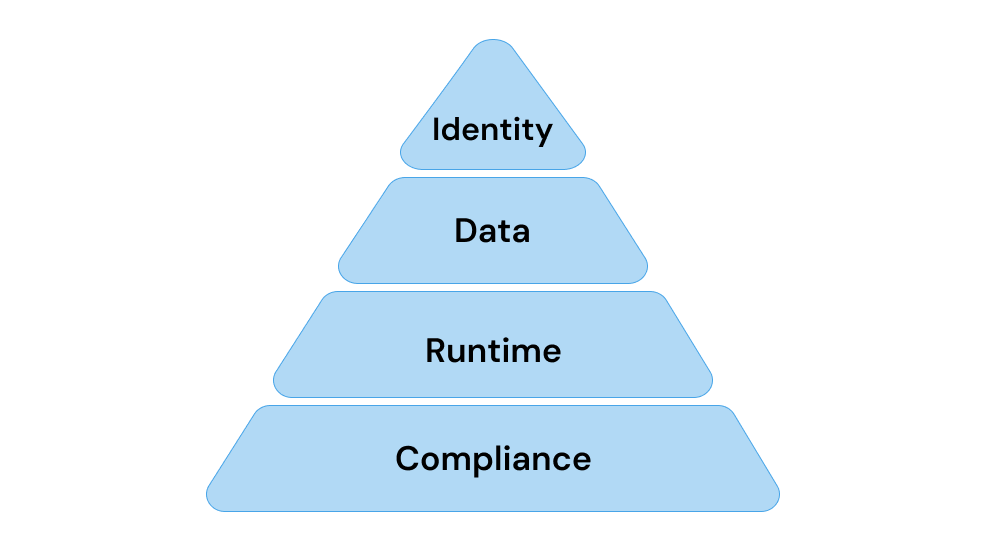
Cloud security isn't a pre-launch checklist it's embedded into every architectural layer.
Identity Layer: Zero Trust architecture assumes every request is potentially hostile even internal ones. Least-privilege access means services authenticate every call and receive only the permissions needed for that specific operation. IAM policies become product logic, not IT afterthoughts.
Data Layer: Encryption at rest protects against disk theft; encryption in transit prevents network interception. But the critical decision is where sensitive data lives. Multi-tenant SaaS architectures must isolate tenant data at the database level, not just application logic.
Runtime Layer: Vulnerability scanning tools like Trivy check container images before deployment. But scanning alone doesn't prevent zero-day exploits. Runtime protection tools like Falco detect abnormal behavior processes opening unexpected network connections or accessing files they shouldn't touch.
Compliance Layer: Continuous auditing beats annual certification because infrastructure changes constantly in Cloud and DevOps Engineering environments. Config rules that automatically flag S3 buckets becoming public or encryption being disabled catch mistakes before auditors or attackers find them.
This shift-left approach embeds security into CI/CD pipelines. Every code commit triggers automated checks: static analysis, dependency scanning, infrastructure-as-code validation. Issues surface during development, not during pre-launch audits when fixing them blocks the entire release.
What this means for leaders:
Security embedded in architecture costs 10x less than security retrofitted later
Compliance isn't a feature it's a design constraint from day one
Runtime protection catches threats that static scanning misses
Monetization Models That Require Architectural Support
| Model | Infrastructure Requirement | Why Architecture Matters | Failure Mode |
|---|---|---|---|
| Usage-Based Pricing | Real-time metering per API call and storage | Must track every billable event without impacting performance | Revenue leaks from unmetered requests |
| Subscription Tiers | Feature flagging and tenant isolation | Different tenants need different capabilities without code changes | Breaking tenant isolation or shipping features to wrong tiers |
| Freemium | Auto-scaling from free to paid workloads | Free users must cost near-zero while paid users get guaranteed resources | Free-tier usage bankrupts margins |
| Multi-Tenant SaaS | Complete data isolation and per-tenant configurations | Single codebase securely serves thousands of customers | Cross-tenant data leaks destroy the business overnight |
This is why monetization is a product engineering problem, not a billing feature.
Multi-tenancy is the clearest example. Shared infrastructure dramatically reduces total cost of ownership one cluster serves 1,000 customers instead of 1,000 separate deployments. But naive implementations fail catastrophically.
Noisy neighbor problems occur when one tenant's spike consumes resources needed by others. Without resource quotas, a single customer's data import job can slow the entire platform.
Data isolation failures happen when tenant IDs are application-enforced but not database-enforced. One SQL injection or misconfigured query exposes all customers' data. True isolation requires tenant separation at the infrastructure layer.
Software Product Development must include monetization architecture from day one. Retrofitting usage metering into an application designed for flat-fee billing requires rewriting core request handling often impossible without breaking existing customers.
The Migration Reality: Beyond Lift-and-Shift
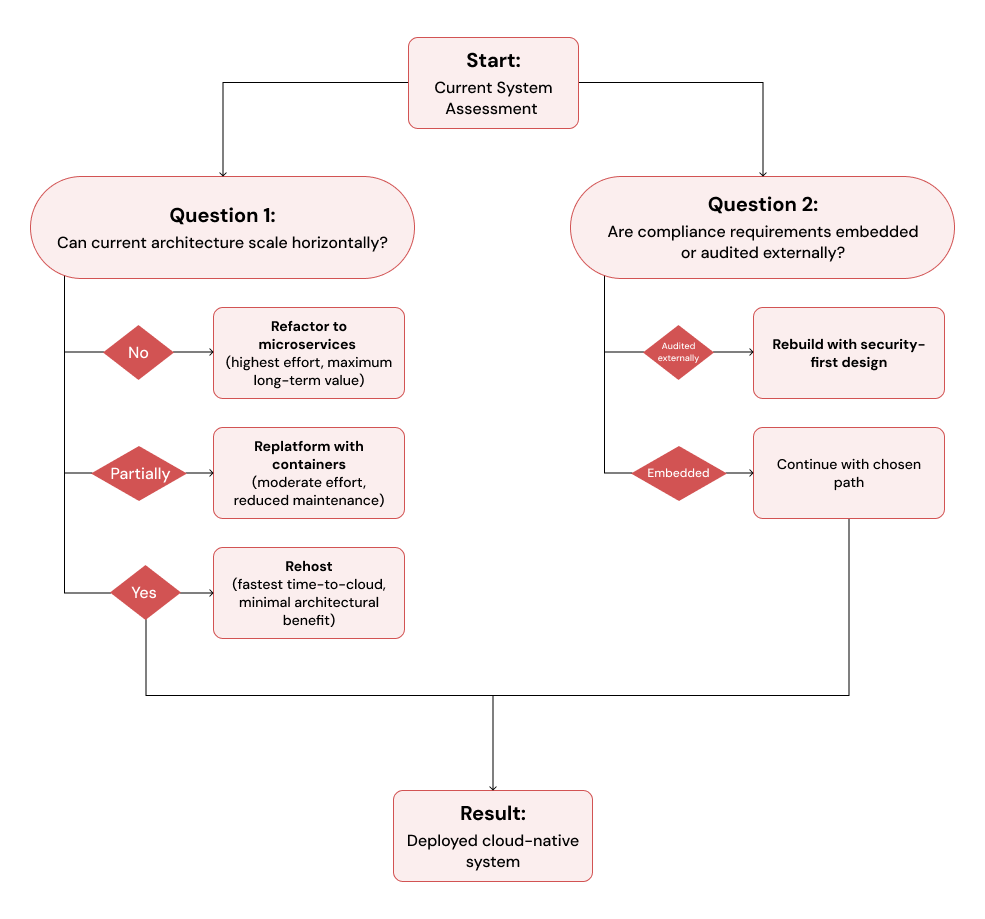
Most teams choose rehost (lift-and-shift) because it's fastest. They migrate existing VMs to cloud VMs, change nothing architecturally, and get… a more expensive data center. No auto-scaling. No improved resilience. Just a monthly cloud bill.
Replatform containerizing applications without restructuring them captures some benefits. Docker containers deploy consistently across environments. Teams can implement CI/CD pipelines. But monolithic containers still can't scale components independently.
Refactor decomposing monoliths into microservices unlocks the real advantages. Each service scales independently, deploys independently, and fails independently. Teams can experiment with new technologies in one service without risking the entire platform. But refactoring is measured in quarters, not weeks.
Why refactoring timing is a business decision, not a technical one: Does the product need cloud benefits immediately (rehost), or can you invest 6-12 months building foundations that enable exponential growth (refactor)? There's no universal answer, only informed trade-offs based on revenue risk, competitive pressure, and regulatory timelines.
Real-World Impact: What Changes After Implementation
When CloudChipr rebuilt their cost optimization platform as cloud-native microservices on Kubernetes, operational costs dropped 60%. But the real win was velocity: new features that previously took three-week release cycles now deploy in days because changes isolate to individual services.
A fintech platform on Tencent Kubernetes Engine (TKE) handling payment processing split transaction validation, fraud detection, and settlement into independent services. During Black Friday, transaction processing auto-scaled to 50 instances while fraud detection CPU-intensive but lower-throughput ran on GPU-optimized nodes. Total infrastructure cost increased 3x for peak day but handled 15x normal volume without degradation.
ESnet consolidated hundreds of single-purpose VMs into multi-tenant Kubernetes clusters. The infrastructure team shrank from managing 300+ servers to orchestrating 3 clusters. Engineering time shifted from maintenance to feature development.
In short: Cloud-native architecture trades upfront design complexity for long-term operational simplicity and economic efficiency.
Practical Next Steps for Leaders
Start with an honest architectural assessment. Can your current system scale horizontally? If not, what's preventing it shared state, tightly coupled services, database architecture?
Identify your scaling bottleneck. Is it compute, database reads, database writes, or external API rate limits? The solution differs dramatically based on the actual constraint.
Calculate your real cloud migration readiness:
Do you have infrastructure-as-code?
Automated testing coverage above 70%?
Observability tooling that surfaces bottlenecks before outages?
These aren't prerequisites they're parallel workstreams that must advance together.
Choose migration strategy based on urgency and resources. Rehost gets you to cloud quickly. Refactor positions you for future growth. The wrong choice is mixing them inconsistently some services refactored, others lifted-and-shifted without a plan for convergence.
Most importantly, recognize that cloud-native isn't a destination it's a capability maturity model. No product is "cloud-native" or "not cloud-native" absolutely. Each service exists somewhere on the spectrum from monolithic to fully distributed, from manually deployed to continuously delivered, from security-audited to security-embedded.