

 Updated on 3 February 2026

For product companies scaling SaaS platforms in healthcare, HCM, or HealthTech, releasing faster without breaking production becomes a business risk. Teams often confuse DevOps with velocity, pushing for rapid deployments without the safety mechanisms that prevent catastrophic failures. But here's the reality: DevOps isn't about moving fast it's about building a resilient system through controlled experimentation that enables sustainable speed while reducing risk.
High-performing teams deploy 46 times more frequently than their peers yet experience 96% fewer failures. This isn't magic it's the result of treating every release as a hypothesis-driven experiment rather than a blind deployment. When software product engineering embraces this mindset, organizations transform deployment from a high-risk event into a routine, low-stress operation.
The Speed Trap: Why Fast Without Safe Fails
Most organizations approach DevOps services with a single metric in mind: how quickly can we deploy? This narrow focus creates a dangerous pattern. Teams rush features to production, celebrate deployment frequency, and then spend nights firefighting outages. The problem isn't speed itself it's speed without experimentation frameworks.
Consider a mid-sized HealthTech company scaling their patient management platform. Initially, they deployed monthly with extensive manual testing. Pressured to compete, they adopted "DevOps" by deploying weekly without changing their validation approach. Within three months, patient data synchronization issues caused a compliance incident. They had speed, but no control.
The DevOps lifecycle offers a different path. Instead of deploying faster, high-performing teams deploy smaller changes more frequently. Each deployment becomes an experiment with clear hypotheses, automated validation, and predefined rollback triggers. This approach fundamentally changes risk calculation: a single 1,000-line code change is exponentially riskier than ten 100-line changes deployed sequentially with validation between each.
Software engineering services that truly understand this principle build safety into velocity. They recognize that DevOps automation isn't about eliminating human judgment it's about augmenting it with systematic validation at every step.
From Deployment to Experimentation: The Mindset Shift
Traditional deployment follows a linear path: build, test in staging, deploy to production, hope nothing breaks. Experimentation-driven DevOps operates differently. Every change becomes a testable hypothesis with measurable outcomes and automatic validation.
A DevOps engineer operating in this model asks fundamentally different questions:
What behavior should this change produce, and how will we measure it?
What percentage of users should see this change initially?
What metrics indicate success versus failure?
How quickly can we detect and rollback if assumptions prove wrong?
This shift appears subtle but transforms software product development. Instead of binary success/failure, teams gain granular insight into how changes perform under real conditions. A feature that works perfectly in staging might degrade performance for users on slower networks something only experimentation in production reveals.
Product Strategy & Consulting teams leverage this approach to validate market assumptions alongside technical ones. By treating feature launches as experiments, they gather data on user adoption, performance impact, and business value simultaneously far more valuable than deployment metrics alone.

The DevOps Experimentation Framework: Seven Connected Phases
The DevOps lifecycle structures experimentation across seven interconnected phases, each building on the previous to create a complete feedback system. Unlike traditional linear processes, these phases form a continuous loop where insights from production directly inform development decisions.
| Phase | Experimentation Function | Business Impact |
|---|---|---|
| Continuous Development | Branch-based feature experiments isolated from the main codebase | Enables parallel innovation without risking production stability |
| Continuous Integration | Automated build validation identifies integration issues early | Reduces debugging time and accelerates developer feedback loops |
| Continuous Testing | Progressive validation across unit, integration, and performance testing | Builds confidence in changes before production exposure |
| Continuous Deployment | Gradual rollout strategies such as canary releases and blue-green deployments | Allows controlled production experimentation with minimal risk |
| Continuous Monitoring | Real-time metrics collection and anomaly detection | Provides immediate visibility into experiment performance and outcomes |
| Continuous Feedback | Production insights continuously inform development priorities | Drives data-backed product and roadmap decisions |
| Continuous Operations | Automated remediation and self-healing infrastructure | Reduces mean time to recovery (MTTR) and improves system resilience |
This structure enables continuous integration and continuous delivery in product engineering to function as a coherent system rather than disconnected practices. Each phase produces data that informs the next, creating a learning loop that improves system resilience over time.
For cloud engineering services, this framework leverages elastic infrastructure to run experiments that would be cost-prohibitive in traditional environments. Teams can spin up complete production-like environments, run chaos experiments, collect data, and tear down infrastructure all automatically.
Chaos Engineering: Deliberate Failure as Validation
Chaos engineering represents the purest form of DevOps experimentation deliberately injecting failures into systems to validate resilience assumptions. Rather than waiting for production incidents to discover weaknesses, teams proactively create controlled failure conditions.
The process follows a scientific method:
Define a steady-state hypothesis about system behavior. For example: "Our payment processing system maintains 99.95% uptime even when the primary database becomes unavailable." This hypothesis should be measurable and specific to business outcomes, not just technical metrics.
Inject controlled failures that test this hypothesis. In a Kubernetes environment, this might mean randomly terminating pods, simulating network latency, or exhausting memory resources. The key word is "controlled" these experiments run in production-like environments with blast radius limits and automatic abort conditions.
Measure actual behavior against predicted outcomes. DevOps automation services collect metrics throughout the experiment, comparing system performance to baseline conditions. Deviations indicate areas requiring improvement.
Iterate based on findings. When experiments reveal weaknesses, teams strengthen those areas and expand the experiment. When systems prove resilient, teams increase failure intensity or add new failure modes.
| Chaos Workflow Step | Tools & Approach | Decision Gate |
|---|---|---|
| Hypothesis Definition | Prometheus and Grafana used to establish baseline system metrics | Business impact thresholds are clearly defined |
| Fault Injection | Chaos Mesh and Gremlin introduce controlled system failures | Blast radius restricted to less than 10% of system capacity |
| Observation | Application Performance Monitoring (APM) tools measure impact against baseline | Automated abort triggered if degradation exceeds 5% |
| Remediation | Automated rollbacks and circuit breakers mitigate failures | Permanent fixes validated in the next chaos cycle |
| Automation | Scheduled chaos experiments integrated into CI/CD pipelines | Progressive increase in experiment complexity based on pass rate |
QA engineering services integrate chaos experiments into standard testing pipelines, normalizing failure injection as part of quality assurance rather than a separate activity. This integration means every deployment candidate proves resilience before reaching production.
For organizations building software product engineering services, chaos engineering provides competitive differentiation. Clients increasingly demand proof of resilience, not just feature velocity chaos experiment results become powerful sales tools.
CI/CD Pipelines: The Experimentation Backbone
A properly designed DevOps CI/CD pipeline functions as an automated experimentation system that progressively validates changes through increasingly stringent gates. Each gate represents a hypothesis test with clear pass/fail criteria.
Process Flow:
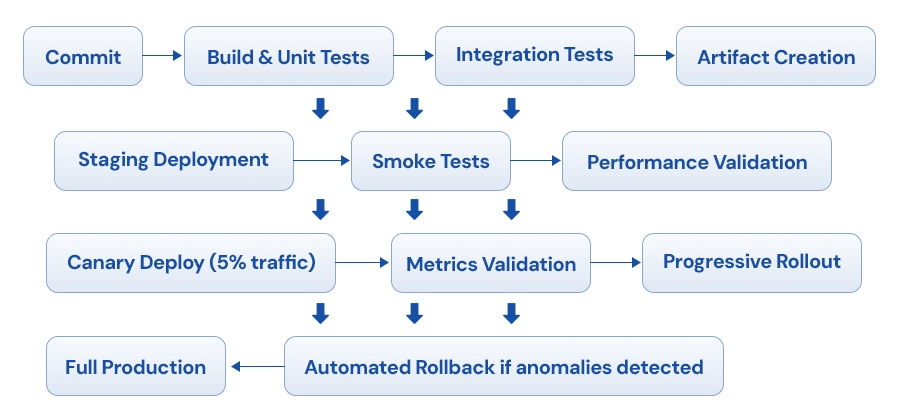
This flow embeds experimentation at every transition. Changes don't simply "pass" to the next stage they must prove they meet specific criteria. For example, a canary deployment might require:
Error rates remain within 0.1% of baseline
p95 latency doesn't increase by more than 10ms
Business metrics (conversions, user engagement) remain stable
No new error patterns appear in logs
DevOps automation for product teams makes these validations automatic and objective, removing human bias from go/no-go decisions. When metrics deviate, rollback triggers automatically no 2 AM emergency calls required.
Three deployment strategies enable safe experimentation:
Canary releases expose changes to a small user percentage first. If a new search algorithm performs well for 5% of users, it gradually expands to 10%, 25%, 50%, and finally 100%. Each expansion is an experiment with clear success metrics.
Blue-green deployments maintain two identical production environments. Changes deploy to the idle environment, undergo validation, then traffic switches instantly. If issues emerge, switching back takes seconds. This approach works exceptionally well for database migrations or infrastructure changes where gradual rollout isn't feasible.
Feature flags decouple deployment from release, enabling experimentation with unprecedented precision. Product Design and Prototyping teams can test UI variations with specific user segments, measure engagement differences, and make data-driven design decisions all without additional deployments.

Cloud Infrastructure: Elastic Experimentation at Scale
Cloud engineering transforms experimentation economics. Traditional infrastructure requires teams to provision capacity for peak load plus safety margin expensive and inflexible. Cloud and DevOps integration enables elastic experimentation where resources scale with actual need.
Consider load testing: on-premises infrastructure forces compromises. Teams might test at 60% of expected peak load due to cost constraints, missing critical failure modes that only emerge under realistic conditions. Cloud environments spin up thousands of load generators, simulate peak traffic, collect detailed metrics, and terminate resources often costing less than maintaining a fraction of that capacity full-time.
Cloud engineering services provide infrastructure-as-code (IaC) frameworks like Terraform that make entire environments reproducible. Experimentation requires identical staging and production environments; IaC guarantees this. A single configuration file defines the complete stack networks, security groups, compute resources, databases deployable identically across environments.
This reproducibility enables sophisticated experiments. Teams can:
Clone production environments to test infrastructure changes without risk
Run parallel experiments with different configurations to compare performance
Automate disaster recovery testing by periodically destroying and rebuilding environments
Validate security configurations against compliance requirements through automated scans
Data engineering services particularly benefit from this elasticity. Training machine learning models, processing large datasets, and running batch analytics all require temporary compute spikes perfect use cases for cloud experimentation frameworks.
When DevOps Experimentation Can Backfire
Honesty about limitations builds trust. DevOps automation isn't universally beneficial context matters significantly. Understanding when experimentation adds risk rather than reducing it prevents costly mistakes.
Regulatory environments limit experimentation scope. Healthcare platforms operating under HIPAA, financial services under SOC 2, or government systems under FedRAMP face constraints that make certain experiments risky. Injecting chaos into production systems handling protected health information requires extreme caution and often isn't permissible. These environments need modified approaches shadow environments that mirror production without containing sensitive data, or carefully scoped experiments during low-traffic maintenance windows.
Early-stage startups face different trade-offs. A three-person team building their MVP shouldn't invest heavily in chaos engineering or complex DevOps CI/CD pipeline architectures. At that stage, speed to market and product-market fit matter more than operational excellence. Over-engineering DevOps creates opportunity cost time spent perfecting deployments could better serve customer discovery.
Complexity can exceed organizational capability. Implementing feature flags, canary deployments, and automated rollbacks requires cultural readiness and technical sophistication. Organizations jumping from quarterly releases to continuous deployment without intermediate steps often experience confusion rather than improvement. The experimentation mindset requires gradual adoption aligned with team maturity.
Cost considerations in high-transaction systems. While cloud engineering enables elastic experimentation, high-volume systems face real cost implications. Running comprehensive chaos experiments across massive Kubernetes clusters handling millions of requests per second can become expensive. Teams must balance experimental thoroughness against operational budget reality.
Measuring What Matters: Beyond Vanity Metrics
DevOps success isn't measured by deployment frequency alone that's a vanity metric disconnected from business value. DORA (DevOps Research and Assessment) metrics provide a comprehensive framework connecting technical practices to outcomes.
| DORA Metric | Elite Performance | What It Reveals | Experimentation Connection |
|---|---|---|---|
| Deployment Frequency | Multiple deployments per day | Indicates strong team confidence in releasing changes | Frequent, small experiments significantly reduce release risk |
| Lead Time for Changes | Less than one hour | Reflects high process efficiency and automation maturity | Automated pipelines enable rapid experimentation and validation |
| Mean Time to Recovery (MTTR) | Less than one hour | Demonstrates system resilience and operational readiness | Chaos experiments expose and close recovery gaps |
| Change Failure Rate | Less than 15% | Measures the quality of testing and release discipline | Progressive rollouts detect issues early and limit impact |
Elite performers excel across all four metrics simultaneously this correlation matters. Organizations optimizing only deployment frequency while ignoring change failure rate create chaos, not value. Software product engineering services focus on balanced improvement across the complete metric set.
For product engineering services, these metrics connect to business outcomes. Reduced MTTR means less revenue loss during incidents. Lower change failure rates mean fewer customer support tickets and higher satisfaction. Faster lead times enable competitive response to market changes. This connection transforms DevOps from IT concern to strategic business capability.
QA engineering services particularly benefit from change failure rate insights. Improving this metric requires systematic root cause analysis not just fixing bugs, but understanding why testing didn't catch them. This learning loop continuously strengthens the entire DevOps lifecycle.
Real-World Implementation: Patterns from Scale
Theory matters less than practice. Organizations successfully implementing experimentation-driven DevOps automation share common patterns worth examining.
Etsy transformed from monthly batch releases to deploying 50+ times daily by embracing continuous experimentation. Their key insight: developer confidence comes from safety systems, not caution. They built comprehensive automated testing, canary deployments with automatic rollback, and feature flags enabling instant disable of problematic changes. This infrastructure reduced deployment fear, paradoxically enabling faster movement by making each individual deployment lower risk.
Capital One standardized DevOps across 300+ applications serving millions of customers in a heavily regulated industry. Their approach: unified platforms with embedded experimentation. Rather than letting each team build custom pipelines, they created opinionated templates encoding best practices. Teams experiment within guardrails automatic security scanning, compliance validation, and progressive deployment built into every pipeline. This combination achieves both innovation and control.
These examples share a pattern: successful DevOps doesn't eliminate human judgment it systematizes it. Automated tests encode quality expectations. Deployment gates reflect risk tolerance. Monitoring thresholds capture operational requirements. Teams experiment freely within these boundaries, knowing the system prevents dangerous mistakes.
The Business Case: Why This Matters to Product Leaders
CTOs and product leaders care about business outcomes, not technical practices. Framing DevOps as controlled experimentation connects directly to strategic concerns:
Market responsiveness: Organizations shipping multiple validated experiments daily can pivot faster than competitors locked into quarterly release cycles. When market conditions shift, experimental infrastructure enables rapid response.
Risk management: Experimentation-driven DevOps services reduce business risk by making changes smaller and more controlled. A failed experiment affecting 5% of users for 10 minutes is a minor incident; a bad quarterly release affecting everyone simultaneously is a crisis.
Resource efficiency: DevOps automation services reduce operational toil, freeing senior engineers for product innovation. Teams spending 60% of time on deployment logistics can't focus on customer value.
Competitive differentiation: Clients increasingly evaluate vendors on operational maturity alongside features. Demonstrating chaos engineering results and low MTTR differentiates proposals in competitive situations.
Talent attraction: Elite engineers seek environments enabling mastery. DevOps engineer roles offering genuine experimentation authority attract stronger candidates than positions focused on manual deployment execution.
Core Principles to Remember:
DevOps success requires balancing speed with safety through systematic experimentation
Every deployment should validate specific hypotheses with measurable outcomes
Cloud and DevOps integration enables elastic experimentation previously impossible
DORA metrics connect technical practices to business results
Chaos engineering reveals weaknesses before customers experience them
Product engineering consulting aligns DevOps practices with specific industry requirements
Getting Started: First Steps for Product Teams
Organizations implementing experimentation-driven DevOps should start modestly and scale systematically:
Begin with baseline metrics: Measure current deployment frequency, lead time, MTTR, and change failure rate. Improvement requires knowing your starting point.
Automate testing first: Manual testing creates deployment bottlenecks. Invest in comprehensive automated test suites before optimizing deployment speed.
Implement progressive deployment: Start with simple blue-green deployments, then add canary releases as confidence grows. Each technique reduces blast radius incrementally.
Build monitoring depth: Experimentation requires rich telemetry. Instrument applications thoroughly before increasing deployment frequency.
Foster blameless culture: Experimentation means some experiments fail that's valuable learning, not individual failure. Teams fearing blame stop experimenting.
Partner with expertise when needed. Software product engineering services accelerate implementation by bringing patterns from previous implementations. Sometimes the fastest path involves external product engineering consulting that transfers knowledge while building capability.
For organizations in healthcare or HCM specifically, Cloud and DevOps Engineering expertise combined with regulatory understanding proves particularly valuable experimentation frameworks must account for compliance requirements from inception.
The transformation from deployment-focused DevOps to experimentation-driven software product engineering isn't primarily technical it's organizational. Tools enable the shift, but mindset determines success. Teams viewing every change as a validated experiment, every deployment as learning opportunity, and every incident as system improvement create environments where speed and stability reinforce rather than contradict each other.
That's the real promise of DevOps not moving faster,but building systems resilient enough that moving fast becomes safe.
About AspireSoftServ
At AspireSoftServ, our product engineering services integrate experimentation-driven DevOps into complete Software Product Development lifecycle. We provide specialized cloud engineering services, QA engineering services, and DevOps automation tailored to healthcare and HCM platforms. Our product engineering consulting helps organizations build resilient systems where deployment becomes routine rather than risky.
Ready to transform your release process? Explore our approach to Product Strategy & Consulting and Product Design and Prototyping that makes experimentation core to product evolution.