

 Updated on 2 October 2025

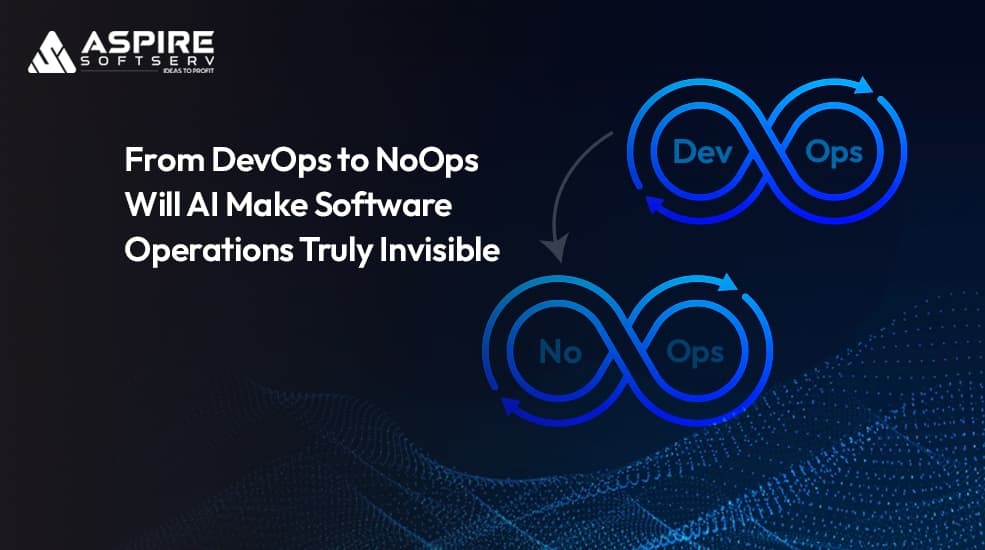
The software operations landscape is undergoing a fundamental transformation. For decades, operations teams have battled complexity through better processes, tools, and automation. DevOps brought developers and operations together, creating CI/CD pipelines and infrastructure-as-code. AIOps added machine learning to detect anomalies and predict failures. Now, NoOps promises something more radical: operations that manage themselves, with AI agents making decisions autonomously while human engineers focus on strategy and innovation.
But is this vision realistic? Can AI truly make software operations invisible, or is NoOps just another buzzword? This article examines the architecture, real-world applications, and practical roadmap for AI-powered autonomous operations. Whether you're evaluating AI-driven DevOps transformation or exploring cloud-native product engineering, you'll find concrete answers here.
The promise is compelling: reduce operational costs by 40-50%, cut incident response time by 80%, and free your engineers from repetitive toil.
What NoOps Really Means (And What It Doesn't)
NoOps doesn't mean "no operations team" or "fire all your SREs." Instead, it represents a shift in what operations teams do. Rather than spending hours triaging alerts, manually patching servers, or writing runbooks for every possible failure scenario, engineers design and oversee AI agents that handle these tasks automatically. The team's focus elevates from reactive firefighting to proactive system design, business alignment, and continuous improvement.
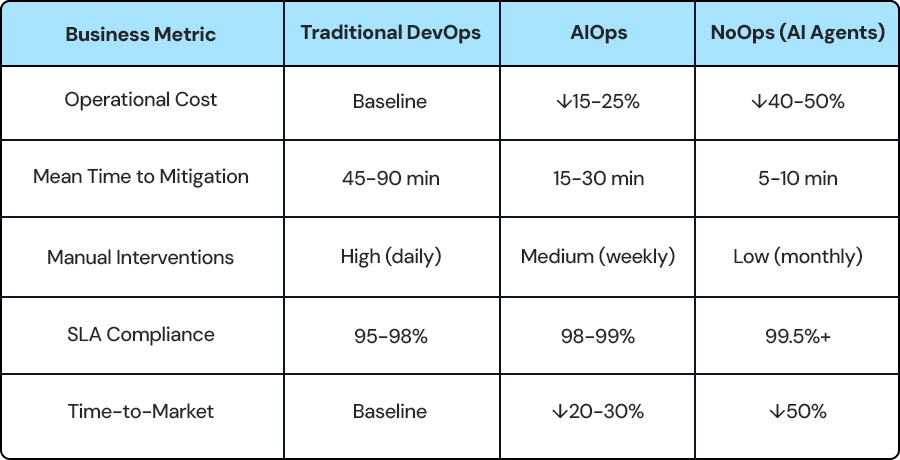
The table above shows where NoOps delivers measurable business impact compared to traditional approaches. These aren't theoretical numbers—they come from organizations already implementing AI-driven operations at scale.
Looking to adopt AI-driven NoOps in your enterprise? Our digital product engineering services help you assess readiness, design multi-agent architectures, and implement autonomous operations safely.
The Technical Foundation: How AI Makes Operations Invisible
At the core of NoOps lies agentic AI systems that don't just detect problems but reason about them, simulate solutions, and take action autonomously. Unlike traditional automation that follows pre-programmed rules, AI agents adapt to new situations, learn from outcomes, and make context-aware decisions.
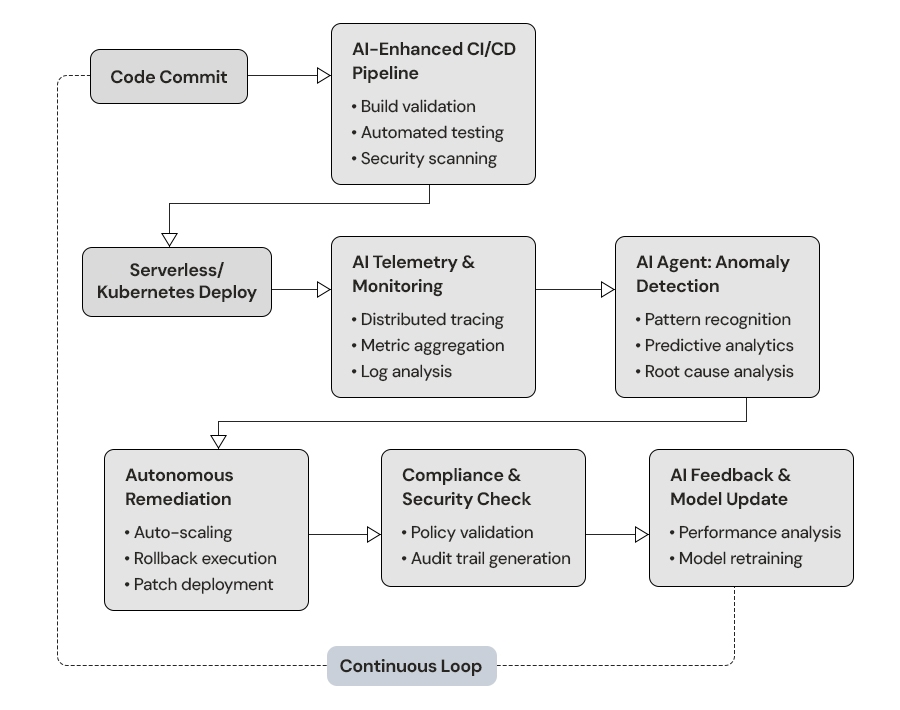
The architecture consists of four integrated layers working together continuously:
Perception Layer: AI agents ingest telemetry from every system component application logs, infrastructure metrics, distributed traces, cloud billing APIs, and business events. Advanced anomaly detection algorithms identify deviations from normal patterns before they become incidents. Semantic understanding powered by large language models extracts meaning from unstructured logs and error messages.
Reasoning Layer: Graph-based planning algorithms map dependencies between services. Bayesian networks perform root cause analysis by calculating probabilities across potential failure points. Reinforcement learning models evaluate multiple remediation strategies, simulating their outcomes before selecting the optimal approach.
Action Layer: Once a decision is made, the action layer executes changes through APIs and infrastructure-as-code tools. It might scale container replicas, reroute traffic, roll back a deployment, apply security patches, or isolate compromised systems. Every action is logged with full context for audit trails and compliance requirements.
Learning Loop: After each action, the system measures outcomes and feeds results back into training data. Models improve continuously, becoming more accurate at prediction and more effective at remediation.
Real-World Applications: Where NoOps Delivers Results Today
Autonomous Incident Response and Recovery
An e-commerce platform experiences sudden database latency spikes during a flash sale. Traditional DevOps teams would receive alerts, investigate logs, identify the slow query, and manually scale resources a process during which customers experience degraded performance and potentially abandoned carts.
With AI-driven operations, anomaly detection algorithms identify the latency spike within seconds by analyzing query execution patterns across database nodes. The reasoning layer traces the issue to a missing index on a newly added column. The AI agent automatically provisions read replicas to handle immediate load, then generates an index optimization plan. It tests the change in a shadow environment, validates performance improvement, and applies it to production. Meanwhile, it throttles non-essential background jobs to preserve resources for customer-facing transactions.
The business impact: revenue protected during peak traffic, no manual intervention required, and automated postmortem reports. Organizations implementing this capability report 80% reduction in mean time to mitigation and 50% lower operational costs.
Struggling with incident response bottlenecks? Our AI consulting services design custom autonomous operations frameworks tailored to your infrastructure.
Intelligent Security Patching
A fintech company discovers a critical vulnerability in their API gateway. Traditional approaches involve emergency change requests, manual testing, scheduled maintenance windows, and coordinated deployments across multiple environments.
AI agents transform this scenario. Vulnerability intelligence feeds directly into the agentic platform the moment a CVE is published. The AI analyzes the vulnerability's impact on specific software versions and configurations in use. It automatically retrieves the patch, tests it in isolated staging, runs regression tests against critical user journeys, and analyzes dependency chains.
Once validation completes, the AI orchestrates a blue-green deployment strategy, routing traffic gradually to patched instances while monitoring error rates in real-time. If any anomaly appears, automatic rollback occurs within seconds. Throughout the process, compliance logs are generated automatically and security teams receive detailed reports.
The result: zero-day vulnerabilities patched rapidly with zero missed SLAs and complete audit trails proving compliance.
AI-Powered Cost Optimization
A SaaS startup notices their monthly cloud bill has doubled despite only modest growth. Traditional FinOps requires manual analysis, investigation, and lengthy meetings to decide on optimization strategies.
AI-driven FinOps agents operate continuously. They ingest real-time data from cloud billing APIs, resource utilization metrics, and business usage patterns. Multi-objective optimization algorithms identify opportunities: oversized VM instances running at low CPU utilization, development environments left running unnecessarily, storage volumes filled with obsolete data, underutilized reserved instance capacity, and workloads suitable for spot instances.
The AI acts on these findings automatically. It right-sizes instances during off-peak hours, schedules shutdown of non-production environments, implements lifecycle policies for storage, purchases optimal reserved instance commitments, and migrates suitable workloads. Each action considers performance requirements, availability needs, and compliance policies.
Companies report 30-40% cloud cost reduction with ongoing optimization preventing cost drift as platforms grow.
Compliance Automation for Regulated Industries
A healthcare technology platform must maintain HIPAA compliance across hundreds of microservices and databases. Traditional compliance involves quarterly audits, manual configuration reviews, and constant anxiety about violations.
AI compliance agents monitor continuously. They use retrieval-augmented generation to understand regulatory requirements, then map those to specific technical controls. The agents scan every system component: checking encryption settings, verifying access controls, monitoring data retention policies, and ensuring network segmentation rules are enforced.
When violations are detected perhaps a developer accidentally disabled encryption or misconfigured a security group the AI agent automatically remediates by re-enabling encryption, closing ports, updating security groups, and logging incidents with full context.
The transformation: continuous compliance instead of point-in-time audits, violations remediated in minutes, audit preparation time reduced by 90%, and constant visibility into compliance status.
Evolution Path: From DevOps to NoOps
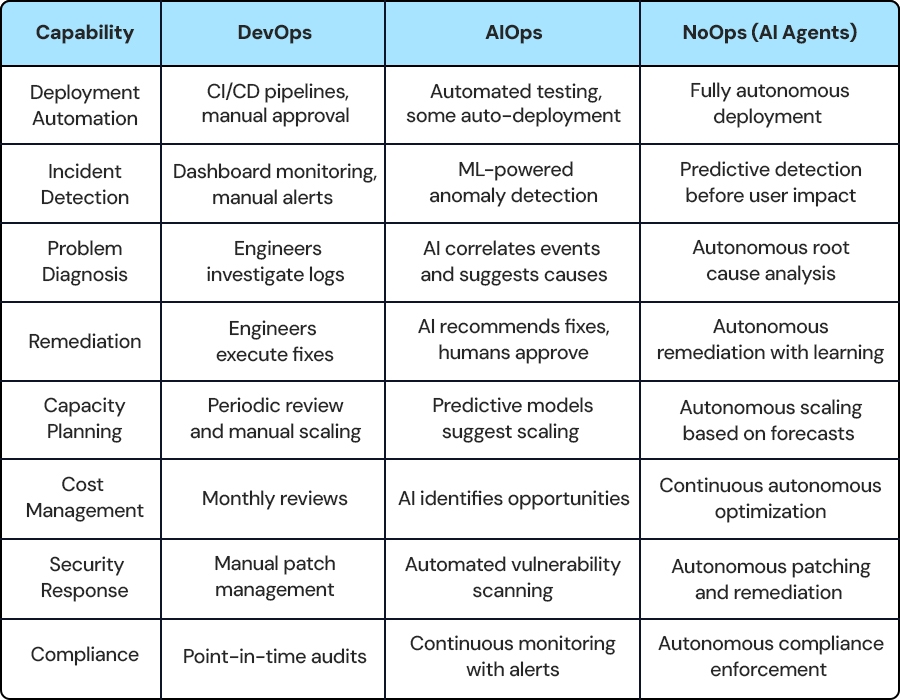
Organizations move through these stages progressively, building capabilities and confidence before advancing to full autonomy.
Is Your Organization Ready? The NoOps Maturity Assessment
Not every organization can jump directly to autonomous operations. Success depends on technical readiness, organizational culture, and workload nature.
Stage 1: Traditional DevOps - Manual deployments supported by CI/CD automation, dashboard-based monitoring with human-triggered alerts, and runbook-driven incident response. Observability is limited to basic logging and metrics.
Stage 2: AIOps Adoption - AI-assisted anomaly detection reduces alert noise, automated correlation of events across systems, machine learning models provide remediation recommendations, and cross-functional teams work with shared dashboards.
Stage 3: Partial NoOps - The pragmatic target for most enterprises. Autonomous healing handles non-critical workloads without human intervention, AI-driven scaling and cost optimization runs continuously, and production deployments have AI oversight with human approval for high-risk changes. SaaS platforms, e-commerce sites, and digital products are ideal candidates.
Stage 4: Full NoOps - AI manages most operational decisions, humans focus exclusively on strategy and system design, and autonomous operations extend across all workloads. This suits greenfield cloud-native products and serverless applications.
Which Workloads Are Safe for Autonomous Operations?
Ready for NoOps automation:
Serverless applications on AWS Lambda, Azure Functions, or Google Cloud Run
Cloud-native SaaS products with comprehensive observability
E-commerce platforms with predictable traffic patterns
Development and staging environments
Cost optimization and resource scaling
Security patching for non-critical systems
Requires hybrid approach:
Financial trading systems
Healthcare patient-facing applications
Legacy monolithic applications
Multi-cloud hybrid architectures
Not ready for autonomous operations:
Safety-critical systems in aviation or medical devices
Government and defense infrastructure
Applications with unclear business rules
Systems lacking basic observability
Practical Implementation: Best Practices and Common Pitfalls
Build Strong Foundations First - Standardize infrastructure using Kubernetes, infrastructure-as-code, and GitOps practices. Invest heavily in comprehensive telemetry including structured logging, detailed metrics, distributed tracing through OpenTelemetry, and custom instrumentation. Without rich observability data, AI agents are effectively blind.
Prioritize Explainability and Trust - Deploy explainable AI systems that articulate why they made specific decisions. Implement comprehensive model monitoring with drift detection. Establish clear human-in-the-loop override controls for high-risk operations like production rollbacks and customer data access.
Adopt Multi-Agent Architecture - Orchestrate specialized agents for different domains: SRE agents for infrastructure, FinOps agents for cost optimization, DevSecOps agents for security enforcement, and MLOps agents for model deployment.
Common Failures to Avoid:
Overfitting automation by creating overly aggressive auto-remediation without testing leads to AI agents amplifying failures. Always implement circuit breakers and gradual rollouts.
Black box AI risks emerge when teams deploy systems they don't understand. Insufficient model explainability undermines trust and creates audit failures. Prioritize interpretability over marginal accuracy gains.
Cultural lag kills NoOps initiatives. If operations teams see AI agents as threats rather than tools that elevate their work, they'll resist adoption and create defeating processes.
Poor data quality guarantees poor AI decisions. Clean, timely, well-structured telemetry data is the foundation of everything.
Need expert guidance navigating NoOps adoption? Our product engineering consulting team helps assess readiness and design safe automation strategies.
What Decision-Makers Must Address Now
Skills and Organizational Transformation - Build AI fluency across operations teams. Restructure teams around cross-functional squads where operations engineers, data scientists, security specialists, and compliance experts work together designing and overseeing autonomous systems.
Security, Compliance, and Trust Framework - Adopt defense-in-depth approaches including adversarial testing, supply chain risk management for AI models, and regular external audits. Deploy mandatory human-in-the-loop checkpoints for high-risk operations.
Strategic Technology Partnerships - Engage with specialized AI consulting services to design multi-agent architectures tailored to your industry's requirements. Leverage product engineering consulting expertise for end-to-end transformation.
Frequently Asked Questions About NoOps
Is NoOps replacing DevOps teams? No. NoOps elevates operations teams from repetitive tasks to strategic system design and AI governance. Engineers transition from responding to alerts to designing agent behaviors and optimizing AI performance.
What's the ROI of AI-driven DevOps transformation? Average returns include 40-50% operational cost reduction, 70-80% faster incident detection, 30-40% cloud infrastructure cost savings, and 35-50% faster time-to-market.
Can NoOps work for legacy systems? Partially. Legacy applications require modernization before autonomous operations become viable. The path involves implementing comprehensive observability, containerizing applications, starting with AIOps, and introducing autonomous capabilities incrementally.
What industries benefit most from NoOps? SaaS platforms see highest value due to cloud-native architecture. E-commerce benefits from predictable traffic patterns. Fintech gains through compliance automation. Digital media handles scaling demands effectively. Healthcare achieves compliance automation improvements.
TL;DR
NoOps uses agentic AI to automate software operations, reducing manual interventions while elevating engineering teams to strategic work.
Business impact is substantial: 40-50% operational cost reduction, 80% faster incident response, 30-40% cloud cost savings, and 50% faster time-to-market.
AI agents work through four layers: perception (monitoring), reasoning (diagnosis), action (remediation), and continuous learning (improvement).
Real-world applications deliver today: autonomous incident response, zero-touch security patching, AI-powered cost optimization, and continuous compliance automation.
Most enterprises should target Stage 3 (Partial NoOps) with selective automation of non-critical workloads and human oversight for high-risk operations.
Success requires strong foundations: comprehensive telemetry, standardized infrastructure, explainable AI, and cross-functional teams with AI fluency.
Key risks to mitigate: over-reliance on automation, skills gaps, regulatory concerns, and cultural resistance through staged adoption.
Conclusion:
Start your NoOps journey with confidence. Our digital product engineering and AI consulting services help companies adopt AI-driven operations safely and effectively. We design AI systems that manage tasks automatically, make sure everything follows compliance rules, and modernize older systems for cloud-ready automation. We also train teams to manage AI operations and governance. With our support, your business can reduce operational work, cut costs, and let your engineers focus on more important, strategic work. Transform your operations with AI and create smarter, more efficient systems with expert guidance every step of the way.