

 Updated on 29 January 2026


Enterprise-ready products fail not because of strategy, but because engineering decisions are made too late.
For CTOs and founders in the USA and UK building SaaS, HCM, or Healthcare platforms, the gap between strategic planning and engineering execution is where most startups lose millions and their competitive edge.
This article is for you if:
You're building a SaaS, HCM, or Healthcare platform
You plan to sell to enterprise customers
You can't afford a post-Series A rewrite
You want infrastructure to support pricing, scale, and compliance from day one
The $3M Contract That Never Closed
A healthcare startup spent 18 months building their patient management platform. Product-market fit? Perfect. Sales pipeline? $3M in signed contracts ready to close.
Then enterprise customers asked one question: "How do you handle multi-tenancy?"
The answer forced a 14-month complete rewrite. Those contracts? Delayed. Runway? Burned. Competitors? Already capturing market share.
The problem wasn't bad strategy it was that engineering thinking came too late. This isn't about one missing feature. It's about a fundamental gap: strategy told them what to build, but no one asked whether the how could support enterprise requirements, regulatory compliance, secure data handling, performance under load, or sustainable revenue generation.
Why Strategy Alone Creates Hidden Risk
Pure product strategy & consulting focuses on product-market fit while technical debt silently accumulates. Teams build MVPs that work for 100 users but crash at 1,000 not because the product idea was wrong, but because foundational engineering decisions were never made.
The pattern repeats across industries:
A fintech platform prioritized features over infrastructure. During peak trading hours, their monolithic architecture buckled. Result: customer churn, regulatory scrutiny, and six months of emergency refactoring costing more than building it correctly initially.
A B2B SaaS company launched with single-database architecture. When their first enterprise customer demanded data isolation and audit trails, they needed to rebuild their entire data layer. Four months of engineering time vanished time investors expected would go toward growth.
What Actually Breaks (And When)
| What Breaks | When It Breaks | Why Strategy Missed It | Cost Impact |
|---|---|---|---|
| Data architecture | First enterprise security review | Strategy prioritized features over multi-tenancy design | 14-month rewrite; $3M in contracts delayed |
| Infrastructure capacity | At 10,000 concurrent users | No load testing or scalable architecture planning | 52% cloud cost overrun; ARR growth blocked |
| Deployment pipeline | When release velocity matters | Manual processes don’t scale | Release velocity drops 70% vs competitors |
| Security & compliance | During due diligence | HIPAA/SOC 2 treated as a “later” concern | Full security architecture rebuild required |
Most Series A CTOs don't get budget for rewrites only for growth. But when your foundation can't support your business model, growth becomes impossible.
What Product Engineering Actually Covers (Beyond Just Scalability)
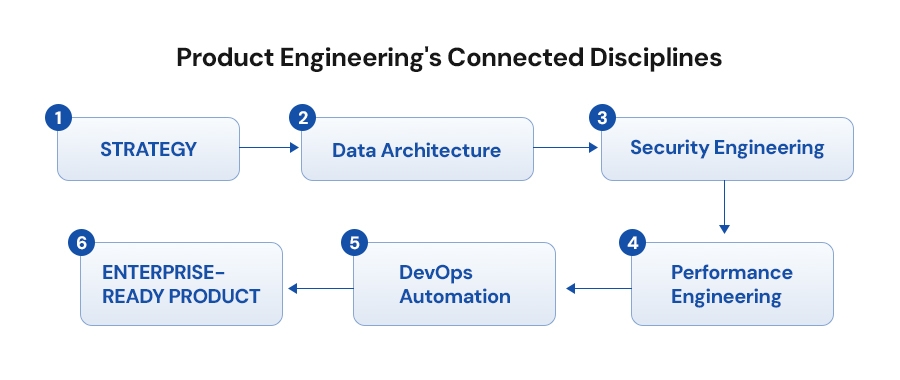
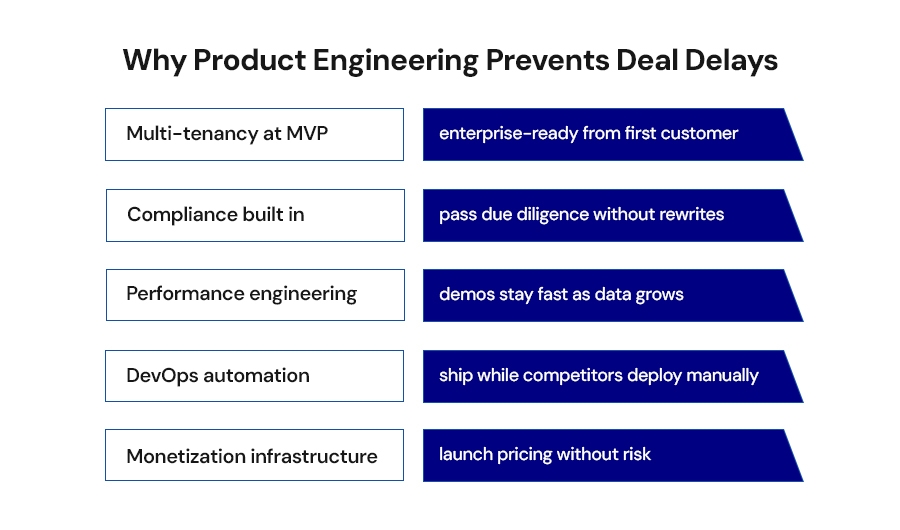
Software product engineering isn't just about handling more users it's about building products where strategy, architecture, security, compliance, monetization, and operations align from the first commit.
The healthcare startup's problem wasn't only multi-tenancy. It was interconnected gaps:
Data Architecture: How do you isolate customer data? Handle HIPAA audit requirements? Enable customer-specific configurations without custom code branches?
Security Engineering: How do you implement RBAC that scales? Encrypt data at rest and in transit? Handle authentication for enterprise SSO?
Performance Engineering: How do you ensure sub-second response times as data grows? Design queries that don't degrade? Cache intelligently?
Operational Engineering: How do you deploy without downtime? Monitor system health? Detect issues before customers report them? Roll back safely?
Monetization Engineering: How do you meter usage accurately? Implement tiered pricing? Handle subscription lifecycle events? Track costs per customer?
This is what product engineering services address not as separate workstreams, but as integrated decisions shaping architecture from day one.
The Engineering Gaps Strategy Documents Don't Capture
Enterprise product development requires decisions that never appear in product roadmaps but determine whether those roadmaps are achievable.
Gap 1: Multi-Tenant Data Architecture
What strategy said: "Build patient management for multiple healthcare providers."
What engineering needed to ask: Row-level security or separate schemas? How to handle customer-specific customizations? Data migration paths? Individual customer backups?
Real solution: A micro-financing platform faced similar needs processing 2,300+ applications monthly for multiple lenders. They designed multi-tenant architecture from day one: isolated data, customer-specific workflows, audit trails built in. Result: enterprise-ready from launch, no rewrites needed.
Gap 2: Security and Compliance Architecture
What strategy said: "We'll handle HIPAA compliance."
What engineering needed to ask: How to encrypt PHI? Implement audit logging for every access? Handle data residency? Enable customer security audits?
Why it matters: Compliance isn't added later it's architectural. Retrofitting encryption and audit trails typically requires database rewrites and API redesigns.
Real solution: Healthcare platforms using cloud native product development design encrypted storage, immutable audit logs, and data residency controls from initial schemas. When enterprise customers request SOC 2 reports or HIPAA documentation, the answer is immediate.
Gap 3: Performance Engineering at Scale
What strategy said: "The app needs to be fast."
What engineering needed to ask: Acceptable latency targets? Query optimization for millions of rows? Caching strategy? Performance monitoring and alerts?
Real solution: A global consumer goods company building AI product development tested whether ML models could predict consumer preferences 4x faster than traditional methods. They validated speed at every sprint not just at launch. Result: 70+ new SKUs created faster than competitors could research one.
Gap 4: DevOps and Deployment Automation
What strategy said: "We need to release features regularly."
What engineering needed to ask: How to deploy without downtime? Roll back when deployments break? Test before production? Coordinate database migrations? Enable gradual feature rollouts?
Real solution: DevOps product engineering with CI/CD pipelines via Jenkins or GitLab. Automated testing catches bugs pre-production. Feature flags enable safe rollouts to 5% of users. Blue-green deployments eliminate downtime. MTTR drops from hours to minutes. Enterprise software development teams report 3x productivity gains.
Where Product Engineering Connects Everything
Product Engineering is the connective tissue between strategy and execution that ensures what you're building can deliver on promises made to customers and investors.
The healthcare startup's journey with integrated product engineering services:
Week 1-2: Discovery with Engineering Thinking
Strategy validates market demand
Engineering asks: multi-tenancy requirements, HIPAA implications, performance targets
Decision: Multi-tenant architecture with row-level security, encrypted storage, audit logging
Impact: 2 weeks planning prevents 14-month rewrite
Week 3-8: Foundation Building
Database schemas include tenant isolation from first migration
Authentication includes SSO hooks even if not initially used
APIs include rate limiting and usage metering
Monitoring deployed alongside application
Impact: 20% slower initial development, zero enterprise rework
Month 6: Enterprise Sales Ready
Enterprise customer asks: "How do you handle multi-tenancy?"
Answer: "Here's our architecture documentation, security audits, HIPAA certification."
Result: $3M in contracts close on schedule, not delayed 14 months
The difference? Engineering thinking informed strategy from day one.
Process Flow Infographic Content:
Monetization Engineering: Business Models Need Architecture
Multi-tenancy and metering are foundational architecture decisions, not features to add later.
Three Real Scenarios
Scenario 1: Tiered Pricing Without Infrastructure
A SaaS company tried launching Basic/Pro/Enterprise tiers but discovered their authentication couldn't enforce user limits and had no SSO integration points.
Cost: 4 months rewriting authentication while Series A momentum stalled.
Scenario 2: Usage Pricing Without Telemetry
A fintech wanted per-API-call billing but never instrumented request logging or customer attribution.
Cost: Rebuild entire pipeline with revenue leakage or billing disputes during transition.
Scenario 3: Freemium Done Right
A healthcare platform architected feature flags and analytics from day one. They identified high-engagement users, enabled seamless upgrades, and A/B tested pricing safely.
Result: 32% conversion rate (industry average: 2-5%).
Monetization Requirements Table
| Component | Why It’s Non-Negotiable | Cost of Skipping It |
|---|---|---|
| Multi-tenant isolation | Ensures enterprise-grade data sovereignty | Enterprise deals stall without a costly platform rewrite |
| Feature flags per tier | Enables tiered pricing and safe production tests | Pricing launches blocked or risky in production |
| Usage metering | Powers accurate consumption-based pricing | Revenue leakage, billing disputes, and trust issues |
| Payment automation | Manages upgrades, renewals, and failures | Manual billing leads to failed payments and customer churn |
| Cost attribution | Reveals profitable vs loss-making accounts | Cloud costs cap ARR growth (52% of firms affected) |
Real Outcomes: Success vs Failure
Success: Micro-Financing Platform
Approach: Multi-tenant architecture, asynchronous processing, API integrations with resilient error handling, audit logging for compliance.
Result: 2,300 applications monthly in under 5 minutes. 45% efficiency gain. Scales to 10,000 applications without fundamental changes.
Failure: Healthcare Platform
Approach: Single-tenant architecture, manual deployments, no compliance infrastructure, untested performance.
Failure moment: Enterprise due diligence couldn't answer basic questions about data isolation, HIPAA logs, deployment security, or performance at scale.
Cost: 14-month rewrite, $3M contracts delayed, competitors captured market, runway burned on fixes instead of growth.
When Product Engineering Partners Make the Difference
If you're preparing for enterprise sales, seeing post-MVP performance issues, or planning tiered pricing without metering these moments require product engineering partnerships to prevent expensive pivots.
Effective partners ask uncomfortable questions during strategy sessions:
Your roadmap shows multi-provider support have you designed multi-tenant data isolation?
You're targeting healthcare is HIPAA in your initial architecture or 'we'll add it later'?
You promise sub-second response have you modeled performance at 100,000 records?
Your Series A deck shows $5M ARR can infrastructure handle that load?
Teams building HCM, Healthcare, or SaaS platforms bring in partners who integrate product strategy & consulting with software product development where strategy and engineering inform each other continuously.
The Bottom Line
The healthcare startup that lost $3M in contracts didn't fail because of bad strategy. They failed because strategy evolved without engineering thinking.
Every strategic decision has engineering implications:
Strategy: "Target enterprise healthcare" → Engineering: Multi-tenancy, HIPAA, audit logging, SOC 2, enterprise SSO
Strategy: "Usage-based pricing" → Engineering: Request metering, aggregation, billing integration, cost attribution
Strategy: "Ship faster than competitors" → Engineering: CI/CD automation, feature flags, monitoring, rollback procedures
Strategy: "Use AI for personalization" → Engineering: Data pipelines, feature stores, ML infrastructure, model governance
When strategy and engineering evolve together, these implications get addressed during architecture design not during sales cycles.
Three actions to take now:
Audit architecture against business model: Can your infrastructure support your pricing model? Pass enterprise due diligence? Handle projected scale?
Identify engineering gaps in roadmap: Which features have hidden complexity? Which "add later" items require foundational changes?
Integrate engineering into strategy sessions: Before strategic commitments, ask: "What are engineering implications? What architecture do we need? What can't we change later?"
The products that win aren't the ones with the best initial strategy or engineering they're the ones where strategy and engineering informed each other from the first decision.
Ready to ensure your product strategy and engineering architecture are aligned before expensive gaps emerge?
Explore our Product Engineering Services to see how we bridge strategy and execution from your first architectural decision preventing the $3M contract delays that happen when engineering thinking comes too late.