

Healthcare organizations face mounting pressure in 2025. With updated HIPAA modernization requirements and the emerging AI Transparency Act, manual compliance processes are no longer viable. The stakes are high: the average healthcare data breach now costs $10.93M, and regulatory penalties continue to escalate. Healthcare firms leveraging product engineering services are transforming this challenge into opportunity by automating compliance workflows, cutting audit costs by 40%, and reducing breach risks by 60%.
This technical blueprint reveals how digital product engineering transforms regulatory adherence from an operational burden into a competitive advantage, backed by real-world results and proven implementation strategies.
The Compliance Crisis: Why Manual Processes Fail
Healthcare providers, payers, and health tech companies are struggling with an increasingly complex regulatory landscape. The transition from paper-based and semi-digital systems to fully automated compliance frameworks isn't just about efficiency it's about survival in a highly regulated industry where mistakes carry million-dollar consequences.
Manual compliance processes create four critical vulnerabilities that expose organizations to significant risk:
Evolving regulations that outpace manual update cycles, including HIPAA modernization, state-specific privacy laws, and new AI governance requirements
Manual data handling contributing to 68% of security incidents according to HIPAA Journal's 2024 analysis, with human error remaining the leading cause of breaches
Fragmented legacy systems creating data silos that cost organizations an average of $4.2M per breach due to delayed detection and response
Labor-intensive audits consuming 200+ hours per compliance cycle, diverting clinical and IT resources from patient care and innovation
Impact: Organizations relying on manual compliance processes face 3x higher penalty risk and 50% longer audit cycles compared to automated systems. More critically, they lack real-time visibility into their compliance posture, discovering violations only during scheduled audits or after breaches occur.
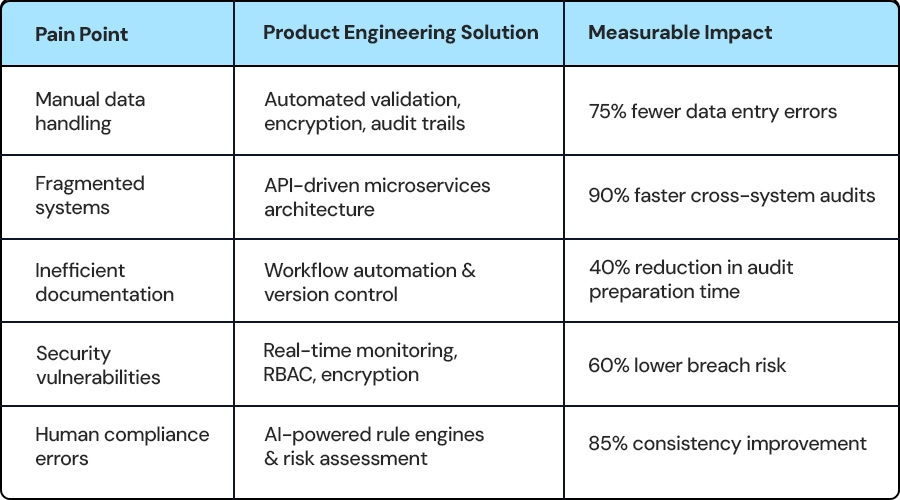
The table below illustrates how product engineering consulting addresses each pain point with measurable outcomes:
Why Automate Healthcare Compliance with Product Engineering?
The case for automation extends beyond risk mitigation. Forward-thinking healthcare organizations recognize that digital product engineering services deliver strategic advantages that directly impact bottom-line performance and competitive positioning. When compliance becomes automated, it transitions from a cost center to an enabler of innovation and operational excellence.
Modern product engineering services deliver five critical advantages that transform how healthcare organizations approach regulatory adherence:
1. Eliminates Human Error Through Intelligent Automation
Automated workflows ensure consistent HIPAA adherence across all patient touchpoints, from registration through billing. Rule-based engines validate every data transaction against current regulations, catching potential violations before they occur rather than discovering them during audits.
2. Accelerates Audit Cycles with Real-Time Readiness
Digital audit trails and real-time compliance dashboards reduce review cycles from weeks to days. Auditors access pre-formatted reports with complete documentation, evidence chains, and policy acknowledgments instantly available. This continuous audit readiness eliminates the scramble that traditionally precedes regulatory inspections.
3. Strengthens Security Through Layered Defense
End-to-end encryption, role-based access control (RBAC), and continuous monitoring create multiple security layers that protect sensitive health data. AI-powered anomaly detection identifies unusual access patterns within minutes, enabling immediate response before breaches escalate.
4. Adapts to Regulatory Changes Without System Overhauls
Modular architectures enable rapid policy updates across the entire organization without requiring complete system rebuilds. When HIPAA rules change or new state regulations emerge, compliance teams update rule engines and workflow configurations rather than rewriting code.
5. Frees Clinical and IT Resources for Strategic Initiatives
Automation reduces time spent on administrative compliance tasks by 65%, allowing teams to focus on patient care, clinical innovation, and digital transformation initiatives that drive competitive advantage.
ROI Insight: Healthcare firms implementing digital product engineering services for compliance automation save an average of $1.8M annually through reduced audit costs, avoided penalties, and operational efficiency gains. Organizations also report 30% faster time-to-market for new services due to built-in compliance frameworks.
The Automated HIPAA Compliance Framework
Modern product engineering services follow a seven-stage lifecycle that transforms compliance from reactive firefighting to proactive risk management. This framework applies equally to HIPAA, HITRUST, GDPR, and emerging AI governance requirements, providing a foundation for comprehensive regulatory adherence.
1. Assessment: Establish Your Compliance Baseline
AI-driven risk assessment tools scan existing infrastructure to identify vulnerabilities and benchmark compliance baselines. These automated assessments analyze system configurations, access logs, data flows, and policy documentation against HIPAA, HITRUST, and state-specific regulations. The assessment phase typically reveals 30-40% more compliance gaps than manual reviews, particularly in areas like audit logging completeness, encryption coverage, and access control consistency.
2. Policy Development: Automate Governance Distribution
Workflow engines generate, distribute, and track policy acknowledgments digitally across all departments and locations. Version control ensures teams always work with current compliance standards, while automated notifications alert staff when policies change. Digital acknowledgment tracking provides auditors with complete evidence that every employee received and confirmed understanding of current policies.
3. Implementation: Embed Security at Every Layer
The implementation phase deploys technical controls that enforce compliance automatically:
Role-based access controls (RBAC) that grant minimum necessary privileges based on job function
Multi-factor authentication (MFA) for all system access, with biometric options for high-security areas
End-to-end encryption protecting data at rest, in transit, and during processing
Secure API gateways that validate, authenticate, and monitor all third-party integrations
Automated staff onboarding that provisions access, assigns training, and tracks completion without manual IT intervention
4. Continuous Monitoring: Achieve 24/7 Compliance Visibility
AI-powered platforms provide round-the-clock compliance surveillance with anomaly detection, automated alerts, and real-time dashboards showing compliance posture across all departments. Machine learning models establish baseline behavior patterns for each user and system, flagging deviations that may indicate policy violations or security threats. This continuous monitoring catches issues within minutes rather than discovering them weeks later during scheduled reviews.
5. Incident Response: Automate Crisis Management
Automated incident management frameworks trigger immediate responses to potential breaches system lockdowns, evidence collection, stakeholder notifications, and corrective workflows. Pre-configured playbooks ensure consistent response regardless of when incidents occur or which staff members are available. Automated evidence collection preserves chain of custody for forensic analysis and regulatory reporting.
6. Training Management: Ensure Continuous Competency
Learning management systems (LMS) automatically assign, track, and certify employee compliance training based on roles and regulatory requirements. New hires receive appropriate training before system access is granted, while existing staff receive refresher courses and policy update training automatically. Certification tracking provides auditors with complete training histories for all employees with access to protected health information.
7. Continuous Improvement: Build Self-Optimizing Systems
Analytics feedback loops integrate audit findings, incident data, and regulatory updates into system improvements, policy revisions, and targeted retraining. This creates a self-improving compliance ecosystem that becomes more effective over time. Quarterly risk assessments identify emerging vulnerabilities before they become violations, while automated benchmarking compares your compliance posture against industry standards.
End-to-End Workflow: Compliance Automation in Action
Understanding how product engineering consulting streamlines patient data flow while maintaining regulatory adherence requires examining the complete care journey. Each touchpoint represents an opportunity for compliance automation to reduce risk while improving efficiency. The table below shows how automation transforms each stage from manual liability into automated assurance:
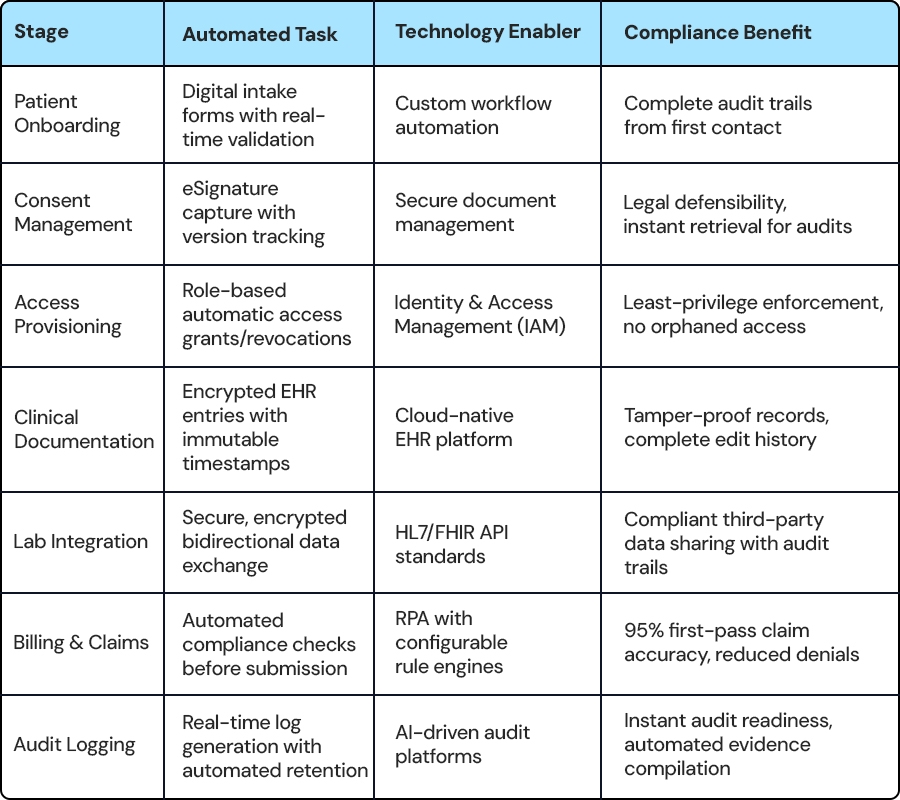
This automated workflow creates a continuous compliance thread from patient registration through final billing, with every transaction validated, logged, and monitored automatically. When auditors request documentation, systems generate comprehensive reports in hours rather than weeks.
Product Engineering Patterns Driving Compliance Success
Successful compliance automation requires more than simply digitizing manual processes. Digital product engineering employs specific architectural patterns that balance regulatory requirements with operational agility and cost efficiency. These patterns represent proven approaches that have delivered measurable compliance improvements across hundreds of healthcare organizations.
Microservices & API-First Architecture
Digital product engineering builds modular systems where each service patient management, billing, lab integration, consent management operates independently but communicates through secure, standardized APIs. This architectural approach provides critical advantages for compliance:
Rapid compliance updates without requiring full system rebuilds or extensive regression testing
Seamless third-party integrations with labs, payers, and pharmacies through standardized FHIR and HL7 interfaces
Isolated security boundaries that contain breaches to individual services rather than exposing entire systems
Independent scaling allowing high-security services to operate on dedicated infrastructure with enhanced monitoring
When HIPAA requirements change, organizations update the affected microservice and its API contracts rather than modifying monolithic codebases. This reduces compliance update timelines from months to weeks while minimizing disruption to ongoing operations.
Cloud-Native Infrastructure with Automated Compliance Controls
Cloud platforms configured with automated backup, geo-fencing, disaster recovery, and compliance monitoring maintain regulatory adherence across distributed environments while reducing infrastructure costs by 35%. Cloud-native architectures provide built-in advantages:
Automated patching and updates that address security vulnerabilities within hours of disclosure
Geographic data residency controls ensuring patient data remains in compliant jurisdictions
Immutable infrastructure where configurations are versioned and auditable, preventing configuration drift
Automated disaster recovery with tested failover procedures and documented recovery time objectives
AI-Powered Continuous Monitoring and Predictive Risk Detection
Machine learning models detect unusual access patterns, flag policy violations in real-time, and predict compliance risks before they become breaches. These AI systems analyze millions of events daily, identifying subtle patterns that human reviewers would miss. Predictive models can forecast which departments or processes face elevated compliance risk based on access patterns, error rates, and training completion data, allowing proactive intervention.
No-Code/Low-Code Workflow Tools for Agile Compliance
Compliance teams can modify workflows, add validation rules, and update policies without IT bottlenecks cutting change implementation time from weeks to hours. These platforms empower compliance officers to respond immediately to regulatory updates or internal policy changes, maintaining continuous adherence without waiting for development cycles. Visual workflow designers make it easy to document processes for auditors while ensuring those documented processes match actual system behavior.
Case Study: Value-Based Care Provider Transformation
A multi-state healthcare network with 47 clinics and 12,000 patients struggled with legacy systems causing compliance gaps that resulted in $2.1M in annual penalties. Fragmented EHR, billing, and lab systems created audit nightmares, with documentation scattered across multiple platforms and manual processes vulnerable to human error. Patient data flowed through seven different systems with inconsistent access controls and incomplete audit logging.
Partnering with a product engineering services provider, they implemented a comprehensive compliance automation platform over a 14-month engagement. The solution architecture included cloud-native SaaS platform built on microservices, automated billing workflows integrated with claims management and payer systems, API-based interoperability for seamless lab, pharmacy, and payer data exchange, comprehensive RBAC with end-to-end encryption for all data at rest and in transit, and AI-driven audit tools with predictive risk scoring and automated evidence compilation.
Measurable Results Achieved:
Penalty reduction: 92% decrease in compliance violations within the first year
Audit efficiency: Audit preparation reduced from 18 days to 3 days per cycle
Claims accuracy: 97% first-pass acceptance rate, up from 73% previously
Cost savings: $1.9M annually in combined compliance and operational costs
Continuous readiness: Real-time compliance dashboards provided instant visibility for regulatory inspections
Staff productivity: Clinical staff regained 12 hours per week previously spent on compliance documentation
The product engineering consulting team delivered end-to-end design, development, and integration using agile methodology with bi-weekly sprints. They established DevOps pipelines with automated compliance testing, created reusable compliance accelerators deployed across all clinics, and provided ongoing optimization and support future-proofing compliance while improving care delivery efficiency.
Technologies Powering Compliance Automation
Product engineering services leverage cutting-edge technologies to create compliance systems that are both robust and adaptable. Each technology addresses specific compliance challenges while integrating seamlessly into comprehensive automation platforms:
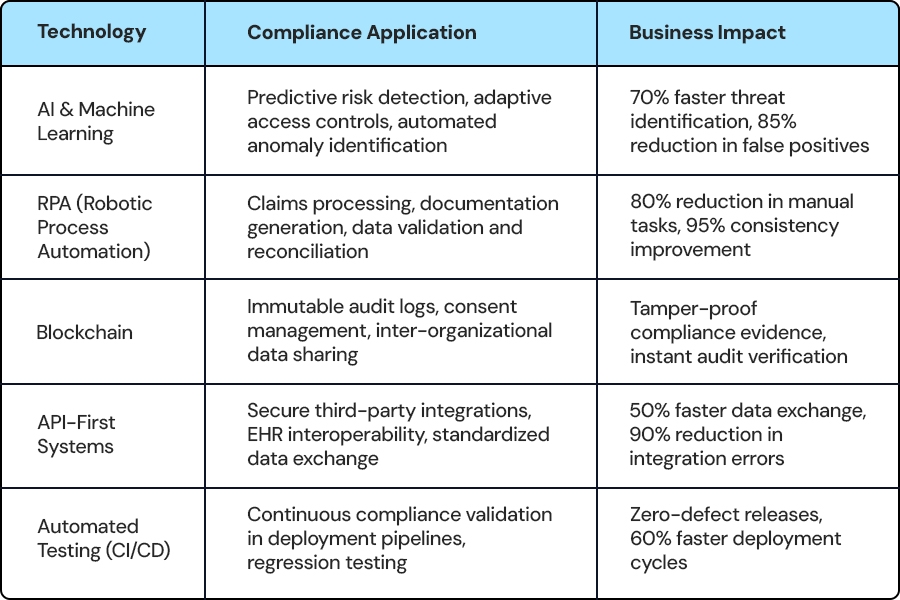
These technologies work together rather than in isolation. For example, AI models analyze data collected through API integrations, identifying patterns that trigger RPA workflows to remediate issues automatically, with all actions logged via blockchain for audit trails.
Best Practices for Deploying Automated Compliance
Successful compliance automation requires careful planning and cross-functional collaboration. Organizations that achieve the best results follow these proven implementation practices:
1. Conduct Comprehensive Gap Analysis
Assess current technology stack, workflows, and compliance state before designing solutions. This analysis should identify not just current gaps but also architectural limitations that would prevent scaling automated compliance across the organization. Involve compliance officers, IT leaders, clinical staff, and external auditors in this assessment to capture all perspectives.
2. Set SMART+ Goals with Ethical Guardrails
Define Specific, Measurable, Achievable, Relevant, Time-bound objectives that include ethical considerations. For example: "Reduce audit preparation time by 40% within 12 months while ensuring patient data privacy exceeds HIPAA minimum requirements and maintains patient trust."
3. Select Compliant Vendors and Verify Commitments
Ensure all cloud and software providers sign Business Associate Agreements (BAA) before processing any protected health information. Verify vendors maintain relevant certifications like HITRUST CSF, SOC 2 Type II, and ISO 27001. Review vendors' breach response procedures and data retention policies.
4. Prioritize Interoperability and Future Integration
Choose API-enabled tools that support standard healthcare data formats like FHIR and HL7. This ensures you can integrate future technologies without replacing entire systems. Avoid proprietary data formats or vendor lock-in situations that limit your ability to adapt to changing compliance requirements.
5. Foster Cross-Functional Collaboration Throughout Implementation
Include compliance officers, legal advisers, IT teams, clinical staff, and end-users in design decisions from day one. Create joint working groups that meet weekly during implementation. Clinical staff understand workflow realities that technical teams might miss, while compliance officers identify regulatory nuances that developers need to encode into systems.
6. Implement Continuous Monitoring with Stakeholder Access
Real-time compliance dashboards should be accessible to all relevant stakeholders, not just IT teams. Executives need high-level compliance posture visibility, compliance officers need detailed violation tracking, and department managers need team-specific metrics. This transparency creates accountability and enables rapid response to emerging issues.
7. Establish Regular Feedback Loops and Optimization Cycles
Quarterly risk assessments and system updates maintain optimal compliance posture as regulations evolve and your organization grows. These reviews should analyze audit findings, incident data, near-miss events, and industry benchmarks to identify improvement opportunities. Treat compliance automation as a living system that requires ongoing optimization rather than a one-time project.
Why 2025 Is the Inflection Point for Compliance Automation
Three converging factors make compliance automation not just beneficial but essential for healthcare organizations operating in 2025 and beyond. Organizations that delay automation face not just penalties, but competitive disadvantage as peer institutions gain operational efficiency through digital product engineering services.
Regulatory Evolution Demands Real-Time Adaptability
HIPAA modernization initiatives and emerging AI governance requirements demand systems that can adapt to regulatory changes within days rather than months. Traditional manual compliance processes cannot keep pace with the current rate of regulatory change. The proposed AI Transparency Act would require healthcare organizations to document how AI systems process patient data and make clinical recommendations compliance that's nearly impossible without automated audit trails and system monitoring.
Breach Costs Have Reached Unsustainable Levels
Average healthcare breach costs reached $10.93M in 2024 according to IBM's Security Report, representing a 53% increase over five years. These costs include regulatory fines, legal fees, remediation efforts, and reputational damage that reduces patient acquisition and retention. Automated compliance systems detect and contain breaches within minutes rather than the industry average of 277 days, dramatically reducing breach costs when incidents do occur.
Digital Transformation Funding Creates Implementation Opportunities
Federal initiatives and state programs provide financial incentives for healthcare IT modernization, including compliance automation projects. Organizations that leverage this funding window can implement enterprise-grade compliance systems with reduced upfront investment. This funding won't remain available indefinitely organizations that act now gain both financial advantages and competitive positioning benefits.
Transform Compliance from Burden to Competitive Advantage
Healthcare organizations facing regulatory complexity, operational inefficiency, or data fragmentation no longer need to view compliance as pure overhead. Product engineering services transform compliance automation from a defensive necessity into a strategic capability that enables innovation, improves patient care, and reduces operational costs. Organizations with automated compliance systems can launch new services faster, expand into new markets more confidently, and respond to competitive threats more quickly than peers still managing compliance manually.
The transformation starts with recognizing that compliance and innovation aren't competing priorities they're complementary capabilities that modern digital product engineering makes possible simultaneously. When compliance becomes automated, it stops consuming resources that could drive growth and instead becomes infrastructure that enables growth.
Ready to automate your healthcare compliance and gain competitive advantage?
Explore our Product Engineering Services for Healthcare designed to automate compliance workflows, reduce audit risk by 60%, and accelerate your digital transformation. Our product engineering consulting experts deliver end-to-end solutions from comprehensive assessment through implementation, optimization, and continuous improvement.
Schedule a discovery session to learn how our digital product engineering team can build a secure, compliant, future-proof system tailored to your organization's unique regulatory requirements, clinical workflows, and growth objectives. We'll analyze your current compliance state, identify quick-win opportunities, and design a roadmap that delivers measurable results within 90 days.
Start Your HIPAA Automation Project