

 Updated on 16 December 2025


Engineering teams waste an estimated 22–30% of their budget building features that fail to deliver measurable returns. For CEOs and CTOs leading companies with 1–500 employees, every development dollar counts. Before allocating precious engineering bandwidth to your next product feature, you need to validate clear product feature ROI signals that justify the investment.
The stakes are high. A mid-sized SaaS HR platform recently spent $380,000 building a custom onboarding dashboard only to discover users preferred their existing workflow. The feature sat unused, technical debt accumulated, and the engineering team's backlog grew even longer. With the right ROI signals before feature funding, this expensive mistake could have been avoided.
This guide walks you through the critical ROI evaluation framework that helps product leaders make data-driven feature investment decisions, avoid costly missteps, and focus engineering resources on high-impact development that drives revenue and retention.
Why Product Feature ROI Analysis Matters in 2026
Product feature ROI isn't just a financial exercise it's a strategic decision-making framework that separates high-performing product teams from those constantly battling feature bloat and technical debt. When you invest in features without validating ROI signals, you risk several critical problems:
Your engineering team's limited bandwidth gets consumed by low-impact work while competitors ship features that actually move the needle. Studies show that feature development ROI analysis helps companies reduce wasted development cycles by up to 40%, allowing leaner teams to punch above their weight. For companies facing skill shortages in React, Node.js, or Python, every hour of engineering time matters even more.
Cost overruns become the norm rather than the exception. Without clear product development ROI analysis, features routinely exceed time and budget estimates because hidden dependencies, technical debt, and scope creep weren't factored into the original calculations. This creates a cascading effect where your product roadmap becomes increasingly unreliable.
Stakeholder confidence erodes when promised features fail to deliver expected business outcomes. Investors and board members want to see data-driven decision-making, not gut-feel product management. How to measure ROI of product features becomes the foundation for maintaining stakeholder trust and securing future funding rounds.
The real cost of poor ROI analysis extends beyond wasted engineering hours. Technical debt accumulates, team morale suffers from shipping unused features, and opportunity costs compound as you miss market windows while building the wrong things.
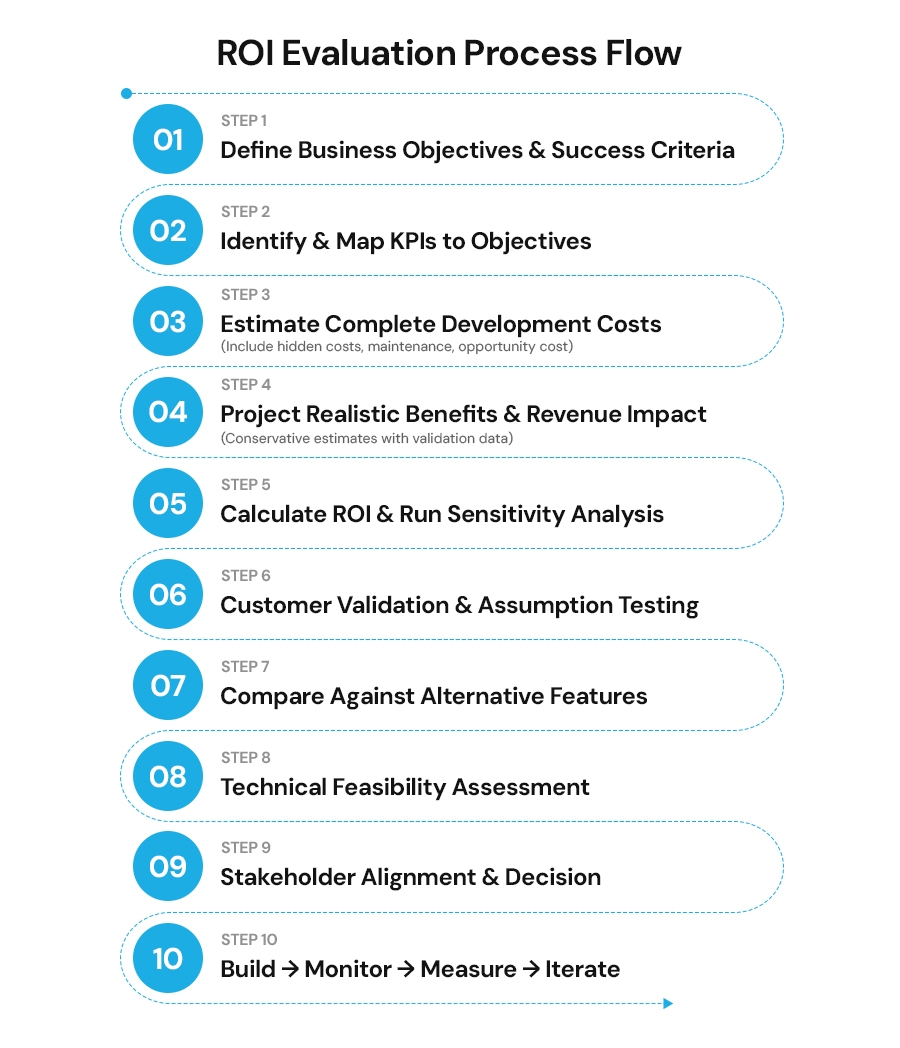
ROI Evaluation Process Flow
Define Clear Objectives and Feature Prioritization Metrics
Before estimating costs or calculating returns, establish exactly what success looks like for your proposed feature. Generic goals like "improve the product" or "make users happy" don't provide the measurable foundation needed for product feature ROI analysis.
Start by connecting each feature to specific business outcomes. Are you trying to reduce customer acquisition cost by improving trial-to-paid conversion? Does this feature address a primary driver of churn that's costing you 5% of MRR monthly? Will it unlock a new customer segment that expands your addressable market by 30%?
Your feature prioritization metrics should include both quantitative and qualitative dimensions. Here's a practical framework that covers the critical evaluation criteria:
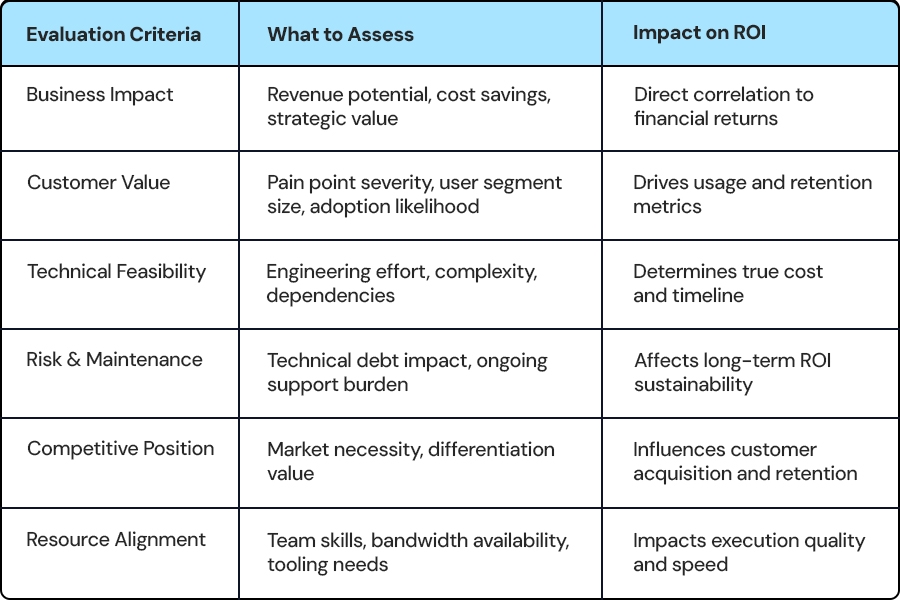
When you're mapping these metrics to your feature candidates, think about how Product Strategy & Consulting fits into the bigger picture. The features you choose should align with your overall product vision and market positioning, not just solve isolated problems.
Let's look at a practical example from a fintech company we worked with. They were debating between building a custom document parsing feature or integrating with an existing OCR API. The custom build scored high on "competitive differentiation" but when they mapped it against feature investment decision criteria, the API integration delivered 80% of the value at 35% of the development cost, with near-zero ongoing maintenance. The ROI choice became clear once objectives were properly defined. Sometimes the smart play isn't building everything from scratch it's knowing when Product Design and Prototyping can validate a lean approach first.
The strongest feature prioritization metrics frameworks use weighted scoring systems. Assign importance weights to each metric category based on your current business priorities. A growth-stage SaaS company might weight customer acquisition metrics at 40%, revenue expansion at 30%, and technical feasibility at 30%. An enterprise product with high churn might reverse those priorities. The weighting itself becomes a strategic conversation that forces clarity on what actually matters most to your business right now.
Calculate Product Feature ROI: The Complete Cost-Benefit Framework
Calculate ROI for software features requires more nuance than plugging numbers into a simple formula. While the basic ROI equation (Gain from Investment - Cost of Investment) / Cost of Investment × 100 provides the foundation, accurately estimating both sides of that equation determines whether your analysis actually predicts reality.
Estimate True Development Costs
Most teams drastically underestimate the actual cost of feature development because they only account for direct coding time. A complete cost analysis for product development ROI analysis includes:
Direct Development Costs: Development team salaries and fully-loaded costs (including benefits, equipment, overhead) multiplied by estimated time. If three engineers at $150K fully-loaded cost will spend six weeks on this feature, that's roughly $52,000 in direct labor. But you're not done yet.
Infrastructure and Tooling Costs: Cloud resources, third-party APIs, development tools, testing environments, and staging infrastructure all add up. A complex real-time feature might require additional database instances, message queues, and CDN resources that cost $800–$2,000 monthly from day one. This is where expertise in Cloud and DevOps Engineering matters skilled teams can architect solutions that scale efficiently without burning through your infrastructure budget.
Hidden Opportunity Costs: Every feature you build means other features don't get built. If your engineering team has capacity for only three major features per quarter, choosing this one means deprioritizing the other two. What's the potential ROI of those alternatives? This gets tricky because you're comparing known costs against hypothetical benefits, but it's a crucial part of honest ROI analysis.
Technical Debt and Maintenance: Features don't just get built they require ongoing maintenance, bug fixes, updates, and support. Industry data suggests maintenance consumes 15–25% of the original development cost annually. A $50,000 feature will likely cost $7,500–$12,500 per year to maintain. And that's assuming you built it right the first time. Poor architectural decisions or rushed Software Product Development can double or triple those ongoing costs.
Quality Assurance and Testing: Comprehensive QA, automated testing, security reviews, and performance testing can add 25–40% to base development time. Skimping here leads to production bugs that create even higher costs downstream. One healthcare SaaS platform recently discovered their "simple" patient portal feature actually cost 2.3× their original estimate when they factored in HIPAA compliance testing, security audits, and the two weeks of senior engineering time required to untangle architectural dependencies. They learned the hard way that cutting corners on testing just shifts costs to later stages where they're more expensive to fix.
Estimate Feature Benefits and Revenue Impact
The gain side of the SaaS feature ROI framework equation requires equal rigor. Break expected benefits into direct revenue impact and indirect value drivers:
Direct Revenue Benefits: New customer acquisition enabled by the feature, conversion rate improvements, pricing tier upgrades, or reduced discounting. Be specific with your assumptions. If you believe this feature will improve trial-to-paid conversion from 12% to 15%, calculate exactly how many additional paying customers that represents based on your trial volume.
Cost Savings Benefits: Reduced support volume (tickets × average handling cost), eliminated manual processes (hours saved × labor cost), infrastructure optimization, or reduced churn. A fintech client implemented automated identity verification that reduced manual review time by 18 hours per week $54,000 in annual savings at their support team's fully-loaded cost.
Lifetime Value Impact: Features that increase retention or expansion revenue have compounding effects. If you increase average customer lifetime from 28 months to 32 months, that's a 14% LTV increase across your entire customer base. Model this carefully based on your unit economics.
Competitive and Strategic Value: Some features are table stakes for enterprise deals or prevent competitive losses. While harder to quantify, estimate the deal value at risk. If sales reports losing two enterprise deals per quarter due to missing SSO integration, and average enterprise ACV is $75,000, that's $150,000 in quarterly opportunity cost.
The ROI Calculation in Action
Let's work through a complete example for a B2B SaaS platform considering an advanced analytics dashboard:
Estimated Costs:
Development: 8 weeks × 2.5 engineers × $3,000/week fully-loaded = $60,000
Infrastructure: $500/month × 12 months = $6,000
QA and testing: 30% of dev cost = $18,000
Annual maintenance (20% of dev): $12,000
Total Year 1 Cost: $96,000
Estimated Benefits (Year 1):
Improved enterprise conversion: 4 additional deals × $50,000 ACV = $200,000
Reduced churn in existing base: 2% reduction × $2M ARR = $40,000
Support ticket reduction: 12 hours/week × $50/hour × 52 weeks = $31,200
Total Year 1 Benefit: $271,200
ROI Calculation: ($271,200 - $96,000) / $96,000 × 100 = 182% first-year ROI
This analysis suggests strong returns, but dig deeper into the assumptions. How confident are you in that enterprise conversion lift? What if it's only 2 additional deals instead of 4? Sensitivity analysis helps you understand which assumptions drive ROI and which are nice-to-haves.
Product Roadmap ROI Signals: When to Proceed vs. Pause
Not every feature with positive ROI deserves immediate development. Your product roadmap ROI signals framework should include trigger points that indicate when a feature is truly ready for investment versus when it needs more validation.
Green Light Signals (Strong Go Indicators):
Multiple customer segments requesting the feature with demonstrated willingness to pay. When six enterprise prospects representing $450,000 in potential ARR all mention the same capability gap during sales calls, that's a clear signal. The market is telling you this feature unlocks revenue.
Clear competitive pressure where lack of this feature is costing you deals. If your win/loss analysis shows you're losing 15% of competitive evaluations specifically due to this gap, the ROI case becomes urgent. Every quarter of delay represents continued lost deals.
Strong alignment with strategic direction and existing technical architecture. Features that leverage your current tech stack and strengthen your core value proposition typically deliver higher ROI because they compound with existing strengths rather than creating architectural sprawl.
High confidence in cost and benefit estimates backed by data. If you've built similar features before, interviewed users extensively, and can point to comparable market examples, your ROI projections are more reliable.
Yellow Light Signals (Proceed with Caution):
Only a single customer segment wants this, and it represents a small portion of your revenue base. Building specialized features for niche segments can fragment your product and increase maintenance burden without proportional returns.
The feature requires significant technical debt paydown first. Sometimes the highest ROI move is addressing underlying architecture issues before adding new capabilities. Technical debt vs new feature ROI calculations often reveal that modernizing your API layer or optimizing database performance will enable multiple future features and deliver better overall returns.
Benefit estimates rely heavily on assumptions rather than data. If your ROI case depends on "we think users will love this" without validation, pump the brakes. Build a lightweight prototype, run user testing, or launch a limited beta first.
Red Light Signals (Don't Build Yet):
No clear business case or revenue connection. "It would be cool" or "competitors have it" aren't sufficient justification. Every feature needs a compelling answer to "how does this drive revenue, reduce costs, or prevent churn?"
Resource constraints mean building this delays higher-ROI features. If your engineering team is already at 85–90% capacity and this feature would push back three other initiatives with stronger ROI, the opportunity cost is too high.
Market feedback suggests users can work around the gap. When potential customers say "nice to have" rather than "must have," it signals lower urgency. Focus on must-have capabilities first.
Feature Investment Decision Process: A Step-by-Step Framework
Successful feature investment decisions follow a repeatable process that reduces bias and ensures consistent evaluation across your product roadmap. Here's the framework that leading product organizations use:
Step 1: Intake and Initial Screening
Feature requests flow in from sales, support, customers, and internal stakeholders constantly. Establish a standardized intake form that captures: who's requesting it, what problem it solves, how many customers/users are affected, business impact estimate, and urgency level. This creates a filterable backlog rather than a chaotic list.
Step 2: Impact vs. Effort Scoring
Run quick, rough estimates on potential impact and required effort. Impact considers revenue potential, customer reach, and strategic value. Effort accounts for engineering complexity, dependencies, and time requirements. This creates your initial prioritization quadrant:
High impact, low effort = Quick wins (do first)
High impact, high effort = Major projects (evaluate carefully)
Low impact, low effort = Fill-in work (do when capacity allows)
Low impact, high effort = Time sinks (avoid unless strategic)
Step 3: Detailed ROI Analysis for Top Candidates
Features that score high on impact deserve full cost vs value analysis for product features. This is where you build the detailed cost breakdown, benefit projections, and sensitivity analysis described in the previous section. Don't waste time on detailed ROI for features that already screened out as low priority.
Step 4: Technical Feasibility and Architecture Review
Have your engineering leadership assess architectural implications, technical debt impact, and implementation approach. Sometimes what sounds simple to product or business stakeholders requires significant refactoring. A senior architect caught that a "simple" API integration feature would have required restructuring their entire authentication layer turning a two-week project into a six-week project.
Step 5: Customer Validation
Before committing to development, validate assumptions with real users. This doesn't mean building the feature first. Create mockups, prototypes, or detailed specs and get feedback. A B2B platform saved four months of development time when customer validation revealed their proposed workflow was too complex users wanted something 60% simpler.
Step 6: Portfolio-Level Review
Look at your feature slate holistically. Does this mix align with company strategy? Are you balancing customer retention features with acquisition features? Do you have the right technical debt paydown projects mixed in? Your overall roadmap should reflect strategic priorities, not just individual feature ROI.
Step 7: Go/No-Go Decision with Stakeholder Alignment
Bring together product, engineering, sales, and executive stakeholders for final decision. Present the complete ROI case, technical plan, validation results, and resource requirements. Document the decision rationale so you can reference it later during post-launch reviews.
Step 8: Continuous Monitoring and Post-Launch Review
Set specific checkpoints to measure actual performance against projections. Thirty days post-launch, ninety days post-launch, and six months post-launch are natural review points. Did usage match expectations? Did the business metrics move as predicted? Were cost estimates accurate? This feedback loop improves your future ROI estimation accuracy.
How Product Engineering Services Maximize Feature ROI
Companies facing engineering bandwidth constraints, skill gaps, or cost pressures increasingly turn to product engineering services to improve feature development ROI. The right engineering partner brings specialized capabilities that enhance returns across the feature development lifecycle.
Strategic Feature Planning and Validation: Experienced product engineering teams help refine your feature concepts and validate technical approaches before committing to full development. They've built similar capabilities across multiple products and can spot potential pitfalls, suggest alternative implementations that cost less, or identify opportunities to leverage existing platforms and APIs. This front-end work typically improves ROI by 25–40% compared to diving straight into development.
Efficient Development with Specialized Skills: When your internal team lacks specific expertise whether that's React for complex UIs, Node.js for real-time features, or Python for ML capabilities hiring and onboarding permanent staff can take months and cost $150,000+ annually per engineer. Product engineering services provide access to specialized skills immediately, allowing you to scale up or down based on project needs without long-term commitments. This flexibility alone can improve your feature development ROI by 30–40% compared to the traditional hiring model.
Automation and Technical Efficiency: Modern product engineering practices emphasize automation for testing, deployment, infrastructure provisioning, and monitoring. Teams experienced in these approaches build features that cost less to maintain because they're architected for reliability from the start. A healthcare platform reduced their post-launch bug rate by 65% by partnering with engineers who implemented comprehensive automated testing from day one. That's not just fewer customer complaints it's real dollars saved on support and emergency fixes.
Scalable Architecture That Reduces Future Costs: How a feature is built fundamentally impacts long-term ROI. Well-architected features scale efficiently as usage grows, integrate cleanly with future additions, and minimize technical debt accumulation. Poor architectural choices create compounding costs one e-commerce platform spent $120,000 refactoring a poorly-designed search feature just eighteen months after launch because it couldn't handle their growth. Strong Cloud and DevOps Engineering practices prevent these expensive do-overs by getting the foundation right the first time.
Cloud optimization and DevOps engineering practices reduce infrastructure costs while improving performance. Engineering teams skilled in cloud-native development and infrastructure-as-code can often reduce hosting costs by 30–50% while simultaneously improving reliability and deployment speed. That's the kind of ROI that shows up in your P&L every single month.
Common Pitfalls in Product Feature ROI Analysis
Even experienced product leaders make predictable mistakes when analyzing product feature ROI. Understanding these pitfalls helps you avoid them:
Overestimating Benefits Based on Optimistic Scenarios: It's human nature to imagine the best-case scenario. "If this feature converts just 10% of our free users to paid, that's $2 million in new revenue!" Reality is usually messier. Users don't discover features immediately, adoption takes time, and your conversion assumption might be off by 50% or more. Use conservative estimates and build sensitivity models that show ROI across a range of outcomes.
Underestimating Ongoing Maintenance and Evolution: That initial development cost is just the beginning. Features require bug fixes, compatibility updates as platforms evolve, security patches, and inevitable enhancement requests. Budget 15–25% of initial development cost annually for maintenance, or you'll find your engineering team increasingly consumed by technical debt rather than new development.
Ignoring Opportunity Cost: Your engineering team has finite capacity. Building Feature A means not building Features B and C. If those alternative features would have delivered higher ROI, you've made a suboptimal choice even if Feature A itself is profitable. Always evaluate your top three options side by side.
Failure to Validate Assumptions with Users: "We think users will love this" is not a substitute for actual user research. The graveyard of failed features is filled with ideas that sounded great in conference rooms but didn't match how users actually work. Invest in validation before development, not after.
Mixing Strategic and Financial ROI: Some features are strategic necessities even if the direct financial ROI is weak. Enterprise SSO might not directly generate revenue but unlocks enterprise deals. Be honest about which features are strategic table stakes versus revenue generators. Don't force strategic features to meet aggressive financial ROI thresholds, but don't pretend revenue features are strategic must-haves to avoid ROI scrutiny.
Building a Data Infrastructure for Accurate ROI Tracking
How to measure ROI of product features after launch requires robust analytics and data infrastructure. Many companies build features without instrumenting them properly, making it impossible to determine actual performance against projections.
Your data infrastructure should capture feature-specific metrics from day one. When users interact with your new feature, you need to track usage frequency, session duration, completion rates, error rates, and correlation with key business metrics like retention and revenue. Modern analytics platforms make this relatively straightforward, but it requires intentional planning during the development phase.
Establish baseline metrics before launch so you can measure change accurately. If you're building a feature to reduce churn, document your current churn rate by cohort and customer segment. If you're aiming to improve conversion, know your current conversion rate with precision. Without solid baselines, you're guessing about impact.
Set up automated dashboards that surface feature ROI metrics without manual analysis. Product and executive teams should be able to check feature performance as easily as checking email. Real-time visibility enables faster course corrections when features aren't performing as expected.
Connect feature usage data to your CRM and financial systems. The most powerful ROI analysis comes from understanding which customers use which features and how that correlates with expansion revenue, renewal rates, and lifetime value. This requires data integration across your product analytics, customer success platform, and billing system.
Making Better Feature Investment Decisions in 2026
Product feature ROI analysis transforms product management from opinion-driven debates to data-informed decisions. For CEOs and CTOs managing lean engineering teams, limited budgets, and aggressive growth targets, every feature investment must deliver measurable returns. You can't afford to guess anymore not when your competitors are making smarter bets with better data.
The companies that win in competitive markets are those that consistently fund the right features while avoiding expensive mistakes. They validate assumptions before coding begins, estimate costs comprehensively, project benefits conservatively, and track actual performance rigorously. This discipline creates a compounding advantage not only do they ship higher-impact features, but their ROI estimation accuracy improves with each iteration. It's like compound interest, but for product development capability.
Whether you're building your product in-house or leveraging product engineering services to accelerate development, the framework remains the same: define clear objectives, quantify costs and benefits, validate with users, and monitor results. The specifics of calculate ROI for software features may vary by industry and business model, but the principle holds across B2B SaaS, healthcare technology, fintech, and beyond. Good Product Strategy & Consulting helps you adapt these frameworks to your specific context without losing the rigor that makes them valuable.
Start with your next feature decision. Apply this framework rigorously. Document your assumptions, track actual outcomes, and refine your approach based on what you learn. Over time, your feature investment decisions will become more accurate, your product roadmap will drive stronger business results, and stakeholders will have confidence that development resources are focused on maximum-impact work.
Ready to improve your product feature ROI? Begin by auditing your current feature backlog using the feature prioritization metrics outlined here. Identify which features have strong ROI signals and which are consuming resources without clear returns. That clarity alone can unlock significant value by reallocating engineering capacity to your highest-leverage opportunities.
Need help validating your feature ROI or accelerating development with specialized engineering expertise?
Connect with our team to explore how product engineering services can help you build high-ROI features faster and more cost-effectively than expanding your in-house team.
Make Confident Feature Investment Decisions