

 Updated on 17 December 2025


Automation roadmap planning has become a strategic imperative for mid-market companies navigating the complexities of 2026's technology landscape. For CEOs, CTOs, and engineering leaders managing teams of 1-500 employees, the challenge isn't just understanding automation it's implementing it effectively when engineering resources are already stretched thin.
If you're leading a company with limited engineering capacity, you're likely facing a familiar set of pressures: manual processes slowing down releases, technical debt accumulating faster than you can address it, and the constant struggle to balance operational demands with strategic innovation. This guide addresses these real-world constraints head-on, providing a practical automation roadmap framework tailored specifically for teams working within resource limitations.
Why Your 2026 Automation Strategy Can't Wait
The automation landscape in 2026 has evolved beyond simple task automation. Modern automation strategy for 2026 encompasses AI-powered workflows, intelligent orchestration, and low-code platforms that democratize automation capabilities across your organization. For mid-market companies, this shift represents both opportunity and urgency.
Consider the typical mid-market engineering team: developers juggling feature development with maintenance, manual QA processes consuming 15-20 hours per week, deployment cycles taking days instead of hours, and critical business processes dependent on spreadsheets and email chains. These aren't just inefficiencies they're competitive vulnerabilities in a market where faster-moving companies are automating their way to 30-40% cost reductions and deploying features 3-5 times faster.
The reality for companies in HR tech, healthcare platforms, fintech, and retail is particularly acute. Regulatory compliance demands increase operational overhead, while customer expectations for rapid feature delivery intensify. An effective automation roadmap addresses both dimensions: reducing compliance-related manual work while freeing engineering capacity for product innovation.
Understanding Automation Challenges for Mid-Market Companies
Before diving into automation roadmap steps, it's essential to acknowledge the specific automation challenges for mid-market companies that differentiate your situation from enterprise-scale automation initiatives.
The Resource Constraint Reality
Your engineering team is likely 5-30 people, each wearing multiple hats. Your lead React developer is also managing DevOps. Your senior Python engineer is fielding support escalations. Your Node.js specialists are maintaining legacy systems while building new features. This isn't poor planning it's the reality of engineering capacity constraints automation efforts must work within.
Traditional automation approaches designed for enterprises with dedicated automation teams, months-long implementation cycles, and six-figure budgets simply don't translate to your context. You need automation for limited engineering capacity that delivers ROI in weeks, not quarters, and can be implemented without hiring specialized automation engineers.
The Technical Debt Dilemma
Most mid-market companies are managing a patchwork of systems: legacy applications that can't be easily replaced, manual integrations between critical tools, custom scripts maintained by one or two people, and documentation that's perpetually "in progress." Any automation planning for small teams must account for this technical reality rather than assuming a clean slate. The accumulated technical debt often becomes the hidden cost that slows down every initiative, making it crucial to address automation strategically rather than reactively.
The Skill Gap Challenge
Your team knows React, Node, Python, and AWS fundamentals. They're solid engineers. But automation architecture, workflow orchestration, and integration patterns may fall outside their core competencies. Effective automation roadmap best practices for small teams leverage low-code solutions and established patterns rather than requiring deep specialization in automation tools.
The Automation Readiness Framework: Assessing Your Starting Point
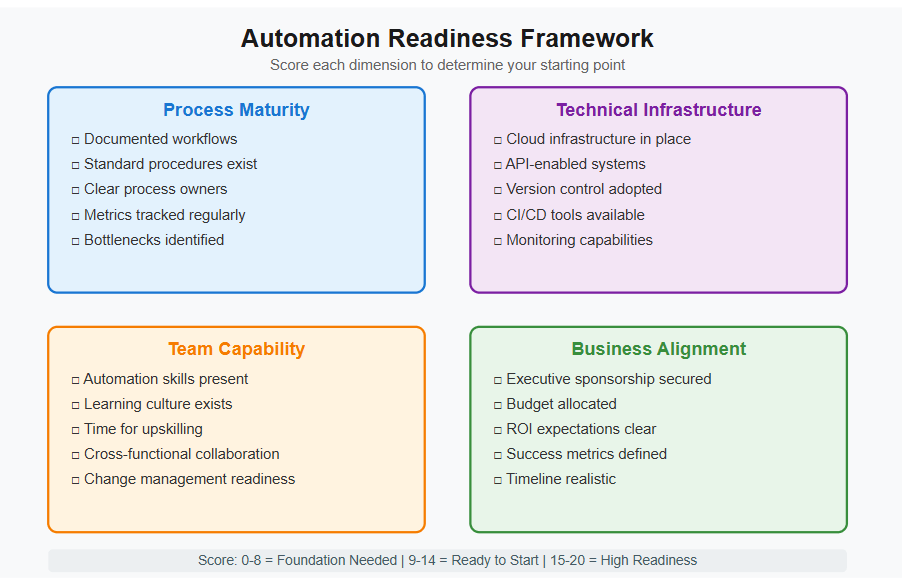
Before jumping into implementation, assess your organization's automation readiness across four dimensions. This framework helps you understand where you're starting from and what foundation work might be necessary before launching automation initiatives.
Evaluate your Process Maturity by examining whether your current workflows are documented and understood. If critical processes exist only in people's heads, automation becomes significantly harder. Look at whether you have standard operating procedures, clear ownership for each process, regular tracking of process metrics, and identified bottlenecks. Companies scoring low here should invest 2-4 weeks documenting processes before automating them.
Your Technical Infrastructure readiness determines which automation approaches are feasible. Cloud-native infrastructure enables faster automation deployment than on-premise systems. API-enabled applications integrate more easily than legacy systems requiring custom connectors. If you're still manually deploying code or lack version control, foundational DevOps practices should precede complex automation initiatives. Cloud and DevOps Engineering capabilities form the backbone of successful automation strategies, enabling infrastructure-as-code and automated deployment pipelines that reduce manual intervention.
Team Capability assessment focuses on whether your team can maintain and expand automation once implemented. Do you have at least one person with automation experience who can mentor others? Is there protected time for learning new tools and approaches? Does your culture embrace change, or will automation face organizational resistance? Companies with strong technical teams but no automation experience should plan for 20-30% of initial automation effort going toward training and skill development.
Finally, Business Alignment ensures your automation efforts have organizational support and clear success criteria. Executive sponsorship matters less for choosing specific tools and more for sustaining investment through the inevitable challenges of implementation. Clear ROI expectations prevent scope creep and keep efforts focused on business impact rather than technical elegance.
Score yourself honestly across these twenty criteria. A score of 15-20 indicates high readiness for aggressive automation rollout. A score of 9-14 suggests you're ready to start with pilot projects while building capabilities. Below 8 means you need foundation work before automation will deliver ROI.
How to Build an Automation Roadmap: The Five-Phase Framework
Phase 1: Strategic Process Assessment
The foundation of how to build an automation roadmap begins with identifying high-impact automation opportunities. Unlike generic advice to "automate repetitive tasks," effective assessment for small teams requires ruthless prioritization.
Start by mapping workflows that directly impact your business metrics. For a SaaS company, this might be your release pipeline where manual QA, deployment approvals, and post-deployment verification consume 40+ engineering hours per release. For an HR tech platform, it could be client onboarding workflows where manual data entry, account provisioning, and configuration steps delay time-to-value.
Focus your initial assessment on three categories of processes. First, engineering workflow bottlenecks such as manual testing procedures, deployment processes requiring multiple approvals, incident response workflows dependent on manual escalation, and code review processes with inconsistent tooling. Second, cross-functional operations including customer onboarding requiring coordination across teams, reporting and analytics pulled manually from multiple systems, compliance documentation assembled from disparate sources, and vendor management with manual status tracking. Third, business-critical but manual tasks like invoice processing and payment reconciliation, customer data synchronization across platforms, security audit preparation, and backup verification procedures.
The assessment should quantify both time cost and error rate. A manual QA process consuming 20 hours weekly represents $4,000-6,000 monthly in engineering cost at mid-market rates. If it also introduces defects that escape to production 15% of the time, the downstream cost multiplies significantly.
Phase 2: ROI-Driven Prioritization
Effective automation planning for small teams requires a clear-eyed evaluation of which processes deliver maximum return for minimum implementation effort. The goal isn't comprehensive automation it's strategic automation that moves business needles.
Calculate the automation ROI for small engineering teams using three factors. Implementation cost includes tool licensing, engineering time for setup and testing, and training for team members who'll maintain the automation. Ongoing maintenance covers monitoring, updates when systems change,and troubleshooting when automations break. Expected return encompasses time saved per cycle, error reduction value, and secondary benefits like faster feature deployment or improved compliance.
For mid-market companies, quick wins in the first 90 days are critical for building organizational buy-in. A CI/CD pipeline automation that reduces deployment time from 3 hours to 15 minutes delivers visible, measurable impact immediately. An automated incident response workflow that routes alerts, creates tickets, and notifies stakeholders based on severity saves 10-15 hours monthly while improving mean-time-to-resolution.
Industry-specific prioritization matters significantly. Healthcare platforms must prioritize HIPAA compliance automations automated audit logging, access control verification, and data encryption checks. Fintech companies benefit from automated reconciliation workflows, fraud detection rules, and regulatory reporting. HR tech platforms should focus on client data migration automation, user provisioning workflows, and automated compliance documentation.
Phase 3: Tool Selection for Limited Capacity Teams
The right automation tools for teams with low capacity balance power with accessibility. Your selection criteria should prioritize platforms that don't require dedicated automation specialists to maintain.
For workflow automation connecting SaaS tools, platforms like Zapier and Make enable non-engineers to build and maintain integrations. A marketing operations manager can automate lead routing from your CRM to your product without engineering involvement. For engineering-focused automation, GitHub Actions, GitLab CI/CD, and Jenkins provide CI/CD capabilities that integrate with your existing development workflow. For cloud infrastructure automation, Terraform and AWS CloudFormation enable infrastructure-as-code without requiring dedicated DevOps engineers.
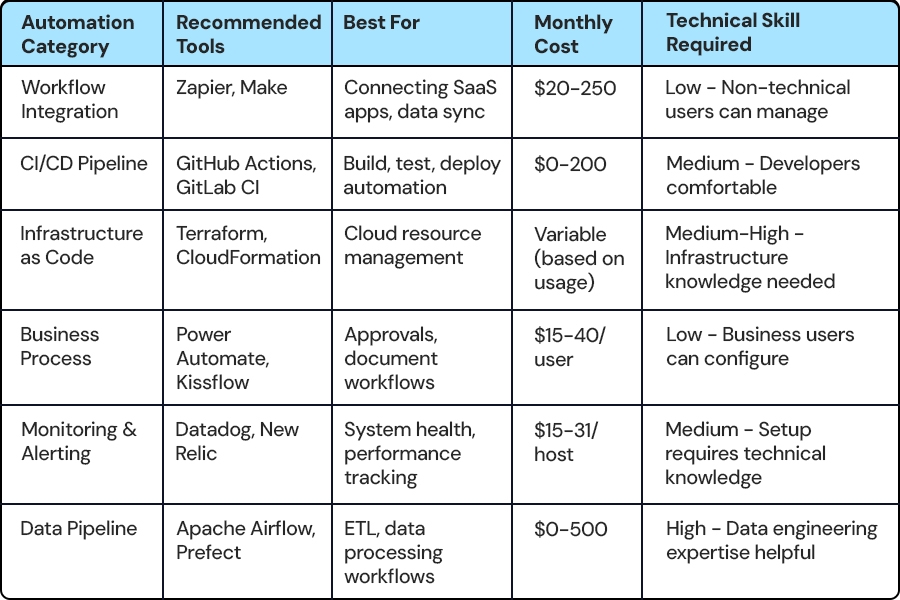
Consider a practical tool selection framework. For simple integrations connecting 2-3 applications with straightforward logic, use Zapier or Make with monthly costs of $20-100. For engineering workflow automation including CI/CD, testing automation, and deployment pipelines, implement GitHub Actions or GitLab CI/CD with costs of $0-200 monthly depending on usage. For infrastructure automation managing AWS, Azure, or GCP resources with code, deploy Terraform or CloudFormation with costs tied to infrastructure usage. For business process automation involving approval workflows, document generation, and multi-step business logic, consider Power Automate or Kissflow at $15-40 per user monthly.
A typical implementation for a 50-person mid-market company might include GitHub Actions for CI/CD ($50/month), Zapier for SaaS integrations ($250/month), and Terraform for infrastructure management (no direct cost), delivering comprehensive automation coverage for under $300 monthly in tooling costs.
Phase 4: Phased Implementation Without Disruption
Scaling automation with limited resources requires a deliberate rollout approach that minimizes risk while building organizational confidence in automated systems.
Begin with a pilot automation targeting a well-understood, high-visibility process. Your first automation shouldn't be your most complex problem it should be your best teaching opportunity. A successful pilot demonstrates value, builds team skills, and identifies organizational readiness for broader automation.
For example, a software development team might pilot CI/CD automation for a single repository, automating build, test, and deployment for one application while maintaining manual processes for others. This approach allows the team to refine automation patterns, identify edge cases, and build confidence before expanding to additional repositories. Many companies find that eliminating manual bottlenecks with CI/CD delivers immediate productivity gains while teaching the team automation principles applicable to other workflows.
The expansion phase should follow clear success criteria from the pilot. If your initial CI/CD automation reduced deployment time by 70% and eliminated configuration-related production issues, expand it to three more repositories in phase two. Document lessons learned, refine your automation patterns, and train additional team members.
A practical automation roadmap template 2026 phased schedule might look like this:
Q1 2026 - Foundation & Pilot
Map and document top 10 automation opportunities
Calculate ROI for each opportunity
Select automation platform and complete initial setup
Implement pilot automation for highest-ROI process
Measure and document pilot results
Q2 2026 - Expansion
Expand successful pilot automation to 3-5 additional workflows
Implement second automation category (e.g., add infrastructure automation if pilot was CI/CD)
Train 3-5 team members on automation maintenance
Document automation architecture and troubleshooting procedures
Q3 2026 - Optimization
Refine existing automations based on performance data
Implement third automation category
Establish automation governance framework
Create automation runbooks for common scenarios
Q4 2026 - Maturity & Scale
Expand automation coverage to 70%+ of identified opportunities
Implement monitoring and alerting for all critical automations
Conduct ROI analysis and present business case for continued investment
Plan 2027 automation roadmap based on results
Phase 5: Governance Without Bureaucracy
Automation governance for small teams must balance control with agility. Your goal isn't to create approval bottlenecks it's to ensure automations remain maintainable, secure, and aligned with business objectives.
Establish clear ownership for each automated workflow. Every automation should have a primary owner responsible for monitoring, maintenance, and troubleshooting, plus a backup owner who can step in when needed. This doesn't require dedicated roles your lead engineer might own CI/CD automation while your senior developer owns integration workflows.
Implement lightweight monitoring that alerts on automation failures without creating noise. A Slack channel receiving notifications when automations fail, a weekly dashboard reviewing automation performance and error rates, and monthly reviews of automation ROI and optimization opportunities provide sufficient governance for most small teams.
Documentation should be practical, not comprehensive. Each automation needs a purpose statement explaining what it does and why, a dependency map showing what systems it connects, runbook procedures for common troubleshooting scenarios, and contact information for the primary and backup owners.
Industry-Specific Automation Roadmaps
Healthcare Platform Automation
Healthcare companies face unique automation priorities driven by HIPAA compliance and patient data security. Your automation strategy for 2026 should prioritize automated audit logging capturing every access to protected health information, automated access reviews identifying inactive accounts or excessive permissions, automated encryption verification ensuring data at rest and in transit meets requirements, and automated incident response for potential security events.
A healthcare platform with 25 employees might implement automated HIPAA audit reporting saving 30 hours monthly in compliance documentation, automated patient data backup and verification reducing data loss risk, and automated access provisioning and deprovisioning reducing unauthorized access risk. The ROI includes both time savings and risk mitigation a single HIPAA violation can cost $100,000-$1.5M, making compliance automation extraordinarily valuable. Companies building secure, compliant products often integrate automation early in their development lifecycle to ensure regulatory requirements are met from day one.
HR Tech Platform Automation
HR technology companies benefit significantly from client onboarding automation. The typical manual onboarding process requires 20-40 hours per client, involving data migration, account configuration, user provisioning, and testing.
Automation opportunities include automated data migration from client legacy systems, automated account and workspace provisioning based on contract terms, automated user creation and permission assignment, and automated testing and validation before handoff. A well-executed onboarding automation reduces implementation time from 30 hours to 8 hours, enabling your team to handle 3x more client implementations without adding headcount. HR tech products that prioritize compliance and scalability through automation gain significant competitive advantages in time-to-value and customer satisfaction.
Fintech Automation Priorities
Financial services companies must balance automation efficiency with regulatory requirements and audit trails. Priority automations include automated reconciliation comparing transaction records across systems, automated fraud detection rules analyzing transaction patterns, automated regulatory reporting generating required documentation, and automated compliance checks validating transactions against rules.
A fintech startup with limited engineering capacity might implement automated daily reconciliation saving 10 hours weekly, automated suspicious activity detection reducing fraud losses by 40%, and automated regulatory report generation saving 20 hours monthly during reporting periods. The combined impact delivers $8,000-12,000 monthly in time savings while reducing compliance and fraud risk. Fintech companies that accelerate both compliance and growth through strategic automation often see faster paths to profitability and market expansion.
Measuring Automation ROI: Metrics That Matter
Generic automation metrics like "tasks automated" or "automation coverage" provide limited insight for resource-constrained teams. Focus instead on business impact metrics that justify continued investment.
Track engineering capacity recovery by measuring hours saved per week from automated processes, percentage of engineering time redirected to feature development, and reduction in after-hours incident response. A successful automation initiative should show 15-25% of engineering capacity recovered within six months.
Monitor operational efficiency improvements including deployment frequency increase, mean time to recovery decrease, defect escape rate reduction, and manual error elimination. These metrics demonstrate automation's impact on product quality and velocity.
Calculate financial impact through direct cost savings from reduced manual effort, indirect savings from error prevention and faster incident resolution, and revenue impact from accelerated feature delivery. A mid-market SaaS company automating key workflows typically sees $40,000-80,000 in annual cost savings from a 15-person engineering team.
Common Automation Roadmap Pitfalls to Avoid
Over-Automation Before Foundation
Teams with limited capacity often attempt to automate too many processes simultaneously, spreading implementation efforts too thin and creating multiple partially-functional automations that require constant troubleshooting. This approach delivers negative ROI as maintenance burden exceeds benefits.
Focus on completely automating 2-3 high-impact workflows rather than partially automating 10. A fully automated CI/CD pipeline delivering reliable deployments 100 times over six months provides more value than five half-built automations requiring manual intervention.
Ignoring Maintenance Burden
Every automation requires ongoing maintenance. APIs change, systems evolve, business requirements shift. An automation that saves 10 hours weekly but requires 5 hours of monthly troubleshooting provides less net benefit than a simpler automation saving 7 hours weekly with minimal maintenance.
When evaluating automation opportunities, factor maintenance burden into ROI calculations. Complex integrations between frequently-updated systems may not justify their implementation cost for small teams.
Automation Without Training
Automations that only one person understands create bottlenecks and single points of failure. If your lead engineer builds sophisticated automation workflows but doesn't train others on maintenance and troubleshooting, you've simply shifted dependency from manual processes to that individual.
Invest 20% of implementation time in documentation and knowledge transfer. Every automation should have at least two people who can troubleshoot and modify it.
Partnering for Acceleration: When to Consider Product Engineering Services
For many mid-market companies, accelerating automation roadmap implementation through product engineering services delivers faster ROI than pure internal development. This approach makes sense when you need specialized automation expertise your team lacks, face aggressive timelines for automation implementation, want to free internal engineering for product development, or require architecture design for scalable automation.
A product engineering services partnership typically provides automation architecture design based on your specific systems and processes, implementation of priority automations with knowledge transfer to your team, training for your engineers on automation maintenance and expansion, and ongoing support for complex automation scenarios. This model enables faster automation rollout while building internal capabilities, with most engagements showing ROI within 4-6 months through accelerated implementation and reduced trial-and-error.
Organizations working with experienced partners benefit from Product Strategy & Consulting that aligns automation initiatives with broader business goals, ensuring technology investments support market positioning and competitive differentiation. When automation roadmaps require new capabilities or system rebuilds, Software Product Development expertise helps teams build scalable, maintainable solutions rather than technical debt. For companies starting from concepts or early prototypes, Product Design and Prototyping services can validate automation approaches before full implementation, reducing wasted effort on solutions that don't fit actual workflows.
Your 2026 Automation Roadmap: Next Steps
Building an effective automation roadmap for teams with limited engineering capacity requires focus, pragmatism, and commitment to measurable outcomes. The companies that succeed in 2026 won't be those with the most comprehensive automation they'll be those with strategic automation aligned to business priorities and executed within resource constraints.
Start this week by identifying your top three automation opportunities based on time consumption, error rates, and business impact. Calculate rough ROI for each opportunity considering implementation cost and expected return. Select one pilot automation to implement in the next 30 days and establish success metrics before beginning implementation.
The journey from manual processes to strategic automation isn't instantaneous, but with the right automation roadmap steps, even small teams can achieve transformational results. Your competitive advantage in 2026 won't come from having unlimited engineering resources it will come from using the resources you have with maximum strategic impact.
Plan Your 2026 Automation Roadmap.