

 Updated on 17 June 2026

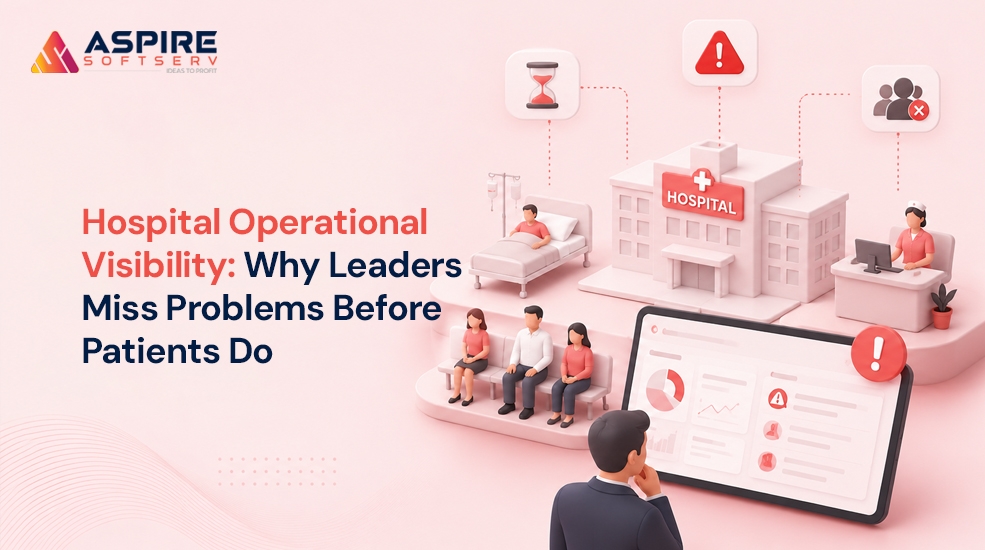
Healthcare operational efficiency is the gap most hospital leaders don't see until patients already feel it. Across fragmented workflows, delayed data, and disconnected systems, hospitals generate enough information to detect problems early but most organizations still struggle to convert that data into timely action. The cost shows up in wait times, staff overload, discharge delays, and declining patient satisfaction scores.
Who Should Read This
This article is for:
Hospital Operations Leaders and Administrators
Healthcare CIOs and CTOs
Digital Transformation Teams
Healthcare Product Owners and Leaders
Multi-location Healthcare Providers
If your organization struggles with patient flow, long wait times, discharge delays, or operational visibility, this guide will help you identify the root causes and the right solutions.
The Visibility Gap in Healthcare
Hospital operational efficiency is not just an administrative goal it is directly tied to clinical experience and throughput. A leader may review monthly reports showing admissions, average length of stay, or billing turnaround time, but those metrics rarely reveal where a breakdown is forming in real time. The result is reactive management instead of proactive intervention, and patients feel it through longer waits, repeated paperwork, and poor communication.
| Operational Layer | What Leaders Often See | What Actually Happens | Patient Impact |
|---|---|---|---|
| Front Desk | Registration completed | Queue buildup, missing documents | Longer waiting time |
| Triage | Average triage time | Bottlenecks during peak hours | Delayed clinical attention |
| Bed Management | Occupancy rate | Bed turnover delays | ED crowding, admission delays |
| Diagnostics | Test turnaround time | Sample handoff delays | Slower diagnosis |
| Discharge | Discharge count | Pending approvals, billing lag | Late discharge, poor satisfaction |
7 Signs Your Hospital Has an Operational Visibility Problem
Before solving the problem, leaders need to recognize it. These are the clearest indicators that operational blind spots exist:
Patient complaints are increasing despite stable staffing levels
Emergency department wait times vary significantly by shift or day
Leaders rely on weekly or monthly reports instead of live operational data
Bed occupancy is tracked but bed turnover is not
Staff spend hours manually coordinating between departments
Discharge delays consistently affect new admission capacity
Operational issues are only discovered after patient escalation
If three or more of these sound familiar, the hospital is managing through hindsight rather than foresight.
What Operational Blind Spots Cost Hospitals
Decision-makers care about outcomes and costs. Operational visibility gaps directly affect both. When workflows run on delayed data and manual coordination, the compounding effect touches every layer of the hospital:
Increased patient wait times and declining satisfaction scores
Higher overtime costs due to unplanned staffing adjustments
Lost appointment capacity from scheduling misalignment
Delayed reimbursements caused by billing and discharge friction
Lower staff productivity from repetitive manual handoffs
Compliance exposure from undocumented operational exceptions
Research from the American Hospital Association consistently identifies care coordination gaps and delayed data as leading drivers of avoidable operational costs in acute care settings. The compounding effect means that even small delays addressed early can prevent significant downstream loss.
Example: How a Small Registration Delay Creates Hospital-Wide Congestion
Consider a hypothetical but realistic scenario: a hospital handling 300 outpatient visits per day a common volume for a mid-sized urban facility experiences an average registration delay of five minutes per patient. What appears to be a front-desk inconvenience quickly becomes a hospital-wide operational bottleneck:
Triage queues grow as patients arrive faster than they are processed
Doctor consultations run behind schedule from the first hour
Diagnostic orders stack up before the afternoon shift begins
Discharge processing shifts later, blocking incoming admissions
Patient satisfaction scores fall across every department
This is how healthcare operational challenges compound. The root cause is rarely where the pain is most visible and without healthcare operational visibility, leaders keep solving the symptom instead of the source.
Patient Flow as the Pressure Point
Patient flow management is the clearest indicator of whether a hospital is operating smoothly or approaching breakdown. It is not a single process it is a chain of transitions that depends on timely coordination between people, systems, and resources. When one step slows, the impact travels across the entire care journey.
Common failure points in patient flow:
Registration bottlenecks caused by manual verification or incomplete records
Triage delays from inconsistent prioritization or staffing mismatch
Diagnostic delays from batch processing or poor order routing
Bed allocation delays from lack of live occupancy data
Discharge delays from disconnected billing, pharmacy, and physician workflows
Hospitals that lack real-time operational visibility typically discover these issues through complaints or emergency escalations by which point the operational problem has already become a patient experience problem.
Why Off-The-Shelf Hospital Software Often Fails
When hospitals face operational visibility gaps, the instinct is often to buy another software tool. But generic healthcare software is rarely built to match how a specific hospital actually operates and that mismatch is where visibility breaks down again.
Common limitations of off-the-shelf solutions include:
Limited workflow customization that forces teams to adapt processes to the tool rather than the reverse
Difficult EHR integrations that create data silos instead of eliminating them
Poor cross-department visibility because the tool was designed for one function, not the end-to-end patient journey
Lack of real-time operational analytics beyond basic reporting
Vendor lock-in that prevents integration with existing systems
This is precisely why healthcare operations management increasingly requires a product engineering services partner rather than a software vendor. The difference is fundamental: a software vendor delivers a product; a product engineering partner designs, builds, and evolves a solution around how the organization works.
As a product engineering partner with experience across healthcare organizations in the US, UK, and Middle East, AspireSoftServ builds these platforms with compliance, EHR interoperability, and AI-readiness as core requirements not additions. With a global delivery model and deep expertise across AI/ML, cloud infrastructure, and healthcare-specific regulatory environments, Aspire brings the combination of technical depth and domain experience that generic vendors cannot replicate.
How Product Engineering Solves Healthcare Visibility Challenges
A modern healthcare platform development approach is built around business outcomes first, services second:
Product Strategy & Consulting: Designing patient flow systems that identify bottlenecks before they impact care delivery. This means mapping the full patient journey, finding friction points, and building the operational architecture before development begins.
Product Design and Prototyping: Creating intuitive operational dashboards and staff-facing interfaces that reflect how clinical and administrative teams actually work not how software vendors assume they work.
Software Product Development: Building appointment platforms, queue management systems, patient engagement portals, and hospital workflow applications that integrate with existing EHR and ERP environments without disruption.
Cloud and DevOps Engineering: Deploying scalable operational platforms that provide real-time visibility across departments, with CI/CD pipelines, automated monitoring, and the uptime reliability that mission-critical hospital environments require.
This combination is what separates point solutions from durable digital product engineering that grows with the hospital's operational needs.
Healthcare Platforms That Improve Operational Visibility
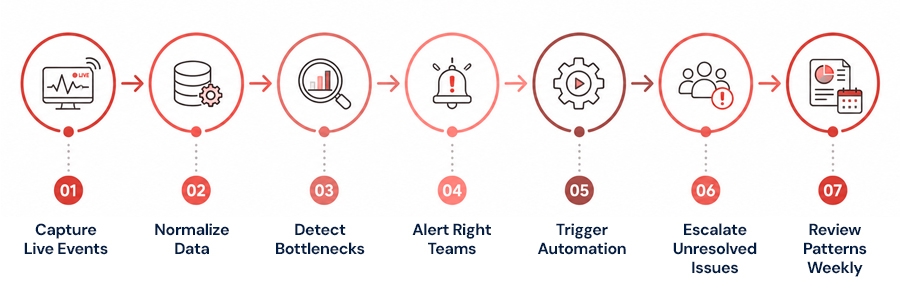
Effective healthcare operations management relies on purpose-built platforms that connect clinical and operational layers. Examples of platforms that deliver measurable visibility include:
Doctor Appointment and Scheduling Platforms
Hospital Queue Management Systems
Patient Flow Optimization Platforms
Clinical Analytics Dashboards
Patient Engagement Applications
AI-Powered Operational Monitoring Tools
Each of these directly supports hospital workflow management by giving frontline teams and leadership a shared real-time view of what is happening and where intervention is needed.
Example: Reducing Patient Wait Times Through Operational Visibility
A mid-sized healthcare provider was experiencing average patient waiting times exceeding 45 minutes, persistent discharge delays, and a manual queue tracking process that relied on staff phone calls and whiteboards. Operational data existed across three separate systems that were never connected.
After implementing automated workflow alerts, a centralized queue management layer, and live operational dashboards through a product engineering engagement:
Patient processing time dropped by approximately 30–35% across registration, triage, and discharge
Discharge delays reduced as billing, pharmacy, and physician workflows were connected on a single trigger-based system
Staff coordination improved because exceptions became visible automatically rather than through escalation
Leadership gained a real-time operational view across all departments for the first time
What made the difference was not a new software subscription it was a purpose-built healthcare product development engagement that designed the solution around the hospital's actual workflows, integrations, and compliance requirements.
Healthcare Workflow Automation: Where Timing Changes Everything
Healthcare workflow automation reduces manual handoffs, standardizes task execution, and surfaces delays automatically. It does not replace clinical judgment it removes administrative friction that slows care delivery. The biggest advantage is timing. Automation makes exceptions visible as they happen instead of waiting for manual reporting, which is critical in busy emergency departments, outpatient facilities, and diagnostic centers where minutes matter.
| Workflow Area | Manual Method | Automated Method | Operational Benefit |
|---|---|---|---|
| Registration | Repeated data entry | Pre-filled digital intake and verification | Faster check-in |
| Triage | Staff calls and manual queues | Priority-based routing and alerts | Better response time |
| Diagnostics | Phone follow-ups, batch checks | Automated order and result notifications | Reduced turnaround |
| Bed Management | Spreadsheet tracking | Live occupancy and discharge triggers | Faster bed turnover |
| Discharge | Manual checklist coordination | Rule-based discharge workflow | Earlier patient exit |
Healthcare Data Analytics: From Reporting to Prediction
Hospitals do not just need reporting they need prediction. With healthcare data analytics, leaders can identify patterns such as increasing queue lengths, repeated order delays, or unusually long discharge cycles before those patterns affect patient satisfaction. The best-performing organizations combine data from EHR systems, scheduling tools, patient portals, bed management tools, and service queues into a single operational view. They apply threshold rules, anomaly detection, and machine learning models to anticipate congestion rather than react to it.
This is where predictive analytics in healthcare operations becomes a genuine competitive advantage particularly as cloud-native healthcare applications make real-time data pipelines more accessible than they were even a few years ago. If outpatient appointments are consistently overbooked on Monday mornings, the system identifies that pattern and recommends schedule adjustments before the problem repeats. This creates a continuous improvement loop that compounds over time.
Operational Maturity Roadmap
The path to better performance through healthcare workflow optimization is incremental. Hospitals do not need to replace everything at once they need a phased plan that builds visibility first, then control, then prediction.
Map the highest-friction workflows registration, triage, diagnostics, bed management, and discharge
Identify where delays are discovered too late and where data is still manual or siloed
Introduce live dashboards and exception alerts for the most critical bottlenecks
Automate repeatable tasks and approval steps using healthcare process automation
Add analytics models to predict queues, occupancy spikes, and discharge delays
Connect operational insights to leadership reviews and continuous process redesign
This roadmap is most effective when supported by product engineering solutions that integrate with existing hospital systems rather than forcing disruptive replacement. AI in healthcare operations accelerates each phase by reducing the manual effort required to monitor, interpret, and act on operational signals.
Strategic Outcomes
When hospitals improve visibility before patients feel the impact, measurable outcomes follow across every layer of the organization.
| Management Focus | Traditional Approach | Modern Approach |
|---|---|---|
| Monitoring | Monthly or weekly reports | Live operational signals |
| Response | Manual escalation | Automated alerts and routing |
| Optimization | Department-specific fixes | End-to-end patient journey redesign |
| Planning | Historical averages | Predictive capacity management |
| Ownership | Siloed accountability | Shared operational governance |
Wait times decrease, staff coordination improves, discharge cycles shorten, and leadership gains confidence in operational decisions. Over time, these gains improve financial performance because better flow means better resource utilization and fewer emergency escalations. The real goal is not just efficiency it is creating a system where problems are visible early enough to act on them.
Final Perspective
Healthcare leaders struggle to see operational problems early because their systems are fragmented, their data is delayed, and their workflows depend too heavily on manual coordination. Generic software rarely solves this because it cannot adapt to how each organization actually operates. Once leaders connect live operations, automate common processes, and apply healthcare analytics solutions through a purposeful digital product engineering approach, they move from reactive firefighting to proactive control.
Healthcare operational efficiency should be treated as a design problem, a data problem, and a technology problem at the same time. Hospitals that invest in better operational visibility now through strategic healthcare product development and engineering will improve both patient trust and long-term resilience.
AspireSoftServ works with healthcare organizations across the US, UK, and Middle East to design and build platforms that connect clinical and operational systems from patient flow applications and queue management tools to AI-powered dashboards and EHR integrations.
Improve Hospital Visibility With Expert Engineering