

 Updated on 30 April 2026

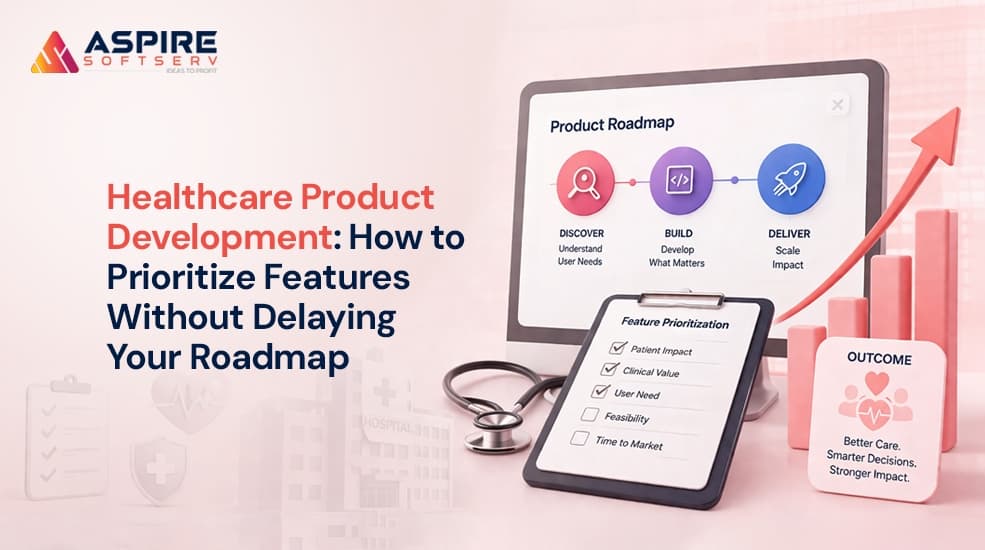
What is feature prioritization in healthcare products?
Feature prioritization in healthcare products is the process of ranking product features based on patient impact, operational efficiency, US compliance requirements (HIPAA, FHIR, CMS), and engineering effort to ensure the right things get built in the right order, without delaying releases or burning budget.
Who This Is For
CTOs and engineering leaders managing healthcare app development or complex SaaS platforms in the US market
Product managers handling competing stakeholder priorities across clinical and operational teams
Founders scaling digital health product development from pilot to enterprise, navigating HIPAA compliance and EMR integrations for the first time
This challenge is equally common across healthcare, HCM platforms, and other complex digital products where user experience and backend efficiency are both business-critical not optional.
What Each Stakeholder Actually Cares About
Before any prioritization framework works, alignment has to exist across the room. In healthcare product decisions, misalignment between stakeholders is often the root cause of roadmap gridlock not the backlog itself.
| Role | Primary Priority | Prioritization Signal |
|---|---|---|
| CTO | Architecture scalability and technical debt | Can we build this without breaking what's live? |
| CFO | Cost reduction and ROI clarity | What's the financial risk if this slips? |
| Product Leader | Feature velocity and user adoption | Are we building what users actually need? |
| Clinical Staff | Usability and workflow fit | Does this make my job easier or harder? |
| Compliance / Legal | HIPAA, FHIR, FDA readiness | Are we protected before this goes live? |
When each stakeholder sees prioritization through their own lens without a shared framework, the loudest voice wins. That's not a prioritization strategy it's a risk.
Why Healthcare Product Roadmaps Fail
Most healthcare product design challenges don't start in the code. They start in the conference room, when a clinical director wants a patient portal redesign, a CFO wants cost-reduction automation, and your engineering lead is already stretched thin across two sprints.
The result? A bloated backlog with no clear north star.
Healthcare software development in the US operates under constraints most other industries don't face. HIPAA compliance, HL7/FHIR interoperability standards, payer-provider data structures, insurance-driven workflows, and CMS reporting requirements all create a technical environment where a single poorly sequenced decision can trigger a cascade of rework, compliance gaps, and delayed releases.
What makes digital health product development uniquely difficult is dual accountability: you're responsible for outcomes that matter to patients and metrics that matter to operations. Neither can be ignored. Neither can be fully separated from the compliance and integration constraints that govern both.
The Real Trade-Off: Patient Experience vs Operational Efficiency
Patient experience in healthcare technology is about designing for the person receiving care intuitive appointment booking, seamless telemedicine flows, medication reminders, and empathetic interfaces that reduce anxiety during vulnerable moments. Research from HIMSS consistently shows products prioritizing usability see 20–30% improvements in patient adherence.
Healthcare workflow automation, on the other hand, targets the system behind the care scheduling algorithms, inventory tracking, billing integrations, and queue management. Gartner data suggests these operational improvements reduce costs by 15–25%, often within the first two quarters of deployment.
How to balance patient experience and operational efficiency is ultimately a sequencing problem, not a binary choice. The best healthcare product teams don't pick a side they build a prioritization system that lets the right features win at the right time, informed by data rather than stakeholder volume.
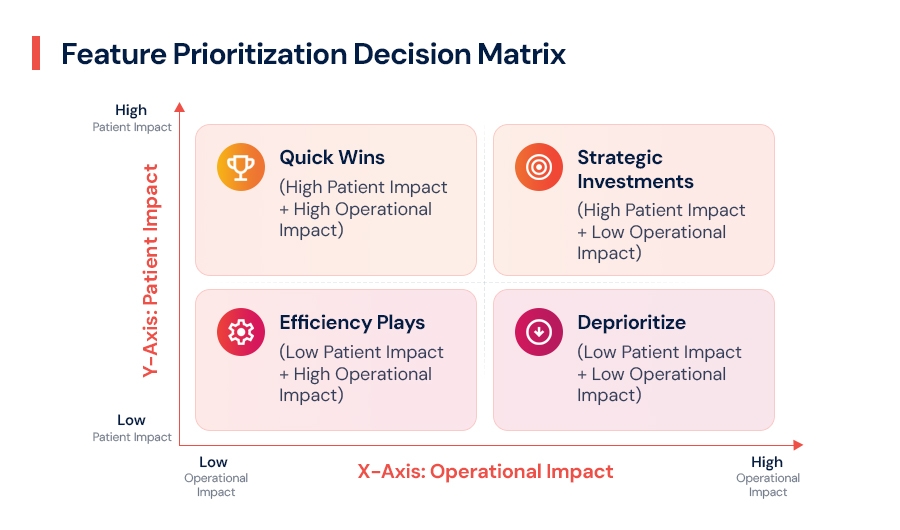
How to Prioritize Features in Healthcare Apps: Step-by-Step
Step 1 Gather Requirements From the Right Stakeholders
For patient centric healthcare software design, you need input from three groups simultaneously: patients or caregivers, frontline clinical staff, and operations and admin teams. Run structured discovery sessions with each group separately, then bring findings together for cross-functional review.
Categorize every feature request into one of three buckets: patient-centric, operations-centric, or hybrid. This categorization is the foundation of sound Product Strategy & Consulting it forces honest conversations about who you're building for before a single sprint is planned.
Key inputs to collect:
Patient satisfaction scores and drop-off points in current workflows
Clinical staff time-on-task data for key processes
Support ticket volume by feature area
US regulatory deadlines HIPAA audit timelines, CMS compliance windows, FHIR mandate dates
Step 2 Score Features Using the RICE Framework for Healthcare
The RICE framework (Reach, Impact, Confidence, Effort) forces quantification before debate. In healthcare product roadmap prioritization, weight the Impact dimension across two KPIs simultaneously: patient NPS contribution (40%) and operational savings potential (60%).
RICE Scoring Example:
| Feature | Reach | Impact | Confidence | Effort | RICE Score |
|---|---|---|---|---|---|
| Appointment reminders (patient engagement) | 10,000/mo | 3 | 80% | 2 months | 120 |
| Hospital queue management system | 500/mo | 2 | 90% | 1 month | 90 |
| Telemedicine video integration | 5,000/mo | 3 | 70% | 4 months | 26 |
Features scoring above 80 are your immediate roadmap candidates. Features below 40 should be deferred unless a compliance trigger forces them forward.
Step 3 Choose the Right Prioritization Method for the Situation
Not every prioritization decision calls for the same framework. Using RICE when you need quick stakeholder alignment or MoSCoW when you need data-driven sequencing is a common source of roadmap friction.
Prioritization Methods Comparison:
| Method | Best For | Limitation |
|---|---|---|
| RICE | Data-driven, quantified decisions | Requires reliable usage data |
| MoSCoW | Stakeholder alignment workshops | Can become politically influenced |
| Value vs Effort Matrix | Quick directional prioritization | Less precise for complex features |
| Weighted Scoring | Compliance-heavy environments | Time-intensive to set up |
Step 4 Apply Healthcare-Specific Qualitative Filters
Before any feature reaches your sprint, run it through three qualitative checks:
Compliance gate: Does it require HIPAA review, FDA clearance, HL7/FHIR updates, or EMR system development architecture changes? Add buffer time upfront, not after the fact.
Adoption risk: Is it dependent on behavior change from patients or clinicians? It needs a change management plan alongside the release plan.
Integration complexity: Does it touch payer APIs, insurance systems, or legacy EMRs? High integration complexity routinely triples effort estimates in US healthcare environments.
Common Mistakes in Healthcare Product Prioritization
Understanding what goes wrong is often more useful than another framework. These are the patterns that consistently derail healthcare product development roadmaps in the US market:
Building for stakeholders, not users. The feature a clinical director requests in a steering committee meeting is often not the feature that reduces patient drop-off or clinician time-on-task. Without user validation, you're building based on assumption.
Underestimating compliance as a sequencing constraint. HIPAA reviews, FHIR integration work, and CMS reporting requirements aren't just compliance checkboxes they're timeline variables that should be mapped against every feature before sprint planning begins.
Treating architecture as someone else's problem. Product teams that don't understand their healthcare SaaS architecture constraints make prioritization decisions that look correct on a roadmap and are impossible to execute in engineering. This is the #1 source of sprint spillover.
Prioritizing features before fixing foundational infrastructure. A patient portal redesign built on an unstable scheduling backend will fail regardless of how good the UX is. Operational infrastructure must be sequenced correctly often before patient-facing work delivers its full value.
Skipping DevOps readiness. Teams without mature healthcare DevOps practices CI/CD pipelines, feature flags, proper staging environments can't safely ship at the speed their roadmap assumes. Every release becomes a high-stakes event, which slows everything.
Why Internal Teams Struggle With Prioritization at Scale
Even well-funded product teams hit a wall. The problem usually isn't effort it's structural. Most internal teams weren't built to handle the full scope of healthcare product roadmap prioritization at enterprise scale, particularly in the US market where compliance requirements and payer complexity create a constantly shifting technical environment.
Common failure points:
Limited architecture visibility: Engineers are heads-down in sprints, not thinking about how today's feature decision affects FHIR compliance or multi-tenant scaling in Q4.
No DevOps maturity: Without proper CI/CD pipelines and feature flag infrastructure, every release is a risk which biases teams toward safe, low-impact features.
Lack of AI and data capability: Teams without data science depth can't build the propensity models that make dynamic prioritization possible.
Conflicting stakeholder pressure: Without a neutral framework, the loudest voice in the room wins. That's almost never the right prioritization signal.
This is the gap where structured Product Strategy & Consulting and product engineering services create the most immediate value bringing frameworks and cross-functional experience that internal teams typically take years to develop.
What This Costs If You Get It Wrong
This is the section most product blogs skip and the one that matters most to CFOs, boards, and Series B investors reviewing delivery track records.
Rework costs 3–5x more than getting it right in discovery. A feature built without proper user validation that requires architectural changes post-launch typically consumes 3–5x the original engineering estimate. On a $400K build, that's $1.2M–$2M in avoidable cost.
Engineering inefficiency from poor prioritization inflates spend by 30–50%. Teams spending 40–60% of sprint capacity on fixes rather than new features are effectively running at half productivity. At $150K/month in engineering cost, that's $75K/month wasted or $900K annually.
Delayed enterprise deals compound monthly. US hospital networks and large payer organizations run procurement cycles of 6–12 months. A feature that slips one quarter often means a deal that slips a full fiscal year.
Missed FHIR or HIPAA compliance windows create legal exposure. Non-compliance in US healthcare isn't a roadmap inconvenience it's a regulatory risk that can result in fines starting at $100 per violation, scaling to $1.9M annually per violation category under HIPAA Tier 4.
When Companies Actually Bring in External Product Engineering Partners
The decision to bring in external product engineering services rarely happens proactively. It almost always happens after one of these triggers:
After missed deadlines that have affected enterprise customer relationships or investor confidence
Before Series B scaling, when the architecture built for an MVP needs to support a multi-tenant, enterprise-grade platform
During enterprise deal pressure, when a health system or large payer is conditionally committed but the product isn't ready
When internal hiring can't keep pace with the technical breadth required architecture, DevOps, AI, QA, and domain expertise simultaneously
When rework has become the default, and leadership realizes the issue isn't execution speed but foundational sequencing
The companies that bring in partners proactively before the crisis consistently see better outcomes. The ones that wait until a deadline has already been missed spend the first engagement fixing what reactive decisions created, rather than building forward.

How Healthcare Companies Actually Build These Products
Building a healthcare platform internally in the US typically takes 12–18 months from discovery to production-ready deployment. The timeline isn't driven by feature complexity alone it's driven by HIPAA compliance reviews, HL7/FHIR integration work, payer API negotiations, EMR vendor coordination, and the QA rigor required before a clinical tool goes live in a health system.
Companies working with specialized product engineering services consistently reduce this timeline by 30–50%. The reason isn't speed for its own sake it's that experienced partners bring pre-built Cloud and DevOps Engineering pipelines, cloud-native architecture patterns, and healthcare domain expertise that internal teams spend the first 6–9 months building from scratch.
Internal Team vs Product Engineering Partner:
| Factor | Internal Team | Product Engineering Partner |
|---|---|---|
| Time to Market | 12–18 months | 6–9 months |
| DevOps Maturity | Often built from scratch | Pre-built CI/CD pipelines |
| HIPAA / FHIR Readiness | Reactive | Embedded from day one |
| Healthcare Domain Expertise | Limited or siloed | Domain-specific and current |
| Cost Efficiency | High long-term overhead | Optimized delivery model |
| AI Integration | Requires separate hiring | Built into engineering workflow |
Technical Strategies That Close the Gap
Building for Patient Experience Without Sacrificing Scale
Patient centric healthcare software design at scale requires an architecture that supports personalization, fast load times, and accessibility all within a compliant data environment satisfying US HIPAA requirements and supporting FHIR-based data exchange with payer and provider systems.
Improving patient experience with technology means thinking beyond UI design. Does your appointment confirmation flow reduce no-shows? Does your medication reminder adapt to a patient's behavior pattern? These are product engineering questions that require Product Design and Prototyping alignment upfront not just design decisions made in a UX sprint.
Automating Operations Without Creating Clinician Burnout
Healthcare process automation tools when designed thoughtfully reduce administrative burden, not clinical judgment. The right healthcare operational efficiency software integrates with existing workflows rather than replacing them. This is where Software Product Development expertise specific to healthcare pays off knowing which integrations are load-bearing and which are optimizations determines how you sequence the build.
A US-based healthcare platform deployed RPA-based workflow automation integrated with their EMR system development environment, connecting scheduling, patient flow, and billing data in a single operational view. The result: a 40% reduction in wait times not by removing staff, but by eliminating manual data entry creating delays upstream across all three systems.
Where AI Changes the Prioritization Game
AI in healthcare products is shifting from a buzzword to a genuine prioritization accelerator. Propensity models trained on historical EHR data now predict which features will see the fastest adoption, allowing product teams to sequence releases based on likely impact rather than gut feel. This is where AI & Data engineering capability becomes a direct competitive advantage in digital health product development.
What This Looks Like in Practice
A US-based digital health company managing a patient engagement platform was experiencing significant drop-off at onboarding. Their backlog had 60+ feature requests, with internal teams split between a redesigned onboarding flow and a new automated scheduling backend.
A hybrid prioritization exercise using RICE scoring and dual KPI weighting revealed that the scheduling backend was causing the friction showing up as onboarding drop-off patients were abandoning because appointment slots weren't updating in real time. The right sequence was operational fix first, experience layer second.
After restructuring the roadmap and rebuilding the scheduling system on a cloud native healthcare applications architecture with FHIR API support, onboarding completion improved by 35% within two sprints without touching the UX at all.
The problem visible in the product was not where the solution lived in the stack. Structured healthcare product development prioritization consistently surfaces this insight before expensive builds begin.
Building Your 12-Month Healthcare Product Roadmap
Healthcare product roadmap prioritization should be quarterly, not annual. US healthcare markets shift quickly CMS policy changes, payer contract structures, and new interoperability mandates can make a locked annual roadmap obsolete by month three.
| Quarter | Patient Features | Ops Features | Milestone |
|---|---|---|---|
| Q1 | Onboarding flow, appointment management | Basic scheduling workflow automation | MVP Launch |
| Q2 | Telemedicine platform features, accessibility | Hospital queue management system | 10K Active Users |
| Q3 | Personalization using AI in healthcare products | Automated billing, FHIR API integrations | HIPAA Certification |
| Q4 | Feedback loops, patient engagement improvements | Full EMR system development integration | Enterprise Sales Readiness |
Roadmap review checklist before each quarterly cycle:
Are the top 5 features aligned to both patient NPS and operational KPIs?
Has each feature cleared the HIPAA and FHIR compliance gate?
Does the engineering estimate account for payer API and EMR integration complexity?
Is there a defined rollback plan for high-risk releases?
Has the team validated assumptions with actual users in the last 30 days?
Quick Recap
Prioritization is a product and engineering decision with direct cost, timeline, and compliance consequences
Balance patient impact and operational impact using quantified frameworks, not stakeholder volume
Apply qualitative filters compliance, adoption risk, integration complexity after RICE scoring, not instead of it
US healthcare context is not optional: HIPAA, HL7/FHIR, payer-provider structures, and CMS timelines are inputs into your roadmap
Fix your Cloud and DevOps Engineering foundation early, or every prioritization decision becomes harder to execute
Recognize when the gap between your roadmap and your delivery capability requires external expertise and don't wait for a missed deadline to make that call
Frequently Asked Questions
How do healthcare companies prioritize product features?
Most effective healthcare product teams use a combination of the RICE framework (Reach, Impact, Confidence, Effort), stakeholder discovery sessions across clinical and operational groups, and compliance-gate filters that account for HIPAA, FHIR, and FDA requirements. The key is weighting Impact across both patient NPS and operational savings not optimizing for one at the expense of the other.
What is the RICE framework in healthcare product development?
RICE is a quantitative prioritization model that scores features based on how many users they reach, how much impact they create, how confident the team is in the estimate, and how much engineering effort is required. In healthcare specifically, the Impact score should be weighted against dual KPIs patient experience metrics and operational efficiency savings to reflect the dual accountability of healthcare products.
How do you balance patient experience and operational efficiency in healthcare software?
The most effective approach is sequencing, not balance. Start by identifying which operational bottlenecks are creating the patient experience problems you're seeing often, fixing backend infrastructure delivers patient-facing improvements without a single UX change. Then layer patient experience features on a stable operational foundation. Cleveland Clinic's approach leading with hospital workflow optimization tools before UX investment is a proven example.
What is the biggest mistake in healthcare product development?
Treating compliance as a late-stage checkboxing exercise. US healthcare products that don't account for HIPAA review timelines, FHIR API integration complexity, and CMS reporting requirements in their initial roadmap sequencing consistently run into delays in the final 20% of development when the cost of changes is highest and the pressure to ship is greatest.
When should a healthcare company bring in external product engineering services?
The clearest signals are: repeated sprint spillover with no root cause resolution, enterprise deals contingent on features that keep slipping, architecture limitations preventing scale, or a team that lacks depth across DevOps, AI, compliance, and domain expertise simultaneously. The companies that bring in partners before a deadline crisis consistently outperform those that wait.
How Product Engineering Services Connect to Prioritization
The gap between a well-scored roadmap and a shipped product is a product engineering problem and it's the gap most teams underestimate until they're six months behind.
Product Strategy & Consulting makes prioritization decisions defensible to the board and executable by engineering. Product Design and Prototyping validates assumptions before they become expensive builds. Cloud and DevOps Engineering ensures what you prioritize can be deployed, monitored, and iterated at scale within HIPAA-compliant infrastructure. Software Product Development translates roadmap decisions into working healthcare software that meets clinical, compliance, and user standards simultaneously. AI & Data engineering makes prioritization dynamic rather than static. QA and Sustenance ensures what ships stays stable as your platform scales.
We've worked with US healthcare teams across telehealth, EMR, and payer platforms building HIPAA-compliant products that have reduced delivery timelines by 40% and rework by 60%.
The goal of healthcare product development done right is a product that patients trust, clinicians adopt, and operations can sustain built on an architecture that grows with your business without the technical debt that derails scale.