


 Updated on 28 April 2026

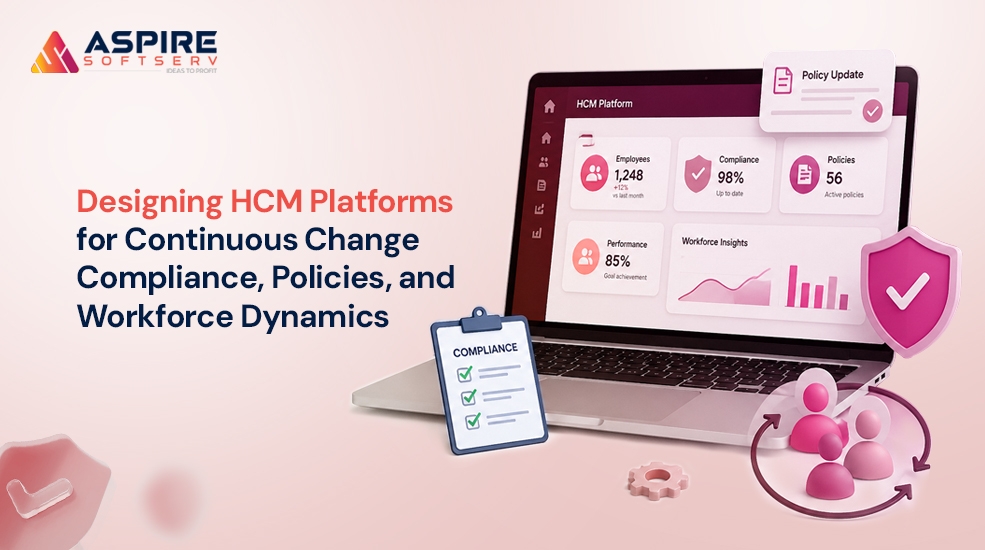
If Your HR Platform Takes Weeks to Adapt, You're Already Paying the Price
Most HR and product leaders don't see the financial exposure until it's too late. The average GDPR violation now costs organizations $4.45 million (IBM Cost of a Data Breach Report 2025). Yet 65% of HR teams still rely on manual, error-prone processes that leave compliance gaps open for months.
Every unacknowledged policy update, every audit conducted manually, every attrition signal missed because your engagement data arrives too late these aren't isolated inefficiencies. They're compounding liabilities.
Most companies only fix this after their first compliance failure. By then, the cost is already 3–5x higher than it would have been at the architecture stage.
This guide is written for CEOs, CTOs, and Product Heads at HR tech companies, SaaS platforms scaling globally, and organizations managing multi-country or multi-location workforces. If your platform struggles with compliance enforcement, policy propagation, or workforce agility what follows will help you decide not just what to fix, but when and how.
The Real Cost of HR Compliance Challenges
HR compliance challenges today aren't about ticking regulatory boxes. They've become strategic liabilities that affect hiring velocity, workforce trust, and operational agility with a measurable price attached to inaction.
The three most critical pressure points organizations face right now:
Regulatory fragmentation across jurisdictions what's compliant in one region may violate local labor law in another, making HR software for multi-location workforce management a non-negotiable architectural requirement
Audit readiness gaps legacy systems cannot generate real-time documentation, leaving organizations scrambling every time an external review is announced
Delayed policy enforcement when remote work policies, DEI mandates, or health protocols change, manual distribution creates a dangerous lag between policy change and workforce acknowledgment
| Compliance Area | Core Challenge | What Modern HCM Must Do |
|---|---|---|
| Data Privacy (GDPR/CCPA) | Consent tracking, data localization | Geo-fenced, encrypted storage with real-time audit trails |
| Labor Laws | Wage/hour rules, overtime tracking | Automated payroll validation and violation alerts |
| DEI & Inclusion | Bias in hiring and promotions | AI-driven fairness monitoring embedded in workflows |
| Health & Safety | Return-to-office and safety mandates | IoT and attendance integration with automated compliance logs |
The answer to these HR compliance challenges isn't more HR headcount. It's smarter architecture. Modern HCM software development decouples compliance logic from core HR workflows using microservices, so each compliance module can be updated, audited, or scaled independently without disrupting the entire system.
If your platform shows even 2 of the compliance gaps above, it's worth evaluating your architecture now. The cost of a proactive review is a fraction of a single regulatory incident.
Building a Smarter HR Policy Management System
An HR policy management system is one of the most consistently underbuilt components in HCM platforms. Most organizations treat it as document storage a place to upload PDFs and send reminder emails. In practice, it's the enforcement backbone of your entire HR operation.
Effective policy management in HR systems built on modern architecture does three things legacy systems cannot:
Maintains version control with rollback capabilities so every policy change is tracked, reversible, and auditable without manual effort
Enforces role-based access automatically contractors see gig economy rules, full-time employees see benefits policies, managers see performance guidelines
Integrates natively with employee management tools so acknowledgments, compliance quizzes, and deadline enforcement are fully automated
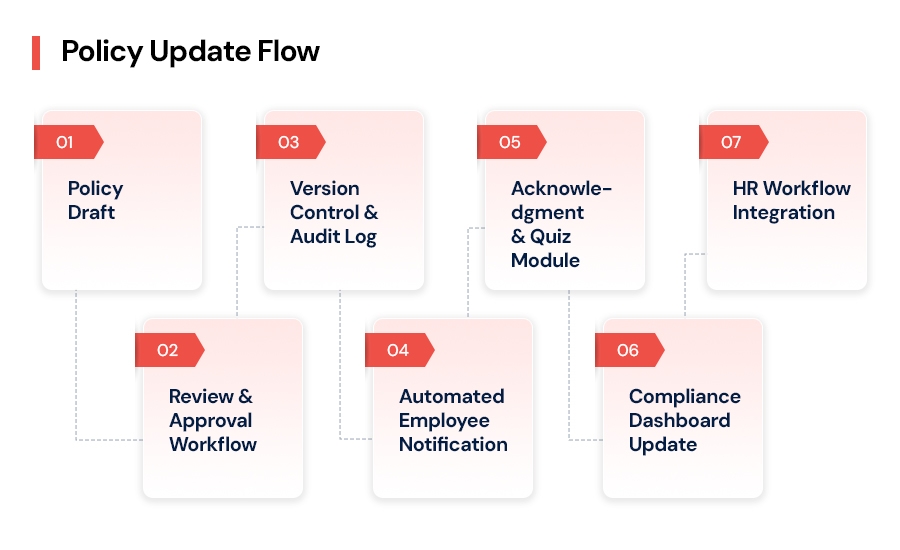
This zero-touch propagation model where a single policy change triggers automated notifications, acknowledgment requests, and dashboard updates is what separates modern HR platform development from systems still dependent on email chains and manual tracking. For enterprises managing multiple business units or geographies, product engineering services can layer configurable workflows on top of this architecture, allowing HR administrators to manage policy rollouts without creating engineering backlogs.
How to Solve Workforce Management Challenges at Scale
Workforce management challenges have intensified since the pandemic reshaped every assumption organizations held about where, when, and how people work. Hybrid models, distributed teams, gig workers, and persistent skills gaps now affect 82% of organizations (Deloitte 2025 Workforce Report).
HR software for workforce management must simultaneously handle scheduling, real-time capacity balancing, skills-based matching, and attrition prediction without manual intervention. The shift in thinking required:
From static scheduling to AI-optimized rostering systems that factor in employee preferences, project timelines, and regional labor constraints simultaneously
From manual coordination to geofenced automation for HR software for multi-location workforce management attendance logged, compliance confirmed, scheduling adjusted based on real-time location signals
From reactive attrition response to predictive intervention using an HR platform with AI for attrition prediction trained on engagement signals, tenure patterns, and performance data flagging at-risk employees 60–90 days before they resign
Manual vs. Automated HCM The Real Difference:
| Approach | Operational Reality | Business Outcome |
|---|---|---|
| Manual HR workflows | Slow, error-prone, compliance gaps | Reactive, costly, high attrition risk |
| Automated HCM platform | Real-time, rule-enforced, scalable | Proactive decisions, lower risk, faster growth |
Cloud and DevOps Engineering practices are what make this work at scale. Deploying workforce management services on auto-scaling cloud infrastructure ensures the system handles peak loads mass onboarding post-acquisition, open enrollment, year-end reviews without performance degradation or emergency IT intervention.
Take the 2-Minute HCM Risk Assessment
Answer these 5 questions to identify your top compliance and scalability risks:
How long does it take to roll out a policy update across your workforce?
Can your system generate audit-ready compliance reports in real time?
Do you have automated alerts for wage, overtime, or regulatory violations?
How easily can your platform adapt to new country-specific regulations?
Are attrition risks and workforce trends visible in real time?
If you answered “No” or “Partially” to 2 or more, your platform likely has hidden architectural risk.
Employee Lifecycle Management: From First Interview to Alumni Network
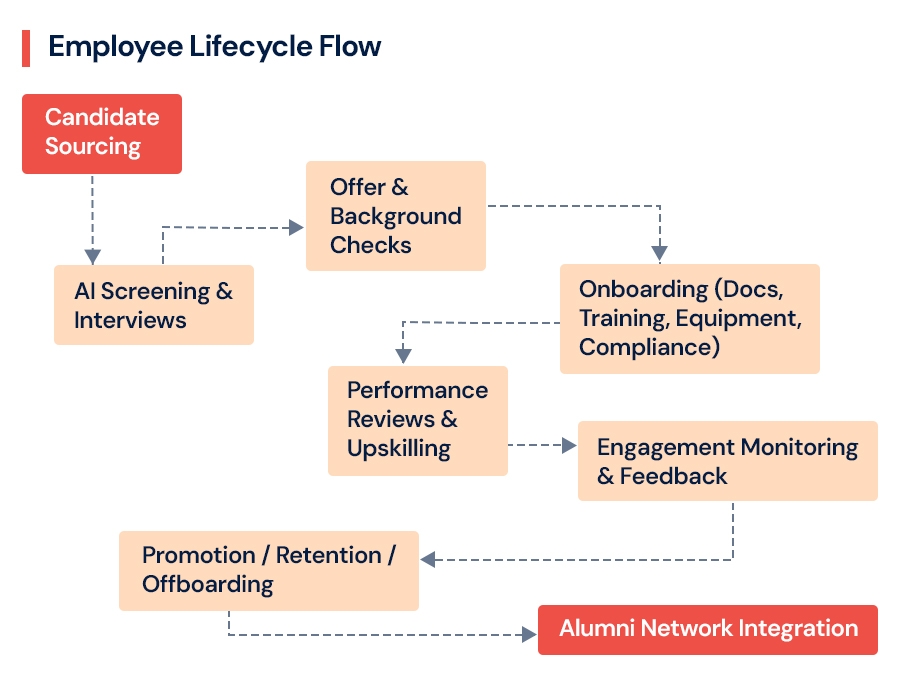
An employee lifecycle management system that works doesn't treat onboarding and offboarding as administrative checkboxes. It treats each stage of the employee journey as a product experience something designed, measured, and continuously improved.
Digitized organizations report employee retention rates of 78% versus 62% at companies still running manual lifecycle processes (Gartner 2025). That gap widens every year as workforce expectations rise. HR software for employee lifecycle management must cover the full journey:
Attraction and hiring AI-assisted resume screening with active bias mitigation built into the evaluation workflow
Onboarding employee onboarding and offboarding software system that automates document signing, equipment provisioning, training assignments, and compliance verification from the moment an offer is accepted
Development personalized learning paths driven by skills gap data surfaced from performance reviews and role progression benchmarks
Engagement monitoring HR system for employee engagement analytics that surfaces actionable insights from pulse surveys, collaboration data, and sentiment signals in real time not quarterly reports that arrive too late
Offboarding secure data archiving, structured exit interviews, and alumni network integration that converts departing employees into long-term brand advocates
Custom HR software development built on event-driven architecture makes this seamless. A single trigger when a new hire enters the system can simultaneously initiate laptop provisioning through IT, a welcome email sequence, a compliance onboarding checklist, and a manager notification no manual coordination required. This is what employee management software development looks like when approached with product engineering discipline rather than assembled from disconnected tools.
HR Automation for Compliance: Making Proactive the New Standard
HR automation for compliance reduces compliance errors by up to 70% and cuts audit preparation time significantly but only when embedded into the product architecture from day one. Added as an afterthought, automation creates integration debt and false confidence.
HR compliance automation software built on workflow engines and rule-based AI can monitor 100% of HR transactions continuously, flagging anomalies before they become violations. The capabilities that deliver the highest ROI:
Automated overtime and wage monitoring that flags violations before payroll closes not after
Predictive compliance scoring that identifies at-risk departments or locations before an audit reveals the problem
Document intelligence for contract analysis, NDA tracking, and acknowledgment verification with near-zero processing errors
Continuous, immutable audit trail generation satisfying both internal governance and external regulatory review requirements
HR workflow automation software brings stateful process management to complex, multi-step compliance workflows background checks, benefits enrollment, I-9 verification allowing them to run in parallel, resume after interruptions, and escalate automatically when human judgment is needed.
| Automation Capability | What It Replaces | Business Impact |
|---|---|---|
| Real-time compliance monitoring | Manual audit preparation | 70% faster audit cycles |
| Document intelligence | Manual review and tracking | Near-zero processing errors |
| Predictive compliance scoring | Reactive violation response | Preempts majority of violations |
| Event-driven onboarding workflows | Manual IT/HR coordination | 40% faster time-to-productivity |
HR automation software development isn't about replacing HR professionals. It's about freeing them from administrative burden so they can focus on the work that actually drives business outcomes workforce planning, culture building, and strategic talent acquisition.
Why This Requires Product Engineering Not Just Development
There's a critical distinction most organizations miss when evaluating HR technology investments: the difference between software development and product engineering.
Software development delivers features. Product engineering services deliver systems that evolve.
For HCM platforms specifically, this distinction determines whether your platform survives its second year or requires a painful, expensive rebuild. Here's what the product engineering approach means in practice:
Architecture-first thinking every feature decision evaluated against its long-term impact on compliance scalability, data integrity, and integration flexibility before a single line of code is written
Cloud + DevOps + AI integrated from day one not added as upgrade packages after the core platform is already locked in and expensive to change
Continuous delivery over project delivery platforms built for ongoing evolution, absorbing regulatory changes, new workforce models, and emerging AI capabilities without full rebuilds
Business outcome orientation every architectural decision mapped to measurable impacts: compliance risk reduction, onboarding speed, attrition rates, audit costs
Software Product Development without this lens produces platforms that work well at launch and deteriorate under real-world change. Product Strategy & Consulting applied before and during development keeps the platform aligned with business goals as those goals evolve.
This is why HR tech leaders at scaling SaaS companies and multi-country organizations consistently find that the lowest-cost path forward isn't the cheapest vendor it's the team that gets the architecture right the first time.
How to Design Scalable HCM Architecture for Compliance-Heavy Organizations
Scalable HR software architecture designed for compliance-heavy environments looks fundamentally different from standard enterprise software. The stakes are higher: data immutability matters for audits, real-time rule enforcement matters for regulatory adherence, and zero-downtime deployment matters because HR systems run continuously across global time zones.
The right foundation for enterprise HR software solutions combines:
Microservices with independent scaling compliance modules, payroll, scheduling, and analytics scale based on actual load, not as a monolithic block that strains under partial demand
Event sourcing for immutable audit trails every state change recorded, queryable, and impossible to retroactively alter critical during regulatory review
Multi-tenant API gateway essential for HR SaaS development where multiple business units or client organizations share infrastructure but require complete data isolation
Embedded AI/ML pipelines HR analytics software development integrated into the platform from day one, not connected through third-party dashboards with their own data latency and integration overhead
HR system development services from an experienced HR system development company should include architectural review at every major milestone not just at kickoff. Regulatory environments change. Business models evolve. The architecture must anticipate that.
Product Design and Prototyping practices applied before development begins validate architectural assumptions with actual users preventing expensive usability gaps discovered post-launch. Cloud and DevOps Engineering ensures that future capabilities integrate cleanly into what already exists without disrupting live operations
Build vs. Modernize vs. Replace: A Decision Framework for HR Leaders
One of the most common and least clearly answered questions HR tech decision-makers face is whether to build a new platform, modernize the existing one, or replace it entirely. The answer depends on three variables: your current architecture's flexibility, the volume of compliance risk exposure, and your growth trajectory over the next 24–36 months.
When modernization is the right move: Your core data model is sound but the application layer is rigid. Compliance modules are manual or disconnected. The platform works for current headcount but shows strain at 1.5–2x scale. In this scenario, a modular modernization adding a compliance automation layer, integrating AI-driven workforce analytics, and migrating to cloud-native infrastructure typically costs 40–60% less than a full rebuild and delivers results within 9–12 months.
When replacement is necessary: The underlying architecture is monolithic with no clean API surface. Data is siloed in ways that make integration prohibitively expensive. The platform was built for a business model that no longer reflects how the organization operates. Attempting to modernize in this context creates compounding technical debt and every quarter of delay increases the complexity of the eventual fix.
When building from scratch makes sense: You're creating a net-new HR SaaS product, entering a new market segment, or the existing platform has zero reusable components worth preserving. Custom HR software development from a clean architectural foundation gives you full control over scalability, compliance design, and AI integration but requires 12–18 months of disciplined product engineering to deliver a production-ready platform.
| Approach | Best For | Timeline | Relative Cost |
|---|---|---|---|
| Modernize existing platform | Sound data model, modular gaps | 6–12 months | Medium |
| Replace with modern platform | Monolithic, high technical debt | 12–18 months | High |
| Build new from scratch | New product, greenfield opportunity | 12–24 months | Highest upfront, lowest long-term |
The organizations that make this decision well do so with an independent architectural assessment not a vendor recommendation shaped by the vendor's own capability set.
Ready to Know Exactly Where Your Platform Stands?
Most organizations don't need a full rebuild. They need an honest expert assessment of where their current system is most vulnerable and a clear, phased path to fix it.
Our team has helped HR tech companies, scaling SaaS platforms, and multi-location workforce organizations cut compliance incidents by over 55%, reduce onboarding time by 40%, and build platforms that grow with their business rather than against it.
The Cost of Waiting: Why Timing Is the Real Risk
This is the section most decision-makers skip and the one that costs them the most.
Organizations that delay HCM modernization don't stand still. They accumulate risk at an accelerating rate:
Delayed compliance fixes mean penalties compound what automated monitoring could have flagged becomes a regulatory incident with fines, legal exposure, and reputational damage that takes quarters to recover from.
Manual workflow debt creates hidden operational costs that don't appear on a single line item but show up in audit preparation hours, rework cycles, payroll corrections, and employee frustration that drives turnover.
Poor architectural decisions made under urgency cost 3–5x more to undo than decisions made correctly from the start and every quarter of delay increases the complexity of the eventual fix.
Talent lost to better-tooled competitors doesn't appear immediately on a P&L, but the compounded cost of turnover recruitment, onboarding, productivity ramp is consistently underestimated
The organizations pulling ahead right now aren't necessarily spending more on HR technology. They made the decision earlier before the pressure forced it.
Real Results: What Modern HR Platform Development Delivers
A Mumbai-based FinTech company approached our team with a platform that had served them well at 500 employees but was failing under the pressure of a 3,000-person hybrid workforce operating across five regulatory jurisdictions.
The problems were clear: a monolithic on-premise system with no real-time compliance monitoring, manual policy distribution that left audit trails incomplete, and an onboarding process that took three weeks when it should have taken three days. The compliance team was spending 60% of its time on audit preparation — time that should have been spent on strategic workforce planning.
The solution wasn't a full rebuild. It was a phased migration to cloud-native HR SaaS development on a modern microservices architecture, with modular capabilities introduced in order of business impact compliance automation first, centralized policy management second, AI-driven workforce analytics third.
Results within 18 months:
55% reduction in compliance incidents through real-time automated monitoring
40% faster onboarding through redesigned employee onboarding and offboarding software system
28% reduction in voluntary turnover after deploying the attrition prediction model
Audit preparation time reduced from weeks to days through automated, immutable record generation
Compliance team redirected from administrative burden to strategic workforce initiatives
This is what Product Strategy & Consulting combined with execution-focused product engineering services actually delivers not just better software, but measurable business outcomes tied directly to risk reduction, cost savings, and workforce performance.
When Should You Act? The Clearest Signals
Many organizations know their HR platform is underperforming but struggle to justify the investment timing. These are the clearest signals that a formal evaluation is overdue:
Policy updates routinely take more than a week to reach and be acknowledged across the full workforce
Your HR team dreads audit season because documentation is incomplete and manually assembled
Scaling to a new region requires months of custom configuration work that delays market entry
You're losing talent to competitors and your engagement data is too lagged or too shallow to diagnose why
Your platform has no embedded AI capabilities, and adding them requires separate tools with their own integration overhead
Compliance incidents are increasing in frequency or severity, even when headcount remains stable
If two or more of these apply, the architecture is the problem not the people operating it. This is the point where a 30-minute expert review typically reveals more than months of internal evaluation.
Looking Ahead: Future-Proofing Your HCM Investment
The HCM platforms that will lead by 2027 share four architectural traits: composability that allows plug-and-play compliance modules for new regions, embedded ethical AI governance satisfying emerging regulatory requirements around algorithmic decision-making, zero-trust security infrastructure, and real-time workforce intelligence operating at the speed of business decisions rather than quarterly review cycles.
Organizations that build or modernize with these traits now aren't just solving today's compliance and workforce challenges. They're creating a platform that absorbs future change rather than resisting it whether that change comes from new labor regulations, workforce model shifts, or the next generation of AI capabilities.
The investment case for custom HR software development built on product engineering principles isn't about the features delivered at launch. It's about the cost avoided over the five years that follow.
Final Thoughts
HR software development is no longer a back-office technology decision. It's a strategic capability that determines how quickly your organization responds to regulatory change, workforce shifts, and competitive pressure. The gap between organizations that have invested in modern HCM software development and those still running legacy platforms is widening measurably, in compliance costs, talent retention rates, and operational speed.
The question was never whether to invest. It's always been when and whether your organization acts before the pressure forces the decision, or after it.
Our team at AspireSoftserv brings deep experience in HR management software development, enterprise platform architecture, and AI integration across regulated industries. We've worked with HR tech companies, scaling SaaS platforms, and multi-location workforce organizations to build platforms that grow with their business not against it.
The conversation starts with an honest assessment of where your current platform stands. No sales pitch. No generic roadmap. Just clarity on your top risks and a realistic path forward.
Transform Workforce Systems Faster