


 Updated on 16 October 2025

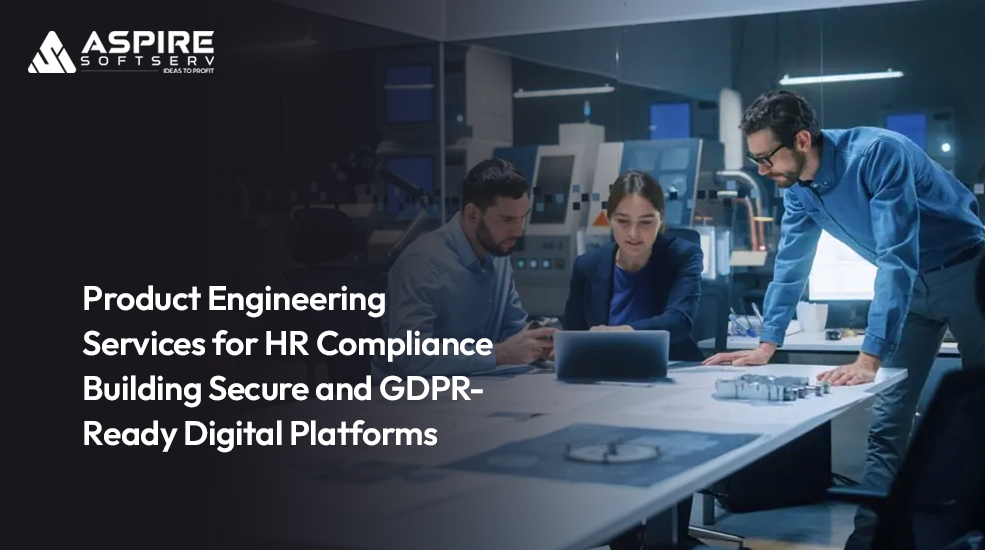
HR compliance in the age of digital transformation is no longer just a regulatory checkbox it's a strategic engineering challenge. As organizations scale globally, HR platforms must navigate complex regulations like GDPR, DPDPA, SOC 2, and ADA while maintaining speed, security, and user experience.
At AspireSoftServ, our Product Engineering Services help HR tech firms build compliance-ready platforms designed for speed, scalability, and regulatory assurance from day one.
This guide explores how modern product engineering practices embed compliance into HR digital products, covering architecture patterns, automation frameworks, and real-world use cases that drive both legal defensibility and business value.
Why HR Compliance Requires Product Engineering Expertise
Modern HR platforms process massive volumes of sensitive data across multiple jurisdictions. They must:
Enable AI-driven recruitment while avoiding algorithmic bias
Orchestrate secure data flows between regions (GDPR in EU, DPDPA in India, CCPA in California)
Provide real-time audit trails and automated compliance reporting
Integrate seamlessly with payroll, background checks, and training systems via secure APIs
Traditional compliance approaches manual audits and periodic reviews can't keep pace. Product engineering services embed compliance controls directly into the software architecture, development pipeline, and operational monitoring.
Key Compliance Frameworks for HR Platforms
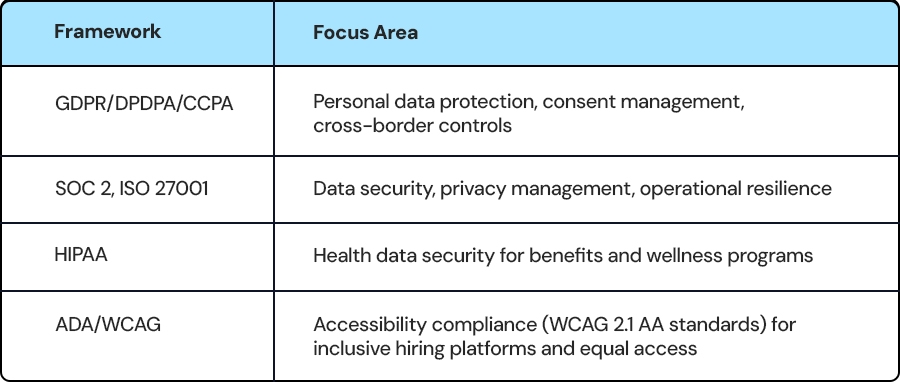
The Product Engineering Lifecycle for HR Compliance
Building compliant HR platforms requires a disciplined, full-lifecycle approach that integrates security and regulatory controls from ideation through operations.
1. Requirements & Threat Modeling
Different regulations apply based on user location, role, and data type, creating a complex compliance landscape. Cross-functional teams map compliance requirements to specific features early in the development process. Security architects conduct threat modeling to identify data flows, storage points, and integration risks before any code is written.
The key deliverable from this phase includes user stories that incorporate explicit compliance features like DSAR (Data Subject Access Request) automation, consent management, and audit logging. This ensures that compliance isn't bolted on later but is foundational to the product design.
2. Cloud-Native Architecture Design
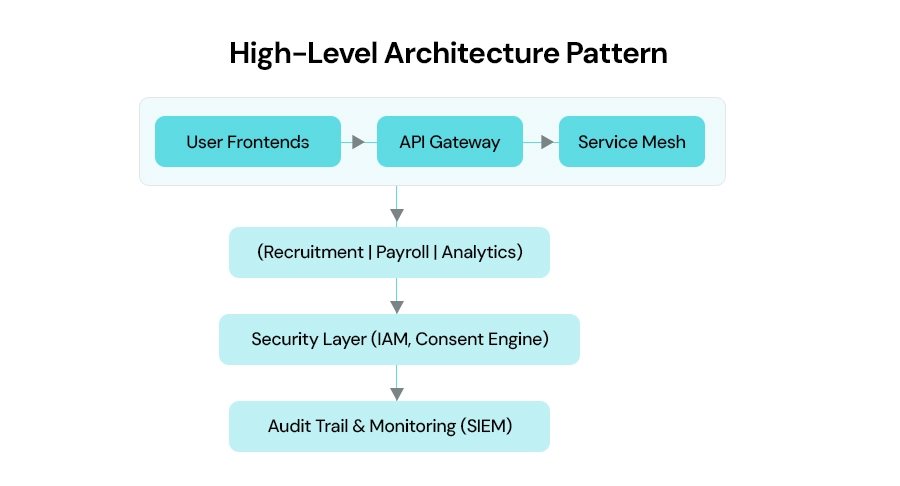
HR platforms must scale globally while meeting data sovereignty requirements, which presents unique architectural challenges. Modern digital product engineering leverage microservices architecture with service mesh for secure inter-service communication, zero-trust networking with API gateways enforcing OAuth2/OpenID, multi-region data localization using geo-tagged databases, and event-driven processing through Kafka or event buses for real-time compliance actions.
Critical to this architecture is data encryption at rest using AES-256 or higher encryption standards for all stored HR data, including employee records, payroll information, and performance reviews. PII (Personally Identifiable Information) protection requires field-level encryption, tokenization, and data masking techniques that ensure sensitive information like social security numbers, bank details, and health records remain protected throughout their lifecycle. These encryption layers work in tandem with encryption in transit (TLS 1.3) to create comprehensive data protection across all touchpoints.
Organizations implementing these patterns reduce compliance violation risks by 65% and cut audit preparation time by 50%. The cost impact is significant, with reduced legal exposure and streamlined regulatory reporting.
High-Level Architecture Pattern
3. Secure Development & Automation
Manual compliance checks create bottlenecks and introduce human error that can lead to costly violations. Compliance as Code integrates regulatory requirements into CI/CD pipelines, ensuring continuous validation. Infrastructure as Code (IaC) ensures consistent, auditable deployments across all environments. Policy as Code using tools like Open Policy Agent enforces access rules automatically at every layer of the application.
Automated testing validates DSAR workflows, consent logic, and data retention policies with every build. Secrets management through HashiCorp Vault protects credentials with strict role-based access control. The business value is substantial automated compliance reduces time-to-market by 40% while maintaining continuous regulatory readiness.
4. Continuous Testing & Validation
Comprehensive compliance testing covers data access authorization scenarios, cross-border data transfer controls, consent withdrawal propagation, automated data purging per retention policies, and rigorous security assessments. Penetration testing conducted by certified ethical hackers simulates real-world attack scenarios to identify vulnerabilities before malicious actors can exploit them. These pen tests specifically target HR-sensitive areas like authentication mechanisms, API endpoints handling PII, and data exfiltration prevention controls.
Compliance audits form another critical validation layer, with both internal audits performed quarterly and external third-party audits (for SOC 2, ISO 27001 certifications) conducted annually. These audits verify that implemented controls match documented policies, access logs are complete and tamper-proof, data retention schedules are enforced automatically, and incident response procedures are tested and effective. An innovation that many organizations overlook is using synthetic data generators for test environments to prevent compliance violations during development while maintaining realistic testing conditions.
Real-World Use Cases
Use Case 1: AI-Powered Talent Matching with Bias Prevention
A global HR SaaS uses machine learning to match candidates to roles, but faces the challenge of ensuring fairness and GDPR compliance simultaneously. The product engineering approach addresses this through multiple layers of protection and transparency.
Input sanitization ensures that PII is tokenized and encrypted before entering ML pipelines, protecting sensitive data throughout the processing chain. This includes masking names, addresses, and contact information while preserving data utility for matching algorithms. Fairness auditing tests models continuously against demographic bias using tools like Fairlearn, catching potential discrimination before it impacts real candidates. Explainable AI logs all matching decisions with reasoning for regulatory inquiries, providing the transparency that GDPR demands.
Consent-gated access performs real-time validation to ensure withdrawn candidates are instantly delisted from all systems. Automated data purging removes rejected candidates' data according to retention schedules without manual intervention. The outcome speaks for itself: 30% improvement in diversity hiring metrics combined with full GDPR compliance across 15 EU countries.
Use Case 2: Global Employee Onboarding Automation
Automating onboarding for a remote workforce across 40 countries with varying regulations requires sophisticated engineering. A dynamic workflow engine using BPMN-based rules adjusts steps per jurisdiction automatically, eliminating the need for manual configuration. Document management handles e-signatures compliant with both eIDAS in the EU and ESIGN Act in the US.
Secure API integration manages background checks via ephemeral channels, with data purged immediately after verification. Compliance gates provide automated checks that prevent progression until regional requirements are met. The result was 60% faster onboarding with zero compliance violations in the first year of operation.
DevSecOps for Continuous Compliance
Traditional security approaches can't keep pace with modern HR platform complexity. Product engineering consulting brings DevSecOps practices that automate compliance at scale.
Core Practices
Infrastructure as Code means all environments are codified and version-controlled, making changes auditable and reversible while standardizing compliance configurations across the organization. Policy as Code defines access rules and retention policies in code, enabling automated enforcement at API and database layers with real-time policy updates across distributed systems.
The automated compliance pipeline integrates security and regulatory checks at every stage:
Build phase: Static code analysis and dependency scanning detect vulnerabilities
Testing: Validates DSAR workflows and privacy requirements
Deployment: Enforces container security and API gateway policies for network isolation
Operations: Leverages SIEM integration and anomaly detection for incident response
Self-service DSAR portals allow end-users to submit access requests that are automatically processed, tracked, and completed within regulatory SLAs. This reduces manual effort by 80% while improving response times and user satisfaction.
Advanced Operational Patterns
Multi-Region Data Sovereignty
For global HR platforms, data localization is critical to compliance. Edge computing nodes process sensitive data within legal boundaries, ensuring that information never crosses unauthorized borders. Hybrid cloud architectures route data based on user location dynamically. Automated geo-fencing prevents unauthorized cross-border transfers, triggering alerts when violations are attempted.
Immutable Audit Trails
Using append-only storage such as blockchain or Kafka-based ledgers creates tamper-evident compliance records. These systems track who accessed what data and when, record all consent changes and system modifications, and provide cryptographically verified logs for legal proceedings. Organizations with immutable audit trails reduce regulatory penalty risks by up to 70%, providing strong legal defense in the event of investigations.
Future-Proofing: AI, RegTech, and Continuous Adaptation
Machine Learning for Compliance Monitoring
Advanced analytics detect anomalies that signal potential violations before they become actual breaches. These systems identify unusual data access patterns, consent flow irregularities, and unauthorized API calls in real-time, allowing security teams to respond immediately.
RegTech Integration
Connecting to regulatory intelligence APIs from Thomson Reuters or LexisNexis provides automatic law change notifications, policy update triggers, and compliance requirement mapping. This strategic advantage helps companies reduce compliance research time by 55% and regulatory lag by 3-6 months, ensuring they stay ahead of legal changes rather than scrambling to catch up.
Best Practices Checklist for Technical Leaders
Technical leaders implementing compliance-first product engineering should follow these critical guidelines:
Automate everything possible: From compliance requirements to DSAR responses and audit generation
Design for regulatory change: Build modular architecture that enables rapid policy updates
Centralize logging: Maintain ready-for-inspection audit trails with optimal retention policies
Champion cross-disciplinary teams: Integrate legal, security, and engineering from day one
Beyond these foundational practices, prioritize user transparency by providing granular privacy dashboards and consent controls that give users real control over their data. Partner with product engineering experts who can leverage specialized digital product engineering servcies to accelerate compliance readiness while maintaining development velocity.
FAQ: Product Engineering for HR Compliance
Q: What is digital product engineering for HR compliance?
A: It's the practice of embedding regulatory controls (GDPR, SOC 2, DPDPA) directly into software architecture, development workflows, and operational monitoring ensuring compliance is automated and continuous rather than manual and periodic.
Q: How can AI-driven HR platforms stay compliant?
A: Through fairness auditing, explainable AI logging, tokenization of PII, real-time consent validation, and automated bias detection integrated into the ML pipeline.
Q: How do product engineering services help with SOC 2 and GDPR?
A: By implementing Policy as Code, Infrastructure as Code, automated audit trails, encrypted data flows, and continuous compliance testing within CI/CD pipelines reducing manual effort while maintaining certification readiness.
Q: What's the ROI of compliance-first product engineering?
A: Organizations typically see 40% faster time-to-market, 50% reduction in audit preparation costs, 65% fewer compliance violations, and 30% improvement in customer trust metrics.
Conclusion: Make Compliance Your Competitive Advantage
Ensuring compliance with digital HR products isn't just about avoiding fines it's about building trust, accelerating global expansion, and creating sustainable competitive advantage. Product engineering services transform compliance from a cost center into a strategic capability.
Modern HR platforms must embed compliance at the architecture level. Cloud-native, microservices designs enable rapid adaptation to regulatory changes without disrupting existing operations. Automated frameworks preserve trust while minimizing operational overhead and human error. AI and RegTech bring new capabilities when built on transparent, auditable foundations that regulators can inspect and verify.
The organizations winning in HR tech aren't treating compliance as an afterthought. They're partnering with product engineering consulting experts to build it into their DNA from day zero, creating platforms that are both innovative and defensible.
Ready to Build Compliance-Ready HR Platforms?
If your HR product is scaling globally, it's time to embed compliance at the engineering level.
AspireSoftServ's Product Engineering experts help HR SaaS companies build secure, compliance-ready platforms that meet GDPR, SOC 2, and DPDPA requirements while accelerating time-to-market.