


 Updated on 21 April 2026

The Wrong HR Platform Decision Can Cost You Millions Here's How to Get It Right
Every year, companies invest hundreds of thousands of dollars into HCM platforms and a significant portion regret it within 18 months. Not because the technology failed them, but because they skipped the decision framework and jumped straight to vendor demos.
Even if you're not deeply technical, this framework will help you make the right investment decision for your team, your budget, and your growth stage. A 150-person company expanding to three countries faces very different HCM challenges than a 40-person startup still running payroll on spreadsheets. In US-based mid-sized companies, HCM platform costs typically increase 15–20% annually once you factor in user growth, compliance add-ons, and vendor fee hikes making early decisions disproportionately expensive when they're wrong.
💡 Key Insight: Most HCM mistakes don't show up in the first 6 months they become expensive after 18–24 months when integrations, workflows, and teams are already locked into a platform.
This blog is built for CTOs, Founders, and senior product leaders at that exact crossroads. Whether you're modernizing a legacy HR stack or building from scratch, the build vs buy software decision is one of the most consequential architectural choices you'll face.
What Does Build vs Buy vs Extend Mean in HCM?
Before diving into the framework, let's anchor the terminology because these three paths are genuinely different in scope, cost, and commitment.
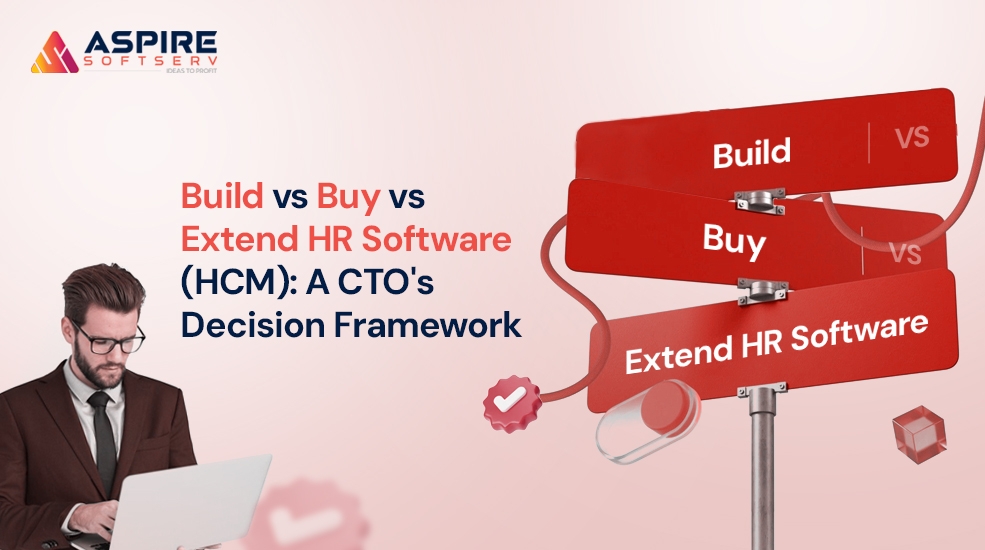
Build = A custom HR system developed from scratch, tailored to your exact workflows, compliance needs, and data architecture
Buy = Off-the-shelf SaaS platforms like Workday, UKG, or BambooHR fast to deploy, vendor-managed, subscription-based
Extend = Custom modules, integrations, or AI layers built on top of an existing platform to close specific gaps
Understanding these distinctions upfront changes how you evaluate every vendor demo, every pricing proposal, and every internal debate that follows.
Quick Self-Assessment: Which Path Are You Leaning Toward?
Answer these questions honestly. If most answers in a category are YES, follow the suggested path.
| Question | If Yes → Consider |
|---|---|
| Do you have fewer than 500 employees with standard HR workflows? | Buy |
| Do you already use Workday or Oracle and have specific capability gaps? | Extend |
| Do you operate across multiple countries with complex compliance requirements? | Build |
| Do SaaS tools fail to support 30%+ of your core workflows? | Build or Extend |
| Is your primary constraint speed to deployment? | Buy |
| Is your primary constraint long-term cost control? | Extend or Build |
This self-check alone can save your team weeks of misaligned vendor evaluation.
The Decision Spectrum: Not All Paths Are Equal
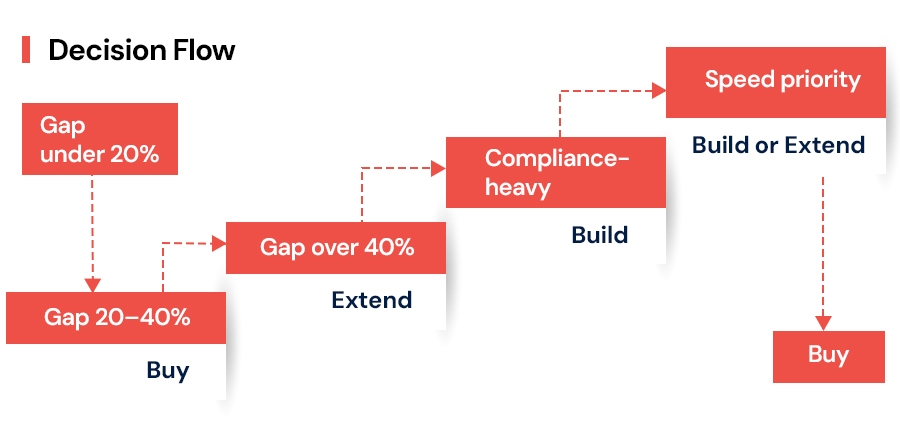
The right choice depends on how much your workflows differ from what standard SaaS platforms cover. Use this rule as your starting anchor:
Gap under 20% → Buy
Gap between 20–40% → Extend
Gap above 40% → Build
Here's how that maps to real decisions:
| Situation | Best Choice | Why |
|---|---|---|
| Standard HR needs, under 500 users | Buy | Speed + out-of-the-box coverage |
| Existing platform with small capability gaps | Extend | Lower cost, faster delivery |
| Complex, regulated, or unique workflows | Build | Full control + IP ownership |
| Entering new markets with compliance needs | Build or Extend | Compliance demands custom control |
| Budget under $1M, deployment in 90 days | Buy | Time-to-value is the priority |
Custom HR software development sits at one end of this spectrum — full ownership, full flexibility, full responsibility. SaaS platforms sit at the other — fast deployment and subscription fees that compound over time. Extend lives in the middle, and for most growing companies, it's where the best ROI is found.
Factor 1: Technical Fit Does the Platform Actually Match Your Workflows?
The right choice depends on how much your workflows differ from standard SaaS. Most platforms cover 80–90% of common HCM functions like payroll, benefits, and basic performance tracking. The decision lives in that remaining 10–20%.
If your gap is under 20%, Buy is sufficient. You're paying for stability, vendor-managed compliance updates, and fast onboarding. For a 200-person US company with standard payroll and hiring needs, this is almost always the right call.
If your gap sits between 20–40%, Extend is where product engineering services become critical especially when integrating or layering capabilities on top of existing HCM platforms. A manufacturing company might extend Oracle HCM with a predictive safety-compliance module for field workers. No SaaS vendor offers that. A focused custom build does, in weeks rather than months.
If more than 40% of your workflows are genuinely unique multi-country payroll rules, proprietary AI talent scoring, or gig worker lifecycle management custom HR software development earns its cost. One global FinTech operating across 14 countries found no SaaS platform could handle their jurisdiction-specific payroll and audit requirements. The custom build took 11 months but delivered 25% lower TCO over five years compared to patching SaaS with workarounds.
Factor 3: Who Is This Decision Really For?
Most frameworks are written for architects not for the CEO or Founder who signs the $2M commitment. Here's a practical shortcut by company profile:
Under 200 employees?
Extend almost always wins. You need capability, not complexity.
Hiring speed is your bottleneck?
Don't Build. Deploy a SaaS ATS and integrate it with your existing stack.
Entering a US-regulated market (HIPAA, SOC 2, CCPA, SOX)?
Build gives you the control you need. Buy means inheriting the vendor's compliance posture and hoping it aligns with your legal obligations.
Running multi-country operations?
Neither Buy nor Extend will close the gap reliably a structured software architecture decision framework is required before committing to any path.
Product Strategy & Consulting becomes especially valuable here. A structured 4 to 6 week consulting sprint validates assumptions before you commit to an architecture path. The cost of that sprint is a rounding error compared to a bad platform decision at scale
The Decision Process: Five Steps That Work in Practice
Step 1 Requirements Workshop: Use MoSCoW prioritization (Must, Should, Could, Won't) across all HCM functions. Aim for 80+ requirements documented before engaging any vendor.
Step 2 Scorecard Evaluation: Rate each decision path against six pillars technical fit, TCO, scalability, security, integration complexity, and vendor risk. Weight them by context. A bootstrapped 150-person company should weight cost heavily. A Series C startup scaling internationally should weight compliance and scalability.
Step 3 Proof of Concept: Run a 4 to 6 week POC before committing. Product Design and Prototyping at this stage is one of the most underutilized investments in enterprise HR decisions. A working prototype surfaces integration gaps and performance assumptions that no RFP ever will.
Step 4 TCO Modeling: Build a dynamic model across three scenarios conservative, base, and aggressive growth. The right decision under conservative growth may look very different at 5x scale.
Step 5 Commit with Exit Clauses: Regardless of path, negotiate SLA guarantees, data portability rights, and contract exit windows. Vendor lock-in is manageable when planned catastrophic when discovered post go-live.
Where Product Engineering Fits Into Every Path
Regardless of whether you Build, Buy, or Extend engineering investment is required. The question is where and how much.
| Decision | Core Engineering Need |
|---|---|
| Build | Software Product Development full-stack architecture, microservices, secure APIs, long-term maintenance |
| Extend | AI integration, Cloud and DevOps Engineering, platform-native customization |
| Buy | Deployment, QA, data integration, Cloud and DevOps Engineering for ongoing operations |
If you Build, you need a capable engineering organization to design architecture and maintain the system long-term. Software Product Development of this scope is not a one-time project it's a sustained product investment.
If you Buy, SaaS is not plug-and-play at enterprise scale. Cloud and DevOps Engineering handles deployment, monitoring, and integration with your existing ERP, CRM, or data warehouse.
If you Extend, the surface is smaller but more specialized. This is where product engineering services partners with HCM experience reduce time-to-value significantly building precisely on top of vendor API layers without replacing what already works.
In all three scenarios, enterprise software decision making benefits from external perspective. Internal teams are often too close to the current architecture to evaluate trade-offs objectively.
Real-World Scenarios: Three Companies, Three Paths
The Global FinTech (Build): A 5,000-employee financial services firm across 14 countries found no SaaS vendor could handle their jurisdiction-specific payroll and audit requirements. Custom HCM on a Kubernetes-based microservices architecture with AI-powered compliance forecasting delivered 25% lower five-year TCO compared to the Workday alternative when accounting for the compliance modules they would have built regardless.
The Mid-Market Retailer (Buy): A 2,000-person retail chain deployed UKG in three months and cut time-to-hire by 40%. The trade-off appeared in year two: an 18% subscription increase and pressure to pay for unused modules. Lesson Buy works when speed is the priority and pricing guardrails are negotiated upfront.
The Manufacturing Giant (Extend): A large manufacturer extended Oracle HCM with low-code AI modules for predictive staff scheduling and automated compliance reporting. Engineering time dropped 60% compared to a full rebuild. They kept platform stability while adding exactly the capabilities their operations required the textbook case for Extend.
Risks Every Team Should Plan For
Build risks: Scope creep is the most common failure mode. Agile sprint structure with clear milestones keeps projects from drifting. Talent risk losing key engineers mid-project is underestimated and underplanned for.
Buy risks: Vendor lock-in is more serious than feature lag. If your data can't be exported cleanly, you've permanently lost negotiating leverage. Always negotiate data portability before signing.
Extend risks: API deprecation and vendor roadmap changes can invalidate custom extensions with minimal notice. Build SLA monitoring and roadmap review requirements into your contract.
A product engineering consulting audit every 12 to 18 months ensures your architecture stays aligned with actual business needs.
Not Sure Which Path Is Right for You?
Most teams realize too late that they chose the wrong path usually after the 18-month mark when workflows, integrations, and teams are already locked in. We run a 30-minute architecture review where we map your HCM gaps, estimate your 5-year cost across all three paths, and give you a clear Build, Buy, or Extend recommendation for your stage. No sales pitch just clarity.
Final Summary: Build vs Buy vs Extend
Build = Full control, full complexity. Right when differentiation or compliance demands it.
Buy = Speed and simplicity. Right when standard coverage is sufficient.
Extend = The balance of both. Right for most growing mid-sized organizations.
For most mid-sized US companies, Extend provides the best ROI unless compliance requirements or strategic differentiation demands full custom control. The honest, data-backed reality is that Extend wins for roughly 70% of mid-sized enterprises because it balances cost, speed, and control without the full risk of a custom build or the ceiling of SaaS.
The decision isn't permanent. Companies that Build often introduce Buy components as they scale. Companies that Buy find themselves Extending within 18 months. What matters is that the first decision is grounded in data, modeled over five years, and validated through a structured process not a vendor pitch.
If you're at that stage right now, the most valuable move is a structured assessment before any contract is signed. Our team has supported 50+ HCM transformations across FinTech, Healthcare, and Manufacturing. We're ready to pressure-test your assumptions no cost, no obligation.
Don’t guess validate your decision with experts.