


 Updated on 26 February 2026

Most healthcare AI projects don't fail because of bad algorithms. They fail because teams treat AI as a feature, not a product engineering challenge. A sepsis prediction model with 95% accuracy in testing becomes clinically useless when it generates 200 alerts per day, overwhelming nurses who learn to ignore it. An imaging tool trained on Stanford data misses 40% of anomalies in rural clinics. These aren't AI failures they're product engineering services failures: poor data architecture, rushed deployment, and AI bolted onto systems never designed to support it.
The gap between AI's promise and its actual impact in healthcare comes down to one question: Are you building AI, or are you engineering a sustainable healthcare product that happens to use AI? This distinction determines whether your investment becomes a competitive advantage or a costly lesson in technical debt.
This guide is for healthcare product leaders, CTOs, and engineering heads building AI-powered platforms not research demos.
Where AI Actually Delivers Clinical Value
Healthcare AI applications transform outcomes in three narrow but high-impact domains: pattern recognition in imaging, predictive modeling from structured data, and operational workflow automation. The commonality? Each involves clearly defined inputs, measurable outputs, and workflows where AI augments not replaces clinical judgment.
Diagnostic Imaging: Proven ROI at Scale
AI algorithms detect anomalies in X-rays, MRIs, CT scans, and pathology slides with speed and consistency humans cannot match. IDx-DR, an FDA-approved diabetic retinopathy screening tool, achieves 87% sensitivity and 90% specificity enabling scalable early detection in underserved areas where ophthalmologists are scarce. Microsoft's InnerEye reduces radiotherapy planning time by 90% for head and neck cancers, cutting patient wait times from weeks to days.
| AI Imaging Tool | Clinical Application | Performance Edge | Integration Challenge |
|---|---|---|---|
| IDx-DR | Diabetic retinopathy screening | 87% sensitivity, 90% specificity | EHR API compatibility across vendor systems |
| InnerEye (Microsoft) | Radiotherapy contouring | 90% time reduction | DICOM workflow integration, radiologist training |
| DeepMind | Breast cancer detection | Matches expert radiologists | False positive management, liability frameworks |
The engineering challenge isn't training the model it's building the surrounding product. How does the AI communicate uncertainty to radiologists? What happens when it contradicts human interpretation? These are Software Product Development questions that determine whether AI imaging becomes a tool or a liability.
Predictive Risk Modeling: From Patterns to Proactive Care
Predictive analytics in healthcare identifies at-risk patients hours before symptoms manifest. Models analyze electronic health records (EHRs), lab results, and vital signs to forecast sepsis, readmissions, and disease progression. When deployed correctly, sepsis prediction systems reduce mortality by up to 20% through early intervention. Chronic disease management platforms cut costs by 75% for conditions like diabetes by optimizing treatment timing and resource allocation.
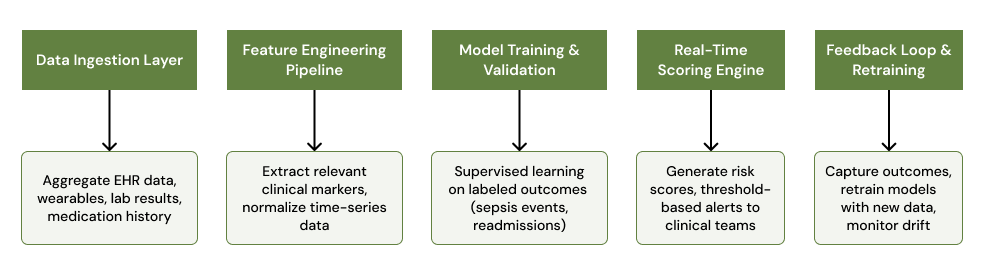
The ai healthcare benefits here are measurable: 18 million fewer healthcare providers needed globally by 2030 (WHO projection) as AI handles routine risk stratification. But the engineering reality is brutal. Epic's sepsis prediction model, deployed across dozens of health systems, missed 67% of cases in some hospitals due to site-specific EHR configuration differences. The model wasn't wrong the Product Design and Prototyping process failed to account for workflow variability across clinical settings.
Operational AI: The Unsexy Value Engine
Beyond clinical applications, ai healthcare solutions generate ROI through administrative automation and operational optimization. Natural language processing (NLP) extracts structured insights from unstructured clinical notes, automating medical coding for risk adjustment and reducing hierarchical condition category (HCC) errors that cost Medicare billions annually.
| Operational AI Use Case | Value Delivered | Common Failure Mode |
|---|---|---|
| NLP for clinical documentation | 80% reduction in manual coding time | Training data misalignment with specialty-specific terminology |
| Predictive scheduling | 20% reduction in no-shows | Over-optimization creating patient access issues |
| Claims fraud detection | $100B annual savings (industry-wide) | False positive rates eroding auditor trust |
AI chatbots triage patient symptoms, reducing unnecessary emergency department visits by 30%. Ambient sensors monitor vital signs contactlessly, flagging deteriorations before they become crises. These applications work because they target high-volume, low-complexity decisions where failure modes are manageable and human oversight remains in the loop.
The engineering challenge? Integration. A chatbot that doesn't sync with your EHR creates duplicate work. A scheduling algorithm that ignores physician preferences gets gamed by staff. Success requires Cloud and DevOps Engineering that treats AI as a living system requiring continuous monitoring, not a deploy-and-forget model.
The $4 Billion Lesson: Where AI Spectacularly Fails
IBM Watson Health's collapse $4 billion in losses before sale to a private equity firm epitomizes AI failure in healthcare. Watson for Oncology promised to revolutionize cancer treatment by analyzing medical literature and patient data to recommend therapies. Oncologists rejected it. Why? Just 12-33% concordance with human recommendations because Watson was trained on synthetic cases and hypothetical scenarios, not real patient outcomes. It optimized for academic correctness, not clinical utility.
Bias Amplifies Healthcare Disparities
Biased datasets don't just skew results they perpetuate systemic harm. Optum's algorithm, used to manage care for 200 million Americans, systematically underestimated Black patients' healthcare needs by assigning lower risk scores than warranted by actual health conditions. The model used healthcare spending as a proxy for health need, failing to account for systemic barriers that reduce minority patients' access to care. This wasn't an edge case it was the core dataset decision that AI & Data Engineering teams must catch during problem validation.
Explainable AI in healthcare attempts to address this through techniques like SHAP (SHapley Additive exPlanations) and LIME (Local Interpretable Model-agnostic Explanations), which show which features drove predictions. But explainability doesn't equal causality. A model can explain why it flagged a patient as high-risk without proving that intervention will help. Worse, explanations can create false confidence, leading clinicians to trust recommendations they shouldn't.
Black-Box Models Erode Clinical Trust
Non-transparent models face adoption resistance even when accurate. A deep learning algorithm that predicts pneumonia severity without showing its reasoning challenges the fundamental clinical workflow: hypothesis, evidence, reasoning, decision. Clinicians trained to defend their decisions to patients, families, and malpractice attorneys won't stake their licenses on AI outputs they can't explain.
| AI Hype vs. Reality | Promised Value | Actual Failure Rate | Root Cause |
|---|---|---|---|
| Watson for Oncology | Precision therapy recommendations | 67–88% oncologist disagreement | Synthetic training data, no real-world validation |
| Epic Sepsis Model | Early warning system | 67% missed cases (site-dependent) | Workflow integration gaps, alert fatigue |
| General diagnostic autonomy | Replace clinician judgment | High bias in minority populations | Unrepresentative training datasets |
The pattern? Teams prioritized model performance on test sets over Product Strategy & Consulting that would have identified workflow incompatibilities, data quality issues, and adoption barriers before millions were spent.
Engineering Reliable Healthcare AI Products
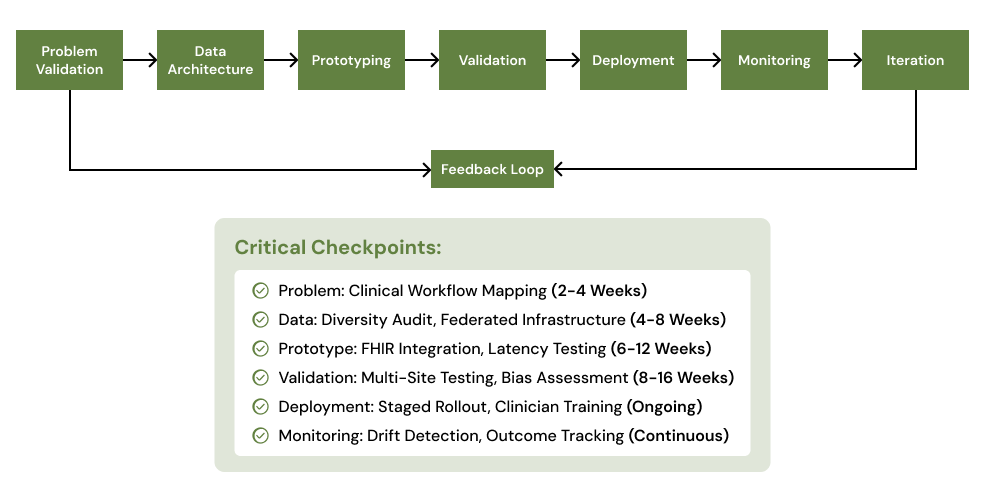
Building AI that clinicians actually use requires rethinking the development lifecycle. Start with the problem, not the algorithm. What clinical decision are you improving? What happens if the AI is wrong? Who owns the error?
Development Roadmap for Product-First AI
Problem Validation Before Code Human-centered design sessions with clinicians reveal the difference between what executives think doctors need and what actually improves care. A predictive model that identifies patients at risk of opioid misuse matters only if it fits into prescribing workflow and suggests actionable alternatives.
Data Architecture as Foundation Federated learning frameworks allow model training across institutions without centralizing sensitive patient data, addressing privacy concerns while improving generalizability. Data diversity isn't optional it's the difference between a model that works for Stanford patients and one that works for rural America. This is where AI & Data Engineering expertise separates successful deployments from biased failures.
Prototyping with Production Constraints Build with deployment reality in mind. Can your model run on hospital servers, or does it require cloud infrastructure most health systems don't have? Does it integrate via FHIR APIs, or does it need custom EHR builds that take 18 months? Product Design and Prototyping that ignores operational constraints creates beautiful demos and unusable products.
Validation Beyond Accuracy Temporal validation (testing on future data) catches overfitting to historical patterns. External validation across different health systems exposes site-specific biases. Calibration metrics ensure predicted probabilities match actual outcomes a model that says "30% risk" should be right 30% of the time, not just better than random.
Deployment as Continuous Process Models drift as patient populations, treatment protocols, and disease patterns change. Monitoring systems must catch when a model trained on pre-pandemic data starts failing post-COVID. Retraining pipelines must balance model freshness against the risk of destabilizing clinical workflows a core Cloud and DevOps Engineering challenge for ML systems.
Case Studies: Success Through Engineering Discipline
TidalHealth's implementation of IBM Micromedex drug interaction checking reduced clinician search time by 60%, improving prescribing decisions without disrupting workflow. The difference from Watson's failure? Micromedex addressed a narrow, well-defined problem (drug interactions) with transparent rule-based logic clinicians could verify, not a black-box attempting to replace oncological judgment.
Inferscience's HCC coding AI optimizes Medicare Advantage funding by ensuring accurate risk adjustment coding from clinical documentation. It works because it augments human coders with suggestions they can accept or reject, maintaining human accountability while scaling throughput.
The pattern in successful deployments: AI handles volume and consistency while humans own judgment and accountability. Failed deployments reverse this, expecting AI to make nuanced decisions while relegating humans to rubber-stamping outputs.
The Product Engineering Mindset for Healthcare AI
Healthcare AI fails when treated as a technology project. It succeeds when approached as a product engineering challenge requiring:
Clinical workflow integration designed from day one, not retrofitted. If your AI requires clinicians to open a separate application, you've already lost adoption. If it generates alerts that don't map to actionable interventions, you've created alert fatigue, not clinical value.
Data governance frameworks that address privacy, bias, and drift as architectural requirements, not compliance afterthoughts. HIPAA compliance is table stakes. The harder questions: How do you ensure training data represents your deployment population? How do you detect when model performance degrades? How do you retrain without introducing new biases? These challenges demand AI & Data Engineering teams who understand both ML and healthcare operations.
Explainability as a feature, not a research problem. Clinicians need to understand why AI flagged a patient, what evidence supports the recommendation, and what happens if they disagree. This isn't about publishing SHAP values in journals it's about building interfaces that communicate uncertainty in clinically meaningful ways.
Continuous validation and monitoring treating ML models as living systems requiring ongoing care, not static software releases. A model deployed in January performs differently in June as flu season ends and COVID variants emerge. Engineering teams must build feedback loops that capture outcomes, detect drift, and trigger retraining before clinical impact occurs.
Future Directions: Engineering Challenges Ahead
The next wave of healthcare AI will push engineering complexity further: reinforcement learning for dynamic treatment optimization, digital twins for simulating patient-specific interventions, and genomic AI for precision immunotherapy. Each promises transformative impact. Each demands product engineering discipline that most healthcare organizations lack.
Regulatory frameworks are evolving. The FDA has approved over 58% of AI-enabled radiology devices submitted, but approval doesn't guarantee adoption. Clinical integration, workflow compatibility, and demonstrable ROI determine whether approved AI becomes standard of care or expensive shelfware.
The competitive advantage won't go to teams with the most sophisticated algorithms. It will go to teams that integrate strategy, design, development, and deployment into a coherent product vision that solves real clinical problems.
Conclusion: AI Works Where Engineering Discipline Prevails
AI delivers measurable value in imaging, predictive analytics in healthcare, and operational automation but only when built with product engineering rigor. The difference between transformative impact and costly failure isn't the AI itself. It's whether you engineer for adoption, integration, bias mitigation, explainability, and long-term sustainability from the start.
Avoid black-box models in high-stakes decisions. Prioritize transparency over marginal accuracy gains. Build with clinical workflows, not against them. Treat data quality and diversity as non-negotiable requirements, not nice-to-haves.
Most importantly, recognize that healthcare AI isn't a data science problem it's a product engineering services challenge requiring architecture thinking, deployment discipline, and continuous validation. The teams that understand this distinction will build AI that clinicians trust and patients benefit from. Those that don't will join Watson in the cautionary tale category.
Ready to build healthcare AI that clinicians actually use?
Explore how product engineering services from AspireSoftserv integrate AI strategy, architecture, and deployment into sustainable healthcare products from initial concept through production monitoring. See how we help healthcare companies avoid the billion-dollar mistakes and build AI that delivers.