

 Updated on 2 June 2026

Who This Blog Is For
This guide is written for:
CTOs and VPs of Engineering dealing with slow software releases, rising engineering costs, and release cycle optimization pressure
Founders and Product Owners watching competitors ship faster while their roadmap slips quarter after quarter
Engineering leads modernizing legacy architecture problems in HCM, Healthcare, or SaaS platforms where release reliability matters as much as speed
If your team spends more time coordinating deployments and managing production hotfixes than building product value this guide is for you.
By the end of this guide, you will have a concrete architectural framework and implementation sequence for measurably reducing release cycle time without a full rewrite, and without halting product delivery.
The Real Cost of Slow Feature Releases
Many growing software companies reach a point where shipping even a small feature takes weeks instead of days. Engineering teams spend more time coordinating deployments and debugging regressions than building product value.
Slow software releases carry direct business consequences that compound over time.
Missed market windows. In fast-moving SaaS markets, a four-week release cycle vs. a four-day cycle is not a minor operational difference it is a strategic disadvantage.
Rising engineering cost. Tightly coupled systems force cross-team coordination meetings before any change can ship, increasing cost and slowing decision-making at every level.
Lost enterprise sales and customer trust. Enterprise procurement teams now assess roadmap velocity during vendor diligence. When RFPs require features on 60–90 day timelines, a four-week release cycle becomes a deal-blocking risk, not just an inconvenience. When your release cycle cannot support their requests on a reasonable timeline, engineering bottlenecks become a direct revenue problem.
Compliance and operational risk. Regulatory requirements in Healthcare and Finance evolve continuously. If your architecture cannot ship compliance updates quickly, the risk extends well beyond engineering.
The root causes of slow releases typically fall into five categories: tightly coupled systems, manual or fragile deployment pipelines, insufficient automated testing in software development, weak observability, and misaligned team structures. Each pillar below addresses one of these directly.
Signs Your Engineering System Is Already Slowing Growth
Engineering leaders often sense release velocity problems before they can articulate the cause. These signals are worth recognizing:
Releases require cross-team coordination meetings before any change can ship
Engineers avoid touching certain modules because changes break unpredictable things elsewhere
Production hotfixes are increasing quarter over quarter
Onboarding a senior engineer takes more than six to eight weeks
Roadmap estimates slip repeatedly, even for seemingly straightforward features
Your CI pipeline takes 30–45 minutes or longer, causing developers to context-switch while waiting
If three or more of these describe your organization, the architecture and delivery system not the team is the constraint.
Industry Context: Why Release Velocity Is a Higher-Stakes Problem in HCM and Healthcare
For SaaS companies in general, slow releases cost market share. In HCM and Healthcare, they carry consequences that extend into compliance exposure, patient outcomes, and enterprise contract risk. This distinction matters when designing your architecture and release strategy.
HCM Platforms
In HCM platforms, slow release cycles directly delay improvements to payroll processing accuracy, onboarding workflow automation, benefits administration, and recruitment pipeline features. These are not peripheral capabilities they are the core product surface that enterprise HR buyers evaluate during procurement and renewal.
When billing logic, employee data management, and reporting modules are entangled in a shared monolith, a change to payroll calculation can destabilize the onboarding workflow. This creates a compounding problem: the longer teams avoid touching legacy modules, the more the architecture degrades, and the slower releases become across the entire product.
For HCM vendors under pressure from enterprise clients to deliver custom onboarding workflows, compliance reporting updates, or integration features within fixed contract timelines, release cycle optimization is not an engineering priority it is a commercial obligation.
Healthcare Platforms
In healthcare systems, the stakes are compounded by compliance requirements, patient safety considerations, and audit obligations. Appointment scheduling improvements, patient intake workflow updates, clinical reporting dashboards, and communication features need to evolve independently without destabilizing each other or creating HIPAA exposure.
When a healthcare platform cannot ship a scheduling improvement without a full regression cycle, both patients and operations teams bear the cost. More critically, delayed compliance updates in response to evolving HIPAA requirements, SOC 2 audit findings, or new interoperability mandates can create regulatory exposure that legal and compliance teams escalate above the engineering roadmap entirely.
Healthcare platforms operating under SOC 2 Type II certification requirements need to demonstrate continuous control effectiveness. A slow, manual release process makes this harder to evidence and more expensive to maintain. Architecting for release engineering best practices is, in this context, also architecting for compliance efficiency.
The Shared Principle
Because HCM and Healthcare platforms operate with sensitive workflows, regulated data, and high enterprise buyer expectations, release reliability matters as much as release speed. The architecture patterns below address both dimensions not as separate concerns, but as two properties of the same well-designed system.
Pillar 1: Modular, Decoupled Architecture
The core principle: Design systems so teams can change, test, and deploy components independently without triggering cascading failures or full-system regression cycles.
This is where scalable software architecture begins. When components are tightly coupled, a small change forces redeployment and retesting across the entire system the single architectural problem responsible for more feature release delays than any other factor in scaling SaaS companies.
Microservices architecture decomposes your system by bounded context, giving each service a single responsibility and independent deployability. This pattern works best when teams are large enough to own services end-to-end. Adopting microservices architecture too early increases operational complexity before the infrastructure to support it exists a common and costly mistake.
The right time to adopt microservices is when you have two or more dedicated teams per service domain, a mature platform engineering function capable of managing distributed deployments, and consistent metrics showing the monolith itself not team coordination or process is the actual delivery constraint. Before those conditions exist, decomposition adds cost without delivering the independence benefits it promises.
Modular monolith is often the right starting point. Enforcing clear module boundaries and internal APIs within a single codebase dramatically reduces coordination cost without the operational overhead of distributed services. Strong modular architecture alone can cut release cycle time significantly before microservices ever become necessary.
Feature toggles and flags allow teams to merge incomplete features without exposing them to users. This supports trunk-based development and eliminates the coordination overhead of long-lived feature branches one of the most common hidden sources of deployment delays.
Backward-compatible APIs prevent cascading updates across dependent services. Follow additive-only change policies with clearly marked deprecation cycles. This is a foundational system design best practice that preserves team autonomy at scale.
| Pattern | Team Independence | Operational Overhead | Release Speed Impact |
|---|---|---|---|
| Microservices | High | High | Excellent at scale |
| Modular Monolith | Moderate | Low | Strong for early/mid-stage teams |
| Event-Driven | High | Moderate | Excellent for async workflows |
| Shared DB Monolith | Low | Low | Slow creates deep coupling |
This is where Product Strategy & Consulting plays a critical role. Architecture decisions made early define the ceiling of your release velocity for years afterward.
Pillar 2: CI/CD Pipeline Design and Best Practices
A well-designed CI/CD pipeline is the operational backbone of rapid, reliable feature delivery. Teams with PR validation under five to ten minutes deploy significantly more frequently than teams running 30–45 minute pipelines often the difference between daily and weekly deployments.
Fast, incremental builds use dependency caching and parallel steps. Every minute added to CI feedback time reduces commit frequency and increases context-switching cost across the team.
Pipeline as code stores pipeline definitions in version control, ensuring reproducibility and preventing the configuration drift that causes "works in staging, fails in production" incidents. This is a core software deployment automation discipline.
Immutable artifacts container images tagged by content hash ensure what you test in staging is exactly what you deploy to production, eliminating an entire class of environment inconsistency problems.
Progressive delivery gradually routes traffic to new versions using blue-green deployments or canary releases. Teams that adopt progressive delivery consistently see lower change failure rates compared to big-bang deployments often the single highest-impact change a team can make to release safety.
Automated rollbacks triggered by health check failures eliminate the manual scramble during incidents. Automated recovery is foundational to a mature release management process and core Cloud and DevOps Engineering capability.
Delivery Metrics That Matter
Deployment frequency: How often are you releasing to production?
Lead time for changes: How long from commit to production?
Change failure rate: What percentage of releases cause incidents?
Mean time to recovery (MTTR): How quickly do you recover when something breaks?
Long lead time typically points to slow CI or manual QA gates. High change failure rate almost always signals insufficient automated testing in software development or flaky environments.
Pillar 3: Automated Testing and Deployment Automation
Testing is what separates confident releases from risky ones. Without a strong automated test suite, every deployment is a gamble and teams respond by releasing less frequently, compounding the velocity problem.
The testing pyramid structures this investment correctly: plentiful fast unit tests at the base, integration tests validating service contracts in the middle, and a small set of end-to-end tests covering critical user journeys at the top.
Contract testing deserves particular emphasis in microservices architecture environments. Tools like Pact enable consumer-driven contract testing where the consuming service defines the contract it expects, and the producing service validates against it automatically in CI. This prevents the class of integration failures where one team deploys a breaking API change that passes their own tests but silently breaks a downstream consumer. In distributed systems, contract testing is not optional infrastructure it is the mechanism that makes independent deployability safe in practice.
Mutation testing addresses a coverage quality problem that line coverage metrics miss entirely. A test suite with 80% line coverage can still miss critical logic branches. Mutation testing introduces deliberate code faults and verifies that your tests catch them. Teams that adopt it consistently discover gaps in their coverage that numeric thresholds never revealed.
Chaos engineering extends quality discipline into production-realistic failure scenarios. Deliberately injecting latency, terminating service instances, and simulating dependency failures under controlled conditions reveals recovery gaps that no staging environment can replicate. For Healthcare and HCM platforms with high availability requirements, chaos engineering is how teams build justified confidence rather than assumed confidence in their resilience.
AI-assisted test generation is a meaningful shift for high-velocity teams in 2026. LLM-driven tools now generate test cases from code changes, suggest missing coverage paths, and reduce the maintenance burden of brittle tests as codebases evolve. Teams under delivery pressure where test authoring is the bottleneck, not test execution are seeing measurable reductions in test maintenance cost by integrating AI-assisted generation into their DevOps workflow.
Keep PR-level tests fast under five minutes is the target. Parallelize using containerized runners. Provision test environments via infrastructure as code to ensure consistency with production. Monitor flakiness aggressively a test that sometimes passes and sometimes fails erodes pipeline confidence faster than no test at all.
This is core QA Engineering Services territory. Teams that treat testing as an afterthought consistently spend more time on post-release hotfixes than teams that invest in automation from the beginning.
On the infrastructure side, IaC using Terraform or Pulumi provisions environments consistently, eliminating configuration drift. GitOps stores deployment manifests in Git and applies changes automatically providing a full audit trail and eliminating manual production commands that introduce untracked state. Cloud-native architecture leverages managed services to reduce operational burden, keeping engineers focused on product value. This is the foundation of cloud-native product development and a consistent driver of release cycle optimization.
Why Product Engineering Matters Beyond Faster Deployments
Here is something worth stating plainly: release velocity is not just a DevOps problem.
Many organizations invest heavily in CI/CD tooling and still struggle with slow releases. The pipeline is fast, but the architecture is tightly coupled. The deployment is automated, but the testing strategy is inadequate. The infrastructure is cloud-native, but teams are organized around functions rather than products.
True release velocity requires converging architecture decisions, quality engineering, cloud infrastructure, and product alignment into a coherent system. No single tool achieves this in isolation.
This is precisely what product engineering services address not as a collection of disconnected practices, but as an integrated capability designed to move features from idea to production predictably and sustainably. When a product engineering team owns a feature end-to-end, coordination overhead drops significantly, release cycles compress, and roadmap commitments become more reliable.
What a Fast Release Workflow Looks Like in Practice
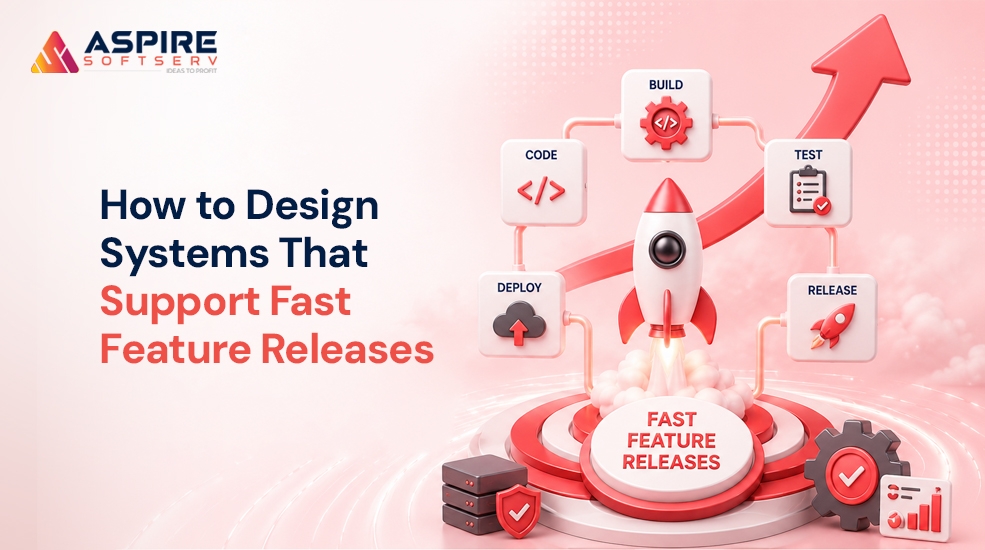
High-velocity teams follow a structured sequence where every stage is gated, automated, and observable. The diagram below shows how a single developer change moves safely from commit to full production.
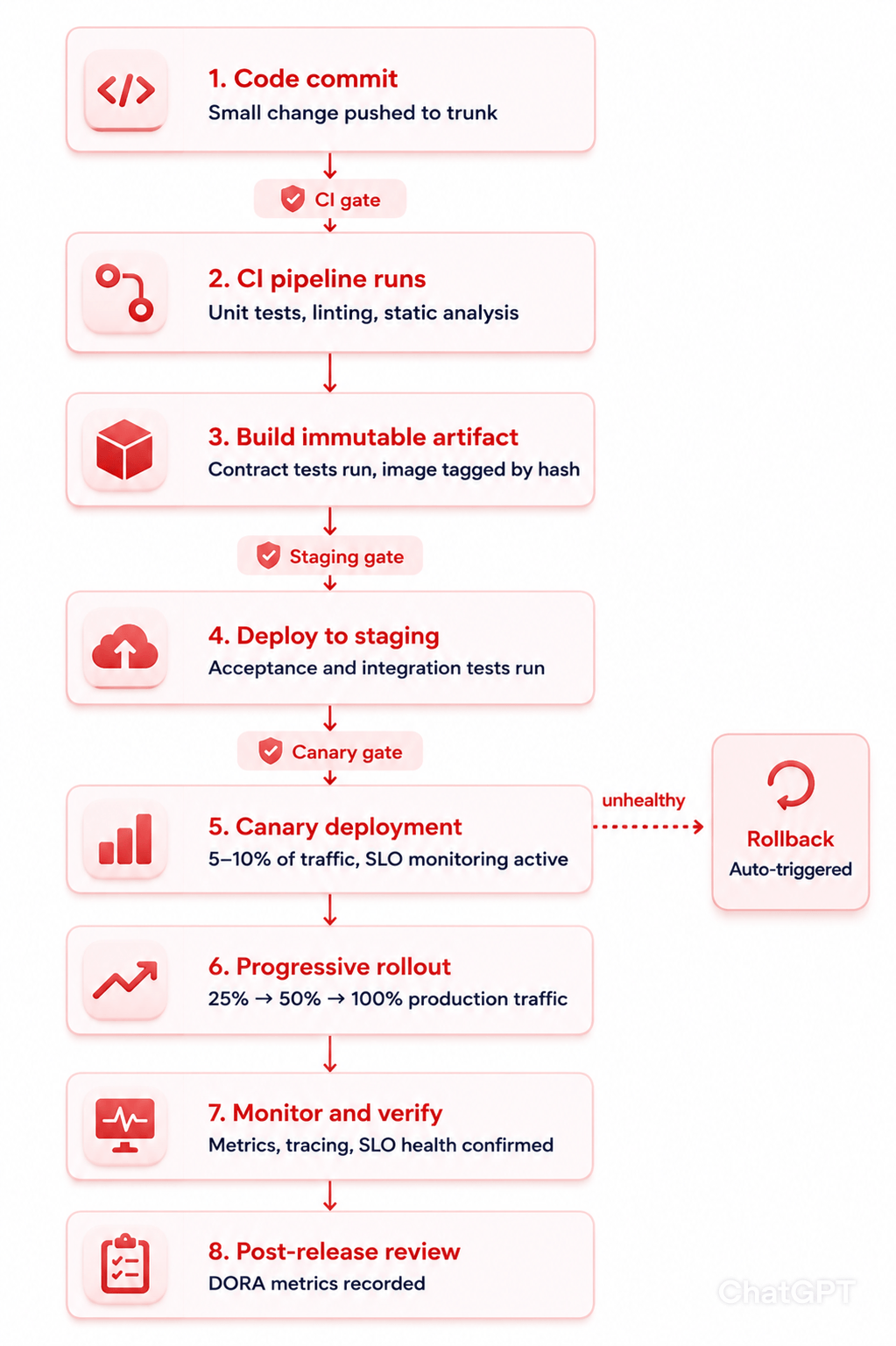
Each stage is a gate. If a gate fails whether at CI, staging, or canary the pipeline stops and the team is notified before the problem reaches users. Teams that implement this flow consistently achieve deployment frequencies measured in hours or days, not weeks.
Managing Technical Debt and Legacy Architecture Problems
Technical debt slowing development is one of the most consistent complaints from engineering leaders at scaling companies. In many organizations, 25–40% of sprint capacity goes to maintenance and rework rather than new features. The challenge is addressing debt without halting product delivery.
The strangler pattern incrementally replaces legacy functionality by routing traffic to new services while the legacy system remains operational. This avoids the big-bang rewrites that delay value delivery and routinely exceed scope and budget. Teams can ship improvements to customers while modernization proceeds in parallel.
Anti-entropy sprints allocate 15–20% of each sprint to refactoring and debt remediation preventing debt from reaching crisis levels without halting velocity.
Compatibility layers implement adapter patterns that shield new features from legacy internals. Teams build new capabilities without touching fragile legacy code, reducing both risk and the hesitation that keeps engineers from innovating in constrained codebases.
This is core Product Sustenance & Support work. Organizations that approach modernization strategically with a clear architecture target and incremental migration path consistently outperform those that attempt wholesale rewrites.
How AI-Ready Architecture Accelerates Product Delivery
Teams building AI-powered features frequently encounter a hard ceiling when their underlying architecture cannot support model serving at scale. AI features fail without scalable product architecture.
A recommendation engine needs stable APIs, low-latency data pipelines, and model versioning infrastructure. An AI copilot in an HCM platform needs to query employee data reliably and serve predictions without degrading application performance all without disrupting the core product delivery cycle.
Designing for AI-ready architecture means separating model serving as an independent service, building data pipelines that support continuous model improvement, and establishing observability for model performance and data drift alongside standard application health metrics.
When your architecture supports these patterns, product teams can release AI-powered features as part of the normal release management process rather than treating each AI release as a special project. This is core AI & Data Engineering capability and in enterprise product engineering, it is increasingly a competitive requirement rather than a nice-to-have.
When Internal Teams Know the Problem but Lack Capacity
Many engineering organizations already understand their release bottlenecks. The challenge is execution under competing constraints:
Architecture bandwidth is consumed by current sprint commitments
Roadmap pressure makes it difficult to pause delivery for platform investment
Internal platform engineering maturity is limited no clear ownership of CI/CD standards or observability frameworks
Legacy constraints make modernization feel like a multi-year undertaking
This is where architecture-led product engineering services and DevOps engineering services create measurable value. A structured engagement identifies the specific bottlenecks causing the most pain, modernizes incrementally without halting delivery, and builds platform capabilities that product teams can consume immediately.
The measure of success is concrete: reduced lead time for changes, higher deployment frequency, lower change failure rate, and a measurable shift in engineering effort from maintenance back toward innovation.
Common Pitfalls to Avoid
Big-bang rewrites delay value and increase risk. Incremental modernization via the strangler pattern almost always outperforms wholesale replacement.
Over-splitting into microservices before organizational readiness creates operational overhead that outweighs the independence benefits. Start with a modular monolith and decompose selectively.
Slow PR feedback loops create context-switching costs that accumulate across the entire team. A 45-minute CI pipeline is not a minor inconvenience it is a structural drag on delivery velocity.
No platform standards mean every team reinvents deployment pipelines and observability stacks independently. The variance compounds as teams scale, creating cross-team release friction that no amount of hiring resolves.
Treating testing as optional creates the cycle of slow, cautious releases that require manual verification before every deployment a compounding trap with no easy exit.
Where to Start: A Practical Implementation Sequence
Rather than prescribing a fixed timeline, this sequence reflects the order of operations that gives most engineering organizations the fastest path from diagnosis to measurable improvement.
Measure first. Baseline your DORA metrics. Identify where time is actually being lost. Without evidence, improvement efforts target assumptions.
Stabilize the pipeline. Automate critical CI checks. Introduce feature flags. Quarantine flaky tests. These changes create a stable foundation for deeper improvements.
Introduce progressive delivery. Implement canary or blue-green deployment for at least one production service. This single change often produces the most visible reduction in release risk.
Address architectural constraints. Apply the strangler pattern to the legacy component causing the most deployment friction. Begin modularizing high-coupling areas of your codebase.
Systematize and scale. Automate infrastructure with IaC. Implement centralized observability. Build platform team capabilities so improvements replicate across teams rather than remaining isolated.
Review and repeat. Delivery improvement is a continuous discipline, not a one-time project. Treat it with its own metrics, ownership, and improvement backlog.
Final Notes
The organizations that ship fastest are not necessarily the ones with the most talented engineers. They are the ones that have invested in software architecture best practices, removed coordination overhead, shortened feedback loops, and built platforms that make doing the right thing the path of least resistance.
Whether you are doing greenfield cloud-native product development, modernizing systems burdened by legacy architecture problems, building AI-ready architecture, or scaling engineering teams through rapid growth the principles remain consistent: reduce coupling, increase automation, shorten feedback loops, and measure continuously.
Software Product Development at scale is not about working harder. It is about building systems that make fast, reliable delivery the default.
If your organization needs help translating these principles into concrete architecture decisions and delivery transformation product engineering services and DevOps engineering services provide the integrated expertise that makes this transition faster and more durable than assembling the capability internally piece by piece.
This guide reflects patterns and practices from enterprise software delivery programs in HCM, Healthcare, and SaaS drawn from real modernization engagements, not theory alone.
Need faster releases without disrupting delivery?