






Building a successful digital product is rarely about getting the first version perfect. Most platforms start with a clear product idea, a lean architecture, and a strong push to deliver value quickly. But as the product grows, the very architecture that enabled speed can begin to slow the team down. What once felt elegant may now create friction across performance, reliability, deployment, and feature delivery.
That is where software re-architecture becomes a strategic decision rather than a technical one. For product leaders, the real question is not whether architecture will eventually need to change. It is when to re-architect a platform and how to tell whether the problem can still be solved with optimization, refactoring, or operational improvements.
This guide breaks down the signals, decision points, and trade-offs product leaders should watch for before committing to a major platform change. It also explains how to evaluate product re-architecture in a way that balances business goals, engineering realities, and long-term scalability the same kind of structured thinking that drives strong outcomes across product engineering services, from early-stage builds to enterprise-scale transformations.
Why Platform Architecture Eventually Breaks Down
Every system has an architecture shaped by early assumptions: team size, user volume, feature scope, transaction complexity, and delivery speed. Over time, those assumptions change. Growth introduces new requirements, and the original architecture may no longer support them efficiently.
Common reasons this happens include:
User growth outpaces the system's design limits
The product expands into new workflows and integrations
The codebase accumulates shortcuts and workarounds
Deployment becomes risky because too many components are tightly coupled
Engineering time shifts from building value to fighting the system
This is usually where technical debt in software development starts to become visible in day-to-day execution. The debt may have been acceptable early on, but it eventually compounds into system architecture problems that affect speed, quality, and cost.
Most teams realize too late when re-architecture becomes unavoidable and expensive. What can be solved in three months today may take twelve months later. And here is what most engineering blogs will not tell you: the majority of teams misdiagnose this as an infrastructure scaling problem when the real issue is coupling components so tightly intertwined that no amount of added compute solves the underlying constraint.
8 Signs Your Software Architecture Is Failing (Before It Breaks Your Product)
The need for re-architecture rarely appears as one dramatic failure. It usually shows up as a pattern of recurring issues. If multiple signs your system needs redesign appear together, that is a strong signal that your platform architecture is no longer aligned with your product's needs.
| Signal | What It Looks Like | Business Impact |
|---|---|---|
| Slow feature delivery | Simple changes take weeks or months | Lost market opportunities |
| Frequent regressions | Fixing one issue breaks another | Lower trust in releases |
| Rising infra costs | Scaling requires disproportionate spending | Reduced margins |
| Application performance issues | Pages, APIs, or workflows slow under load | Poor user experience |
| Unstable deployments | Releases require manual intervention | Higher operational risk |
| Tight coupling | Small changes require multiple teams | Lower engineering velocity |
| Integration pain | New systems are difficult to connect | Slower ecosystem growth |
| Poor observability | Debugging production issues is difficult | Longer incident resolution |
Teams often see 30–50% slower release cycles due to architectural constraints alone. Infrastructure costs can grow 2–3x faster than usage when scaling issues in web applications go unaddressed. Engineering teams may spend 40% or more of their time on maintenance instead of innovation.
These are often the earliest signs your software architecture is failing and the clearest indicators of software system bottlenecks. If the product team is constantly asking developers to "just make this one change" and every change ripples across the platform, the architecture is actively resisting business growth.
If your platform shows 3 or more of these signals, you likely need a formal architecture assessment not another sprint of tactical fixes.
Refactor vs Rebuild: How to Decide When Re-Architecture Is Necessary
One of the biggest mistakes product teams make is assuming every problem requires a rebuild. In many cases, performance tuning, database optimization, caching, or targeted refactoring is enough. The challenge is knowing when to refactor vs rebuild.
A useful rule: if the architecture is fundamentally sound but contains hot spots, optimize. If the architecture itself is blocking the product's next stage of growth, re-architect.
| Situation | Refactor | Re-Architect |
|---|---|---|
| One module is slow or brittle | Yes | Not necessarily |
| Deployment is painful across the whole system | Sometimes | Often |
| New features require major workarounds | Limited benefit | Strong candidate |
| Code quality is inconsistent but manageable | Yes | Maybe later |
| System cannot handle growth without major trade-offs | No | Yes |
| Monolith has become tightly coupled and hard to scale | Limited benefit | Yes |
This is also where leaders should think about legacy system modernization as a continuum, not a binary choice. Sometimes modernization means improving the existing core. Other times it means creating a new foundation while gradually shifting workloads.
How to Know If Your Platform Needs Re-Architecture (Checklist for Product Leaders)
If you are asking how to identify architecture issues in software, start by looking at business symptoms rather than code alone. Architecture is not just a technical concern it shapes product speed, customer experience, and operational cost.
Evaluate these five areas:
Product velocity
Reliability and uptime
Scalability under real load
Cost of change
Team productivity
If two or more of these areas are deteriorating together, the architecture may be failing to support current demand.
Practical indicators to watch:
Release cycles keep getting longer, even when the team grows
Feature requests keep landing in "too complex to estimate"
The same production issue keeps returning in new forms
The platform handles normal traffic well but fails unpredictably during spikes
Teams avoid touching core components because risk is too high
These are strong clues for product leaders trying to spot signs your software architecture is failing before they become existential.
Quick self-diagnosis: Score your platform 1–5 on each of these five areas. If your total falls below 15, your architecture is likely already limiting your product growth.
The Cost of Waiting Too Long
Delaying re-architecture often feels safer because the team can keep shipping in the short term. But the cost of delay compounds every quarter. The hidden cost is that the platform becomes progressively more expensive to maintain.
Common consequences include:
Engineering capacity gets absorbed by firefighting
Roadmap commitments become less predictable
Support and incident response costs rise
The product cannot evolve fast enough to stay competitive
Hiring becomes harder because the codebase is difficult to work in
In many organizations, these issues become visible as application performance issues and increasing customer complaints, but the deeper problem is architectural debt. When the system repeatedly forces the team to compromise, the product begins to lose strategic flexibility.
A healthcare SaaS platform managing patient workflows and clinical integrations saw a 3x increase in API latency under peak load, release cycles growing from two weeks to five weeks, and increasing downtime during deployments. Incremental fixes helped temporarily but could not address the root cause: a tightly coupled monolith where every new workflow touched shared state across the system. A phased modular re-architecture reduced deployment risk by 60% and cut release cycle time by 40%. That outcome is only possible when the structural problem is correctly identified early before a major incident forces a reactive and expensive rebuild.
How to Justify Re-Architecture to Leadership
Re-architecture is not just an engineering decision. It requires alignment across finance, product, and technology leadership. Each stakeholder group evaluates it differently.
How different stakeholders evaluate re-architecture:
CTO concerns: Is the current system creating irreversible technical risk? Can the team continue to ship safely without structural change?
CFO concerns: What is the cost of the current architecture in engineering hours, infrastructure spend, and incident response? How does that compare to the investment required for re-architecture?
VP Engineering concerns: Are teams blocked, slowed, or demoralized by the current system? Is the architecture creating hiring and retention risk?
A practical way to frame the business case:
Estimate the monthly cost of delayed feature delivery in lost revenue or competitive position
Quantify current engineering time spent on maintenance versus new development
Project infrastructure cost growth over the next 12–18 months if the architecture is not changed
Contrast these against the one-time cost of a phased re-architecture engagement
When leaders see that maintaining the status quo costs more over 18 months than the investment required to fix it, the conversation shifts from "can we afford to re-architect" to "can we afford not to."
Common Architecture Problems That Trigger Re-Design
Not every system problem requires a full redesign, but certain patterns strongly suggest it.
The monolith has grown too large and too intertwined
Data models are inflexible and hard to evolve
APIs are inconsistent across services
One failing component brings down the entire platform
Scaling requires vertical capacity increases instead of efficient distribution
Release pipelines are coupled to legacy dependencies
The architecture cannot support modern cloud-native practices
These often point to software scalability issues and create pressure for monolith to microservices migration or another modular architecture shift. However, moving to microservices is not automatically the right answer. If the organization lacks service boundaries, observability, and operational maturity, a migration may create new complexity instead of solving the old one.
When to Move From Monolith to Microservices
The decision about when to move from monolith to microservices should be driven by business and operational needs, not technology trends.
Microservices make sense when:
Multiple teams need to work independently
Different components scale at different rates
The platform requires frequent, isolated deployments
Fault isolation is critical
The domain is large enough to support clear service boundaries
A monolith may still be the better choice when:
The product is early-stage or mid-stage
The team is small
The domain is tightly coupled and not well understood
Operational maturity is limited
Simplicity is a competitive advantage
In other words, microservices solve coordination and scaling problems only when the organization is ready to manage distributed complexity. Otherwise, a well-structured modular monolith may be the smarter path.
The microservices complexity trap is real. Teams that migrate prematurely without mature DevOps practices, clear service boundaries, and strong observability often end up with distributed monoliths: systems that carry the overhead of microservices without any of the benefits.
How Much Does Re-Architecting a Platform Cost?
This is one of the most common questions product and finance leaders ask and one of the least honestly answered in most guides.
The honest answer is: it depends on scope, risk tolerance, and approach. But here is a useful way to think about it.
Factors that drive re-architecture cost:
Size and complexity of the existing codebase
Degree of coupling across components
Volume of integrations and third-party dependencies
Data migration complexity
Team availability and parallel delivery expectations
Whether a full rebuild or phased migration approach is used
A targeted modular refactor of a mid-size SaaS platform may take three to six months and engage a focused engineering team. A full re-architecture of a large enterprise system with multiple integrations may take twelve to eighteen months with a phased rollout.
The more important number is the cost of not re-architecting. If your engineering team spends 40% of its time on maintenance, your infra costs are growing 2–3x faster than usage, and each release cycle is adding two weeks of delay, the financial case for change often becomes clear within a single quarter of honest accounting.
How Long Does Re-Architecture Take?
Timeline depends on complexity and approach, but here are realistic benchmarks:
| Scope | Typical Timeline |
|---|---|
| Targeted module refactor | 6–12 weeks |
| Modular monolith restructure | 3–6 months |
| Phased microservices migration | 6–18 months |
| Full platform re-architecture | 12–24 months |
The phased approach consistently outperforms the big bang rewrite both in delivery predictability and in business continuity.
Can You Re-Architect Without Downtime?
Yes when done correctly, platform re-architecture does not require service interruption. The key is using proven incremental migration strategies rather than attempting a full cutover.
Approaches that minimize or eliminate downtime:
Strangler pattern: Replace old components gradually while the existing system continues to serve traffic
Parallel run: Operate old and new systems simultaneously, validating the new system before cutover
Feature flag-based migration: Enable new architecture paths incrementally for subsets of users
Blue-green deployment: Maintain two production environments and switch traffic when validated
The goal is to make the transition invisible to end users while giving the engineering team confidence at each step.
Platform Re-Architecture Strategy: A Step-by-Step Process
A good platform re-architecture strategy starts with the business outcome, not the technology stack. Product leaders should define what success looks like before any code is changed.
Step-by-step process:
Identify the business pain
Map the pain to architecture symptoms
Classify issues as optimize, refactor, or re-architect
Define the future-state architecture
Plan migration in phases
Validate with measurable technical and product KPIs
Execute with continuous monitoring and rollback controls
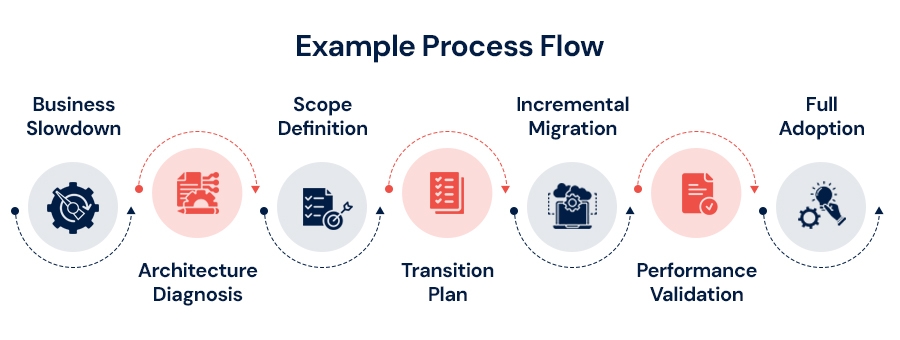
This is where architecture-led software product development becomes critical aligning product roadmap, scalability, and system design early to avoid expensive rebuilds later. A phased approach reduces risk and avoids the "big bang rewrite" trap. It also allows teams to prove the value of change incrementally.
How Product Engineering Enables Safe Re-Architecture
Re-architecture is not just a back-end engineering problem. It spans strategy, design, development, infrastructure, and quality and each phase requires a different discipline working in coordination.
Here is how a full-service product engineering approach maps to each phase of re-architecture:
| Phase | Discipline | Role |
|---|---|---|
| Decision | Product Strategy & Consulting | Define business case, scope, and success metrics |
| Validation | Product Design & Prototyping | Validate new architecture against real user workflows |
| Build | Software Product Development | Implement modular, scalable system components |
| Scale & Deploy | Cloud and DevOps Engineering | Set up pipelines, observability, and rollback controls |
| Reliability | QA Engineering | Validate stability, performance, and regression coverage |
| Evolution | Sustenance Engineering | Maintain and evolve the plat |
This end-to-end alignment is what separates a successful re-architecture from a failed one. When strategy, engineering, and operations move together, risk is contained and value is delivered incrementally.
A Leader's Checklist for Deciding on Re-Architecture
Before committing to a platform-wide change, product leaders should review the following checklist.
| Question | What a "Yes" Suggests |
|---|---|
| Is feature delivery slowing despite a capable team? | Architecture may be the bottleneck |
| Are incidents becoming harder to isolate? | Coupling or observability issues |
| Does scaling cost rise faster than usage? | Inefficient design |
| Are teams blocked by shared modules or databases? | Need for clearer boundaries |
| Are product plans limited by technical constraints? | Architecture is shaping strategy |
| Can the current platform support the next 2–3 years of growth? | If no, re-architecture is likely |
If the answer to multiple questions is "yes," the product should seriously consider re-architecture.
Re-Architecture Versus Modernization: Knowing the Difference
Leaders sometimes use these terms interchangeably, but they are not the same.
Modernization usually means updating components, frameworks, deployment methods, or infrastructure
Re-architecture means changing the structural design of the system
Rebuild means starting over with a new implementation
The right choice depends on the scale of the problem. A team focused on when to upgrade legacy systems may only need modernization. But if the architecture itself blocks scale, resilience, or product evolution, then a deeper redesign is required.
How to Handle System Bottlenecks in Production
Production bottlenecks can reveal whether the platform is fundamentally strained or just poorly tuned. Product leaders should pay close attention to repeated incidents, slow queues, timeouts, and customer complaints during peak usage.
How to handle system bottlenecks in production:
Measure where latency begins
Identify whether the issue is compute, storage, network, or code
Check whether the bottleneck is isolated or systemic
Apply targeted fixes if it is isolated
Reassess architecture if bottlenecks are recurring across services
When the same pressure points keep returning, it is often a sign that tactical fixes are masking a structural issue. Recurring software system bottlenecks across multiple services are one of the clearest signals that the architecture itself needs to change.
Where Product and Engineering Leadership Must Align
Re-architecture fails when it is treated as a purely technical initiative. Product leaders need to align the redesign with customer value, roadmap priorities, and revenue impact. Engineering leaders need to translate architectural constraints into business risk.
This is where product strategy and consulting can help organizations frame the decision objectively, especially when multiple stakeholders disagree about the urgency of change. Product design and prototyping can also play a role in validating new architecture directions against real user needs before significant engineering investment is committed.
Teams offering architecture-led product engineering often support this kind of evaluation by analyzing both product direction and system health bridging the gap between what the business needs and what the system can actually support.
Choosing the Right Modernization Path
There is no universal answer to platform change. The right path depends on product maturity, scale, risk tolerance, and team capability.
| Condition | Best Path |
|---|---|
| Small team, early product | Optimize or refactor |
| Growing product, moderate complexity | Modularize and modernize |
| Large team, frequent releases, strong boundaries | Re-architect selectively |
| Severe coupling and repeated failures | Major re-architecture or rebuild |
| Legacy platform with business-critical usage | Incremental modernization |
This decision framework is especially relevant for Series A and B SaaS companies and enterprise platforms where architectural constraints begin limiting go-to-market speed, customer experience, and cost efficiency simultaneously.
What Product Leaders Should Ask Before Starting
Before launching a re-architecture effort, leaders should ask:
What business problem are we solving?
Which architectural constraints are limiting us?
Can the current system support the next product phase?
What risks increase if we do nothing?
What is the smallest change that creates meaningful improvement?
These questions keep the conversation grounded in outcomes rather than implementation preferences.
Final Take
Knowing when should you re-architect your application is ultimately about recognizing when your current platform no longer matches your business ambitions. If feature delivery has slowed, performance has degraded, incidents are harder to manage, or the product cannot scale without major trade-offs, the architecture may be the limiting factor.
The best decisions are rarely made at the first sign of trouble. They come from observing patterns, measuring impact, and distinguishing between when to refactor vs rebuild. For many teams, the right path is a phased redesign supported by strong engineering discipline, clear product priorities, and a realistic transition plan.
Are your releases slowing despite team growth? Are infra costs rising faster than usage? Are the same production issues appearing in new forms every quarter? If yes, your platform may already be past the point where optimization alone is enough.