


 Updated on 21 May 2026

Introduction
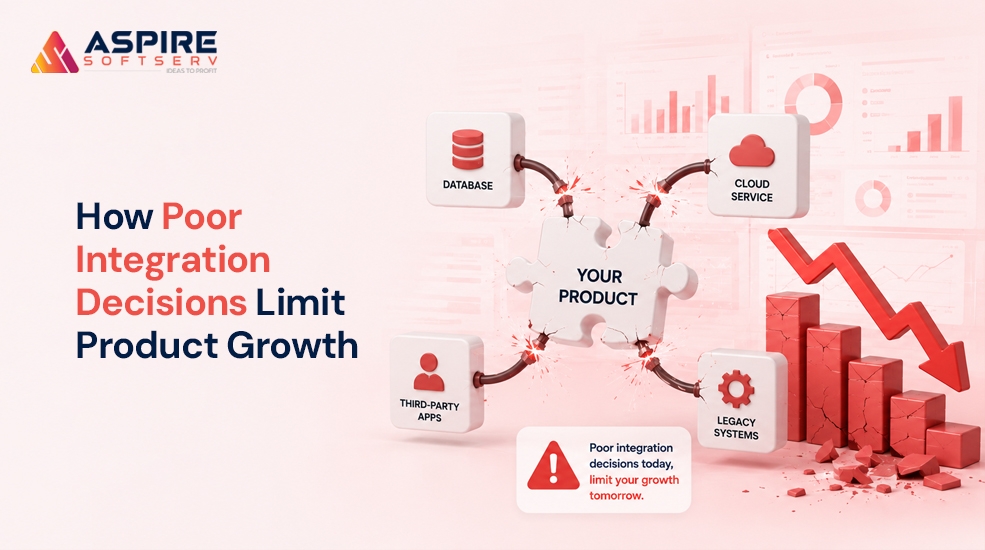
Every software product reaches a point where the real bottleneck isn't the idea, the team, or even the funding. It's the integration layer the invisible connective tissue binding your internal modules, third-party services, APIs, and infrastructure together.
For growing product teams, especially those scaling users and onboarding enterprise customers, integrations become the biggest hidden bottleneck. When those connections are designed well, products scale gracefully. When they aren't, growth stalls. Releases slow down. Partners churn. Engineering teams spend more time firefighting than shipping.
This is the hidden cost of poor software architecture design and it compounds quietly until it becomes a crisis. This is also where modern product development services focus heavily on integration-first architecture, because fixing it later is almost always 3–5x more expensive than designing it right the first time.
Why Integration Is a Strategic Decision, Not Just a Technical One
Integration decisions directly impact how fast your product grows, how much it costs to run, and how easily you can scale. Most teams treat integration as a plumbing problem something to wire up quickly and move on from. That's the first mistake.
From a business perspective, poor integration shows up as slower releases and delayed revenue opportunities. For leadership, it often looks like increasing cost without proportional growth. Integration decisions directly determine:
How fast your team can ship new features without cross-team coordination overhead
Whether your product can handle 10x user growth without performance degradation
How quickly you can onboard enterprise customers and new partners
How much your infrastructure and support costs escalate at scale
A poorly designed integration doesn't just slow engineers down it slows revenue. It increases churn. It makes enterprise sales harder. For growing companies, system integration challenges are product strategy problems disguised as engineering problems.
The Most Common Integration Failure Modes
Integration problems follow predictable patterns. Recognizing them early is the difference between a fixable architecture and a complete rebuild.
1. Tight Coupling at the Wrong Boundaries
When services call each other directly with synchronous blocking behavior and share database schemas, one change requires coordinated deploys across multiple teams. One failing service cascades into broader outages. This is one of the most damaging integration issues in software development manageable early on, catastrophic at scale.
2. Poor API Design and Versioning
APIs without semantic versioning or backward compatibility guarantees are landmines. Every update risks breaking integrations with customers, partners, or internal services. This is a leading cause of API integration problems that teams underestimate until a major customer churns or a partner escalates.
3. Inconsistent Data Models and Pipelines
When the same business entity is represented differently across systems, you get reporting errors, reconciliation overhead, and analytics you can't trust. Bad data integration issues lead to poor product decisions built on inaccurate foundations and erode stakeholder confidence over time.
4. Ad Hoc Third-Party Integrations
Point-to-point connectors built quickly for each new vendor create a sprawling, brittle network. When a vendor changes their API and they will every connector breaks independently. These are among the most common third-party integration problems in SaaS products, particularly when there's no abstraction layer separating vendor logic from core business logic.
5. No Observability Across the Integration Layer
If you can't see where failures happen, you can't fix them efficiently. Without distributed tracing and integration-level SLOs, latency spikes and silent errors are nearly impossible to diagnose. This dramatically inflates SRE overhead and mean time to resolution.
6. Forcing Synchronous Patterns Where Async Would Suffice
Synchronous calls on the critical path create scalability ceilings. Under load, response times spike and user experience degrades. Many integration issues in cloud-native applications trace back to this exact problem architectures that worked fine at 10,000 users collapsing at 100,000.
How Integration Problems Map Directly to Business KPIs
| Integration Problem | Business Impact |
|---|---|
| Tight coupling between services | Slow releases, frequent regressions, delayed features |
| No API versioning | Partner churn, broken customer integrations |
| Inconsistent data models | Poor decisions, lost stakeholder trust |
| Ad hoc third-party connectors | Slow partner onboarding, compliance risk |
| No observability or tracing | High SRE costs, user-facing downtime |
| Synchronous calls on critical path | Scalability ceiling, poor UX at scale |
If your product is already facing two or three of these issues, it's usually not a quick fix. It points to deeper architectural gaps that need structured product engineering, not patchwork solutions applied one at a time.

Real-World Patterns: What This Actually Looks Like
SaaS Onboarding Slowdown
A mid-market HR software company found that every new payroll provider integration took 6–8 weeks to ship, with frequent regressions after provider API updates. The root causes were point-to-point connectors with no abstraction layer, no contract tests, and provider-specific logic embedded deep in the monolith. After building an adapter layer with automated contract testing, onboarding time dropped to 2 weeks and support tickets fell by 60%. This is a textbook case of enterprise system integration challenges that scale poorly without architectural guardrails.
Mobile App Latency Under Load
A consumer fintech product saw latency climb from 200ms to 1.5 seconds under 2x normal traffic the direct result of a synchronous call to an external fraud detection API sitting on the critical user path with no circuit breaker and no fallback. This is a clear example of how poor system integration affects scalability in ways that are invisible until traffic grows. Moving enrichment to an event-driven pipeline and adding circuit breakers with OpenTelemetry tracing brought latency back under 250ms and reduced error rates by 70% during traffic spikes.
Teams that have experienced these patterns firsthand understand one thing clearly: the impact of bad integration on product performance is never isolated to one component. It spreads.
Quick Self-Assessment: Is Your Product Hitting Integration Limits?
Run through this checklist honestly. It takes two minutes and will tell you more than most architecture reviews:
Are APIs documented and versioned? (Yes / No)
Do services share databases or schemas? (Yes / No)
Is there distributed tracing across integration points? (Yes / No)
Are SLAs and failure behaviors of third-party services modeled? (Yes / No)
Do async patterns exist where they're needed? (Yes / No)
Is there a canonical data model with a single source of truth? (Yes / No)
If you answered "No" to two or more, you likely have integration-related growth limits today. Most teams don't realize this until releases slow to a crawl or a major incident surface in production.
Key Takeaways for Product Leaders
Before going deeper into solutions, here's what matters most from a business and architecture perspective:
Integration problems slow product growth more than most code quality issues
Most risks come from early architectural shortcuts that made sense at the time
Fixing integrations reactively is 3–5x more expensive than designing them right upfront
Scalable products invest in integration design early not after the first crisis
Most teams try to fix these issues one by one, but without a structured product engineering approach, the same problems resurface in different forms
Integration Architecture Patterns That Scale
Fixing integration problems doesn't mean rewriting everything from scratch. It means applying the right patterns at the right architectural boundaries.
API Gateway + Backend for Frontend (BFF)
Centralizing cross-cutting concerns authentication, throttling, routing, logging through an API gateway prevents duplication and gives you a single control plane. BFF patterns let you tailor APIs for mobile and web clients separately, reducing over-fetching and improving performance. This is foundational to integration architecture best practices for any product serving multiple client surfaces.
Event-Driven Architecture (EDA)
Decoupling producers from consumers through an event bus eliminates synchronous dependencies for non-real-time workflows. Events with stable schemas, registered in a schema registry, become the reliable backbone of your system. This pattern is central to how modern product engineering solutions address scalability without sacrificing reliability.
Adapter Layer for Third-Party Services
Rather than embedding vendor-specific logic throughout your codebase, an adapter layer abstracts each provider behind a uniform interface. Swap vendors, handle breaking changes, and onboard new partners without touching core business logic. Combined with contract testing, this dramatically reduces the impact of bad integration on product performance when providers change their APIs.
Service Mesh for Resilience and Observability
A service mesh provides consistent mTLS, automatic retries, circuit breaking, and telemetry across all services especially valuable as your software product development matures and the number of internal services grows beyond what manual coordination can handle.
Canonical Data Model with Data Mesh Principles
Define canonical entities and publish them via readable contracts. Domain teams own their data products, and consumers rely on stable, versioned interfaces. This eliminates the silent data drift that causes data integration issues at scale.
Integration Decision Lifecycle: Process Flow
Discovery → Design → Build → Test → Deploy → Operate → Iterate
| Phase | Key Actions |
|---|---|
| Discovery | Audit integrations; classify by business impact and failure risk |
| Design | Define contracts and SLA expectations; choose sync vs. async deliberately |
| Build | Implement adapters and mocks; isolate all provider-specific logic |
| Test | Add consumer-driven contract tests; run smoke tests in CI |
| Deploy | Use staging with synthetic traffic before production cutover |
| Operate | Monitor SLOs, distributed traces, and cost-per-request metrics |
| Iterate | Apply versioning; communicate deprecation timelines to partners |
This lifecycle separates teams that scale cleanly from those who accumulate software integration challenges with every new feature shipped. Product engineering consulting brings this structured approach to teams that are moving fast but starting to feel the weight of early architectural decisions.
Prescriptive Steps to Fix Integration Problems
Architecture & Design
Favor async communication; use synchronous calls only for user-facing flows requiring immediate response
Apply the adapter pattern for every third-party service; keep provider logic out of core domain services
Define a canonical data model and enforce it through schema registries (Avro, Protobuf, JSON Schema)
Implement semantic API versioning and maintain backward compatibility as a non-negotiable standard
Resilience & Observability
Add retries with exponential backoff, circuit breakers, bulkheads, and timeouts on all external calls
Instrument distributed tracing with OpenTelemetry and define integration-specific SLOs not just service-level metrics
Run chaos tests simulating third-party outages to validate graceful degradation before it happens in production
Testing & CI/CD
Add consumer-driven contract tests (Pact or similar) to every CI pipeline
Run integration smoke tests against provider sandboxes or recorded responses
Automate end-to-end tests that include third-party dependencies in isolated environments
Security & Compliance
Never share database credentials or allow direct DB access with external services
Use short-lived tokens, OAuth2, and mTLS for all external authentication flows
Conduct third-party risk assessments before onboarding new vendors; maintain an approved vendor registry
Data Integrity
Prefer event-driven replication for analytics stores to avoid coupling to OLTP databases
Enforce schema validation at every integration boundary to stop dirty data propagation
Track data lineage for compliance, troubleshooting, and audit requirements
Most teams attempt to address these areas independently. But without a structured digital product engineering approach that connects architecture, testing, and operations into a coherent system, the same failure modes resurface in different forms six months later.
Common Mistakes Teams Make (and Why)
| Mistake | Why It Happens | Consequence |
|---|---|---|
| Shared DB schemas across services | Short-term speed, legacy monoliths | Tight coupling, hard migrations |
| No API versioning | Governance deprioritized | Breaking changes for partners |
| Point-to-point connectors | Quick ad-hoc builds | Brittle, unmaintainable code sprawl |
| No contract testing | Test coverage gaps | Integrations break on provider changes |
| Sync calls on critical path | Simplicity preference | Scalability ceiling, poor UX |
| No observability investment | Considered non-essential early | Slow incident resolution, high SRE cost |
When Should You Take Integration Problems Seriously?
The answer is before they surface in production. But there are clear signals that it's already time to act:
Feature delivery timelines are growing even though the team size hasn't changed
Onboarding new partners or enterprise customers takes weeks when it should take days
You can't add a third-party service without risking a regression somewhere else
Production incidents regularly trace back to an integration point
Engineers are spending more time debugging cross-service issues than building new features
For leadership, these signals often look like a team that's growing but delivering less. The root cause is almost always architectural and this is precisely where product engineering consulting brings the most value. Not just identifying what's broken, but building the governance, tooling, and design patterns that prevent the next round of breakage from happening at all.
90-Day Migration Roadmap
| Weeks | Focus Area |
|---|---|
| 1–2 | Audit existing integrations; classify by risk and business impact |
| 3–6 | Add tracing, standardize API gateway rules, implement circuit breakers for critical flows |
| 7–12 | Build adapter layer for top 3 third-party systems; add consumer-driven contract tests |
| 13–16 | Introduce canonical data models and deploy event bus for decoupling |
| 17–20 | Add CI gates, sandbox testing, and chaos testing for third-party failure scenarios |
| 21–26 | Migrate traffic using strangler pattern; monitor SLOs and iterate on issues |
How to Measure Progress: Integration Health KPIs
Once you begin fixing integration problems, track these metrics to confirm movement in the right direction:
Mean time to integrate how long new partner onboarding actually takes
Mean time to detect how quickly integration failures are identified
Integration error rate per 10,000 requests
95th percentile latency for integration calls under load
Number of production incidents attributable to integration points
Customer onboarding success rate and time-to-value
These metrics turn integration health into a business conversation the kind that belongs in a quarterly review, not just a technical postmortem.
Conclusion
Integration decisions are not purely technical choices they are strategic ones that determine how fast your product grows, how much it costs to operate, and how well it competes. Poor integration creates coupling, fragility, and escalating costs that compound silently until they surface as slow releases, rising churn, and failed enterprise deals.
The good news is that these problems follow predictable patterns and respond well to structured remediation. By applying proven architectural approaches API gateways, adapter layers, event-driven architecture, contract testing, and observability teams can transform their integration layer from a growth limiter into a genuine competitive advantage.
Strong product engineering services ensure that integrations support growth rather than block it. If integrations are slowing your product down or making releases harder than they should be, the right product development services partner can help you identify the root cause and fix it without disrupting your existing roadmap.
If your product is showing the early signs of integration-related slowdown, we can help you find the root cause and build the architecture that scales with your growth not against it.