


 Updated on 31 March 2026

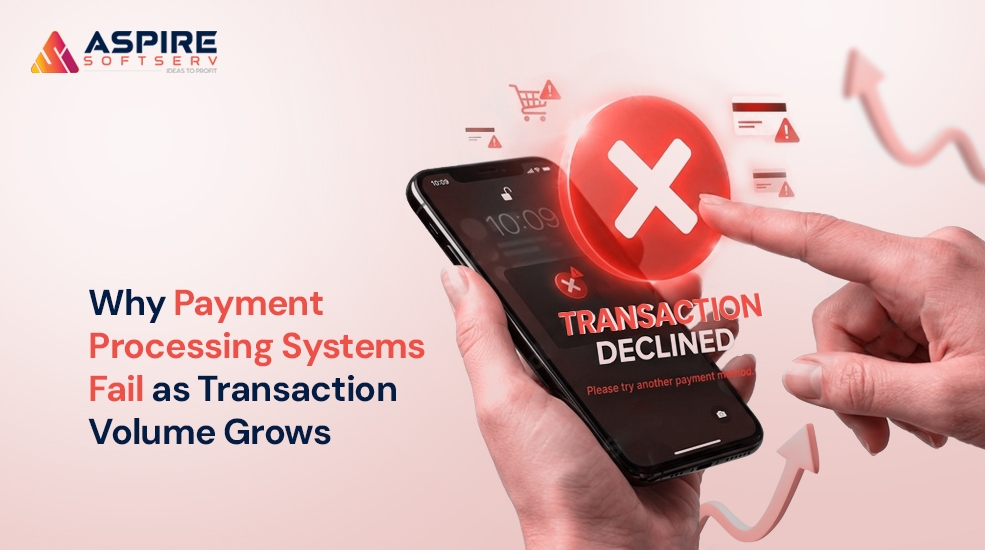
If your finance team is spending more time chasing reconciliation discrepancies than reviewing actual business metrics, you are likely not dealing with a people problem. You are dealing with an architecture problem baked into your payment processing system from its earliest days.
This is not just a payment problem. It is a product engineering problem how your system was designed to handle growth.
This usually starts quietly. Your platform handles a few thousand transactions daily without issue. Then volume grows ten thousand, fifty thousand, a hundred thousand transactions a day and suddenly reports do not match, settlements get delayed, and manual reconciliation starts eating hours every week. What felt like minor technical debt becomes a recurring operational fire.
This blog breaks down exactly why payment processing platforms fracture under growing transaction volumes, what the underlying architecture failures look like, and how engineering teams at mid-market FinTech companies can fix the foundation before it becomes a compliance or revenue problem.
The Real Cost of Reconciliation Failures
Before diving into the technical breakdown, consider this: a 1% transaction mismatch rate for a platform processing one million daily transactions at even $0.01 average value translates to $10,000 in daily exposure roughly $3.6 million annually. That figure compounds when you factor in regulatory penalties under PSD2 or PCI-DSS, which demand complete audit trails and near-perfect uptime.
According to a 2025 Deloitte report, 68% of FinTech firms report reconciliation failures costing over $5 million annually. The majority of these are not giant enterprises. They are fast-growing platforms that scaled their transaction volume without scaling their reconciliation architecture alongside it.
Common Payment Reconciliation Problems Teams Search For
Before diagnosing root causes, it helps to name the symptoms your team is likely already experiencing. These are the most common issues mid-market FinTech teams report and the exact pain points that signal an architecture problem:
Payments received but not matched in the ledger
Duplicate transactions appearing after retry attempts
Delayed settlements with no clear reason
Reports not matching finance records across systems
Manual reconciliation workload growing week over week
Specific transaction types consistently causing exceptions
If two or more of these are familiar, the rest of this blog is directly relevant to your situation.
Check If Your System Is Already at Risk
Most teams discover architecture limitations reactively after a merchant complaint, a compliance flag, or a finance team escalation. These are the signals that indicate your reconciliation layer is already under strain:
You cannot quickly explain why a specific payment shows as unmatched
Your finance team depends on engineering to investigate reconciliation exceptions
Fixing one reconciliation issue seems to create another elsewhere in the system
Certain parts of the codebase are avoided because changes tend to break reconciliation flows
Mismatch rates are trending upward even during normal volume periods not just during peak loads
If this describes your current situation, it is not a scaling issue waiting to happen. It is an architecture limitation already affecting your operations.
How Payment Reconciliation Actually Breaks
Payment processing systems ingest data from multiple sources simultaneously payment gateways like Razorpay or PayPal, bank APIs, merchant ledgers, and internal CRMs. At modest volumes, a simple rules engine and relational database keeps up. As volume grows, mismatches appear from four distinct failure points.
Volume Overload
Batch processors designed for 5,000 transactions per run start creating backlogs when runs hit 50,000 or 100,000. What processed in 10 minutes now takes 90, and the next batch begins before the previous one completes. Finance teams lose real-time visibility entirely during these windows.
Data Delays From Asynchronous Events
A payment is confirmed on your side but the bank API confirmation arrives 8 seconds later. Your system has already logged it as unmatched. Now you have an orphaned transaction requiring manual intervention.
A simple example: a payment of ₹4,500 is received but sits unmatched because the bank API response was delayed by 6 seconds just outside your system's matching window. This shows as a discrepancy in your ledger, triggers a manual review, and if it happens thousands of times daily, your finance team is buried in exceptions.
Duplicate Transaction Problems
When a payment retry fires without a unique transaction identifier, your system records the same transaction twice. At scale, 5 to 15% false positives from duplicates translate directly into overpayment liabilities and reconciliation confusion.
Schema Incompatibilities
When a gateway updates their API increasingly common with ISO 20022 mandate rollouts legacy parsers break without warning. A single schema incompatibility can cause a system-wide halt lasting hours.
Table 1: Common Transaction Reconciliation Issues and Their Business Impact
| Issue Type | Description | Business Cost Example |
|---|---|---|
| Duplicates | Identical transactions from retries without unique keys | Overpayment liabilities, finance team overhead |
| Orphaned Transactions | Unmatched inbound/outbound due to API latency | Regulatory fines, delayed settlements |
| Partial Matches | Amount rounding errors or reference mismatches | Manual intervention, SLA breaches |
| Latency Drift | Bank APIs lag beyond matching window | Customer complaints, churn risk |
| Schema Incompatibilities | Gateway updates break legacy parsers | System downtime, revenue loss |
Why Traditional Architectures Crumble Under Growth
If your reconciliation takes hours instead of minutes, your system is almost certainly hitting one of these three structural problems.
Most payment processing platforms at the 10K–50K daily transaction stage are running some version of an ETL pipeline: extract payment data from sources, transform it through a rules engine, and load it into a central ledger. This architecture works reliably at low volumes. It has three weaknesses that surface predictably as volume grows.
Monolithic bottlenecks prevent parallel processing. A single-threaded matching engine processes transactions sequentially. When transaction volume doubles, processing time more than doubles and when that engine fails, everything stops.
Relational databases ensure data accuracy, but they slow down significantly when transaction volume grows. Standard SQL clusters begin throttling write operations well before most mid-market platforms realize they have hit a ceiling. A well-documented 2024 incident at a major payment processor demonstrated this exactly SQL Server clusters forced failover cascades that impacted settlement windows for thousands of merchants.
Batch processing windows are fundamentally incompatible with real-time expectations. Hourly reconciliation batches meant acceptable delays in 2018. In 2025, merchants and end users expect near-real-time settlement visibility. Hourly batches mean an hour of financial blind spots unacceptable from both a customer experience and a compliance standpoint.
When Should You Fix Your Reconciliation Architecture?
The right time is much earlier than most engineering leaders assume. Here are the specific signals that indicate your current architecture is reaching its limits:
Daily mismatch rates are trending upward without changes to your codebase
Your finance team's manual reconciliation workload is growing week over week
Settlements are delayed past agreed SLAs with merchants or customers
Reports from different systems show different numbers for the same time period
Gateway schema updates have caused reconciliation failures more than once
If two or more of these are true, the architecture work needs to be on your roadmap now not after the next growth phase.
The Scalable Architecture Fix: A Practical Roadmap
Rebuilding a reconciliation layer does not require replacing everything simultaneously. The most successful migrations move in phases, maintaining operational continuity throughout.
Phase 1: Change How Transactions Flow Through Your System
To fix this, you do not need to rebuild everything. You need to change how transactions enter and move through your system.
The first and most impactful change is replacing polling-based batch ingestion with a streaming architecture. Instead of pulling transaction data every hour, every payment event initiated, confirmed, refunded is published in real time to a partitioned data stream using tools like Apache Kafka or Apache Pulsar.
At a practical level, this means:
Event-based processing replaces batch jobs for real-time transaction flows
Clear separation between transaction ingestion and downstream matching logic
Each event carries a unique transaction identifier, which eliminates the root cause of most duplicates
Stream processors like Apache Flink or Kafka Streams then consume these events and route them to the matching engine. Schema Registry tools handle API evolution gracefully, so gateway updates no longer cause parsing failures.
Product Strategy & Consulting alignment is critical here. Streaming architecture choices need to map directly to your business SLAs whether high-value merchant reconciliation requires sub-minute windows or whether standard end-of-day processing is acceptable for lower-value flows.
Phase 2: Build a Matching Engine That Handles Reality
Once events are streaming cleanly, the matching engine needs to handle both exact and approximate matching. Most growing platforms need two modes running in parallel.
Deterministic matching handles clear-cut cases: exact matches on transaction ID, amount, and timestamp. This covers roughly 80–85% of transaction volume in a well-maintained system.
Probabilistic matching handles the remainder partial matches caused by rounding differences, reference number inconsistencies, or timing mismatches. ML-based approaches achieve 97% accuracy even on fuzzy matches.
For platforms with complex payment structures split payments, multi-party settlements, marketplace flows graph-based matching provides 99% accuracy by modeling the relationship network between transactions rather than matching individual records in isolation.
Table 2: Matching Engine Approaches Compared
| Approach | Accuracy | Best For | Tools |
|---|---|---|---|
| Rule-Based | ~85% | Simple, high-volume exact matching | Drools, custom SQL |
| ML-Enhanced | ~97% | Fuzzy matching, reference mismatches | Flink ML, Faiss |
| Graph-Based | ~99% | Split payments, marketplace flows | Neo4j, JanusGraph |
Product Design and Prototyping approaches work well here build a prototype matching engine against a sample of your historical transaction data before committing to a full deployment. This validates accuracy targets without production risk.
The matching engine is deployed as a containerized microservice, enabling Cloud and DevOps Engineering teams to configure auto-scaling rules tied to queue depth. When transaction volume spikes during peak periods, additional matcher instances spin up automatically.
Phase 3: Storage That Handles High Write Volumes
The storage layer has two distinct requirements that most relational databases handle poorly under load: high-throughput writes and flexible reads for reporting and exception queries.
For writes, distributed databases designed for append-only ledgers such as Apache Cassandra provide high durability without the write serialization bottleneck of traditional relational systems.
For reads and reporting, search-optimized databases handle fuzzy transaction lookup, while analytical query engines handle mismatch trend analysis and settlement timing reports.
For orphan recovery, time-to-live queues automatically requeue unmatched transactions after a configurable window typically 5 minutes eliminating the manual follow-up that occupies finance teams in legacy systems.
Software Product Development best practices apply strongly here: zero-downtime migrations using dual-write patterns ensure the existing production system continues operating while the new storage layer is validated in parallel.
Phase 4: Monitoring and Auto-Remediation
A reconciliation system without real-time observability is incomplete. Production monitoring should include:
Mismatch rate tracking with automatic scaling triggers
Latency percentile dashboards tracking p99 response times
Schema drift detection that alerts before parsers fail
Automated exception resolution for common orphan patterns
Chaos engineering exercises simulating partial node failures, network partitions, and upstream API delays validate that the system degrades gracefully rather than causing a complete halt.
Real-World Case Study: A Mumbai-Based Neobank Reaching 2M TPS
A Mumbai-based neobank (anonymized) integrated with Razorpay and faced compounding payment reconciliation challenges as daily transaction volumes grew. Their legacy MySQL batch architecture hit a 20% failure rate at 100K TPS peaks, with finance teams spending 15+ hours weekly on manual reconciliation.
The migration followed the phased roadmap above:
Kafka and Flink replaced batch ingestion, reducing p99 latency by 80%
Graph-based matching, designed through product engineering consulting, brought mismatch rates from 15% to under 1%
Deployment on AWS EKS with auto-scaling, managed through Cloud and DevOps Engineering, now handles 2M TPS peaks reliably
Table 3: Before and After Metrics
| Metric | Before (Legacy) | After (New Architecture) | Improvement |
|---|---|---|---|
| p99 Reconciliation Latency | 12 seconds | 180 milliseconds | 97% faster |
| Mismatch Rate | 15% | 0.8% | 94% improvement |
| Monthly Infrastructure Cost | $150,000 | $90,000 | 40% savings |
| System Uptime | 99.2% | 99.99% | Significant improvement |
Most teams do not realize these improvements are possible without replacing their entire system. The key is fixing the right layers first ingestion, matching, and storage while keeping production running throughout the migration.
Implementation Timeline
Weeks 1–4: Audit and Prototype Map all transaction data sources, identify top failure patterns using historical mismatch logs, and build a proof-of-concept matching engine against sample data. Product Design and Prototyping disciplines apply here validate assumptions cheaply before committing to infrastructure investment.
Weeks 5–8: Migrate to Event-Driven Ingestion Implement dual-write to streaming infrastructure while keeping existing batch pipelines live. Validate event completeness before cutting over. Cloud and DevOps Engineering CI/CD pipelines ensure rollback capability at every step.
Weeks 9–12: Deploy Distributed Matching Engine Blue-green deployment of the new matching engine alongside production. Software Product Development testing frameworks validate accuracy against full transaction history before traffic shifts.
Week 13 onward: Optimize and Scale Tune auto-scaling rules, establish ongoing SLO monitoring, and conduct quarterly resilience exercises.
Cost Optimization: What This Actually Costs
Modern reconciliation architectures are not necessarily more expensive than legacy systems particularly when you account for the full cost of the legacy approach: manual reconciliation labor, regulatory penalty exposure, and the engineering time spent firefighting recurring failures.
Serverless components handle low-volume matching workloads cost-effectively. Reserved and spot instance pools manage peak loads efficiently. The neobank case above achieved 40% infrastructure cost reduction while dramatically improving reliability.
A useful benchmark: a 1% improvement in mismatch rate for a platform processing one million daily transactions at $0.01 average value saves approximately $1 million annually in direct exposure. For most mid-market FinTech platforms, the architecture investment pays back within the first year.
Free Checklist: Payment Reconciliation Health Check
Use this to assess whether your current reconciliation architecture is operating within healthy parameters or approaching a failure threshold:
Matching and Accuracy
Are transactions matched within your expected time window consistently?
Is duplicate detection working reliably across all retry scenarios?
Are partial match rates below 5% of total volume?
Operational Overhead
Can your team explain any specific mismatch within 10 minutes without a database query?
Is your finance team's manual reconciliation workload stable or declining?
Scalability
Can your system handle 2x current volume without degraded latency?
Are mismatches automatically resolved for common exception types?
Resilience
Does a gateway schema update require emergency engineering response?
Are settlement delays isolated to specific flows or affecting all transactions?
If you answered "no" to three or more of these, your reconciliation architecture needs a structured review before the next growth phase.
Conclusion: Architecture Problems Do Not Wait for Enterprise Scale
The most expensive time to fix a payment processing system is after it has failed in production, triggered a compliance incident, or caused a merchant settlement dispute. The architecture decisions that create these failures are typically made early when a platform is still small enough that the problems are invisible.
The shift from batch-oriented, monolithic reconciliation to event-driven, modular architecture is not a moonshot project. Executed in phases over 13 weeks, it produces measurable improvements in accuracy, latency, and cost while reducing the regulatory and operational risk that comes with growing reconciliation failures.
If your reconciliation system is producing increasing mismatches, generating growing manual workload for your finance team, or showing inconsistent numbers across reports, these are architecture signals not operational ones. A focused architecture review can identify where delays, duplication, or data gaps originate before they impact revenue or compliance.
Still fixing payment errors manually?