

 Updated on 19 March 2026


When Growth Becomes the Problem: A FinTech Engineering Reality Check
Most investment platforms are not built for the scale they eventually need to support. They are built for what exists today a few thousand users, manageable transaction volumes, and predictable traffic patterns. The engineering decisions made at that stage are entirely reasonable. But when user growth accelerates, when market volatility drives traffic spikes, or when institutional clients demand real-time portfolio visibility, those early decisions become expensive constraints.
This is not a hypothetical. It is a pattern seen repeatedly across wealth management platforms, trading portals, and digital banking products. The architecture that served 10,000 users becomes brittle at 500,000. The database design that worked at moderate load collapses under high-frequency trading data. The monolithic deployment that took 20 minutes to release now takes months to safely change.
Scaling an online investment platform is not purely a technical problem. It is a product engineering problem one that involves trade-offs, architecture decisions, business priorities, and long-term thinking. This blog explores how senior engineering and product leaders can approach that challenge with clarity.
The Hidden Cost of Poor Architecture Decisions
Before discussing solutions, it is worth understanding what is actually at stake when an investment management software platform fails to scale. The consequences are not limited to slow page loads. A CTO at a mid-sized asset management firm described it this way: "We were scaling headcount and infrastructure simultaneously, but our architecture was still designed for a startup. Every new feature took three months because everything was interconnected. We were not building anymore we were patching."
The real business costs behind that statement are significant:
Trading windows missed due to order processing delays
Compliance failures caused by audit trail gaps during downtime
Customer churn when institutional users lose confidence in platform stability
Engineering teams spending 60–70% of their time firefighting rather than building features
Infrastructure costs growing faster than revenue because horizontal scale was never designed in
Mature fintech platform engineering teams typically ship production releases every one to two weeks. When release cycles stretch to months, the root cause is almost always architectural not a people problem or a process problem. This is exactly where product strategy & consulting must intervene before patching becomes more expensive than rebuilding.
The Architectural Shift That Changes Everything
The transition from monolithic to microservices architecture is widely discussed but frequently misunderstood as a purely technical migration. In practice, it is a product and organizational decision as much as an engineering one. The real question is not "should we migrate?" but "which services carry the most business risk, need to scale independently, and are most likely to change frequently?" That framing is product design and prototyping thinking applied to backend infrastructure.
| Aspect | Monolith | Microservices |
|---|---|---|
| Scaling | Vertical only, limited | Horizontal, elastic |
| Deployment | Full system restarts | Independent CI/CD per service |
| Fault Isolation | System-wide failure risk | Service-level quarantine |
| Feature Velocity | Slower, high coupling | Faster, isolated ownership |
| Maintenance Cost | High due to dependencies | Reduced by ~30% over time |
In a microservices model, each functional domain user authentication, portfolio management, trade execution, reporting operates as an independent service. This means the trade execution engine can handle a 5x traffic spike during market volatility without affecting the portfolio analytics service or the user onboarding flow. One banking firm that executed this migration using the strangler pattern achieved a 3x increase in transaction capacity and 40% faster processing times, deployed on Azure Kubernetes Service with Cosmos DB. Maintenance overhead dropped by nearly 30% within the first year.
Data Infrastructure: Where Most Platforms Actually Break
Architecture is the foundation, but data infrastructure is where digital investment platforms most commonly hit performance walls. The solution is not to abandon SQL entirely it is to match the right database to the right workload. This polyglot persistence approach is central to how modern software product development teams architect financial systems.
| Database Type | Primary Use Case | Scaling Benefit |
|---|---|---|
| SQL (PostgreSQL) | ACID-compliant financial transactions | Read replicas, connection pooling |
| NoSQL (DynamoDB / Cassandra) | User profiles, session data | Auto-sharding, high availability |
| Time-Series (InfluxDB) | Market data, price feeds | Optimized for high ingest rates |
| Cache (Redis) | Session tokens, real-time quotes | Sub-millisecond latency |
| Event Stream (Kafka) | Trade events, audit logs | Real-time processing at scale |
For platforms supporting real-time trading, the combination of Kafka for event streaming and Redis for caching is particularly effective. Kafka handles the stream of trade events capturing every action in sequence for both processing and audit purposes. Redis offloads up to 80% of read traffic from the primary database, ensuring that market data queries return in milliseconds rather than seconds.
Example Architecture Stack Used in Modern Investment Platforms
Cloud and DevOps engineering practices determine how reliably data infrastructure is deployed, monitored, and updated. Automated provisioning and deployment pipelines ensure changes do not introduce downtime or regression. For teams evaluating what a production-grade financial platform looks like in practice, the following stack represents the current standard across high-scale deployments:
Kubernetes: container orchestration for independent service scaling
Kafka: real-time event streaming for trade data and audit logs
Redis: caching layer for session management and live market quotes
PostgreSQL: ACID-compliant transactions for financial records
Prometheus + Grafana: real-time monitoring and alerting dashboards
Jaeger: distributed tracing across microservices
WAF + Zero-Trust IAM: security layer enforcing least-privilege access
This is not a theoretical stack. It is the architecture pattern consistently applied across platforms that have scaled successfully from thousands to millions of users.
Auto-Scaling: From Reactive to Predictive
Traditional auto-scaling reacts to load after it has already arrived. For financial software development teams, where traffic spikes are tied to external events earnings releases, rate decisions, market corrections reactive scaling is frequently too slow.
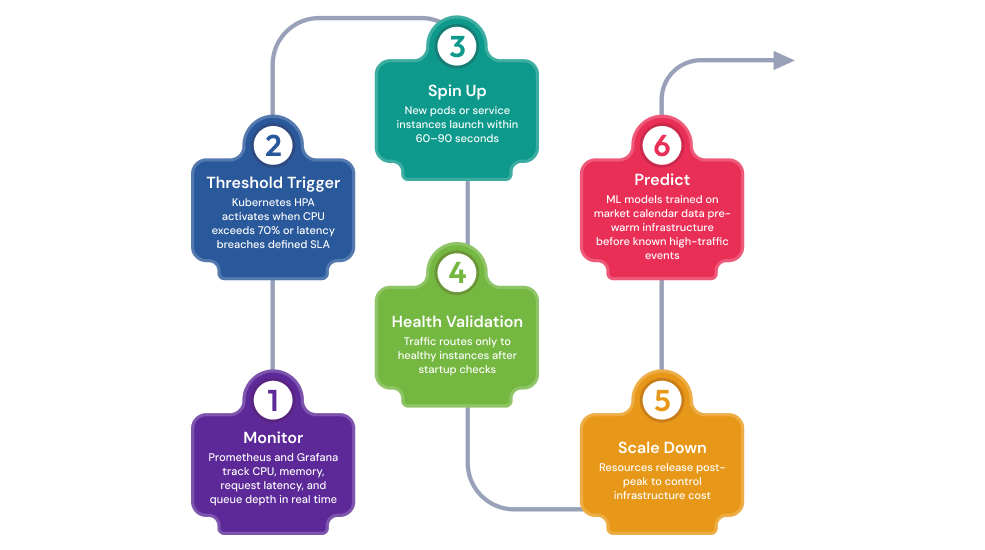
The predictive layer is where significant operational maturity is gained. A trading platform that pre-scales infrastructure 15 minutes before a Federal Reserve announcement is in a fundamentally different position than one that starts scaling reactively after the first wave of traffic hits. This level of sophistication requires investment not just in tooling, but in the observability culture that makes it sustainable.
How Product Engineering Enables Scalable FinTech Platforms
This is where the conversation shifts from engineering mechanics to business outcomes and it is a distinction that separates product engineering services from commodity development work. Rather than treating each technical problem in isolation, product engineering frames them within the product lifecycle: what needs to scale now, what needs to be redesigned for the next growth stage, and what architecture decisions will create the most constraint if deferred.
A typical scalability assessment conducted by a product engineering team includes:
Architecture review against projected load and growth targets
Data infrastructure analysis for read/write bottleneck identification
DevOps maturity evaluation deployment frequency, rollback capability, observability coverage
Performance testing under simulated peak load scenarios
A prioritized, growth-stage scalability roadmap
Product engineering consulting positions software not as execution of a backlog, but as a strategic function that determines how confidently a business can grow. This is the difference between a platform that survives scale and one that is designed for it.
Warning Signs Your Platform Will Not Scale
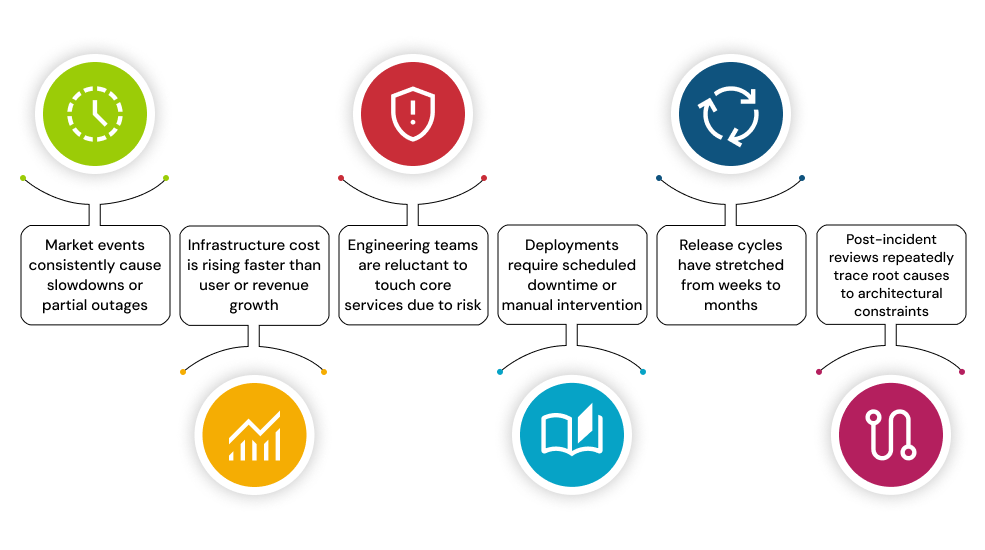
When three or more of these are simultaneously true, continued patching is more expensive in time, cost, and risk than structured re-engineering. Cloud architecture for fintech platforms at this stage is not a future investment it is an immediate operational necessity.
Real-World Results: What This Looks Like in Practice
| Case Study | Scale | Key Technologies | Outcome |
|---|---|---|---|
| ONEIC Pay | 1M+ users, 20K daily txns | Microservices, Kafka | +30% transaction volume |
| Banking Platform | 3× peak traffic | AKS, Cosmos DB | −40% transaction time, −30% infra cost |
| Trading Platform | High-frequency volume | Redis, Kafka | Consistent low-latency trades |
| Wealth Portal | Rapidly growing user base | Cloud-native microservices | High availability, faster integrations |
In each case, the shift was not simply from one technology to another. It was from reactive, short-term engineering decisions to proactive, product-led architecture thinking. Microservices architecture fintech implementations in these cases were grounded in business outcome alignment not technology preference. Each migration was sequenced around risk, business continuity, and measurable performance improvement.
These Scalability Lessons Apply Beyond FinTech
While this blog focuses on investment portals, the architectural patterns and product engineering principles discussed here apply broadly across any platform where growth creates complexity:
SaaS platforms managing multi-tenant data at scale face the same database bottleneck and deployment coupling problems
Healthcare platforms handling real-time patient data under compliance requirements mirror the security and observability challenges of fintech
HCM and workforce platforms with burst usage during open enrollment periods face identical auto-scaling and data infrastructure demands
The underlying engineering discipline matching architecture to growth stage, separating concerns, building for replaceability is what product engineering delivers regardless of industry. FinTech simply makes the consequences of getting it wrong more visible and more costly.
Key Lessons for FinTech Leaders
Scalability problems begin with early architecture decisions, not late-stage traffic spikes
Microservices enable independent product evolution without system-wide risk
Data infrastructure must be purpose-matched to real-time financial workloads
DevOps maturity is the operational backbone that ensures reliability under peak demand
Product engineering thinking prevents long-term platform constraints from accumulating silently
Frequently Asked Questions
Why do investment platforms struggle to scale?
Because early architecture decisions typically prioritize speed of development over long-term scalability. What works efficiently at thousands of users introduces compounding constraints at hundreds of thousands particularly around database design, deployment coupling, and service dependencies.
What architecture works best for fintech platforms?
Microservices combined with event-driven architecture and cloud-native infrastructure consistently delivers the best balance of scalability, reliability, and engineering velocity. The specific technology choices Kafka, Redis, Kubernetes, PostgreSQL should match the platform's specific workload profile.
When should a fintech platform move to microservices?
Typically when user growth, transaction volume, or engineering team size starts exceeding what a monolith can support without increasing fragility. The warning signals listed above are reliable indicators that the migration window has opened.
How do product engineering services differ from standard software development?
Standard development executes requirements. Product engineering services apply strategic thinking to architecture decisions, trade-offs, and long-term platform evolution ensuring the platform is built not just for today's requirements but for the growth stage two years ahead.
Final Thought
Scaling an online investment platform from thousands to millions of users is not a single project with a finish line. It is an ongoing discipline one that requires the same rigor applied to product decisions, customer outcomes, and business strategy as it does to infrastructure and code. The engineering teams and technology leaders who get this right are the ones who stop treating scalability as a problem to solve later and start treating it as a core product capability to design in from the beginning. The investment made in architecture today is the enabler of every product capability tomorrow.
AspireSoftserv specializes in product engineering solutions for fintech and financial services companies. From product strategy & consulting to cloud-native architecture, software product development, and cloud and DevOps engineering, we help investment platforms scale reliably and intelligently.
Build high-performance fintech software with our team