

 Updated on 3 June 2026


Every quarter, leadership teams across growing SaaS, FinTech, and enterprise product companies ask the same question: why is it taking longer to ship features than it did two years ago with a larger engineering team?
The answer is rarely a capability problem. It is a structural one.
When product architecture is not actively managed, it quietly becomes the ceiling on your business velocity. AI initiatives stall before they reach production. Engineering costs rise without proportional output. Market windows close while releases are stuck in QA cycles. The teams most at risk are not the ones making bad decisions they are the ones making reasonable short-term decisions, repeatedly, without a structural counterbalance.
This is the compounding cost of hidden technical debt. And for CTOs, founders, and product leaders, it is not an engineering issue. It is a strategic one.
According to McKinsey, technical debt can consume 20–40% of engineering capacity in growing software teams capacity that could otherwise go toward building competitive features, integrating AI capabilities, or accelerating time to market.
Why Software Becomes Hard to Maintain
The core reason why software becomes hard to maintain is that product growth consistently outpaces product structure. What began as a fast, practical MVP evolves into a system with tangled dependencies, unclear ownership, and brittle workflows not because the team was careless, but because speed was always the priority.
This usually happens when teams optimize for delivery without enough attention to software architecture design. A few shortcuts seem harmless in the moment, but once they repeat across features, teams inherit bad architecture decisions that are expensive to reverse. Many growing product teams especially lean engineering organizations in fast-moving SaaS companies face this exact pattern. Not because of poor talent, but because architectural discipline is rarely embedded early enough into the development process.
The most common drivers are tight coupling between modules and teams, shared databases with unclear data ownership, temporary integrations that quietly become permanent, and patch-based fixes that bypass proper design. Each one is survivable in isolation. Together, they compound into something that slows every team, every quarter, in ways that are difficult to attribute to any single decision.
How Hidden Debt Forms
Hidden technical debt is especially dangerous because it is not visible in source code reviews or sprint reports. It exists in the boundaries between services, in undocumented assumptions, and in "we'll fix it later" decisions that quietly become foundational parts of the system.
This is where leadership matters most. If roadmap pressure consistently wins over design discipline, the organization normalizes fragility. That increases software development risks substantially, because even routine changes can trigger unintended regressions, outages, or release delays.
A typical pattern in fast-growing products follows a predictable path. A feature needs to ship quickly, so the team reuses an existing component instead of creating a clean boundary. The workaround works, so it becomes standard practice. More features depend on it. The product becomes harder to change, test, and scale and no single decision feels like the one that caused it.
Example: A healthcare platform initially built appointment scheduling and billing inside the same service layer. As the product expanded, every change to billing workflows impacted scheduling releases slowing deployments and significantly increasing QA effort. What started as a two-week shortcut became an eighteen-month architectural constraint.
The Real Cost of Rigidity
When architecture degrades, the visible symptom is almost always rework in software projects. Teams spend more time patching, coordinating, and retesting than building net-new value. That rework creates a compounding long-term product risk: slower releases reduce competitiveness, more defects raise support costs, and slower experimentation reduces the company's ability to respond to market shifts.
Architecture debt turns directly into business debt and it compounds the same way financial debt does.
| Business Signal | Engineering Symptom | Leadership Impact |
|---|---|---|
| Slower feature delivery | High dependency chains | Missed roadmap commitments |
| More defects after release | Fragile change paths | Higher support and QA cost |
| Harder onboarding | Complex legacy design | Slower team scaling |
| Frequent hotfixes | Poor system boundaries | Lower predictability |
| Increased cloud cost | Inefficient runtime design | Lower product margins |
The Delivery-to-Rigidity Curve
Most architectural degradation does not announce itself. It follows a curve that is easy to miss until the business impact becomes undeniable. We call this the Delivery-to-Rigidity Curve the predictable sequence through which speed-first decisions gradually erode a product's ability to evolve.
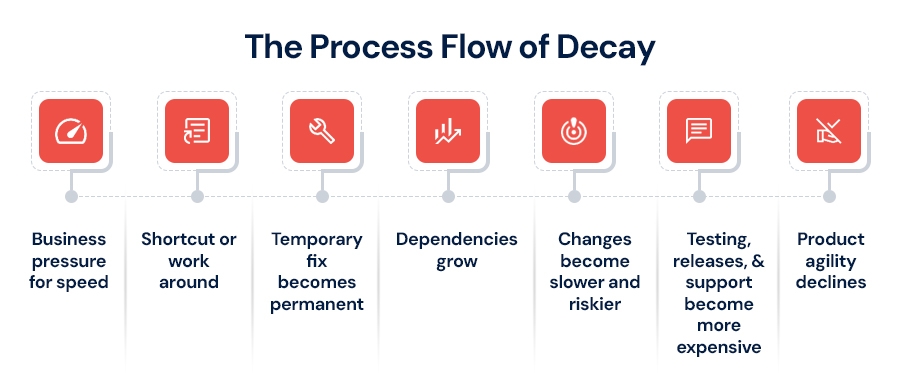
What makes this curve dangerous is that every stage feels manageable in isolation. The shortcut ships the feature. The workaround clears the sprint. The patch closes the ticket. It is only when you look at the cumulative slope slower delivery, rising QA cost, engineering teams avoiding entire modules that the business consequence becomes clear.
Leaders who recognize the Delivery-to-Rigidity Curve early treat architecture as an ongoing business capability, not a one-time technical milestone. Those who recognize it late are usually rebuilding under pressure, with customers watching.
Building for AI Requires a Foundation That Most Products Do Not Have
This is the most urgent architectural challenge of 2026, and it is where fragile product foundations create the most visible business risk.
Many product teams are investing in AI features intelligent automation, predictive workflows, personalization engines, and generative interfaces. Most of these initiatives are slower, more expensive, and less reliable than expected. The root cause is almost never the AI model. It is the product architecture underneath it.
AI-ready architecture requires a level of structural discipline that shortcuts and workarounds make impossible. Specifically:
Data governance and pipeline integrity matter because machine learning models are only as reliable as the data they consume. Products with duplicated data sources, unclear ownership, and inconsistent schemas produce inconsistent model behavior that is difficult to debug and impossible to trust in production.
RAG pipelines and vector infrastructure require clean, well-bounded data layers. When business logic is entangled with delivery concerns, building retrieval-augmented generation on top of that foundation creates retrieval errors that compound downstream.
LLMOps and inference scalability depend on observability that most fragile systems lack entirely. Without clear service boundaries and instrumented dependencies, understanding how a language model is behaving in production and why it occasionally fails becomes an investigation rather than a dashboard check.
AI governance and operational readiness require audit trails, explainability hooks, and clear ownership of model inputs and outputs. These are impossible to retrofit into a system where data flows are undocumented and service responsibilities are blurred.
The teams that are successfully shipping AI features in production are not necessarily the ones with the most sophisticated models. They are the ones with modular software architecture, clean data boundaries, and Cloud and DevOps Engineering practices mature enough to support inference pipelines at scale. Architecture-led development is not a prerequisite for starting an AI initiative but it is a prerequisite for finishing one.
Software Architecture Mistakes Startups Make
Many software architecture mistakes startups make are not dramatic failures they are product decisions that ignore future adaptability. A monolith is not inherently bad, but a monolith with unclear module boundaries, mixed responsibilities, and no refactoring plan becomes a serious bottleneck as teams and customers grow.
The clearest signs of bad software architecture tend to be organizational before they are technical. New features require touching many unrelated parts of the system. Teams cannot explain service boundaries clearly. One change routinely breaks another. Releases depend on heroic effort from a few senior engineers. Data is duplicated across services without a single source of truth.
When these signals appear, the issue is not just code quality. It is that the product's structure no longer matches its business complexity.
Example: An HCM platform added recruitment analytics directly into its core employee database without clear boundaries. Over time, reporting queries began impacting application performance during peak hiring cycles a structural problem that presented itself as a performance problem, and was treated as one for nearly a year before the root cause was addressed.
What Good Architecture Looks Like
The goal is not perfection. The goal is to design for change, so the system can evolve as the business evolves. That is the core purpose of architecture-led development making structural choices early enough to reduce future cost, while staying practical for delivery teams under real pressure.
A healthy approach combines modular software architecture, clear service boundaries, and explicit ownership of data and workflows. In modern environments, cloud-native architecture can significantly improve flexibility but only when paired with strong operational discipline and observability. This is exactly where Cloud and DevOps Engineering becomes a strategic function rather than just an infrastructure concern.
The principles that matter most for decision-makers are keeping core business logic isolated from delivery and infrastructure concerns, defining clear ownership for each domain and dataset, avoiding duplication of the source of truth, using stable interfaces around integrations, and refactoring continuously rather than waiting for a crisis to force the conversation.
When to Refactor Software Architecture
Many leaders ask when to refactor software architecture. The practical answer is when the cost of change is consistently higher than the business value of that change. If every important feature takes longer than expected because of structure not scope then refactoring has become a business priority, not an engineering preference.
The right signals are clear. A module has become a frequent source of defects. Multiple teams are blocking each other on the same code paths. Release risk is rising faster than product value. Performance constraints are limiting growth. The product direction is changing and the system cannot adapt quickly enough to support it.
This is also where product engineering consulting creates measurable value particularly when internal teams are too close to the system to see the structural issues clearly. The right external perspective separates necessary complexity from accidental complexity and helps prioritize changes that reduce future cost rather than just addressing the most visible symptoms.
When Should You Consider a Product Engineering Review?
Most teams wait too long. By the time the conversation starts, the cost is already significant. The right time to assess architectural health is before friction becomes the dominant story in every engineering planning session.
Consider a structured review if feature delivery is slowing every quarter despite team growth, if releases require excessive QA cycles and manual coordination, if teams are actively avoiding certain modules or codebases, if infrastructure cost keeps increasing without proportional user growth, or if AI initiatives are stalling despite model investment.
This is typically the point where architecture-led development combined with disciplined Software Product Development practices creates the most measurable business impact faster releases, lower defect rates, and a system that scales with business ambition rather than resisting it.
How to Reduce Technical Debt
Leaders often look for how to reduce technical debt, but the most effective approach is not a single cleanup project. It is a governance model that keeps architecture connected to product priorities on an ongoing basis.
The practical starting point is mapping the highest-friction user journeys and the code paths behind them. From there, identifying the modules with the most defects, rework, or release delays reveals where structural investment will have the most business impact. Separating core business rules from integrations and UI concerns, prioritizing changes that reduce coupling and duplicate logic, and allocating a fixed capacity for architecture improvement every cycle these are the mechanics of a reduction plan that works without pausing delivery.
Strong Product Design and Prototyping discipline at the feature level, combined with continuous architectural investment, ensures that new capabilities are built on solid ground rather than fragile workarounds.
How to Improve Software Scalability Without Chaos
A major reason why product development slows down over time is that the system was never designed for scale in both technical and organizational terms. As the number of teams, customers, integrations, and edge cases grows, architecture must support more parallel work without creating conflict. The answer is not a rewrite. It is incremental modernization guided by product goals feature-level modularization, clear service and database ownership, strong automated testing around critical flows, and observability for dependencies and performance.
The most durable systems are not the most complex ones. They are the ones that make future choices easier. This is why product architecture best practices are really business continuity practices the engineering discipline that keeps commercial momentum intact as the product and organization scale together.
Your Architecture Either Accelerates Growth or Constrains It. There Is No Middle Ground.
If feature delivery is slowing, AI initiatives are stalling, or engineering effort is increasing without proportional business output, the issue is structural. And structural problems do not resolve themselves they become more expensive with every quarter of deferred attention.
Aspire Softserv works with growing SaaS, HCM, Healthcare, and platform businesses as an architecture-led product engineering partner not a development vendor. Our work spans modernization strategy, AI-ready platform engineering, cloud-native transformation, modular software architecture design, and architecture governance for teams that need to scale product velocity without accumulating the structural debt that eventually slows it back down.
If your product is approaching an inflection point faster growth, a new AI roadmap, a platform expansion, or a delivery slowdown you cannot fully explain a structured architecture review is the clearest starting point. Explore our product engineering services or connect with our team to understand where your highest-cost friction lives and what it would take to remove it.
Find the root cause of delivery slowdowns.