

 Updated on 30 December 2025


Building a Minimum Viable Product should be straightforward: validate your idea quickly, gather user feedback, and iterate toward product-market fit. Yet according to recent data, over 42% of startups fail because they build products nobody wants, and a significant portion of that failure happens at the MVP stage itself.
For CEOs and CTOs leading startups or growing companies with small engineering teams, MVP failure isn't just frustrating it's expensive. Failed MVPs mean wasted development cycles, burned budgets, and missed market windows. The difference between companies that scale and those that stall often comes down to how they approach MVP development from day one.
This guide examines why Minimum Viable Products fail, what high-growth teams do differently, and how strategic product engineering services can help you build MVPs that actually survive first contact with users and evolve into scalable products.
The Real Cost of MVP Failure for Growing Companies
When your MVP fails, you're not just losing the initial development investment. You're losing market positioning, team morale, and the opportunity cost of what you could have built instead. For companies with limited engineering resources typically teams of 1 to 5 engineers these failures hit particularly hard because there's no buffer to absorb the setback.
The financial impact is measurable. A poorly scoped MVP can cost 40-60% more than planned due to rework and technical debt. When you add delayed revenue, lost competitive advantage, and the cost of rebuilding trust with early adopters, the real price of failure becomes clear. This is especially painful for bootstrapped startups and companies operating on fixed funding rounds where every dollar and every month counts.
Expert Insight: The 3 Critical MVP Mistakes That Cost Startups Thousands
Before we dive into the details, watch Pratik Patel, Head of Product Engineering at AspireSoftServ, share the most costly mistakes he's witnessed in 17 years of building MVPs for startups and MSMEs.
In this video, Pratik reveals:
Why choosing the wrong tech stack can add 4-6 months and $60,000+ to your timeline
How one healthcare startup lost a major client and spent $70,000 fixing security issues they ignored early
The difference between vanity metrics (signups) and real success metrics (retention, time-to-value)
How AspireSoftServ's approach helps companies avoid these expensive mistakes
With over 100+ MVPs built across HR tech, fintech, and healthcare, Pratik shares real stories and practical advice you can apply immediately.
Why Most Minimum Viable Products Fail: The Core Reasons
Misunderstanding the Target Market
The most common reason MVPs fail is building a solution for a problem that doesn't exist or isn't painful enough for users to care about. This happens when teams skip rigorous market validation or rely on assumptions instead of customer conversations. For B2B SaaS companies targeting enterprises, this often means building features based on what one potential customer mentioned in passing, rather than validating pain points across multiple prospects in the same vertical.
Wrong Technology Stack Decisions
Choosing the wrong tech stack doesn't just slow you down it creates compounding problems that get worse over time. Many early-stage teams pick technologies based on what's trendy rather than what fits their specific use case, team skills, and scaling requirements. For instance, implementing microservices architecture for an MVP with 500 users creates unnecessary complexity, while selecting outdated frameworks limits your ability to hire developers and integrate modern tools later.
The technology choices that matter most for MVPs include your backend framework, database architecture, cloud infrastructure, and API design. A well-chosen stack using proven technologies like React for frontend, Node.js or Python for backend, and AWS or GCP for infrastructure provides the right balance of development speed, community support, and future scalability. Poor choices here lead to what developers call "technical debt" the accumulated cost of shortcuts and wrong decisions that eventually force expensive rewrites.
Feature Overload vs. Feature Underload
Finding the right feature scope is surprisingly difficult. Feature overload happens when teams try to build too much, mistaking "minimum" for "maximum features we can cram in." This extends development timelines, increases bug surface area, and often results in a confusing user experience. On the other hand, feature underload launching with so few features that the product doesn't actually solve the core problem leaves users frustrated and unlikely to return.
High-growth teams solve this through ruthless prioritization frameworks. They identify the single most painful problem their target user faces and build just enough functionality to solve that problem in a way that's meaningfully better than current alternatives. Everything else gets cut or deferred to post-launch iterations.
Lack of Differentiation in Crowded Markets
If your MVP looks and functions like every other product in the market, you'll struggle to gain traction regardless of how well it's built. This is particularly challenging in mature SaaS categories like HR tech, fintech, and healthcare where dozens of established players already exist. Differentiation doesn't always mean revolutionary features it can be better UX, faster performance, superior integration capabilities, or specialization for a specific industry vertical that competitors ignore.
Weak or Missing Monetization Strategy
Even functional MVPs struggle when there's no clear path to revenue. This doesn't mean you need to charge on day one, but you should understand what users would pay for, how much they'd pay, and what pricing model makes sense for your market. B2B products need to demonstrate ROI for decision-makers, while consumer products need to prove engagement that can eventually be monetized. Without this clarity, you can't make informed decisions about which features to prioritize or how to position your product.
Insufficient User Validation and Feedback Loops
Many teams build in isolation for months, then launch expecting immediate validation. By that point, fundamental assumptions are baked into the architecture and design, making changes expensive. High-growth teams embed validation into every sprint they're talking to users weekly, testing prototypes before full development, and gathering feedback from the earliest possible version. This continuous validation catches problems when they're still cheap to fix.
How Compliance and Security Failures Kill Enterprise MVPs
For companies targeting regulated industries like HR tech, fintech, and healthcare, compliance isn't optional it's existential. A non-compliant MVP can't be sold to enterprise customers regardless of how innovative your features are. Yet many early-stage teams treat compliance as something to "add later," only to discover that retrofitting GDPR, SOC 2, or HIPAA requirements into an existing codebase is prohibitively expensive.
Security vulnerabilities in MVPs are particularly dangerous because they damage trust that's nearly impossible to rebuild. Enterprise buyers evaluate security posture before evaluating features. If your MVP leaks data, stores passwords insecurely, or lacks proper access controls, you won't get a second chance with that customer. The smartest approach is building compliance-ready architecture from day one, which we've detailed in our guide on product engineering for HR SaaS MVPs.
The 8-Week MVP Development Framework That Actually Works
High-growth teams follow a structured, time-bound process that balances speed with validation. This framework has been proven across hundreds of successful startups and is designed specifically for teams with limited resources who can't afford to get it wrong.
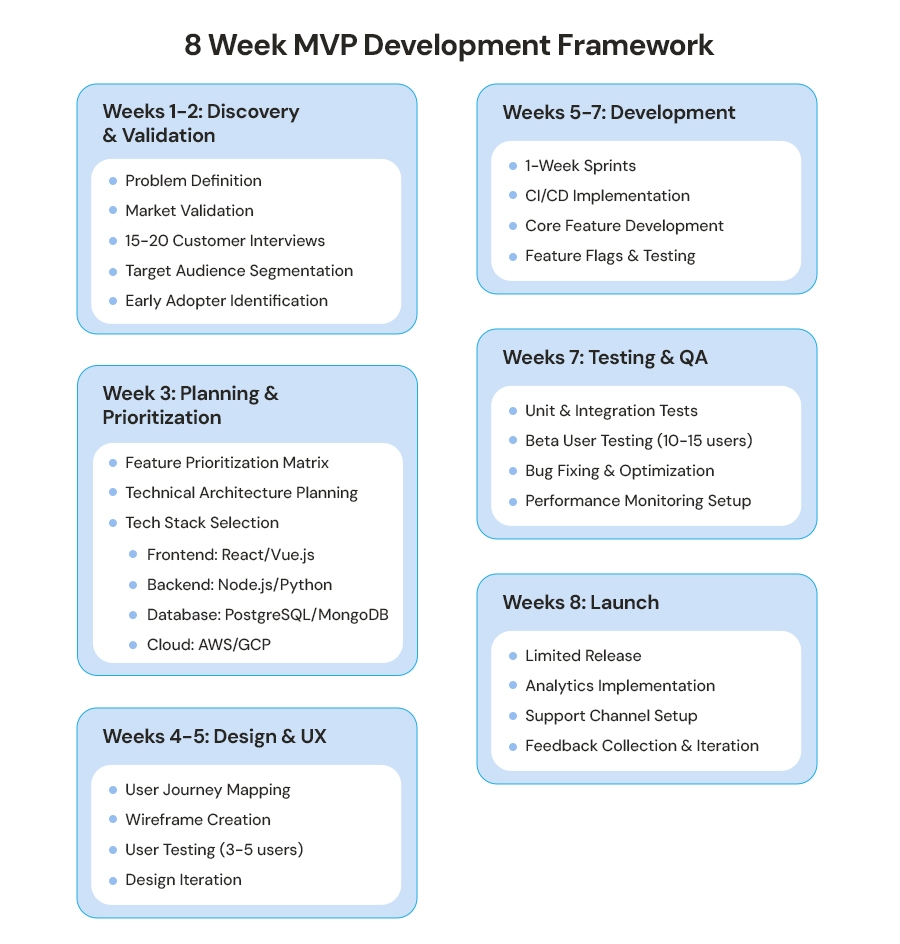
Weeks 1-2: Problem Definition and Market Validation
Before writing a single line of code, successful teams invest 10-15 hours in customer discovery. This means conducting structured interviews with at least 15-20 potential users in your target segment. The goal isn't to ask if they'd use your product it's to understand their current workflow, quantify the pain points, and identify what they're already paying for or doing manually. Document specific problems, not general complaints, and look for patterns across multiple interviews.
Week 2: Target Audience Segmentation and Persona Development
Not all users are created equal for MVP purposes. Identify your early adopters the people whose pain is so acute they'll tolerate an imperfect solution. These are typically power users who are already hacking together their own solutions or paying for inadequate alternatives. Build detailed personas that include not just demographics but also technical proficiency, budget authority, and specific workflows. For B2B products, understand the buying process: who evaluates, who approves, and who actually uses the product daily.
Week 3: Feature Prioritization Using Scoring Matrix
This is where discipline matters most. List every feature anyone has suggested, then score each one across four dimensions: impact on solving the core problem (1-10), development effort (1-10), differentiation value (1-10), and revenue impact (1-10). Features that score highest on impact and differentiation but lowest on effort become your MVP scope. Everything else goes into a "post-MVP" backlog. The goal is to build something in 8 weeks that users can actually test, not a comprehensive solution.
Week 3-4: Technical Architecture and Stack Selection
Your architecture decisions have long-term consequences, so this phase deserves careful thought even under time pressure. For most SaaS MVPs, a modern stack might include:
Frontend: React or Vue.js for component reusability and strong community support
Backend: Node.js for JavaScript consistency or Python for data-heavy applications
Database: PostgreSQL for reliability or MongoDB for flexibility
Infrastructure: AWS or GCP with containerization for consistent deployments
API Design: RESTful or GraphQL depending on data complexity
The key is choosing technologies your team knows well or can learn quickly, with strong documentation and community support. Avoid the trap of using an MVP to learn bleeding-edge technologies that's what side projects are for.
Week 4-5: Design and User Experience Planning
Great UX is what makes an MVP feel complete even with limited features. Map the core user journey from signup through their first successful outcome. Identify friction points and eliminate them ruthlessly. For B2B products, prioritize clear navigation, fast load times, and obvious CTAs over aesthetic flourishes. Create wireframes before full designs, test them with 3-5 users, and iterate before development starts. This catches UX problems when they cost hours to fix, not weeks.
Weeks 5-7: Core Feature Development in Sprints
Break development into one-week sprints with clear, testable outcomes. Each sprint should produce working features that can be demoed and tested. Implement CI/CD (continuous integration/continuous deployment) from the start so you can push updates frequently. Use feature flags to ship code that's not yet ready for users, allowing your team to work on longer features without blocking releases. This agile approach means you're always 1-2 days away from a shippable product, not waiting for a "big bang" launch.
Week 7: Testing, QA, and User Feedback Integration
Testing isn't just about finding bugs it's about validating assumptions. Implement unit tests for critical business logic, integration tests for API endpoints, and end-to-end tests for core user flows. Invite 10-15 beta users who match your target persona to use the product with specific tasks. Watch them use it, noting where they hesitate or get confused. Their struggles reveal UX problems that surveys miss. Fix critical issues and document everything else for post-launch iterations.
Week 8: Launch Preparation and Limited Release
Launch isn't a big public announcement it's opening access to a limited audience while your team is ready to respond quickly. Prepare monitoring and analytics to track user behavior, error rates, and performance metrics. Set up customer support channels, even if that's just a shared email address for now. Create onboarding materials that help users reach their first success moment quickly. Launch to your beta group first, then expand gradually as you validate stability and gather feedback.
What High-Growth Teams Do Differently: Key Success Patterns
Ruthless Focus on One Problem
The companies that scale don't try to solve multiple problems adequately they solve one specific problem exceptionally well. Dropbox didn't try to be a full project management suite; it focused entirely on making file sync reliable and fast. Slack initially focused only on team chat, not enterprise resource planning. This focus allows you to create a solution that's dramatically better than alternatives for your specific use case, which is what drives initial adoption and word-of-mouth growth.
Data-Driven Decision Making from Day One
High-growth teams implement analytics before they implement features. They track user behavior, conversion funnels, feature usage, and performance metrics from the first user session. This data informs every product decision: which features to build next, where users struggle, what drives retention, and what's merely nice to have. Without data, you're making decisions based on the loudest opinion in the room, not actual user behavior.
Continuous Validation at Every Stage
Validation isn't a phase it's a practice. Successful teams validate problem assumptions before building, validate design decisions with prototypes, validate feature implementations with early users, and validate market positioning with prospects. Each validation cycle reduces risk and increases the likelihood that what you're building will actually work in market. This approach costs more time upfront but dramatically reduces the risk of building the wrong thing.
Strategic Partnership with Product Engineering Services
Many high-growth startups accelerate their MVP development by partnering with experienced product engineering services rather than building everything in-house. This isn't about outsourcing it's about accessing specialized expertise in areas where your internal team lacks experience. A strategic partner brings proven development methodologies, architecture patterns that scale, experience with compliance requirements, and the ability to supplement your team during crunch periods without the overhead of full-time hires.
For example, a fintech startup with strong domain expertise but limited engineering resources might partner with product engineering specialists to build their core infrastructure, implement security best practices, and establish CI/CD pipelines while keeping product strategy and consulting in-house. This hybrid approach combines the speed and expertise of experienced engineers with the domain knowledge and customer intimacy of the founding team.
The ROI of Getting MVP Development Right
When you build your MVP correctly from the start, the financial benefits compound quickly. Companies that launch MVPs with solid architecture, clear positioning, and validated product-market fit reduce their time to Series A by an average of 30-40%. They spend less on customer acquisition because their product actually solves a real problem well, leading to organic word-of-mouth growth. They avoid the expensive rewrites that plague teams who take shortcuts early.
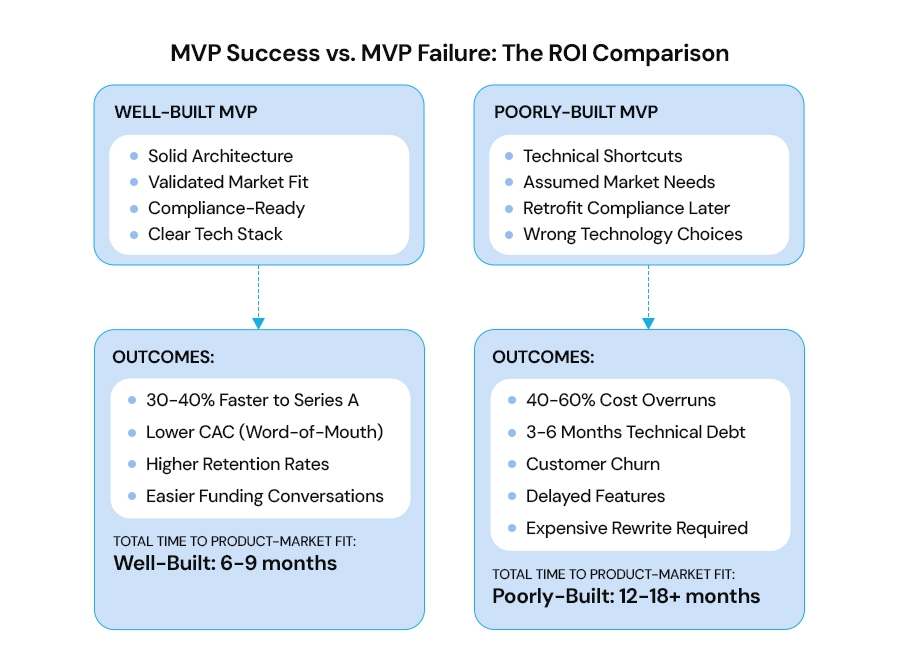
Consider the alternative: a poorly built MVP might save 2-3 weeks initially but cost 3-6 months in technical debt remediation, customer churn due to poor performance, and opportunity cost from delayed feature releases. A mid-market company with a 5-person engineering team can't afford those setbacks. Getting it right the first time isn't slower it's faster when you measure total time to product-market fit, not just time to first deploy.
The ROI also shows up in funding conversations. Investors evaluate MVPs based on user engagement, retention metrics, and technical foundation not just feature count. An MVP with strong architecture, real user validation, and clear growth metrics is significantly more fundable than one with more features but weak fundamentals.
Real Success Stories: MVPs That Scaled
Dropbox: Validation Before Building
Drew Houston didn't build Dropbox's full product before validating demand. He created a simple 3-minute demo video showing how file sync would work, posted it to Hacker News, and watched his beta waiting list grow from 5,000 to 75,000 overnight. This validation gave him confidence to build the full product and raise funding. The lesson: validate demand before you validate implementation.
Airbnb: Manual Operations to Prove the Model
Brian Chesky and Joe Gebbia started by manually photographing properties themselves, coordinating directly with hosts, and handling payments through PayPal. Their MVP was barely automated, but it proved the unit economics worked and that people would actually rent their homes to strangers. Only after proving the model did they build the platform. For B2B SaaS, this translates to doing things manually in early deals to validate workflows before automating them.
Zappos: Zero Inventory Validation
Nick Swinmurn proved demand for online shoe retail without building inventory systems or warehouses. He took photos of shoes in local stores, posted them online, and when someone ordered, he bought the shoes at retail and shipped them. This proved customers would buy shoes online (which was controversial in 1999) before investing in the complex infrastructure needed to scale. The MVP wasn't scalable it was validatable, which was more important at that stage.
Best Practices for MVP Success in Regulated Industries
For companies targeting HR tech, fintech, or healthcare markets, MVP development requires additional considerations around compliance, security, and data handling. These industries demand enterprise-grade reliability even from early-stage products, which affects architecture decisions from day one.
Build Compliance into Architecture, Not on Top
Security and compliance requirements should inform your initial architecture, not be retrofitted later. This means implementing proper authentication and authorization, encrypting data at rest and in transit, maintaining audit logs, and designing data models that support compliance requirements. For HR SaaS targeting US enterprises, this includes GDPR readiness, SOC 2 preparation, and understanding state-specific data regulations. Our detailed guide on building compliance-ready HR SaaS MVPs covers these requirements extensively.
Implement Proper Access Controls Early
Role-based access control (RBAC) is significantly harder to add after launch than to build initially. Enterprise customers will ask detailed questions about who can access what data and how permissions are managed. Build this into your MVP, even if your first customers are small companies that don't immediately use complex permission structures.
Plan for Audit Requirements
Regulated industries require detailed audit trails showing who accessed what data and when. Build logging infrastructure that captures these events from the start. This not only helps with compliance but also with debugging production issues and understanding user behavior. The overhead is minimal compared to the cost of retrofitting logging later.
When to Partner with Product Engineering Services
Building an MVP in-house isn't always the optimal path, especially when your team lacks specific technical expertise or bandwidth. Companies typically benefit from partnering with product engineering services when they face:
Skill gaps in critical areas like cloud architecture, API design, or frontend development
Time pressure to launch before a market window closes or funding runs out
Compliance requirements in regulated industries where mistakes are expensive
Scaling challenges where current architecture can't support growth
Technical debt from a previous MVP that needs rebuilding on solid foundations
A strategic partnership with experienced product engineering services provides access to teams who've built dozens of MVPs, understand common pitfalls, and can accelerate development without sacrificing quality. The key is finding a partner who understands your industry, works collaboratively with your internal team, and transfers knowledge so you can eventually manage the product independently.
AspireSoftServ brings 8+ years of product engineering expertise to startups and growing companies, specializing in React, Node.js, Python, and cloud-native architectures. Our automation-first approach and experience in HR tech, fintech, and healthcare helps companies build MVPs that don't just launch they scale. We work as an extension of your team, not a separate vendor, ensuring knowledge transfer and long-term success.
Measuring MVP Success: Metrics That Matter
Vanity metrics like registered users or page views feel good but don't indicate product-market fit. Focus instead on leading indicators that predict success:
Retention rate: What percentage of users come back after their first session? After one week? After one month?
Time to value: How long does it take new users to reach their first successful outcome?
Feature usage depth: Are users engaging with core features or just signing up and leaving?
Referral rate: Are satisfied users bringing in others organically?
Willingness to pay: For pre-revenue MVPs, what percentage of users say they'd pay if you charged?
These metrics tell you whether you're building something people actually want, which is the entire point of an MVP. If retention is low or time-to-value is too long, you have a product problem to fix before you scale. If these metrics are strong, you've validated product-market fit and can confidently invest in growth.
Moving from MVP to Scalable Product
The hardest transition for many startups isn't building the MVP it's evolving it into a scalable product without losing momentum. This requires strategic refactoring, infrastructure improvements, and sometimes difficult decisions about what to rebuild versus what to optimize.
Plan this transition from the start by avoiding obvious technical debt, documenting architecture decisions, and building with standard patterns that scale. When you do need to refactor, prioritize based on business impact: fix performance bottlenecks that affect user experience before refactoring code that works fine but looks messy.
Most importantly, maintain the customer focus that made your MVP successful. As you add features and scale infrastructure, keep validating with users and measuring the metrics that matter. The best products never stop being MVPs in spirit they're always testing, learning, and iterating based on real user behavior.
Taking the Next Step with Your MVP
Building a successful Minimum Viable Product requires more than just a good idea it demands discipline, customer focus, strategic technical decisions, and the willingness to learn and iterate quickly. By understanding why MVPs fail, following a proven development framework, and leveraging expertise where needed, you can dramatically increase your odds of building something users actually want and will pay for.
Whether you're just starting MVP development or looking to rebuild a failed attempt on stronger foundations, the key is combining speed with validation, flexibility with architecture discipline, and ambitious vision with ruthless prioritization.
Ready to build an MVP that doesn't just launch but scales?
Explore our product engineering services to learn how we help startups and growing companies turn validated ideas into successful products. If you’d like to discuss your idea, you can schedule a call.
Build MVPs That Scale, Not Fail