


Building an HR SaaS MVP that passes enterprise compliance audits isn't just about coding—it requires specialized product engineering expertise that understands both HR workflows and regulatory requirements from day one.
The Compliance Reality for HR SaaS MVPs
The average HR compliance fine in the U.S. costs enterprises $200,000+ according to SHRM data, while CCPA non-compliance triggers $7,500 per violation in California. Over 4,000 ADA accessibility lawsuits targeted SaaS platforms in 2024, with HR systems facing the highest risk due to sensitive employee data handling.
Most HR SaaS MVPs fail compliance audits because they're built by development teams who understand coding but lack deep expertise in regulatory architecture. This is where product engineering services become critical—they bring pre-built compliance frameworks and regulatory knowledge that would take in-house teams months to develop.
The key insight is that compliance isn't a feature you add later—it's an architectural foundation that shapes every technical decision from database design to API endpoints.
Why Generic Development Fails for HR SaaS Compliance
Standard web application development approaches create fundamental compliance gaps that are expensive to fix later. Generic CRUD applications can't handle the complex data sovereignty requirements of multi-state HR operations or the audit trail demands of SOC 2 certifications.
Product engineering consulting teams understand that HR SaaS platforms must be architected differently from the start. They design systems where compliance is embedded in the core architecture rather than bolted on afterward. This means implementing event-driven architectures for automatic audit logging, zero-trust security models for employee data access, and region-aware data storage from the MVP stage.
The technical difference is significant. While generic developers might store all employee data in a single database, compliance-ready architecture requires distributed data models that respect jurisdictional boundaries and regulatory requirements automatically.
The Compliance-First Architecture Approach
Building compliance-ready HR SaaS MVPs requires specific architectural patterns that most development teams haven't implemented at enterprise scale. Digital product engineering services bring proven frameworks that address these challenges systematically.
The foundation starts with microservices architecture where each HR function employee management, payroll, benefits, compliance reporting operates as an independent service. This isolation is crucial for compliance because it allows you to implement different security levels and audit requirements for each data type.
Event-driven architecture becomes essential for maintaining compliance audit trails. Every HR action automatically generates immutable log entries with user identity, timestamps, and data change records. This isn't just good practice—it's required for SOC 2, GDPR, and most enterprise compliance frameworks.
Architecture Pattern | HR SaaS Application | Compliance Value |
Microservices | Independent employee, payroll, benefits modules | Isolated security, region-specific compliance |
Event-Driven | Automatic audit logging for all HR actions | Complete audit trails, regulatory reporting |
Zero-Trust Security | Identity verification for every data access | GDPR/CCPA compliance by design |
API-First Design | Secure integrations with existing HR systems | Enterprise adoption, data control |
The result is an MVP that can handle enterprise compliance requirements from launch rather than requiring expensive rebuilds later.
U.S. Regulatory Requirements for HR SaaS MVPs
Understanding the specific compliance landscape is where product development engineering services provide the most value. U.S. HR SaaS platforms must navigate a complex web of federal and state regulations that generic development teams often miss.
CCPA applies to employee data in California, requiring explicit consent management and "right to deletion" capabilities across all HR systems. This means your MVP needs consent tracking workflows and data deletion procedures that work across distributed databases—not something you can add with a simple feature update.
SOC 2 Type II certification is required by most enterprise clients and takes 12-18 months to achieve if your architecture wasn't designed for it. The key technical requirements include access logging, data encryption at rest and in transit, and comprehensive monitoring systems. These must be built into the foundation, not added later.
HIPAA compliance becomes relevant when handling employee health data through FSA, HSA, or medical leave systems. This requires additional encryption standards and access controls that most development teams haven't implemented.
ADA accessibility requirements have generated over 4,000 lawsuits against SaaS platforms, with HR systems facing higher risk due to employment rights implications. Compliance requires specific technical implementations in frontend design and API responses.
Technical Implementation for Compliance Readiness
The practical implementation of compliance-ready HR SaaS MVPs requires specific technical choices that experienced product engineering services teams understand thoroughly.
Database design must implement row-level encryption for sensitive data like salaries and social security numbers, with separate encryption keys managed through hardware security modules (HSMs). This isn't just encrypting the database—it's designing data structures that support granular access controls and audit requirements.
API security requires OAuth 2.0 implementation with role-based access control (RBAC) that integrates with enterprise identity management systems like Active Directory or Okta. The MVP must support SAML single sign-on from day one because enterprise clients won't adopt platforms that create additional login requirements for employees.
Audit logging must be implemented as an event-driven system where every data modification automatically generates tamper-proof log entries. These logs need structured formats that support automated compliance reporting and regulatory submissions. The technical complexity isn't in generating logs—it's in designing log structures that meet multiple regulatory frameworks simultaneously. 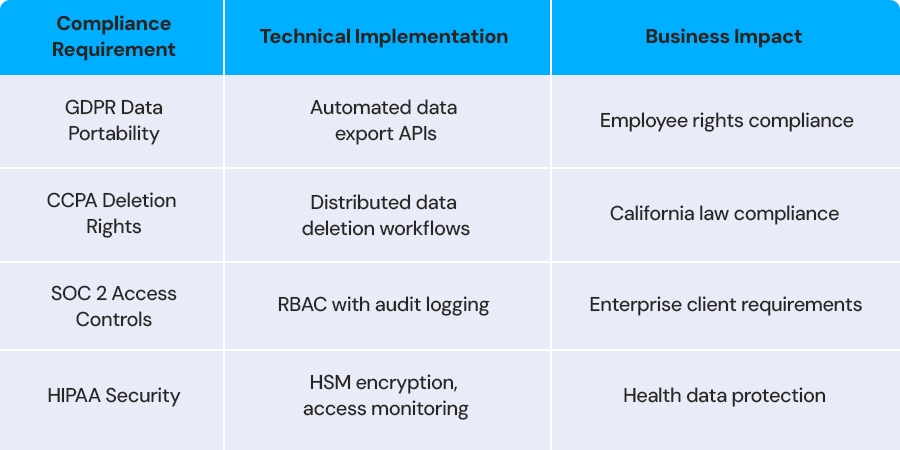
Integration Strategy for Enterprise Adoption
Enterprise HR departments require seamless integration with existing systems, which creates additional compliance challenges that specialized digital product engineering services understand how to navigate.
Integration with legacy HRIS systems like Workday or SuccessFactors requires anti-corruption layer patterns that protect your compliance-ready architecture from the security limitations of older systems. This means designing API gateways that can translate between different security models while maintaining audit trails.
Payroll system integration with providers like ADP or Paychex involves handling highly sensitive financial data that requires end-to-end encryption and specialized access controls. The technical challenge is creating secure data flows that meet both your compliance requirements and the integration standards of established payroll providers.
Benefits administration integration requires connecting to multiple third-party systems (insurance providers, 401k administrators, HSA providers) while maintaining data sovereignty and consent management across all connections. This level of integration complexity requires architectural planning that most in-house teams underestimate.
The key insight is that compliance-ready integration isn't just about API connectivity—it's about maintaining your security and audit standards across every external connection.
Performance Requirements for Enterprise HR Workloads
HR SaaS MVPs must handle enterprise-scale workloads that create unique performance challenges while maintaining compliance requirements. Product engineering consulting expertise becomes critical for architecting systems that scale without compromising security.
Onboarding surges during hiring seasons can generate 10x normal traffic as hundreds of new employees complete paperwork simultaneously. The system must auto-scale while maintaining response times and ensuring that compliance logging doesn't create performance bottlenecks.
Payroll processing requires distributed computing capabilities that can handle complex calculations across multiple states and countries within strict time windows. The technical challenge is parallelizing these calculations while maintaining audit trails and ensuring data consistency.
Benefits open enrollment periods create similar traffic spikes but with the added complexity of handling highly sensitive health and financial data. The architecture must scale performance while maintaining HIPAA-level security controls.
Workload Scenario | Technical Solution | Compliance Consideration |
Mass Onboarding | Auto-scaling microservices | Audit log performance |
Payroll Processing | Distributed computing | Financial data security |
Benefits Enrollment | Queue-based processing | HIPAA compliance at scale |
The Cost of Compliance Mistakes in HR SaaS Architecture
Understanding the financial impact of compliance failures helps explain why specialized product engineering approaches are essential for HR SaaS MVP success. The cost analysis reveals why getting compliance architecture right from the start is critical.
The Hidden Costs of Compliance Failures: Building HR SaaS platforms without proper compliance architecture creates expensive problems that compound over time:
Regulatory fines and penalties: Average HR compliance fine exceeds $200,000, with CCPA violations triggering $7,500 per incident
Emergency architecture rebuilds: Retrofitting compliance into existing systems costs $200K+ and delays market entry by 6-12 months
Failed enterprise sales: 78% of enterprise HR deals require SOC 2 certification before contract signing
Legal exposure: Over 4,000 ADA accessibility lawsuits targeted SaaS platforms in 2024, with HR systems facing highest risk
Data breach consequences: Average cost of HR data breaches reaches $4.45M according to IBM Security reports
The Technical Debt Problem: Non-compliance-ready architecture creates cascading technical challenges:
Database restructuring: Moving from single-database to distributed compliance models requires complete data migration
Security retrofits: Adding encryption, audit logging, and access controls to existing systems often requires rebuilding core components
Integration complications: Legacy architecture can't support enterprise identity management or secure third-party connections
Scalability issues: Compliance logging and monitoring can create performance bottlenecks in systems not designed for regulatory requirements
The Compliance Architecture Investment: Product engineering services that specialize in compliance-ready systems help avoid these costly mistakes through proven architectural approaches:
Prevention over correction: Building compliance into the foundation eliminates expensive retrofits
Faster enterprise adoption: Compliance-ready MVPs can immediately engage enterprise clients without architecture delays
Regulatory confidence: Purpose-built compliance frameworks reduce audit risks and regulatory exposure
Scalable security: Architecture designed for compliance scales efficiently as the platform grows
The Strategic Advantage: The most significant impact isn't just cost avoidance—it's competitive positioning. HR SaaS platforms with compliance-ready architecture can pursue enterprise contracts immediately, while competitors spend months rebuilding their systems to meet basic security requirements.
This architectural foundation becomes especially critical as regulatory requirements continue evolving. Platforms built with compliance-first architecture can adapt to new regulations through configuration changes rather than expensive rebuilds.
Getting Started with Your Compliance-Ready HR SaaS MVP
Success in building compliance-ready HR SaaS MVPs starts with recognizing that compliance is an architectural foundation, not a feature set. The technical complexity of implementing multi-jurisdiction compliance, enterprise security, and regulatory audit capabilities requires specialized expertise that most in-house teams don't possess.
Product engineering services partnerships provide immediate access to proven compliance frameworks, regulatory expertise, and architectural patterns that would take months or years to develop internally. The key is starting with compliance-ready architecture rather than trying to retrofit compliance into existing applications.
The decision framework is straightforward: if your HR SaaS MVP needs to serve enterprise clients, pass regulatory audits, and scale across multiple jurisdictions, the technical complexity demands specialized product engineering expertise from day one.
AspireSoftServ's digital product engineering services have successfully delivered 50+ compliance-ready HR SaaS platforms that pass audits, satisfy enterprise security requirements, and accelerate time-to-market by an average of 67%. Our proven frameworks eliminate the guesswork and technical risk from compliance architecture while ensuring your MVP meets enterprise adoption requirements from launch.
Ready to build your compliance-ready HR SaaS MVP with confidence? Contact AspireSoftServ's product engineering team to discuss your specific compliance requirements and discover how specialized expertise can accelerate your path to enterprise-ready HR SaaS success.
Launch a Secure HR SaaS MVP