

 Updated on 15 May 2026

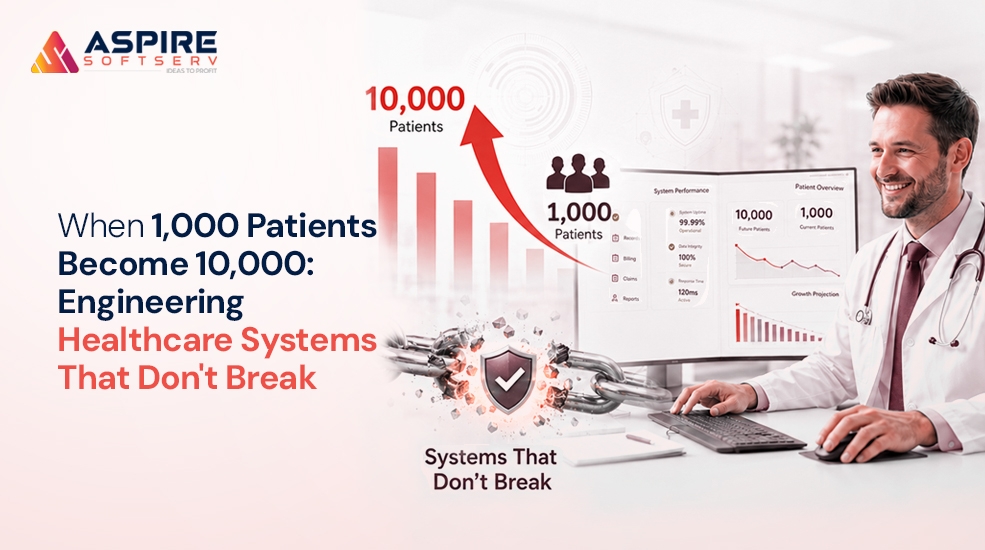
Why Growing Healthcare Platforms Fail Before They Scale
A busy urban hospital in Mumbai was managing 1,200 patients daily with reasonable efficiency average ER wait times around 35 minutes, scheduling systems holding steady, staff not overwhelmed. Then patient volume doubled over 18 months. Wait times hit 3 hours. The scheduling system crashed twice a week. Triage was logged on paper during outages. The technology hadn't failed overnight. It had simply never been built to grow.
This is a common challenge for growing healthcare platforms, clinics, and digital health products handling increasing patient demand. The core problem is rarely the team or the intent it's the architecture. And adding more servers only delays the inevitable. The architecture itself becomes the ceiling.
This blog is for CTOs, Product Leaders, and Healthcare Platform Owners dealing with rising patient volume, system slowdowns, or scaling challenges. It is also relevant for anyone evaluating whether their current system can support the next stage of growth or whether it is already quietly limiting it.
Fixing a system that can't scale requires more than a software upgrade. It requires rethinking how the entire platform is engineered, from data flows to deployment pipelines. This is where structured product engineering services make the difference between a system that survives growth and one that collapses under it.
What is scalable healthcare system architecture? It is an architecture designed to handle increasing patient volume without performance degradation using modular services, event-driven processing, and cloud-native infrastructure that scales horizontally as demand grows.
The Real Cost of a System That Can't Scale
Before getting into solutions, it's worth understanding the full business impact. When hospital management system software buckles under load, the consequences extend far beyond slow screens:
Patient safety risk increases when triage data is delayed or inaccessible
Revenue leaks through missed appointments, duplicate entries, and billing errors
Engineering estimates become unreliable as the codebase grows more tightly coupled
Regulatory exposure grows when audit logs are incomplete or corrupted under load
Infrastructure waste runs 25–40% higher in unoptimized monolithic systems at scale a significant cost drag for mid-sized healthcare platforms
The technical term is bottleneck. The business term is loss of trust, revenue, and patients. Traditional patient management system software is often monolithic one large application where every function is tightly coupled. When one component strains, everything feels it. The architecture itself becomes the ceiling.
Why Cloud and DevOps Determine Whether Your System Scales or Fails
Cloud-native infrastructure paired with mature DevOps practices is what turns well-designed architecture into reliably running production systems. Cloud and DevOps Engineering is not an afterthought it is the operational layer that determines whether architectural decisions actually deliver value under real-world load.
For high-throughput healthcare software development environments, this means:
Kubernetes on AWS or GCP for container orchestration, auto-scaling at 70% CPU utilizatio
Serverless functions for bursty workloads telehealth spikes, batch processing, after-hours reporting
Blue-green deployments for zero-downtime releases in 24/7 care environments
Canary releases to validate changes on a small traffic slice before full rollout
Istio service mesh for zero-trust security and HIPAA-compliant encrypted inter-service communication
The DevOps pipeline itself becomes a safety net: automated security scans, integration tests, and compliance checks run on every commit. Nothing reaches production without validation gates that would otherwise take days of manual review.
Key Monitoring Metrics for 10x Healthcare Systems
| Metric | Target Threshold | Monitoring Tool |
|---|---|---|
| Patient wait time | < 10 minutes average | Custom real-time dashboard |
| API response time (P99) | < 200ms | New Relic / Datadog |
| System error rate | < 0.01% | Datadog alerting |
| Infrastructure utilization | 60–80% average | Kubernetes Metrics Server |
| Event processing lag | < 500ms | Apache Kafka consumer lag tracking |
Moving From Monolith to Modular: The Foundation of Scale
To handle high patient volume, healthcare systems must move from monolithic to modular (microservices) architecture. This is not a preference it is a structural requirement for any healthcare application development project targeting meaningful throughput growth.
Monolith vs. Scalable Architecture Summary
| Dimension | Monolithic System | Scalable Microservices |
|---|---|---|
| Load capacity | Slows at 3–5x volume | Handles 10x+ with predictable cost |
| Failure impact | One bug crashes everything | Isolated failures, 99.9%+ uptime |
| Release speed | High coupling, slow changes | Independent services, faster releases |
| Scaling model | Vertical only hardware limits | Horizontal add instances per service |
| Cost at scale | 25–40% infrastructure waste | Pay-per-use, optimized spend |
In practice, this means patient intake, medical scheduling software, billing, lab results, and discharge each become independent services. Triage scales to 50 instances during peak hours while billing stays at two. No over-provisioning. No cascading failures. No unnecessary cost.
Event-Driven Processing Reduces Patient Delays From Seconds to Milliseconds
Event-driven systems allow healthcare platforms to process multiple patient actions in parallel reducing delays from 8–12 seconds to under 200 milliseconds. This single architectural decision separates systems that handle 10x volume from those that break trying.
In a traditional synchronous system, when a patient checks in, the application waits for each downstream action to complete sequentially notify triage, update the record, assign a bed, confirm via SMS. At high volume, this becomes a queue of blocked requests with no relief valve.
Event-Driven Patient Intake Flow
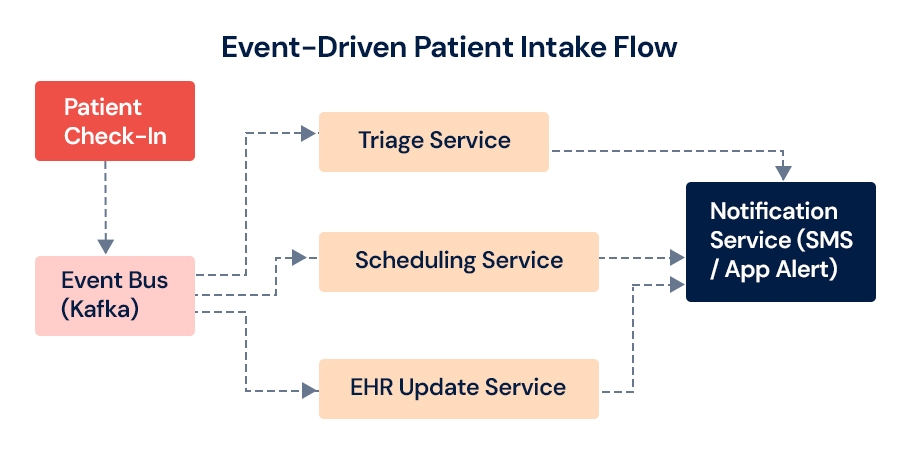
Each service processes in parallel. For a system handling 10,000 patients daily, that latency difference is not academic it's the line between a functional ER and a chaotic one. This architecture also feeds directly into better patient flow management software healthcare outcomes. When data moves in real time across systems, staff see the full picture: bed availability, lab status, incoming transfers, discharge timelines all updated continuously rather than in batch cycles.
Data Architecture: Using the Right Database for the Right Workload
Using multiple databases for different workloads prevents performance bottlenecks at high patient volumes. This concept polyglot persistence is one of the most impactful and underappreciated decisions in healthcare data management system architecture.
A single relational database handling all reads and writes hits performance limits fast. The right approach:
Apache Cassandra for high-write patient logs and time-series vitals
Elasticsearch for fast, complex queries bed availability, patient history lookups
Redis for caching frequently accessed data like scheduling slots and room assignments
PostgreSQL for transactional data requiring ACID compliance billing, consent records
Change Data Capture (CDC) keeps these systems synchronized in near real-time, ensuring every service sees consistent data without polling overhead. This layer quietly prevents entire categories of data inconsistency that plague high-volume environments and eliminates the redundant processing that drives infrastructure waste at scale.
Scheduling and Queue Management: Where AI Eliminates Bottlenecks Before They Form
Medical scheduling software at scale is not a calendar problem it is an optimization problem. With thousands of appointments, variable no-show rates, and unpredictable emergencies, rule-based scheduling breaks down quickly. Machine learning changes the outcome by replacing static rules with adaptive prediction.
Reinforcement learning models trained on historical data can:
Predict no-show probability per patient and pre-fill slots proactively
Dynamically rebalance queues based on real-time provider availability
Prioritize high-acuity patients without manual intervention
Forecast peak load windows 2–4 hours in advance
Scalable Scheduling Process Flow
Intake request received → API Gateway with rate limiting
Availability check → Redis cache (30-second TTL)
Optimization engine → ML model ranks and assigns slots
Confirmation → Event triggers to patient app and EHR
Feedback loop → No-show and outcome data retrains model
The result is hospital queue management system architecture that doesn't just manage queues it actively prevents them from forming. Well-tuned systems consistently achieve 90–95% slot utilization while reducing average patient wait time by 35–40%. The real-time patient tracking system hospital layer built on this stack gives clinical teams live situational awareness that is simply impossible in batch-processing legacy environments.
When Should You Fix This? Five Signs Your Architecture Can't Scale
You should seriously consider an architecture redesign if any of the following are true:
Patient wait times are increasing despite recent infrastructure upgrades
Feature releases are slowing down or becoming riskier with each deployment
Your system struggles noticeably beyond 2–3x peak load
Engineering estimates are consistently inaccurate or impossible to make confidently
Scaling requires adding more people instead of improving systems
If you recognize two or more of these, your architecture not your team is the constraint. Addressing it now costs significantly less than addressing it after a system failure under peak load.
How Product Engineering Solves the Scaling Problem Without Rebuilding Everything
Healthcare systems fail to scale because scaling is treated as a technical fix instead of a product engineering problem. Sustainable growth requires structured thinking that connects technical decisions to clinical and business outcomes not just adding capacity.
Product Strategy & Consulting at the architecture phase identifies which bottlenecks, left unaddressed, will compound into system-wide problems within 12–18 months. It is about knowing which trade-offs are acceptable and which ones silently increase long-term cost and risk.
Product Design and Prototyping ensures high-throughput systems remain usable under pressure. A triage nurse managing 80 patients per shift needs interfaces that surface critical information in one glance. A well-designed check-in flow reduces administrative overhead by 25% without changing a single backend service.
Software Product Development brings these decisions into production custom microservices, integrations with legacy EHR systems using the strangler pattern, and API layers that let old and new systems coexist during transition.
Explore our Product Strategy & Consulting approach and digital product engineering services to understand how structured delivery reduces risk at every phase. The organizations that scale successfully aren't the ones with the largest engineering teams. They are the ones that make better decisions earlier with clear understanding of what getting it wrong actually costs.
A Realistic Roadmap: From Legacy to 10x
Phase 1 Assessment (Weeks 1–4)
Audit current patient management system software for throughput limits
Measure baseline: patients/hour, error rates, mean time to recovery (MTTR)
Identify top 3–5 bottlenecks ranked by business and clinical impact
Phase 2 MVP Build (Months 1–3)
Deploy core microservices for intake, scheduling, and queue management
Integrate event bus and caching layer
Target: handle 2–3x current volume without degradation
Phase 3 Scale and Optimize (Months 4–6)
Enable full auto-scaling on Kubernetes
Introduce ML-based scheduling and healthcare system performance optimization
Stress test to 10x load using simulation tools
Target: stable performance at peak volume, under 10-minute average wait times
The Mumbai hospital from the opening of this blog followed this roadmap. ER wait times dropped from 2 hours to under 20 minutes. Throughput increased 7x. Staff overtime fell by 30%. Infrastructure waste dropped significantly after eliminating redundant monolithic processing. The system didn't just survive growth it enabled it.
The Decision That Determines Everything
How to scale healthcare systems for high patient volume is ultimately a question about product thinking as much as engineering execution. The gap between a system that breaks at 5,000 patients and one that handles 50,000 is not just code it is the quality of decisions made at every layer: architecture, data, infrastructure, UX, and process.
Scaling failures are caused by early architecture decisions not infrastructure limits. The teams that get this right treat scalable healthcare platform architecture not as a feature to add later, but as a design constraint from day one. They engage product engineering consulting early, make trade-offs deliberately, and build systems that grow with their clinical ambitions rather than against them.
If your platform is showing early signs of strain slower response times, scheduling conflicts, data sync delays, risky releases these are signals, not edge cases. The right time to address them is before the next wave of volume arrives. Because by the time the system visibly breaks, the cost of fixing it has already multiplied significantly.