


 Updated on 3 March 2026

High-volume hospitals face a critical challenge that most technology investments fail to solve: the patient experience deteriorates even as more software gets deployed. A leading urban trauma center in Boston recently discovered this firsthand after implementing three separate "best-in-class" tools for scheduling, queue management, and patient tracking, their average wait times actually increased by 12%. The problem wasn't the tools themselves. It was that nobody had engineered them to work as a single, cohesive product.
This is where hospital appointment scheduling, patient scheduling software, and healthcare queue management system implementations typically break down. US healthcare organizations buy solutions. What they actually need is product engineering services the discipline of designing interconnected systems that solve real operational problems, not just check procurement boxes.
For healthcare CTOs, digital transformation leaders, and product heads managing facilities with 3,000+ weekly visits, this distinction determines whether your next modernization effort reduces patient wait times or just adds another dashboard nobody uses.
Why Hospital Patient Flow Fails: It's an Engineering Problem, Not a Tools Problem
Most US healthcare organizations approach hospital patient flow optimization the same way: identify the bottleneck (triage too slow, discharge delays, imaging backlogs), then purchase software that promises to fix that specific issue. Six months later, the bottleneck has shifted, staff are frustrated with yet another login, and the original problem persists in a different form.
This happens because patient flow isn't a features problem it's a systems engineering problem. When a hospital schedules 5,000 appointments weekly across 12 departments, with varying procedure durations, resource dependencies, and acuity levels, you're not managing appointments. You're orchestrating a dynamic constraint satisfaction network where every decision cascades into dozens of downstream effects.
A mid-sized hospital network in Philadelphia learned this during their digital transformation. They had implemented a modern patient scheduling software platform that worked beautifully for scheduling. But when a scheduled 30-minute cardiology consult ran 50 minutes (which happened 40% of the time), the system had no way to communicate with their queue management app or their bed management dashboard. Patients waited. Staff improvised. The expensive scheduling system became a source of truth that nobody trusted.
The issue wasn't lack of features. It was lack of product thinking. The scheduling system, queue display, patient tracking RFID badges, and EHR notifications were engineered in isolation by four different vendors, each optimizing for their own use case. Nobody had designed the product the complete experience of moving patients efficiently through care delivery.
The Three Pillars of Integrated Patient Flow Engineering
Effective digital patient flow solutions require simultaneous design across three interconnected layers. Optimizing any single layer in isolation creates new problems elsewhere.
1. Intelligent Scheduling Architecture
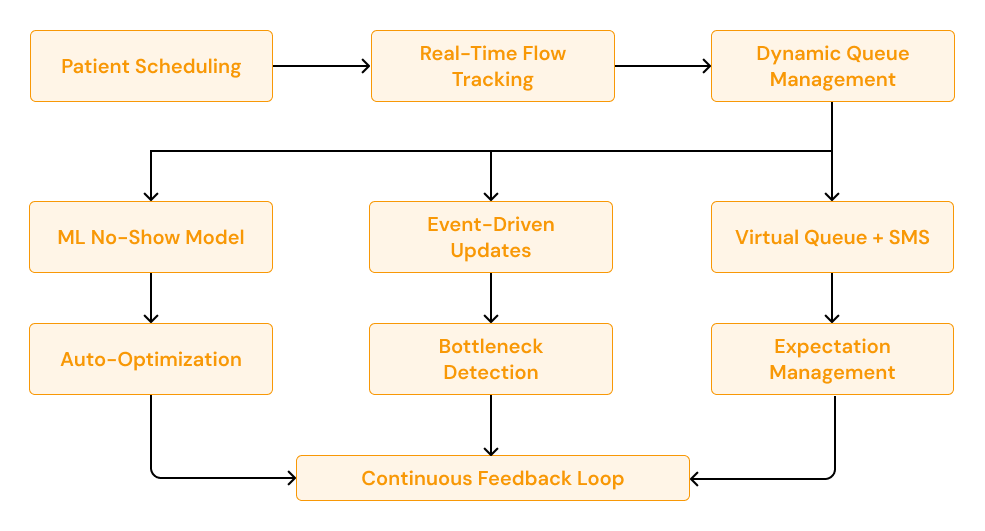
Modern hospital appointment scheduling goes far beyond calendar management. At the architecture level, this is a multi-constraint optimization problem: match patients to providers, to rooms, to equipment, within time windows, respecting acuity priorities, while accounting for historical no-show patterns and real-time delays.
The engineering decision that matters most: should your scheduling logic live as rules-based algorithms or ML-driven predictions?
A 400-bed hospital in Austin chose the hybrid approach during their Product Design and Prototyping phase. Rule-based logic handled hard constraints (Dr. Johnson doesn't work Fridays, MRI suite 2 under maintenance). Machine learning predicted no-show probability based on patient demographics, appointment type, weather conditions, and historical patterns. When the ML model flagged a slot as 65% likely to no-show, the rules engine automatically double-booked with a low-acuity patient who could be easily rescheduled.
This required Software Product Development that treated scheduling as a product feature, not an isolated tool. The codebase integrated three subsystems: the constraint solver, the ML prediction pipeline, and the real-time adjustment layer that responded when things went off-plan.
Key Scheduling Components:
| Component | Engineering Decision | Impact on Flow |
|---|---|---|
| Slot Allocation Engine | Graph-based constraint solver vs. linear programming | Determines how well complex dependencies (room + staff + equipment) are optimized |
| No-Show Prediction | Rule-based vs. ML (XGBoost/LSTM) | 15–20% improvement in slot utilization when ML is trained on 6+ months of data |
| Real-Time Adjustment | Manual override vs. automated re-optimization | Automated systems recover from delays 4x faster |
| Multi-Resource Booking | Sequential booking vs. atomic transactions | Atomic transactions prevent “half-booked” states that cause phantom availability |
2. Real-Time Patient Flow Orchestration
While scheduling determines when patients should arrive, hospital patient flow engineering determines what actually happens after they walk through the door. This is where digital systems must mirror physical reality with near-zero latency.
The architecture pattern that works: event-driven flow tracking with pub-sub messaging. When a patient checks in at registration, that event triggers updates to the triage queue, notifies the assigned provider's dashboard, adjusts room allocation predictions, and updates family notification systems all within 200 milliseconds.
A US hospital network in Seattle implemented this during their Cloud and DevOps Engineering phase using a cloud-based scheduling system. Patient RFID badges published location events every 30 seconds. Each care area (registration, triage, imaging, treatment bays, discharge) subscribed to relevant events and updated their local state. The central orchestration layer maintained a real-time digital twin of every patient's journey.
Flow Tracking Architecture:
Data Collection Layer: RFID badges, mobile check-ins, staff tablet inputs, EHR triggers
Event Processing: Apache Kafka streams for sub-second event propagation
State Management: Redis for current patient positions, TimescaleDB for historical flow analytics
Decision Logic: Real-time bottleneck detection using Little's Law (queue length equals arrival rate times wait time)
Action Layer: Automated staff notifications, dynamic queue reprioritization, resource reallocation suggestions
3. Dynamic Queue Management with Predictive Intelligence
The third pillar connects scheduled intent to actual capacity. A sophisticated healthcare queue management system doesn't just display wait times it actively manages patient expectations and optimizes throughput based on real-time conditions.
Virtual queuing represents the evolution from "wait in this room" to "wait anywhere while we track your position." Patients receive SMS updates when their appointment is 15 minutes out. If the previous appointment runs long, the system automatically notifies waiting patients and offers options: wait longer, reschedule for priority placement, or switch to a different provider with availability.
The engineering complexity: maintaining consistency between virtual queue state and physical capacity while handling edge cases like emergency cases that must jump the queue, patients who arrive early, and last-minute cancellations.
From Strategy to Production: The Product Engineering Process for Healthcare Systems
Building effective patient flow platforms requires a structured approach that most healthcare IT projects skip: treating the outcome as a product that must deliver specific user value, not just meet technical specifications.
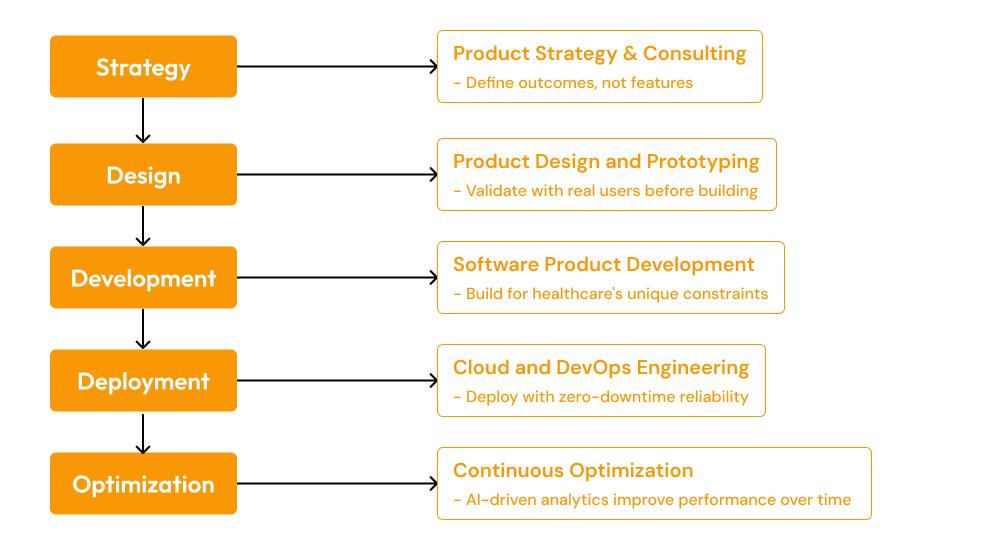
Phase 1: Product Strategy & Consulting Defining Success Beyond Features
The first decision determines everything that follows: what problem are we actually solving?
A regional hospital system approaching us recently framed their need as "we need better patient scheduling software." In the strategy phase, we discovered the real problem: emergency department backups caused by unpredictable discharge timing meant scheduled procedures frequently got bumped, cascading delays throughout the day.
The product requirement wasn't better scheduling it was predictive discharge modeling integrated with OR scheduling that could dynamically adjust. This insight came from stakeholder workshops with nursing staff, department heads, and patients, not from the initial technology RFP.
Strategic Questions That Expose Real Requirements:
What breaks when patient volume spikes 30% unexpectedly?
Where do staff currently bypass your systems to get work done?
Which delays cost the most revenue loss, patient satisfaction, or staff overtime?
What data exists in your current systems that never gets used operationally?
The output isn't a features list. It's a product vision document that defines measurable outcomes: reduce average appointment wait time from 47 minutes to under 30 minutes, increase slot utilization from 72% to 85%, decrease triage queue variability by 40%.
Phase 2: Product Design and Prototyping Validating Before Building
US healthcare systems often skip prototyping, moving directly from requirements to full-scale development. This consistently fails because the real complexity only reveals itself when clinicians interact with workflow mockups.
During Product Design and Prototyping for a 600-bed facility, we built an interactive Figma prototype of the queue management interface. The design looked clean in isolation. When we put it in front of triage nurses during a simulation of peak Friday afternoon volume, we discovered critical flaws within 20 minutes:
Color-coding for acuity worked beautifully until colorblind users couldn't distinguish categories
The "reassign patient" workflow required four clicks unacceptable when handling 12 simultaneous decisions
Predicted wait times displayed as exact numbers ("34 minutes") created patient service failures when estimates were off by 5 minutes; ranges ("30-40 minutes") set better expectations
These insights cost $8,000 in design time to discover. Fixing them post-production would have cost $200,000+ in development rework and user frustration.
Prototyping also extends to simulation modeling. We model digital patient flow solutions as queueing networks using discrete-event simulation tools. This reveals how scheduling rule changes will impact downstream bottlenecks before writing any production code.
Phase 3: Software Product Development Building for Healthcare's Unique Constraints
Healthcare software development differs from typical SaaS in three critical ways: regulatory requirements, integration complexity, and zero-downtime expectations.
A cloud-based scheduling system for healthcare must maintain HIPAA compliance across every service layer. This isn't just encryption at rest and in transit it's audit logging every data access, implementing role-based access control that mirrors hospital organizational hierarchies, and ensuring third-party integrations never expose PHI.
The architecture pattern that handles this: domain-driven microservices with PHI isolation. Patient demographics, insurance data, and clinical notes live in separate services with independent encryption keys. The scheduling service only receives pseudonymized patient identifiers.
Core Development Stack for Healthcare Flow Systems:
| Layer | Technology Choice | Healthcare-Specific Reason |
|---|---|---|
| Backend API | Django (Python) or Spring Boot (Java) | Mature libraries for HL7/FHIR integration, strong typing for clinical data |
| Real-Time Processing | Apache Kafka + Redis | Event-driven updates with sub-second latency for flow tracking |
| Database | PostgreSQL + TimescaleDB | ACID compliance for transactions, time-series optimization for flow metrics |
| Frontend | React or Vue.js | Component reusability across patient-facing, clinical, and admin interfaces |
| ML Pipeline | Python (scikit-learn/TensorFlow) | No-show prediction, wait time estimation, demand forecasting |
Integration with existing EHR systems represents the highest-risk development component. Epic, Cerner, and Meditech each have different FHIR implementation quirks. Rather than building direct integrations, successful implementations use an integration layer that normalizes EHR data into a canonical format the scheduling system consumes.
Phase 4: Cloud and DevOps Engineering Scaling for Healthcare Reliability
US healthcare operations don't have maintenance windows. A scheduling system going down during peak hours means patients can't check in, staff can't access appointment details, and the organization potentially violates patient safety protocols.
Cloud and DevOps Engineering for healthcare requires active-active multi-region deployments. During AI patient flow analytics implementation for a hospital network, we deployed across AWS us-east-1 and us-west-2 with automated failover. When us-east-1 suffered a partial outage during a January ice storm, traffic automatically shifted west with zero patient-facing downtime.
The more challenging requirement: zero-downtime deployments for a system that processes 300+ transactions per minute. Blue-green deployments handle this maintain two identical production environments, route all traffic to blue, deploy updates to green, run automated integration tests, then switch traffic. If green shows issues, instant rollback to blue.
Advanced Capabilities: AI-Driven Flow Optimization and Predictive Analytics
Basic scheduling and queue management create operational parity. AI patient flow analytics create competitive advantage by predicting problems before they become bottlenecks.
No-Show Prediction Models
Traditional systems handle no-shows reactively appointment doesn't show up, slot goes unused, revenue lost. AI-driven systems predict no-show probability at scheduling time and proactively double-book high-risk slots with flexible patients.
A machine learning model trained on 18 months of appointment data for a multi-specialty clinic achieved 82% no-show prediction accuracy using these features:
Patient demographics: Age, zip code, insurance type
Appointment characteristics: Day of week, time of day, department, provider, days until appointment
Historical behavior: Past no-show rate, average lead time between scheduling and appointment
External factors: Local weather forecast, public transit disruptions, day patterns
The model outputs a no-show probability score (0-100%). The scheduling engine uses this operationally. Scores 0-30% get standard single-booking, 30-60% receive extra reminder SMS/email, and 60-100% trigger double-booking with flexible patients or proactive outreach to confirm.
This increased slot utilization from 76% to 89% the equivalent of adding 12% more capacity without building anything physical.
Real-Time Bottleneck Detection
Static reports show where bottlenecks occurred yesterday. Real-time analytics prevent bottlenecks from forming. By analyzing patient flow velocity (time between transitions: check-in → triage → provider → discharge), anomaly detection algorithms flag developing problems.
When average triage-to-provider time crosses 1.5 standard deviations above normal for 15 consecutive minutes, the system alerts the charge nurse and automatically suggests interventions: reassign patients to providers with lighter loads, delay non-urgent scheduled arrivals by 20 minutes, request additional float staff from the hospital-wide resource pool.
Measuring What Matters: KPIs for Product-Engineered Flow Systems
Technology investments require clear ROI metrics. For patient flow systems, success metrics fall into three categories: operational efficiency, patient experience, and financial impact.
Operational Efficiency Metrics
| KPI | Target | Measurement Method | Business Impact |
|---|---|---|---|
| Slot Utilization Rate | >85% | Appointments completed / total available slots | Each 1% improvement = ~$150K annual revenue for 400-bed facility |
| Average Cycle Time | <90 minutes | Check-in timestamp to discharge timestamp | Determines daily patient throughput capacity |
| Queue Wait Time (Median) | <25 minutes | Queue entry to service start across all queues | Primary driver of patient satisfaction scores |
| Schedule Adherence | >80% | Appointments starting within 10 min of scheduled time | Reduces downstream cascade delays |
| System Uptime | 99.9%+ | Total available time / total time | Every hour of downtime = complete operational disruption |
Financial Impact Model
ROI Calculation Example:
A 500-bed US hospital processing 6,000 outpatient appointments monthly at an average billable value of $280 per visit:
Baseline slot utilization: 74% (1,560 unused slots/month)
Post-implementation utilization: 87% (780 unused slots/month)
Additional monthly revenue: 780 slots × $280 = $218,400
Annual revenue gain: $2,620,800
Implementation cost: $450,000 (product engineering, development, deployment)
First-year ROI: 483%
Beyond direct revenue, reduced patient wait times decreased complaint escalations by 62%, improved staff satisfaction scores (reducing turnover costs), and created capacity for growth without facility expansion.
Common Pitfalls in Patient Flow System Engineering
Even well-funded initiatives fail when they miss fundamental product engineering principles:
Pitfall 1: Optimizing subsystems in isolation. Improving triage speed by 20% just moves the bottleneck to the next stage unless capacity planning is holistic.
Pitfall 2: Assuming staff will adapt workflows to software. Successful systems adapt to clinical workflows, not the reverse. If your software requires six extra clicks compared to the paper process, adoption will fail regardless of features.
Pitfall 3: Ignoring edge cases until production. Mass casualty events, system outages, unexpected VIP patients these rare events expose architectural weaknesses that cripple systems designed only for normal operations.
Pitfall 4: Vendor lock-in through proprietary integrations. Use open standards (FHIR for EHR data, RESTful APIs for integrations) to maintain flexibility as technology evolves.
Pitfall 5: No change management strategy. Technology rollouts succeed when staff understand why the change matters. We've seen technically perfect systems fail because nobody invested in training and communication.
Frequently Asked Questions
What is patient flow management in hospitals?
Patient flow management is the systematic coordination of patient movement through healthcare facilities from initial scheduling through discharge. Effective flow management integrates appointment scheduling, real-time tracking, queue optimization, and resource allocation to minimize wait times and maximize throughput.
Why do hospital scheduling tools fail at scale?
Most scheduling tools fail at scale because they're designed as isolated point solutions. High-volume hospitals need integrated systems where scheduling, flow tracking, and queue management work together. When these components operate independently, bottlenecks simply shift rather than resolve.
How does product engineering improve patient flow?
Product engineering treats patient flow as a complete system requiring integrated design across scheduling algorithms, real-time tracking infrastructure, and dynamic queue management. Unlike point tools, product engineering addresses root architectural issues ensuring all components work cohesively to deliver measurable outcomes.
What KPIs matter most for high-volume hospitals?
The most critical KPIs are slot utilization rate (target >85%), average patient cycle time (<90 minutes), median queue wait time (<25 minutes), schedule adherence (>80%), and system uptime (99.9%+). These metrics directly impact both patient experience and financial performance.
What's the typical timeline for implementing a patient flow system?
A properly engineered patient flow system typically requires 4-6 months from initial strategy through production deployment: 2 weeks for strategy, 4 weeks for design and prototyping, 8-12 weeks for development, and 2 weeks for deployment and validation. Organizations skipping design phases often experience project failures or extensive rework.
The Path Forward: Treating Patient Flow as a Product, Not a Project
The US hospitals seeing transformative results from patient flow modernization share one characteristic: they approached it as product engineering, not IT procurement. They invested in Product Strategy & Consulting to define the right problem, used Product Design and Prototyping to validate solutions before building, executed Software Product Development with healthcare-specific constraints in mind, and deployed via Cloud and DevOps Engineering that maintains healthcare reliability standards.
This isn't about buying the most features. It's about engineering systems where scheduling, flow tracking, and queue management work as a coherent product that delivers measurable value: shorter wait times, better resource utilization, improved patient satisfaction, and stronger financial performance.
The question isn't whether your hospital needs better patient flow every high-volume facility does. The question is whether you'll fix it with more tools or with product engineering that actually solves the underlying system design challenge.
If you're planning to modernize patient flow systems, start with product engineering expertise that understands healthcare operations not just healthcare software. Connect with our team to discuss how integrated product engineering services can transform your patient flow challenges into competitive advantages.
Build High-Performance Patient Flow Systems